
New homelessness data: How does California compare to the rest of the country?
Homelessness grew just 3% in California last year, compared to 18% nationwide.
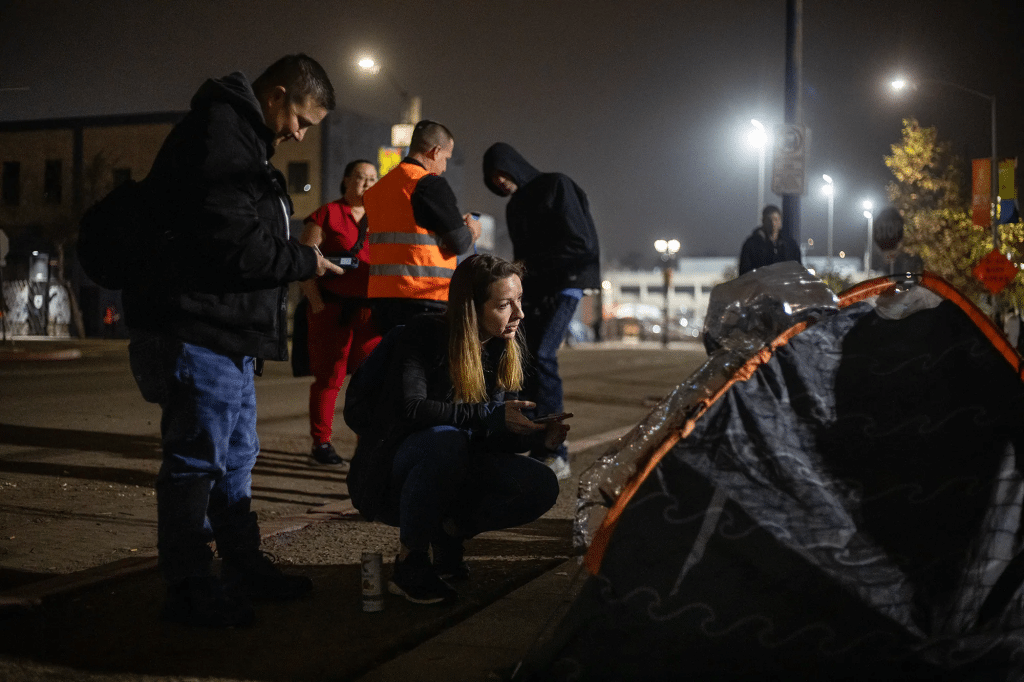
Volunteers Michelle Lefever, left, and Maggie DuRocher, center, survey a resident experiencing homelessness, for the annual point-in-time count in San Diego on Jan. 25, 2024. The voluntary survey is a federally mandated requirement to gather data on the region’s homeless population. Photo by Adriana Heldiz, CalMatters
This story was originally published by CalMatters on January 6, 2025, and is reprinted here with permission.
California’s homeless population remains the biggest in the nation, but the crisis is growing more slowly here than in most of the rest of the country, according to new federal data.
The number of homeless Californians increased just over 3% last year compared to the year before, with more than 187,000 people sleeping on the street or in shelters in the state as of January 2024. Overall, the country saw an increase of slightly more than 18%, and 22 states saw double-digit increases. Just six states, including Wyoming, Tennessee and Maine, saw their homeless populations decrease.
That’s according to the U.S. Department of Housing and Urban Development, which recently released the results of the latest federally mandated homeless point-in-time count. The count, which took place in early 2024, relied on volunteers, outreach workers and city and county employees physically counting the homeless people they saw sleeping outside on one night.
It’s not a completely accurate approach – each county conducts the count differently, some estimate some of their figures, and they are sure to miss unhoused people who sleep hidden in hard to reach areas or at a friend’s house. Most California counties count people in shelters every year, but count people on the street every other year, making year-to-year comparisons difficult. But despite the challenges with the data, officials use the point-in-time count to allocate federal and state dollars, and to help guide homeless policy.
A CalMatters analysis of point-in-time count data in September, when a handful of California counties hadn’t released their results, found nearly 186,000 unhoused people living in the state.
The federal data shows the outsized role California plays in the nation’s homelessness crisis. Nearly a quarter of all unhoused Americans live in California – as well as 28% of all homeless veterans and 44% of all “chronically homeless” Americans (people who have a disability and have been homeless for a significant period of time.)
Two-thirds of California’s homeless residents sleep outside – the highest percentage in the country – highlighting the state’s need for more shelter.
But there were some bright spots in the report: The number of young Californians who were homeless without a parent or guardian fell 11% last year, and the number of homeless veterans and chronically homeless people also dropped.
While the number of people in families with children who were homeless across the country increased nearly 40% last year – a concerning spike that federal officials attribute to an influx of migrants – it remained basically flat in California.
Gov. Gavin Newsom highlighted the areas where California bucked national trends as evidence that his homelessness agenda is working.
“Homelessness continues to rise and increase at ever-higher numbers nationwide, but we are seeing signs of progress in California,” he said in a statement. “We have turned the tide on a decades-long increase in homelessness – but we have more work to do. California‘s plan is ambitious and challenging but the data is proving that it is not impossible: our strategies are making a positive difference.”
This article, which was originally published in CalMatters on January 6, 2025, is republished, with permission. CalMatters is a nonpartisan and nonprofit news organization bringing Californians stories that probe, explain and explore solutions to quality of life issues while holding our leaders accountable. They are the only journalism outlet dedicated to covering America’s biggest state which includes 39 million Californians and represents the world’s fifth largest economy.
Author

Related Articles
The same union supporting a billionaire tax wants voters to limit clinic spending. Here’s what to know about Prop. 44
Proposition 44 would require clinics to spend more money on patient care. The union pushing the measure is the same one supporting the billionaire tax proposal. Clinics say the measure will force closures.
With mail-in rules uncertain, here’s how Californians can prepare to vote in November
The Supreme Court is weighing President Trump’s plan to limit universal mail-in voting with just seven weeks until the November election. California officials are urging people to vote early.