
Uncertainty, shock amid mass staff reductions at federal Education Department
Reduction-in-force notices were sent to hundreds of staff at the U.S. Department of Education. Impacted staff primarily oversee programs supporting vulnerable student groups. Education leaders say they are shocked by the reductions, which will impact students with disabilities.
This story was originally published by EdSource. Sign up for their daily newsletter.
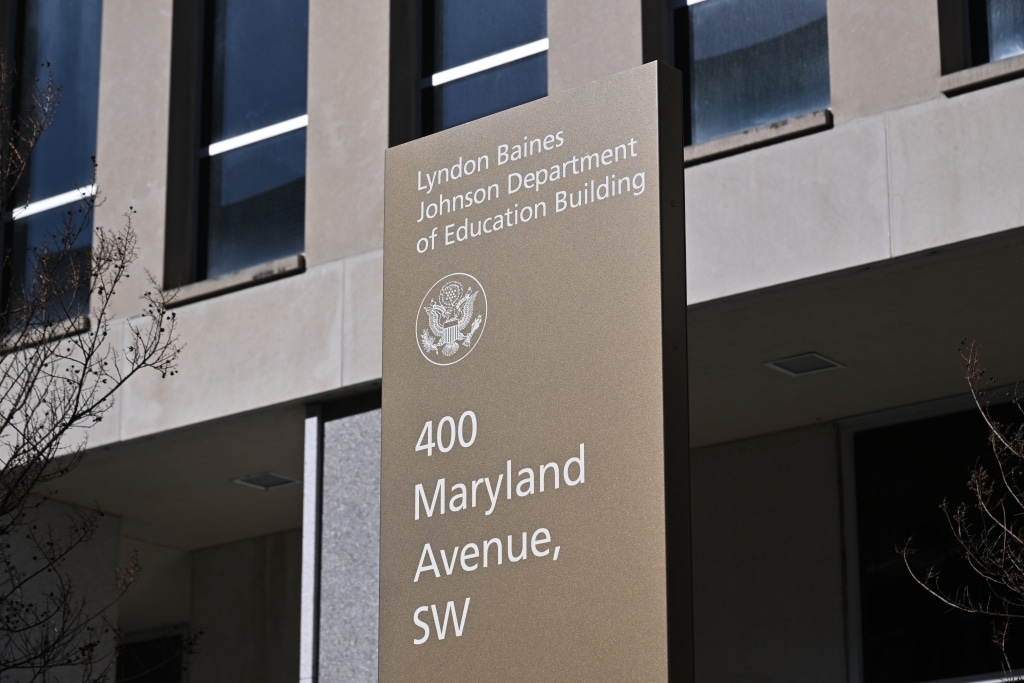
Several offices within the U.S. Department of Education have been gutted after reduction-in-force notices were sent to 466 staff on Friday, according to court filings, leaving education leaders uncertain about the potential fallout from losing hundreds of staff.
With the exception of top officials, such as directors, all staff were laid off from the department’s Office of Elementary and Secondary Education, which administers funding and technical assistance to programs, including the Individuals with Disabilities Education Act, known as IDEA, the McKinney-Vento Homeless Assistance Act, and the Migrant Education Program, among others. These programs primarily support children who make up some of the most vulnerable student groups, including those experiencing homelessness, migrant students and students with disabilities.
“The president talked about going after programs that Democrats support; they went after programs that everybody supports. By everyone, I mean the vast majority of those programs have strong bipartisan support,” said Barbara Duffield, executive director of SchoolHouse Connection, a national homeless advocacy organization.
Some of the staff who received reduction-in-force notices administer programs with federally mandated legal requirements, including IDEA and McKinney-Vento. Without the staff, it’s unclear how federal laws will be upheld.
“We are emphasizing the law is intact, the funding is intact, and we don’t know what’s gonna happen tomorrow, but those two things are true,” Duffield said.
Duffield and other advocates noted that many of the federal staff are experts, having often served in their positions for decades, and quickly answer questions based on their experience.
“All of the things that make these programs work for kids are built on the people behind them at the federal level, at the state level, and at the local level,” she added.
Students experiencing homelessness
Without adequate staffing at the federal Department of Education, one of the more immediate concerns is that states and school districts may not get the appropriate support needed to address homeless students’ needs.
One of the key responsibilities of the education staff is to oversee the McKinney-Vento Homeless Assistance Act, a federal law implemented decades ago to ensure students experiencing homelessness are identified and properly supported. This law also requires homeless student counts, which is how the state knows that nearly 20,000 more homeless students were enrolled by the first Wednesday in October, known as Census Day, during the 2024-25 school year, representing a 9.3% change from the previous school year in California. This surge means the homeless student population in the state has increased 37% in the last decade.
The act outlines regulations mandated by federal law, such as ensuring that homeless students have “the same free, appropriate public education, including a public preschool education, as provided to other children and youths.” It also administers grants under the Education for Homeless Children and Youth program, commonly known as EHCY.
The federal Education Department is legally mandated to provide support to state education agencies, including:
- Answering questions about whether a student’s specific situation makes them eligible for McKinney-Vento services;
- Resolving disputes between districts if a student is moving often;
- Clarifying how transportation for a child should be paid for;
- Determining whether a student’s particular needs can be funded with federal dollars and more.
During the aftermath of a natural disaster, school districts rely on the federal education staff for guidance on how to navigate such sudden changes, Duffield said, noting that homelessness rates among children tend to spike after environmental disasters, including wildfires.
“This is not about fewer federal workers. This is about: Does this law get implemented, and do the children and youth for whom it was designed to benefit, do they actually get the benefits?” Duffield said. “And in the case of students who are homeless, the benefit is getting to go to school and getting an education.”
Shock among special education advocates
Some advocates are particularly shocked that staff administering IDEA for students with disabilities were included in the massive staff reduction, largely because programs for students with disabilities have historically seen broad bipartisan support.
The National Association of State Directors of Special Education said in a statement that they were “confused and concerned by the staffing decisions” because they would make it “impossible” for the federal Education Department to fulfill the legal requirement for students with disabilities to access a free and appropriate public education.
On Monday afternoon, Monterey County education leaders met to discuss support for moderate to severe special education students served by their Head Start division. According to Deneen Guss, the county’s superintendent of schools, discussion during the meeting turned to wondering: “Is there going to be less funding for special education students?”
Guss noted that IDEA was intended to be funded at 40% of what was needed nationally to support students with disabilities, but only provides approximately 8% in funding. With staff reductions, she and her colleagues wonder whether that 8% will be reduced even further.
“What is this going to mean for us if we all have the same requirements, yet less funding?” she said.
The Special Education Local Plan Area Administrators of California are also trying to understand what the staff reductions mean and are looking to the state to maintain guidance.
“Even in uncertainty, the principles of IDEA, in its 50th anniversary year, and our shared commitment to students with disabilities must guide decisions at every level of government,” said Veronica Coates, who chairs the SELPA Administrators of California.
Migrant students
In 2023-24, 77,382 students and young adults age 3-21 were eligible for Migrant Education Programs in California. Monterey County has one of the largest migrant student populations, with 10,078 eligible children and young adults in 2023-24. Migrant students, many of whom are U.S. citizens, are those who have moved during the past three years with their families who work in the agricultural, dairy, lumber or fishing industries.
Nearly all the staff of the Office of English Language Acquisition, which oversaw programs for English learners, were laid off earlier this year. Some federal budget proposals have removed funding for migrant education programs, and now federal education staff have been notified of reductions.
“This same kind of chaos just occurred not that long ago when these federal funds for the migrant program and several other federal programs were being withheld,” said Guss, referring to the federal withholding in July of about $121 million for migrant education in the state, according to an estimate by the Learning Policy Institute.
Guss and her colleague, Constantino Silva, described the role of federal support and funding as being a part of the larger ecosystem of managing education across federal, state, county and district lines. Removing one part of that ecosystem, such as staff at the federal level, “starts this whole vicious cycle of chaos and lack of clarity,” Guss said.
Silva, senior director of migrant education in Monterey County, expects “a dearth of communication and guidance” out of the staff reductions at the federal level.
He and others who administer the Migrant Education Program across California’s counties must abide by federal regulations for the way in which funds are applied. More specifically, the funds must supplement, not supplant, other funding sources, and questions often arise about how federal dollars can be used.
“By sending those questions to the federal government and getting clarification, then we’re more confident that how we’re using the funds is in line with the federal requirements,” said Silva. “Well, that’s going to be challenged now because that communications just not going to be there for a clarification when doubts come up.”
The fallout of so much uncertainty around migrant education programs in recent months is now being felt at the local level, said Silva. The county is having a difficult time filling some staff positions, which he believes is related to the instability of funding for those positions.
Trepidation as a result of ongoing immigration raids, combined with news of withheld funding in July and now the federal staff reductions, has left some families under the impression that migrant education programs might be too unsafe to access or no longer exist.
“That uncertainty alone keeps them from accessing services because they think there are no services,” Silva said.
EdSource reporter Zaidee Stavely contributed to this story.
This story was originally published by EdSource and is republished here with permission.
Author

Related Articles

Internal emails show how fringe groups fueled Sheriff Chad Bianco’s ballot seizure
Records reveal that the unprecedented taking of 650,000 ballots was based on the thinnest of evidence, raising alarms over how the November election could be disrupted.

California middle schools are ground zero for testing AI in classrooms
Districts are trying to develop more systematic approaches to introducing AI into the classroom.

Hundreds of deaths, thousands of injuries, billions of dollars: The cost of extreme heat in California
Heat waves have killed hundreds of Californians and cost billions of dollars in the past decade, according to a new report from the state insurance department.