
This Native man from Northern California has gone missing not once, but twice
A portion of Nick Patterson’s skeletal remains, finally recovered years after he went missing, were lost again by officials during his missing person investigation. The stunning error has complicated the Pit River Tribe’s grieving process and led to suggestions for policy changes.

It was a summer morning in Burney, California — a forested mountain town of just 3,000 — and the day’s creeping heat could be felt from inside the windowless boardroom at the Pit River Tribal Office.
“Everybody really wants to know what happened to him,” Lynette Craig said as she stirred cream into her coffee. Her gaze was soft, her eyes unfocused. She sat at a long table with photos of her son splayed out before her as she described a recent vision she had about what had happened to him. “I had this dream about Nick being cut up.”
Lynette had been having clairvoyant experiences — hearing her son Nick’s voice in her ear and feeling the weight of his presence behind her — over the nearly six years since his disappearance. 26-year-old Nick Patterson was a member of the Pit River Tribe. He was last seen alive by his mother just after New Years Day in 2020. Since then, Lynette has tirelessly searched for answers, taking the initiative to fill in key gaps in the investigative process as multiple law enforcement agencies either could not, or would not, connect the dots.
Nick’s mother liaised between different sheriffs’ offices handling the case. She assembled search teams of friends and family to trail behind investigators scanning the ground for bone fragments. It was Lynette, not detectives, who procured the dental records of her son and a DNA sample from his father — who’s currently being held in a penitentiary in the high desert — that provided the biological evidence needed for investigators to eventually identify Nick’s bones. And it was Lynette who corrected the Modoc sheriff when he got the details of his own investigation wrong while speaking to reporters at a press conference.
Her years of effort in her son’s case culminated in a visit to a funeral home in May of 2025, where she had gone to prepare for burial the bones of a son who once towered over her. But the finality of seeing them did not provide her relief. On the contrary, a second tragedy unfolded as she realized that Nick had gone missing again.
The two disappearances of Nick Patterson: a timeline
January 5, 2020: Nick Patterson leaves his mother’s house, never to return.
April 24, 2024: a skull and humerus are spotted by a Modoc county local on a tract of undeveloped land near the town of Lookout. That same day, the remains are transported to the Human Identification Lab at Chico State, and soon positively identified as those of Nick Patterson.
July 25, 2024: the Modoc Sheriff notifies Lynette Craig that some of her son’s bones have been found.
August 14, 2024: the Modoc County Sheriff conducts a second substantial search of the area where some of Nick’s remains were initially found, recovering an additional two human vertebrae. The bones are sent to the same lab to be examined.
September 24, 2024: the vertebrae are sent back to the Modoc County Sheriff’s Office to be DNA tested by the Department of Justice. Lynette isn’t notified about the transport of her son’s remains, or that they were sitting idle and unattended for months. Later she was sickened to realize that Nick was, as she described it, “locked up in the evidence room” during that time.
May 16, 2025: Nick’s bones are finally released for burial. Lynette arrives at the mortuary to pick the bones up for his memorial and opens the box to place her son’s favorite beanie on his skull. A square shaped hole has been cut out of his cranium by the lab in order to extract DNA, something she felt unprepared to see. But she also discovered that the two vertebrae located during the second search were missing.
Documents reviewed by Shasta Scout indicate that the bones were eventually discovered to have disappeared during transport between the Chico State lab and the Modoc Sheriff’s Office. The lab had used FedEx to ship the segments of Nick’s spine back to Modoc, where they were to be DNA tested by the Department of Justice for final confirmation that they were his.
Staff from the lab did not notify the sheriff’s office of the scheduled delivery because the bones were sent directly, with signature verification required. Without notification of shipping, the sheriff’s office said they assumed that the vertebrae had never left Chico and were still undergoing testing in the lab.
GPS data obtained by a California Department of Justice investigator showed that a contracted driver did deliver the bones to the Modoc County Sheriff, but never obtained the required signature. The sheriff’s office sent Nick’s bones to the funeral home without noticing that additional remains had never arrived from the lab, so it wasn’t until Lynette discovered the missing bones, months after the failed delivery, that the investigation into his missing bones began. At this point, the sheriff’s office underwent “extensive efforts,” the investigation’s final report said, to locate Nick’s remains, but to no avail. The driver was interviewed, but by that time had no recollection of the details of that delivery.
“Unfortunately, based on the above circumstances, any number of possible scenarios could explain the disappearance of your son’s remains, including the driver leaving them outside the [Sheriff’s] office and then being removed by unknown individuals(s),” concluded the investigation, signed off by William “Tex” Dowdy, Modoc’s Sheriff-Coroner, dated September 16, 2025. Sheriff Dowdy told Shasta Scout this month that there have been no updates since the investigation concluded in September.
Professor Eric Bartelink, a forensic anthropologist at the lab in Chico, told Shasta Scout by email that he couldn’t comment on the specifics of the investigation for confidentially reasons, but that the lab “routinely receives cases from law enforcement that are delivered to our facility for skeletal analysis,” including cases originating from outside of California. The distance that some of these human remains must travel would make it difficult for law enforcement to transport them without the use of a third party like FedEx, he said, noting that other government agencies like the Department of Justice use a similar process.
In the 50 years the lab has been in operation, Bartelink said, “I know of no [other] instances in which a case has been misplaced. We have a robust tracking system and transfer of custody forms for cases coming into the lab and being returned.” Because losing human remains is “incredibly rare,” Bartelink was unsure of how the system could be improved. “But this is something that deserves more attention,” he added.
There are still unknowns. Was the driver aware that the contents of the package for which he never sought a signature contained human remains? How did the Sheriff’s Office lose track of Nick for more than eight months? Does it matter how robust FedEx’s tracking system is if law enforcement fails to maintain a proper chain of custody, as defined by state standards and department policy?
For Nick’s mother, his second disappearance complicated the practical but difficult considerations one has to make in the wake of such a traumatic loss.
What date should she list as his death, she asked herself in the weeks before she laid him to rest. “The day he went missing, the day he was reported missing, the date the first remains were discovered?” Lynette wondered aloud, in her conversation with a reporter. What she thought would be simple decisions were anything but, she said, as she tried to plan his memorial amid the chasm of grief that has fogged her memory for the last five years.
Since Nick’s disappearance, Lynette has been burdened with the task of piecing things back together. First the story of his initial disappearance, and now, the disappearance of his body. In doing so, she has navigated a criminal justice system that siloes the law enforcement needs of the contiguous Pit River Nation — which straddles county lines — into separate jurisdictions with limited communication.
What was revealed through the process was how state violence can continue to be inflicted upon California’s Natives well beyond their deaths.
Stuck between worlds
After the partial loss of his skeleton, the question remains: where is Nick? It’s one that continues to haunt his mother and the larger Pit River Tribe. Their collective grieving process was forestalled by his body’s absence, which left them unable to perform his last rites according to Tribal tradition.
Experts have a term for this disruption in mourning: ambiguous loss. It is a cross-cultural phenomenon that occurs in the midst of specific types of tragedies in which someone goes unaccounted for, whether an individual in a missing person case, or a collective group, as occurs in the fallout of war.
“An ambiguous loss is simply an unclear loss. It can be physical or it can be psychological,” said Pauline Boss over the phone. Boss, who coined the term, is a professor emeritus at the University of Minnesota, a family therapist, and a scholar of unresolved grief.
“Physical ambiguous loss would be soldiers missing in action,” she continued, “or something physically missing, such as you’re describing in [Lynette’s] story.” This kind of loss is unresolvable without confirmation of death, Boss explained, but in her experience, even a DNA match on a John Doe body has provided some measure of relief to bereaved families.
In her many years of observing mourning, she has found that the physicality of performing culturally-specific death rituals has an added and profound effect on one’s ability to more effectively confront death. “The people left behind are frozen in their grief,” Boss said. “If you have a body to bury, people can begin the grief process.”
Nick’s mother has endured two instances of the kind of physical loss described by Boss, first when Nick initially went missing and then when part of his remains went missing again. Even the eight-month delay in receiving her son’s bones while they were stored in the Modoc Sheriff’s evidence room continues to haunt Lynette.
“I could have him buried a lot sooner. I mean, there’s been so many things that we weren’t able to do traditionally,” she said, noting how some of her cultural burial conventions would be altered given the state of Nick’s remains.
“We weren’t able to do these things, because he wasn’t in one piece,” Lynette continued, saying her worst fear was that he had been left stuck somewhere between two worlds. “It was bad enough that I had to hear all these stories about what happened to him, you know, supposedly,” she reflected on the still-unresolved criminal investigation into his cause of death, and the whispers of rumored foul play that have drifted from town to town.
In July, the Modoc Sheriff’s Office finally requested assistance with the investigation into Nick’s initial disappearance from the California Department of Justice Office of Native American Affairs. In a similar letter to appealing to the state for help this summer, Modoc District Attorney Nina Salarno indicated that investigators have not dismissed the possibility that foul play played a role in the case.
The continuum of violence against the dead
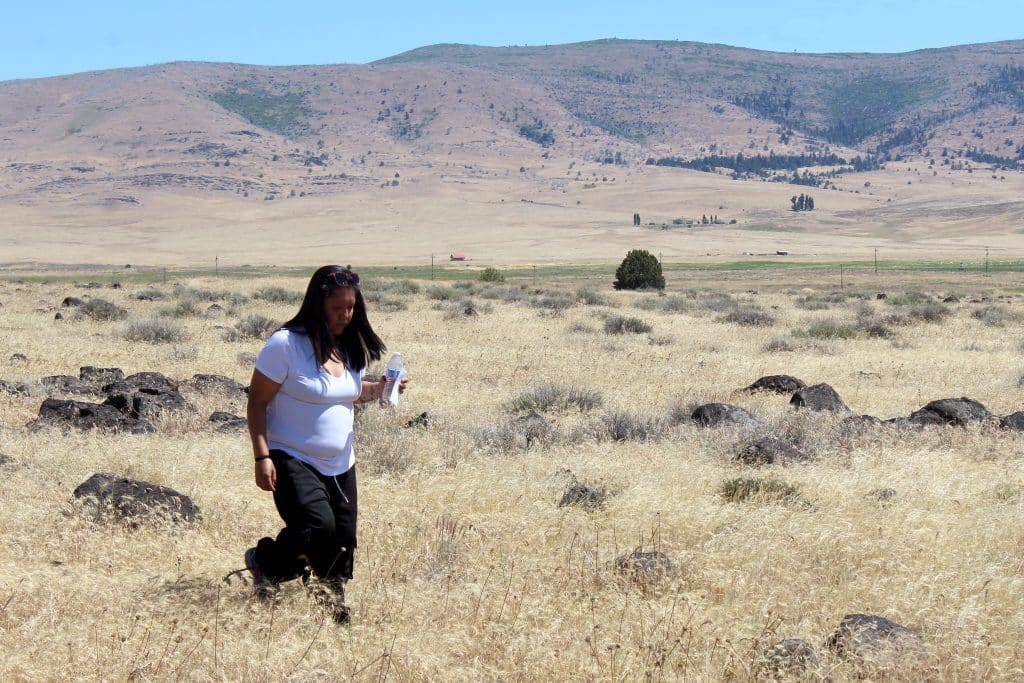
In the time since Nick went missing, both Native and non-Native community members have offered their time and resources to help her move the investigation forward.
After learning of the missing vertebrae in May, Lynette organized a grid search for the remainder of her son’s bones in June. A Missing and Murdered Indigenous Peoples (MMIP) investigator with the Yurok Tribe, a Modoc sheriff deputy in a cowboy hat, members of the sheriff’s posse, and two cadaver dogs with their handlers worked in groups to scour the earth.
Even in the dry heat, mosquitoes swarmed the land around the Lookout Rancheria — the tiny Indian reservation where Lynette was raised, near where Nick was first discovered. It’s tough terrain. The rolling hills are flecked with volcanic rock, rattlesnakes, and the occasional beer bottle. The smell of sagebrush hung heavy in the air. There wasn’t so much as a cloud in the sky as Lynette trekked southeast, through medusahead grasses with bristles that can easily pierce clean through the sole of the wrong kind of shoe.
It was against this backdrop that Morning Star Gali spoke with Shasta Scout. She is a member of the Pit River Tribe and organizer with the nonprofit Indigenous Justice, which advocates for Indigenous families whose loved ones have been murdered or gone missing, among other community initiatives.
“Both living and nonliving Native peoples have been treated as nonhuman and really disregarded,” Gali noted, saying she felt that disregard was evident in law enforcement’s lack of investment in Nick’s missing persons case — as compared to that of Sherri Papini, another Shasta County local whose disappearance became an immediate national sensation.
More generally, Gali described the added bureaucratic hurdles Indigenous people face when seeking justice for acts of violence committed in Indian Country, areas which fall within more particular criminal jurisdictions. Public Law 280 was passed in 1953 on a national level, limiting the federal government’s authority to prosecute most crimes committed on federally recognized reservations. In California, it authorized state law enforcement to police these lands but it provided no financial assistance to the state to expand services, often creating disparities in Native people’s access to resources.
From 2012-2016, as Gali worked as the Pit River Tribe’s historical preservation officer, she was directly involved in reclaiming Pit River human remains and cultural objects from museums, government agencies, and universities, something made possible under the Native American Grave Protection and Repatriation Act (NAGPRA). The act, which was passed in 1990, set up a process through which Tribes could identify and bring home the objects of their ancestors that had been taken from them by anthropologists and archaeologists generations ago.
Though this federal law has been in effect for 35 years, there are still thousands of ancestral remains that have yet to be repatriated to tribes, some of which are currently held in the massive research archives of the University of California system. As the Pit River Tribe’s liaison in the repatriation process, Gali said she insisted on picking up ancestral objects, including bones, in person rather than relying on mail deliveries.
In contrast to Dr. Bartelink’s assessment that the mail system is almost always effective in transporting human remains, Gali believes a physical handoff process should be an essential procedure during criminal investigations involving the remains of Tribal members — similar to what she’s done in the past under NAGPRA.
“Nick’s remains were DNA tested in Chico, and it could have been very easily coordinated to have a Tribal designee go down and pick them up and bring them back. But because the tribe and the family wasn’t notified of that process, his remains were shipped via FedEx,” she said.
On the university side of the NAGPRA process, Allison Fischer-Olson, the Repatriation Coordinator at the University of California, Los Angeles, described the protocols the state academic system is bound to when handling human remains. “You consult tribes before you move something or someone, you ask them how they want it to happen. You ask them if they want to be present, right?”
She pointed out that NAGPRA also lays out a process for when human remains are unearthed during a construction project, a discovery not too dissimilar to how Nick’s bones were initially found, though the process required by NAGPRA is starkly different from the standards of the Modoc Sheriff’s Office.
“When there’s an inadvertent discovery of any type of human remains or something like that, the first step is you call the coroner, because the coroner decides if it’s like a recent possible murder victim,” Fischer-Olsen said. “If it’s archeological, then it kind of diverts, and this whole other process takes over.” It’s at that point that the scrupulous standards required by NAGPRA are applied to the archaeological remains, as opposed to if the bones were being treated as a more contemporary criminal matter, where no such standardized procedures are required for ancestral remains — at least not yet.
Acknowledging that NAGPRA is by no means a perfect system, and that criminal investigations have their own considerations, Fischer-Olsen wondered why some of the same ethical considerations she’s bound to couldn’t be integrated into law enforcement processes.
“If something is deemed by a coroner to be recent or something that requires investigation… it’s just one coroner’s decision [that prevents] it from being treated ethically, as if NAGPRA is the standard,” she observed.
At lunch time, breaking up the long hours of the June search, Lynette and the volunteers sat in the shaded yard outside of her mother’s house, about a few hundred feet from where they were just scanning the ground. They pulled cold-cuts and water bottles from a cooler and chattered about the personal habits of the two cadaver dogs, who sat by their owners smiling and panting. A hush fell over the group as the Deputy Sheriff Erik Von Rader walked past with a bundle of bones, found earlier in the day, cradled in his arms.
As he placed the bones in evidence bags in the back of his squad car, Von Rader explained next steps. The bones, he said, would be analyzed to determine if they were human or animal. By December, the Sheriff told Shasta Scout in response to questions, the bones had been determined to be non-human, leaving the search for Nick ongoing.
Do you have a correction to share? Email us: editor@shastascout.org.
Comments (15)
Comments are closed.
Related Articles

Endangered salmon returned to California’s far north — then the money dried up
Newsom promised to help a Native tribe restore sacred salmon to their ancestral river. Now California is ending the funding. The fish made it back to their ancestral waters for the first time in 80 years — so why is California walking away now?
Wintu people say proposed reforms to a state list of tribes is erasure, threatens their homelands
A state commission’s proposal to remove Wintu and other federally non-recognized tribes from a consultation contact list would leave cultural sites vulnerable to destruction, tribal members say, and represents a form of unconstitutional discrimination.

This week, the California Energy Commission is expected to decide the future of the Fountain Wind project
Wind energy company Repsol needs the Energy Commission’s approval to proceed with a plan to develop a wind energy plant in Shasta County. The recommendation coming from the commission’s director makes that approval seem unlikely.
You this whole situation is very sad, but the worst part is, his mother knows exactly what happened to him…. It was foul play! its a really messed up thing to say but she needs a polygraph test…. i said what i said,i feel really bad saying this..
That a messed up thing to say . Unless you were there personally and then you would be guilty. Give the respect that is deserved.
Thank you!!
Thank you Madison and Nevin for your coverage on Nick’s story again. Our families appreciate your time and concern. Thank you to Annelise as well.
Nevin. Very well done article about troubling cultural histories that seems to continue. I recommend an old film call The Dispossessed and some documentation that went with the film. I think the Redding Rancheria library or Chico State have records and a copy of the film. You could expand your article out into as an interesting historical fiction or short story or even a book, based on fact, bringing the past into the present. Thanks for the well done writing about a troubling reality.
This story is unbelievable! We have come so far to get answers for these families that have missing loved ones. I’m so sorry Lynette, and your entire family.
This is beyond heartbreaking 💔 I’m crying reading this..
For far too many decades, the tragedy of missing and murdered indigenous Native Americans has been largely ignored. The loss of some of Nick Patterson’s remains cannot be explained away with a shrug of the shoulders and the words “I’m sorry.”
I agree with everything you say about past and current systemic mistreatment of Native Americans and inadequate investigations of crimes against them.
I don’t agree that the meaning of the word “violence” should be watered down by expanding its meaning to include everything between murder and hurt feelings. It’s disrespectful of those who have suffered true physical violence.
“What was revealed through the process was how state violence can continue to be inflicted upon California’s Natives well beyond their deaths.”
The disappearance of Lynette Craig’s son is an awful tragedy. The loss of two of his vertebrae during transport is not—it’s just a screw-up that could have been prevented simply by asking his survivors to come pick them up. Even if the loss hadn’t happened, his remains would still be scattered. I object to the language, “…how state violence can continue to be inflicted…” because it implies that “state violence” caused his death, and it dilutes and cheapens the definition of violence. Violence very likely caused Nick Craig’s death. The data suggest it was likely intratribal violence, not “state violence.” Losing the two (of 33) vertebrae that were recovered is careless and disrespectful, but it isn’t violence.
Hi Esteban,
Thanks for this feedback and I do understand your sentiment. But my response is that word violence can and should understood in more expansive terms. For the Native sources we consulted, the “awful tragedy,” as you worded it, is a form of violence that is inextricably linked the long legacy of 1.) how state agencies have systematically desecrated burial places and 2.) inadequately addressed investigations involving Native victims, particularly when they occur on federal reservations due to jurisdictional complications, as addressed in the piece. Many would argue that negligence is indeed a form of violence as it devalues the dead and their surviving kin, especially those who are the victims of it on a systematic scale.
Always grateful for feedback.
Nevin
Nevin — I understand that language evolves, but expanding the meaning of the word “violence” to include every type of systemic harm strips the word of its potency. Conflating “violence” to cover the mass-scale killing and maiming of Palestinians and the inadvertent loss of two vertebrae during a FedEx delivery makes the word less meaningful because it robs the word of discernment. “Negligence” is a passive lack of caring that is abusive when it causes harm. Violence isn’t passive. Violence involves physical force.
Lastly, I understand that my use of “awful tragedy” to describe Nick Patterson’s death does not meet the literary standard for “tragedy” dating back to the ancient Greek playwrights, and in its own way argues against my usage conservatism.
Estaban: Nevin’s statement about violence wasn’t just about the loss of two vertebra. It was about American systems that continue to fail to serve and protect Native community members. Violence doesn’t have to be physical. Please see the United Nations definition here: https://www.undrr.org/understanding-disaster-risk/terminology/hips/so0301#:~:text=Definition,%2C%20or%20deprivation%2C%20or%20combined.
As I mentioned, I understand that language evolves. I also understand the context in which it’s applied in this article, as synonymous with neglect and emotional abuse. I just think that this particular definitional shift waters down the previous meaning of the word.
But I get it. “Old man yells at cloud.”
Very well said.