
A loophole in California law makes it hard to prosecute threats against schools. Will lawmakers close it?
After a man threatened an elementary school in her district, Assemblymember Darshana Patel wants to close a loophole in the law that makes it harder to prosecute threats against places than individuals.
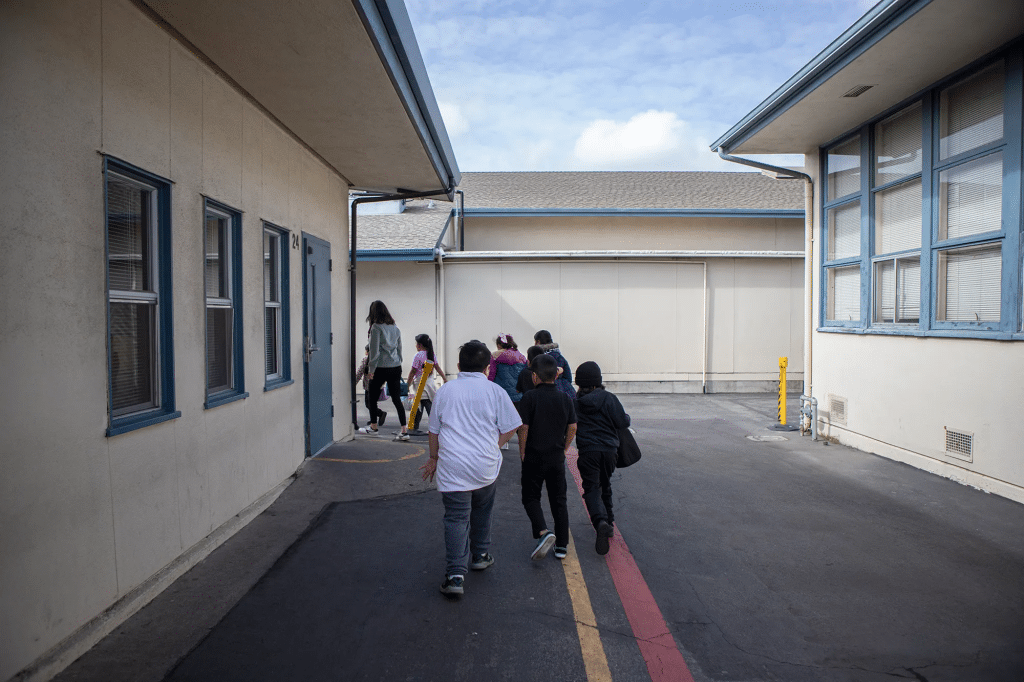
A group of students at an elementary school on Feb. 11, 2025. Photo by Larry Valenzuela, CalMatters/CatchLight Local
This story was originally published by CalMatters. Sign up for their newsletters here.
For over six months, San Diego resident Lee Lor sent hundreds of emails threatening a mass shooting at Shoal Creek Elementary School as replies to random spam emails.
He was arrested and spent 10 months in jail, but the charges were dismissed by a judge last October because Lor didn’t name a specific individual in his threats, as the law requires for prosecution.
A week after he was released, police rearrested Lor after they found a loaded firearm in his house and a map of the San Diego school he threatened — less than a mile from his house. Prosecutors are bringing a new case against him, this time arguing that Lor was targeting the school’s principal.
Those threats prompted Assemblymember Darshana Patel, a Democrat from San Diego who previously served as a school board member in that district, to introduce a bill trying to close the loophole. Her office has tracked at least eight other similar incidents statewide.
“The individual didn’t threaten any specific individual, sure, but it’s the same individuals that go to work there, that attend school there, whose parents drop them off every day there,” Patel told CalMatters. “There are specific people in these named spaces, and if they don’t feel safe, the children, they’re not learning.”
San Diego city Councilmember Marni von Wilpert said she remembers hearing from parents who were frustrated and distraught over the district attorney’s inability to prosecute Lor.
‘Why can’t you hold this guy?’
“I was on the phone with the (assistant district attorney) herself, asking, ‘Why can’t you hold this guy?’ And she said, ‘Because, councilmember, California penal code says for an actionable criminal threat, you must identify an individual you’re going to harm,” von Wilpert told CalMatters. “Imagine explaining that to a parent of a kindergartner. I mean, this man had a map of the school. He had access to guns. It was a very serious threat.”
Lor’s attorney said the emails did not directly name the school’s principal or staff, and that sending the emails in response to spam messages was his way of “ranting into the ether,” the San Diego Union-Tribune reported.
Patel’s Assembly Bill 237 passed the Assembly Public Safety Committee earlier this month and awaits a hearing in the appropriations committee.
But similar efforts have failed in recent years, such as one that would have applied just to schools and places of worship and has now been reintroduced by Sen. Susan Rubio. A 2020 bill would have done the same, but made the maximum penalty for a minor a misdemeanor. Both died in the appropriations committee’s suspense file process, in which hundreds of bills are shelved without debate.
This year’s legislation is opposed by Californians United for a Responsible Budget, a coalition of groups seeking to reduce the number of people in jails and prisons, including the Ella Baker Center, the Asian Law Caucus and the Immigrant Legal Resource Center.
Those groups say it’s already a felony to make a threat that could result in death or injury to another person, even if there is no intent to carry it out.
“That standard has served California well by both protecting the public from criminal threats, but also ensuring that individuals are not convicted of the crime of making a threat unless the individual had some intent to make a threat,” the group wrote in a letter to the committee.
Similarly, the Assembly Public Safety Committee’s analysis says people have been convicted under the current law for making threats against groups without naming specific targets.
But Patel still hopes to close what she sees as a loophole with bill language that is narrowly tailored to focus on credible threats.
Could other recent incidents persuade lawmakers?
In El Dorado County, a man threatened every firefighter at the fire department, in person and over the phone. He could not be prosecuted for criminal threats because he did not identify a specific firefighter.
In Orange County, a suspect made a bomb threat against Saddleback Hospital, which the facility said delayed critical surgeries and emergency care. San Diego police did not make any arrests, though a spokesperson said it’s possible the FBI investigated.
In other incidents, someone threatened a movie theater in Hollywood, a bomb threat forced evacuations at San Francisco International Airport and a Fresno City College professor was arrested for threatening to shoot officials and students, but the charges were dismissed by a judge.
Gov. Gavin Newsom’s office declined to comment on whether he would support the bill.
In 2015, then-Gov. Jerry Brown vetoed a similar bill that would have made it a crime to threaten a school campus.
“No one could be anything but intolerant of threats to cause great bodily injury, especially on school grounds,” he wrote. But, “in recent decades, California has created an unprecedented number of new and detailed criminal laws. Before we keep enacting more, I think we should pause and reflect on the fact that our bulging criminal code now contains in excess of 5,000 separate provisions, covering almost every conceivable form of human misbehavior.”
This article, which was originally published in CalMatters on March 14, 2025 and is republished, with permission. CalMatters is a nonpartisan and nonprofit news organization bringing Californians stories that probe, explain and explore solutions to quality of life issues while holding our leaders accountable. They are the only journalism outlet dedicated to covering America’s biggest state which includes 39 million Californians and represents the world’s fifth largest economy.
Author

Related Articles

They answer the call for Californians in mental distress. The money is running out
California’s mobile crisis teams have surged in popularity as an alternative to police response, but a proposed state budget change could force counties to foot a $150–200M annual bill. Counties spent years building these crisis teams. A quiet budget move could undo progress.

Internal emails show how fringe groups fueled Sheriff Chad Bianco’s ballot seizure
Records reveal that the unprecedented taking of 650,000 ballots was based on the thinnest of evidence, raising alarms over how the November election could be disrupted.

California middle schools are ground zero for testing AI in classrooms
Districts are trying to develop more systematic approaches to introducing AI into the classroom.