
Opinion: After the Carr Fire, I Sought To Understand Catastrophic Wildfires. I Learned the Solution is Supporting Indigenous Stewardship and #LandBack
After the Carr Fire ravaged Shasta County, Elena Nim dove headlong into investigating the cause of catastrophic wildfires, learning how they are inextricably tied to the forced removal and genocide of local Indigenous peoples, whose traditional practices had long maintained the health of forests. California’s wildfire crisis can’t be solved, Nim writes, without changes to how we all relate to the land.
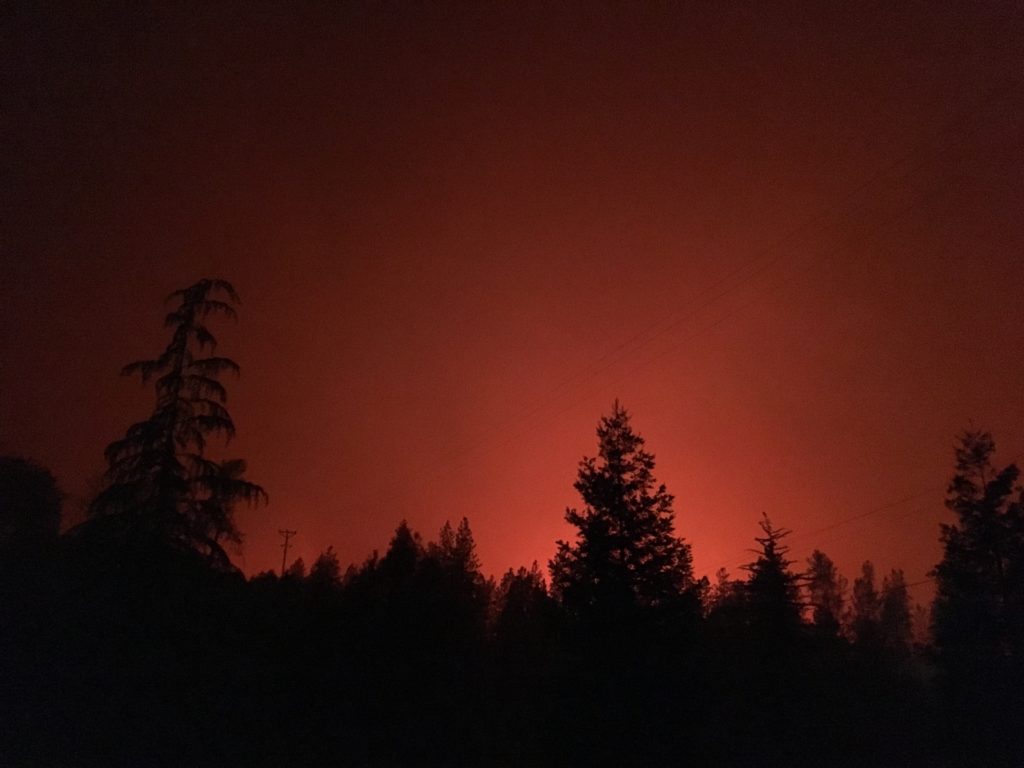
It was 2 in the morning when I felt my mother shake me awake.
Jumping out of bed, I found a bright red night sky outside my window. The tips of flames were already visible above the nearby mountainside as my family and I frantically began packing what we could.
After we left, the Carr Fire swept through our neighborhood. I witnessed the devastation for the first time a week-and-a-half later as we drove through the small, nearly obliterated community of Keswick towards our still-standing home.
Through the car window, I took in the miles of new wasteland—a gray landscape of ash and debris and the skeletal remains of structures, vehicles, and trees. I had never stood before such vast environmental devastation, let alone in a place I so heavily associated with the idea of home. I was horrified.

As someone born and raised in the Redding area, this same landscape had been the forests I grew up in and loved. But that day, returning home after the Carr Fire, my relationship with the land instantly changed. I was torn between wanting to abandon the environment, both physically and emotionally, and wanting to do everything I could to restore it back to the way I remembered.
One year later, transferring from Shasta College to UC Berkeley, I was still seeking peace. While my original plan was to study language and literature, I eventually threw myself into focusing on understanding California’s horrific wildfire seasons, and what, if anything, could be done to mitigate them.
One of my classes, “Fire: Past, Present, and Future Interactions with the People and Ecosystems of California,” was co-taught by two professors, a fire science expert and an anthropologist whose research focuses on the Indigenous peoples of what is now known as California. In their course, I had the honor of listening to numerous Indigenous scholars and traditional knowledge keepers speak about Indigenous land stewardship, including wildland fire scientist Frank Lake of the Karuk and Yurok Tribes, Chairman Val Lopez of the Amah Mutsun Tribal Band, and Chairman Ron Goode of the North Fork Mono Tribe.
From them, I learned about the importance of Indigenous peoples and their cultural uses of fire to the health of forest ecosystems—and of the consequences that have occurred as a result of their dispossession, removal, and genocide. California’s current catastrophic wildfire seasons are in fact directly tied to the forced removal of Native peoples from their ancestral homelands by and for European settlement decades ago.
Many think of Native peoples as hunter-gatherers, a common but incomplete narrative that implies a passive, one-sided, or non-reciprocal relationship with their ancestral homelands. In truth, the Indigenous peoples of what is now known as California have been actively shaping landscapes with fire and agricultural methods for millennia in a way that is not just beneficial to humans, but also necessary for environmental health.
In a docuseries on cultural burning, Ron Goode, one of my class’s guest speakers, explains Indigenous stewardship this way: “When we burn, we are burning to perfect [a] resource….for our culture….[whether] it be food, medicine, fiber, sticks, [or] basketry material…. Fire is a spirit. This land has spirits. And when we’re burning, they come alive.”
The land upon which my childhood home still sits is the ancestral land of the Wintu people. While I am not Indigenous to this land, my mother is of an ethnic group known as the Karay-a people who are native to the islands of Palawan and Panay in the Philippines. My mother is from Panay, but she passed on some of her own traditional knowledge to me on Wintu land, mostly by way of an annual summer garden.
It is because of my mother that I grew to love the land as much as I do. And it is because of her influence that I felt so torn between abandonment and the desire to help with restoration when everything I thought I loved about the land was suddenly “gone.”
But abandoning the land because a disaster had devastated it, wounded it beyond what seemed repairable or curable, would also mean abandoning the Indigenous peoples who have called the land home for thousands of years.
I hope to emphasize that Indigenous knowledge is formed over time—time that comes from Indigenous peoples having lived in a particular place for millennia, and the intimacy of the relationship they form with that place as a result. Because of this, and because Indigenous peoples, as the land’s original stewards, are also the most knowledgeable, it became clear to me that the solution to the wildfire crisis is not just ecosystem restoration, but a restoration of the relationship between Indigenous peoples and their ancestral lands.
Prior to colonization, wildfire seasons in California were characterized by low intensity, high-frequency burns often started by Indigenous peoples, which kept fuel loads lower and less dangerous than they are today. Since Indigenous peoples were removed from their homelands and banned from practicing cultural burns, wildfire seasons in California have shifted to become high-intensity and low-frequency.
Many catastrophic wildfire events such as the Carr Fire and others of the recent past have occurred in forests that are overgrown because they have not been maintained and cared for by Indigenous stewardship. A growing body of scholarship verifies this, including a 2019 Stanford collaborative study with the Yurok and Karuk Tribes that concludes supporting cultural burns can simultaneously revitalize Indigenous cultures and protect communities from wildfires.
These changes in California wildfire seasons have another cause—wildfire suppression, a land management practice introduced by European settlers that aims to extinguish all forms of fire as quickly as possible. The advertising character Smokey the Bear and his famous quote, “Only YOU can prevent forest fires,” have long been used by the U.S. Forest Service to demonize all forms of fire, including Native peoples’ cultural uses.
Today, as fire-prone communities are increasingly experiencing fear and desperation during the hotter months of the year, academic, state, and federal institutions are looking to Indigenous knowledge for solutions. Many have already begun to participate in collaborative land management projects with various Tribes.
UC Berkeley and California State Parks, for instance, have partnered with the Amah Mutsun Tribal Band on their ancestral homelands in Quiroste Valley to “bring their history to light and find more sustainable approaches to managing the plants, animals, and land.” Similarly, just last November, the U.S. Forest Service signed 11 new agreements to advance co-stewardship in national forests with various Tribes.
But for Indigenous peoples, collaborative projects fall short of the sovereignty that would ensure their self-determination and the survival of their people and cultures. As the keepers of thousands of years of intergenerational knowledge of California’s diverse ecosystems, Indigenous peoples are the land. And to meet their needs is to meet the land’s needs, and our own.
Elena Nim was born and raised in the Redding area. They graduated from college with a Bachelor of Science degree in Conservation and Resource Studies before moving back to the Redding area, where they’ve worked to support local Native students as an educator.
Nim writes for Shasta Scout as part of our Community Voices series, which illuminates lived experiences, identities, issues or perspectives that are often misunderstood. Community Voices is supported by a grant from the North State Equity Fund. Want to share your thoughts and opinions with our readers? You can submit your writing here.
Author

Related Articles
Opinion: Healthcare and Food Benefits are at Risk in Rural California. Will the Governor and Legislature Act?
The need for health care, behavioral health treatment, and food assistance will not disappear because federal funding drops. The burden simply shifts downstream to counties — forcing cuts to emergency rooms, food banks, sheriff’s deputies and already-overwhelmed local systems.
“My ancestors have not deserted me”: The life and writings of Wintu poet Alfred Gillis
After recent erasures of the historical contributions and experiences of Indigenous people from public sites, the work of an early 20th century Wintu poet provides poignant insights into how local Native people have fought against invisibility for centuries.
Letter to the Editor: Redistricting California is not a fight the Democrats can win
Anderson resident Curtis Scott draws on current events to scrutinize the value of a proposed redistricting effort by California Democrats. He describes himself as a 50-year resident of Shasta County and life-long progressive.