
California middle schools are ground zero for testing AI in classrooms
Districts are trying to develop more systematic approaches to introducing AI into the classroom.
This story was originally published by EdSource. Sign up for their daily newsletter.
In Gregory Dharman’s eighth grade math class at South Lake Middle School in Irvine, the exit ticket his students turn in every month doesn’t go to the teacher — they go to Snorkl, an artificial intelligence software program capable of grading quizzes, exams and homework.
How does Snorkl work? Students type in responses to questions or answer verbally, and receive instant feedback. If students don’t get an acceptable score, they can retake the quiz until they do.
What is happening at South Lake Middle is happening across California as middle schools become ground zero for introducing AI into curriculum and classrooms. Experts say that students in elementary school may be too young to interact with AI, and students going into high school should already know how to use it. A RAND survey revealed that 41% of middle schoolers in the U.S. said that they use AI for their schoolwork.
At South Lake, Dharman teaches seventh and eighth grade mathematics, robotics and introduction to computer applications. He has been teaching for five years and has received AI training from the Irvine Unified School District for the past three years.
Last year, Dharman served as an educational technology mentor. Every quarter that year, he and dozens of teachers crowded into a large classroom at the district to test different AI tools, learning how to set up an assignment and generate multiple solutions.
Teachers were also taught how to use AI detectors, such as Turnitin and Scribbr, to prevent students from cheating. Teachers were trained to encourage students to use AI as a learning aid, not as a substitute for their own effort or understanding.
“When it comes to teaching the kids how to use AI, it’s like ‘How can I maximize this thing and use it to my advantage?’” Dharman said.
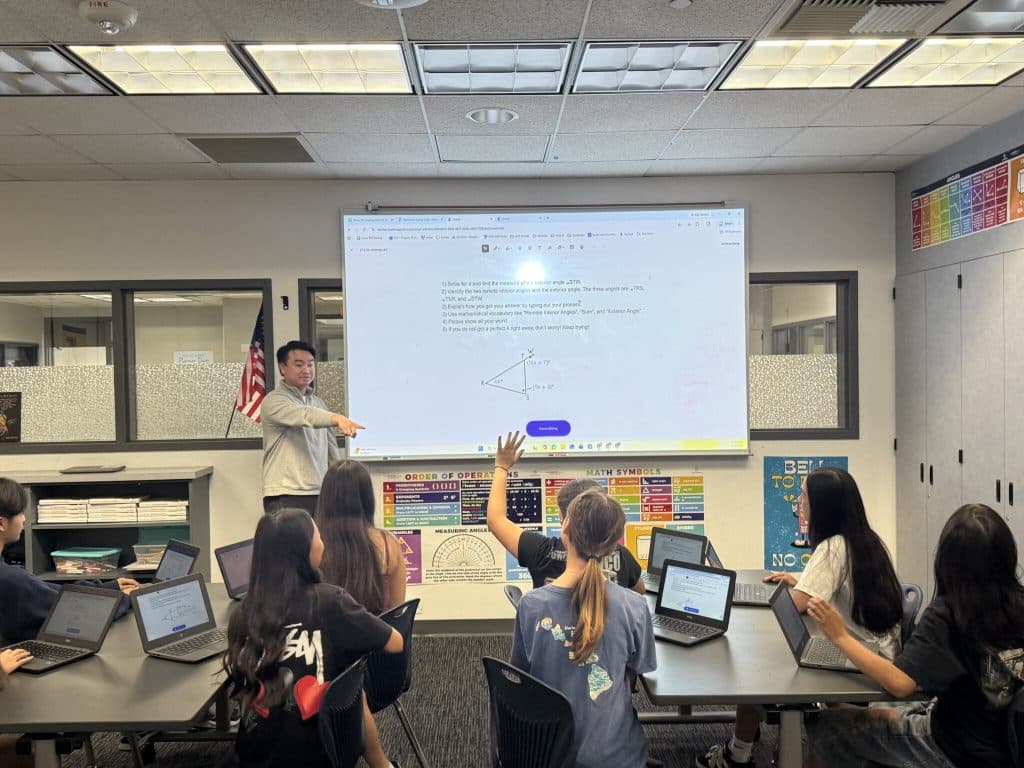
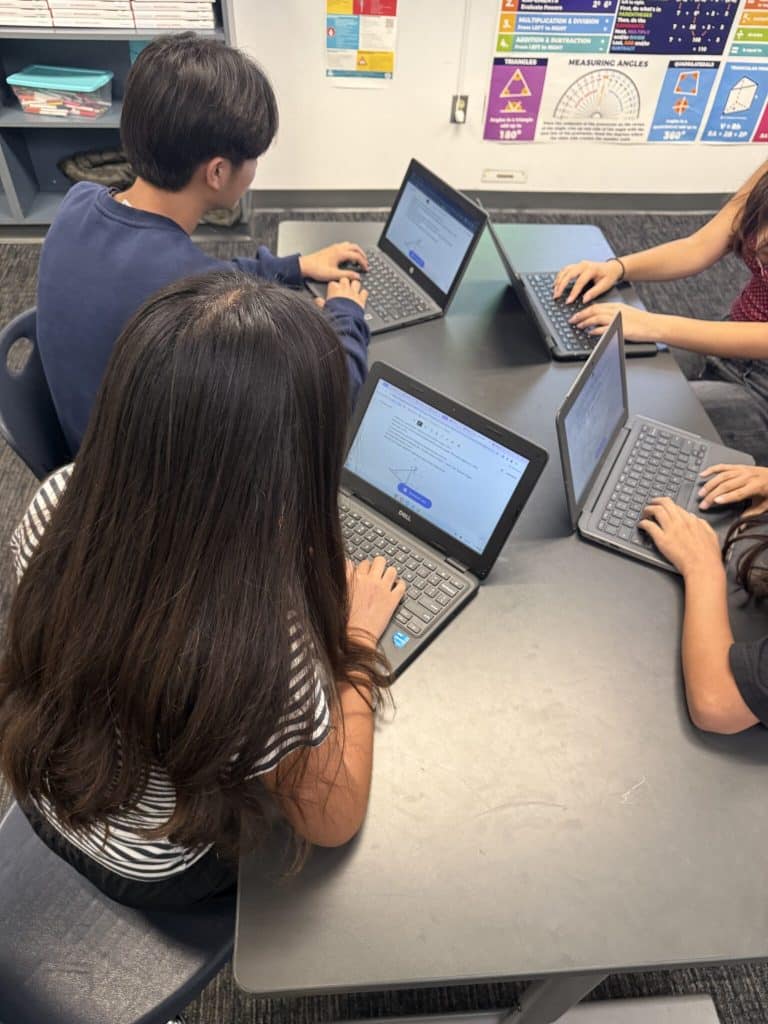
Dharman doesn’t use AI often because he primarily assigns handwritten work. But about once a month, his class trades pencils and papers for Chromebooks. The rapid clacking of keys fills the room as students lean over their screens, experimenting with Snorkl. One student types, “Hey, you’re my tutor. Help me solve this equation.” A second later, a detailed step-by-step breakdown appears, walking him through the problem.
For the exit tickets, Snorkl bases the grading criteria on the content Dharman uploads, though he occasionally adjusts the parameters to fit his own preferences. Dharman said that he uses Snorkl because it pushes students to explain their thinking process and provides good personalized feedback.
“In the future, AI is going to be able to personalize a lot more in terms of education or curriculum toward a specific student, or a specific topic that a student needs,” Dharman said.
But sometimes, Snorkl is wrong.
Once, Dharman explained, a student lost a point for changing the wording of their explanation. They stared at the screen in confusion — their answer was correct. Raising a hand, they explained the situation to Dharman. After checking their work, Dharman fixed the issue. To ensure students receive a fair score, Dharman reviews the exit tickets himself and corrects any errors.
“The more AI evolves and the longer it’s around, the more teachers are willing to be able to introduce it into their classrooms,” Dharman said, “because it’s an inevitable thing that these kids are going to come across.”
Mixed reactions about AI
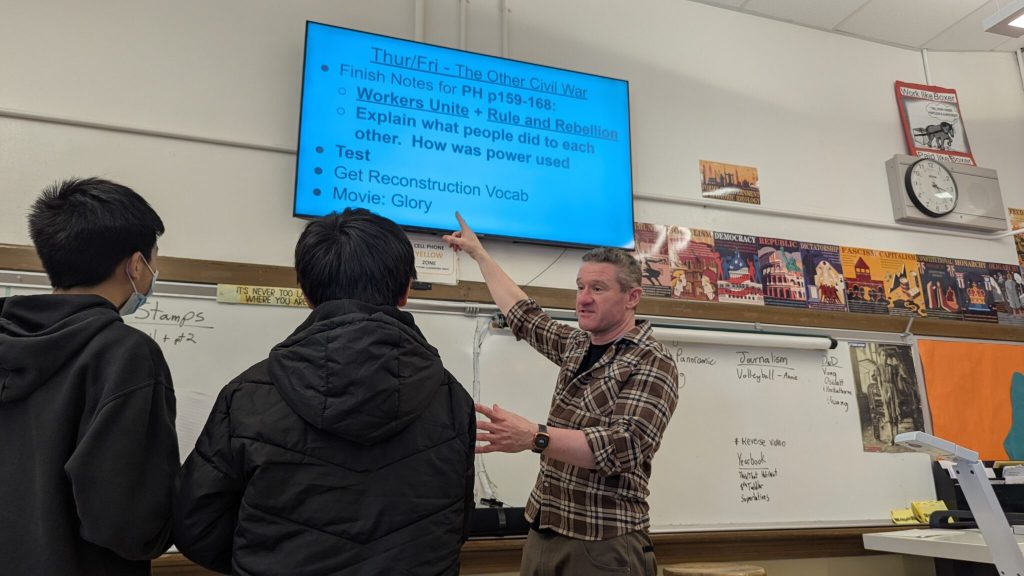
At another California middle school, a veteran teacher is taking a slightly different approach. Instead of using AI at the beginning of the semester, Matthew Helmenstine, a teacher at Marina Middle School in San Francisco, doesn’t. Helmenstine teaches eighth grade social studies and journalism and has taught for 25 years in Italy, Japan and the United States.
In Marina, the school-provided Chromebooks have software that blocks access to AI. However, there aren’t enough Chromebooks for everyone, so students often complete digital assignments on their phones.
By the end of the school year, Helmenstine lifts the restrictions on AI and lets students experiment with it on their phones. He was intrigued by the mixed reactions they had when they were introduced to AI. In February, Helmenstine showed his class a history video about the Mexican-American War — only to realize it was created with AI.
“They lost their minds immediately,” Helmenstine said. “They’re like ‘That’s AI, that’s baloney! That’s garbage! Look at that, that’s horrible!’ They were so angry that it was AI, and I had no idea that they were against it.”
About two weeks later, Marina had a schoolwide assembly for the Chinese New Year. Sixth, seventh and eighth graders gathered in the auditorium to watch a video made by the multimedia teacher. Onscreen, they saw an AI-animated video of four multimedia students riding horseback and trotting off into the horizon. To Helmenstine’s surprise, the students loved it.
But when Helmenstine talks about using ChatGPT in class, his students shy away from the subject, treating it like taboo. He noticed they react differently when exposed to AI-generated art versus AI language models like ChatGPT.
Helmenstine said he thinks students’ conflicting reactions might stem from a lack of familiarity with it. Helmenstine hasn’t received any AI training from the San Francisco Unified School District, but that might change.
Earlier this year, Marina’s principal announced that AI is coming soon, so teachers have to consider how AI will be used in their classrooms.
“To a lot of us that have been doing this [teaching] for a while, it’s kind of scary because we don’t know if it’s going to get away from us,” Helmenstine said. “Or if the kids are not going to be able to put things into categories, like essays, or be able to express themselves.”
To prepare for the growing integration of AI at Marina, Helmenstine wants the district to train teachers to use it to engage students’ minds without diminishing their critical thinking skills.
“The greatest fear is, will students be able to develop vocabulary and express themselves if they’re relying on AI to write essays or poems, or whatever it might be?” Helmenstine said. “And is that going to reduce their intelligence?”
Caught cheating
Another teacher at Marina has caught students submitting AI-generated work as their own.
Xilong “Benson” Li teaches seventh and eighth grade social studies and has been teaching for two years. Recently, he noticed an increase in the number of students turning in AI-generated assignments.
“It is so different from their previous writings, or from their parents’ writings,” Li said. “It is just so far above, or so nonhuman, that it’s easy for me to figure out.”
Marina doesn’t have official policies on AI, so Li disciplines students based on his own expectations. He imposes the same punishment on all of his students.
“Honestly, policy is quite lax,” Li said. “I give 15% even if they don’t turn anything in. But if it’s AI-generated and I can tell, then I just give them a zero for it.”
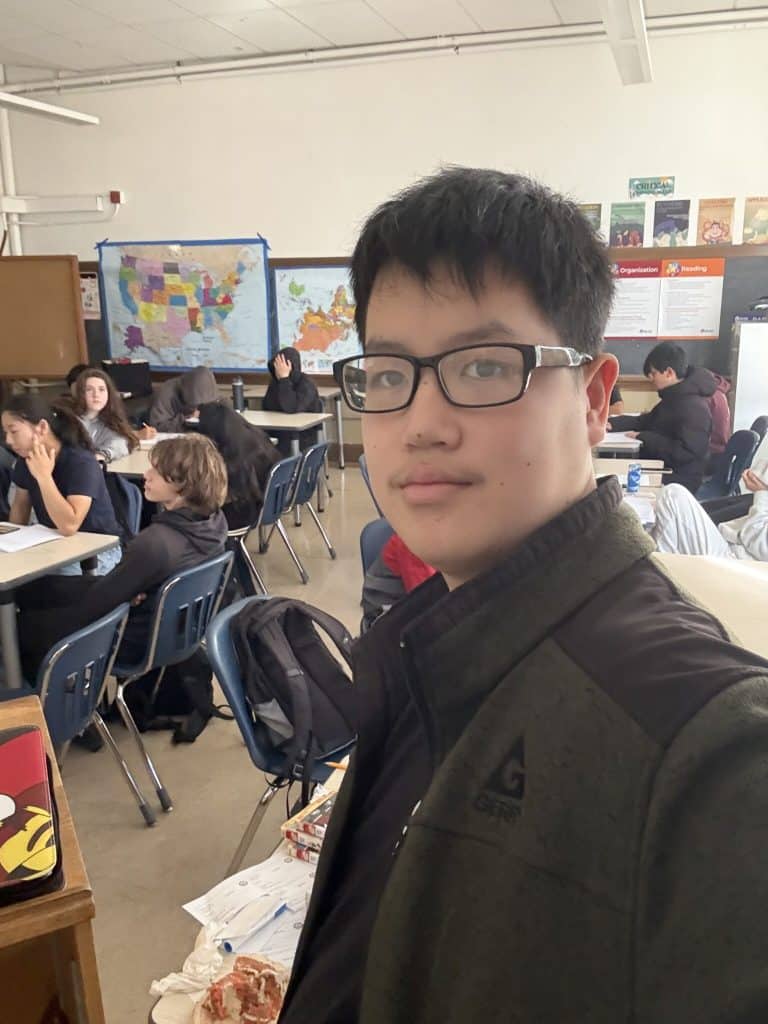
Li knows that students are already exposed to AI outside of school. Occasionally, he shows them its potential. One afternoon, one of his students asked him the century-old question, “Why did the chicken cross the road?” To entertain them, Li opened ChatGPT and told it to write an essay answering the question. His students were fascinated by how quickly ChatGPT could generate a response.
“AI is a helpful tool for students,” Li said. “But it’s too much of a crutch if they just use it verbatim word-for-word, or copy it and pass it off as their own.”
Districts using systematic approaches
While individual teachers are setting their own guidelines around AI, some districts are trying to develop more systematic approaches. Jennie Dougherty, the director of strategic initiatives at KIPP Public Schools Northern California, has been working in education for 19 years and at KIPP for 12 of those years.
At KIPP, she monitors the testing of new AI tools and their impact on select groups of teachers and students.
“We use the micro-pilot to ask questions like: Are students more confused than before? Is the teacher spending more time managing the tech than teaching? Are the kids who were already struggling falling further behind?” Dougherty said. “If the answer to any of those was yes, we stop.”
When Dougherty introduced the AI tool, Coursemojo, to middle schoolers, she thought they would be impressed. Coursemojo is designed to give students immediate feedback on their writing. Instead, after the first test, one of the students said, “I’m gonna crash out!” Dougherty didn’t understand what the phrase meant at first, but later learned that Coursemojo was causing students distress.
Dougherty didn’t understand their reaction. Then she realized that “humans process feedback at the speed of emotion.” The students received multiple rounds of feedback at once. To them, it felt like a bombardment of criticism. It made them question their own work, and whether they were good enough.
The teacher who observed the students as they interacted with Coursemojo noticed how they struggled to respond to the rapid-fire feedback. To foster more positive reactions, the teacher reminded students that feedback isn’t failure, but a sign of learning.
Dougherty said that middle schoolers are still developing their academic identities. She added that before districts introduce AI into the classroom, they need to prepare teachers on how to handle students’ reactions to it.
“Our goal is not to introduce AI early. Our goal is to introduce agency early,” Dougherty said. “Because a measure of our success is not whether students can use AI. It is whether they emerge from our schools knowing who they are, and trusting themselves to navigate whatever comes next.”
Amelia Angeles is a fourth-year literary journalism major and history minor at UC Irvine. She is a member of the EdSource California Student Journalism Corps.
This story was originally published by EdSource and is republished here with permission.
Related Articles

Hundreds of deaths, thousands of injuries, billions of dollars: The cost of extreme heat in California
Heat waves have killed hundreds of Californians and cost billions of dollars in the past decade, according to a new report from the state insurance department.

11 California county education offices underpaid or overpaid millions due to state clerical error
These county education offices, all starting with the letter “S,” mistakenly got or were missing millions in state funding.
California’s foster care system is buckling under the weight of this unexpected cost
Critical infrastructure that holds up California’s foster care system is quietly collapsing, leaving children at risk. A well-meaning reform for sexual abuse survivors in the foster care system is contributing to the crisis