
Opinion: I’m A Legal Aid Attorney: My Clients Aren’t Refusing Housing, There’s No Housing For Them To Refuse
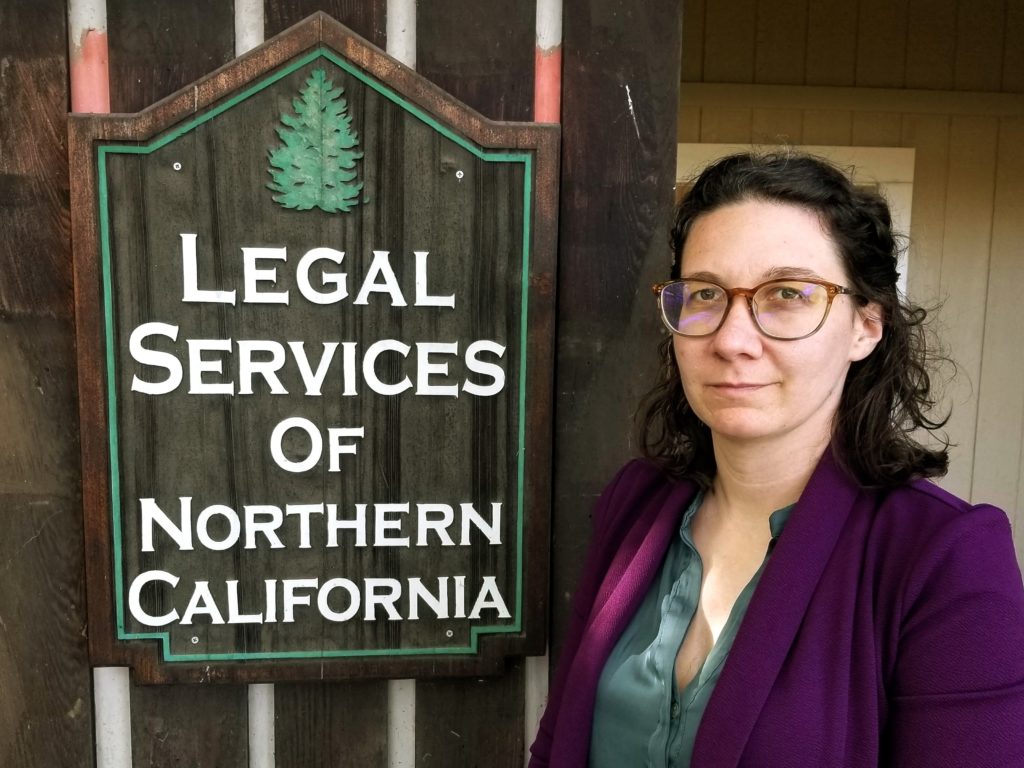
Sarah Fielding is an attorney who provides low-income people in Shasta County with free legal aid to prevent homelessness, including responses to threatened eviction. Despite her best efforts many of her clients still end up homeless, Fielding says, because current programs and services in Shasta County, including Redding, are both uncoordinated and not nearly enough to address housing needs.
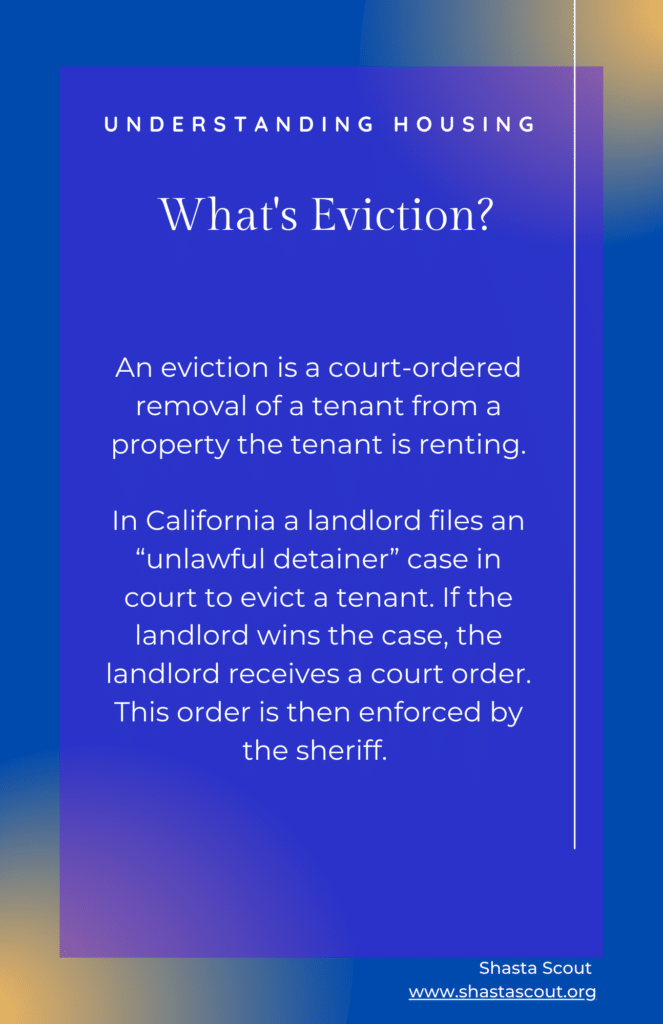
If you visit any of the homeless encampments in town, you’ll find people who ended up there because they were evicted from local housing. They have not always been unsheltered. Folks who live outside used to have a home. People who are evicted do not disappear once the sheriff locks them out.
I am a legal aid attorney. My legal work focuses on helping people meet their basic needs and is provided as a free service to low-income people. Each year, we work with hundreds of folks in the Redding area who are threatened with eviction. Several hundred eviction cases are filed in Shasta County court each year. Tenants lose most of them. Eviction is traumatic, and my clients experience significant stress and anxiety as soon as the threat of eviction arises. Most local evictions and the threat of eviction could be prevented if our region had sufficient affordable housing. When I first started doing this work eight years ago, it was clear that homelessness was a possibility for my clients. Now, with the loss of housing from wildfires, the rapid remodeling of apartment complexes to accommodate higher income tenants, and rising rents, it is almost a certainty.

My pregnant client asks me how she will be able to find a home to live in with her new baby. My client with disabilities, who needs a first floor apartment to accommodate her power wheelchair, asks me where she will be able to go. I have no answers. The job of a legal aid attorney in a county without adequate housing requires unflappable hope and some days I run low.
My evicted clients would have moved if they could. But there is nowhere they can afford. Many of my clients are on Social Security benefits, a program that exists to prevent individuals with disabilities and older adults from living in dire poverty. Currently, the monthly income for someone on these benefits is $1060. The most recent local rental listings compiled by Disability Action Center show that almost all of the available rentals in the Redding area would cost the entirety of my clients’ income or more. A handful exist where their income would cover the rent, but not also utilities, gas, food, cleaning supplies, clothing, or other basic necessities. Property management companies typically require potential tenants to have income at least three times the rent to qualify for the unit. None of my clients qualify on their own. They aren’t refusing housing; there is no housing for them to refuse.
We see many folks who are being evicted because they didn’t move quickly enough after receiving a “no fault” notice. That notice means they did nothing wrong and their landlord is ending the tenancy for a reason that has nothing to do with them. When people are facing eviction I often have to advise them that their best legal option is to move. Moving, I tell them, will stop the eviction process. It will keep them from having a record of an eviction on their credit report. I tell them that an eviction judgment will make it even more difficult for them to find housing because potential landlords will not want to rent to them.
It is good advice, but it is rarely followed. Housing is in such short supply here that there is nowhere that most of my clients can afford to go. Many of them have an eviction case filed in court against them despite having been looking for housing, often for months. They have tried to find friends or family with room for them, unsuccessfully. My clients often save themselves from eviction by moving into their car, telling me they have no other option. Some share their fears about living on the streets.
We regularly see folks who cannot pay their rent, often after they’ve received rent increases or there has been some change to their incomes. There is usually no fix. There is no program that can help them and no cheaper housing they can move into. They are real people, with complex lives and often difficult social issues.
Denise* is an elderly woman who used to split rent with her sister before her sister’s health declined. When her sister went into a nursing home, Denise couldn’t pay the rent anymore. Her friend found court papers in her house and helped her to call us. At that point, she was already at risk of being locked out by the sheriff.
Our office helped get Denise fast-tracked into Home Safe, a program that helps elderly individuals referred by Adult Protective Services (APS) avoid homelessness. We don’t know yet if the program will be able to pay for what she needs – the back rent she owes, her legal fees for eviction, and the partial payment of her rent going forward while she continues to hold out for one of the few spots in a low-income senior apartment, an average 1-2 year wait.
But this is far more generous assistance than most programs are funded to provide, and my fingers are crossed for her. The sheriff is still set to come out next week and lock her out. He is required to comply with a judge’s lock out order. It doesn’t matter if the person is in their 70s or gravely disabled. I’m filing a request with the court to push it out as far as I can, which is only a few weeks. I have my work cut out for me. Even if the program can pay, I’ll still need to convince the landlord to not go through with the eviction. She has no obligation to accept the money and let Denise stay.
I am still holding out hope. I can’t let her join the growing number of individuals over 50 who are homeless for the first time. I have to keep her housed.
Locally, we have an uncoordinated collection of assistance programs to prevent eviction; they do not save most of my clients. I do not discount the important work that these programs in our community do. I am certain they prevent many people from ever needing our help. They are not enough to address the need in our community. I question the prevailing assumption that these programs could prevent homelessness in all circumstances, that everyone living on the street is there by choice–that help was available for them had they only wanted it.
Mary* and Heather* are roommates, and both are Deaf. They fell behind on rent after Heather’s Social Security benefits were inexplicably cut off. Heather hadn’t been able to easily figure out what had gone wrong or how to fix it; navigating Social Security is not an easy task, more so when you have to request and wait for an ASL interpreter. It’s been months since her income went missing. When they got the notice that they had to pay rent or face eviction, there was no program to call on to help until Social Security could be ironed out.
Even with our help it can take months to navigate the maze of Social Security; months we don’t have in the eviction timeline. The time between a landlord filing court papers and the sheriff locking someone out is often just a few weeks. By some small miracle, Heather’s benefits were turned back on before the eviction went through. Social Security had made an error when processing her benefits. They gave her the missed months of income and we asked her landlord to settle. Our clients have the money now, we said, the problem is fixed. It wasn’t our clients’ fault so it’s very unlikely to happen again. But the landlord has refused. The case will go to trial. We have no legal tools that can force the landlord to take the rent. When someone is unable to pay rent there is rarely a defense in court; the tenant loses and is evicted.
Jessica* is a survivor of domestic violence who recently left her financially controlling partner. She is surviving on cash aid while she seeks out treatment for the disabling PTSD she developed from years of abuse. She is facing eviction from the home she can no longer afford without her partner’s income. To meet her housing needs, she was issued a Section 8 Housing Choice Voucher (sometimes referred to as “HUD”), a life-line. In this voucher program the federal government pays part of the rent for very low-income people who cannot afford market-rate rent and who would otherwise be homeless or unable to afford other basic necessities due to the cost of their rent. It usually takes years of waiting to get a Section 8 voucher.
The voucher could provide Jessica and her kids with housing while she gets treatment for her PTSD and figures out her next steps. But having a voucher, as helpful as they are, is no guarantee. Many of our clients with vouchers never find a home where they can use it. Refusing to rent to someone because they use a voucher violates our state fair housing law, but our clients regularly report that this unlawful discrimination is still occuring in Redding. And if Jessica doesn’t find a place quickly enough she will lose her voucher and it will be given to someone else. I hope it works out for Jessica. I try to ignore the nagging knowledge of how many times I’ve seen it not work out.
Each day, I go to work and try hard to stop tragedy. I am an attorney, with funding to provide free legal aid, but my tools are still no match for our community’s affordable housing crisis. Until we change the way we address homelessness and increase our affordable housing supply, many in our community will experience tragedy we could have prevented.
If you or someone you know is facing the threat of eviction or concerned about your ability to maintain housing, you can find Legal Services of Northern California at 1370 West Street in downtown Redding. Or call (530) 241-3565.
Other Resources:
- Local Housing Resources from Shasta 211.
- Frequently Asked Questions about housing.
- Online resources for help with rent and eviction.
- More online resources for those facing rent debt and eviction.
*Names have been changed to protect privacy
Sarah Fielding graduated Cum Laude from UC Hastings College of the Law and is the Managing Attorney of Legal Services of Northern California’s Shasta Regional Office in Redding, CA. For 65 years LSNC has worked to empower the poor to identify and defeat the causes and effects of poverty within their communities through free legal services that facilitate the efficient utilization of all available resources.
Author

Related Articles

“My ancestors have not deserted me”: The life and writings of Wintu poet Alfred Gillis
After recent erasures of the historical contributions and experiences of Indigenous people from public sites, the work of an early 20th century Wintu poet provides poignant insights into how local Native people have fought against invisibility for centuries.

Letter to the Editor: Redistricting California is not a fight the Democrats can win
Anderson resident Curtis Scott draws on current events to scrutinize the value of a proposed redistricting effort by California Democrats. He describes himself as a 50-year resident of Shasta County and life-long progressive.
“What Starts Here Changes The World”: Shasta County’s Clerk Of The Board Shares Her Department’s Role In Government Accessibility
After being honored by the Shasta County Board of Supervisors on November 7, Blankenship shared details of her department’s important work.