
LaBarbera’s multiple Shasta school board roles are likely ‘incompatible,’ state says
The state attorney general’s office has given a local community member the green light to sue Jackie LaBarbera over her dual roles on school boards. California said LaBarbera could be breaking state law by holding her two school board seats at once, but a judge will make any final determination.

For years, the legality of Jackie LaBarbera’s involvement on different school boards has been up in the air. Yesterday, the California Attorney General’s Office weighed in, saying her dual seats on the Shasta County Board of Education and the Anderson Union High School District could violate California’s ban on individuals simultaneously holding two elected positions that conflict.
It’s the next step in a saga that some in the public have been watching since LaBarbera was first voted into her seat on the SCOE Board nearly a year ago. To move forward, former educator Jeff Carr — who issued the initial legal challenge to LaBarbera’s roles — would need to file a case in the Shasta Superior Court under the supervision of the attorney general’s office.
Carr declined to confirm today whether, or how, he plans to move forward.
LaBarbera’s attorney, Tracy Henderson, responded to the state’s opinion by saying the idea of a conflict of interest in LaBarbera’s dual roles is an “extremely vague possibility.”
“The opinion is a stretch of the interpretation of the law,” Henderson said. “Unfortunately, it may force Ms. LaBarbera to resign or face the costs of litigation.”
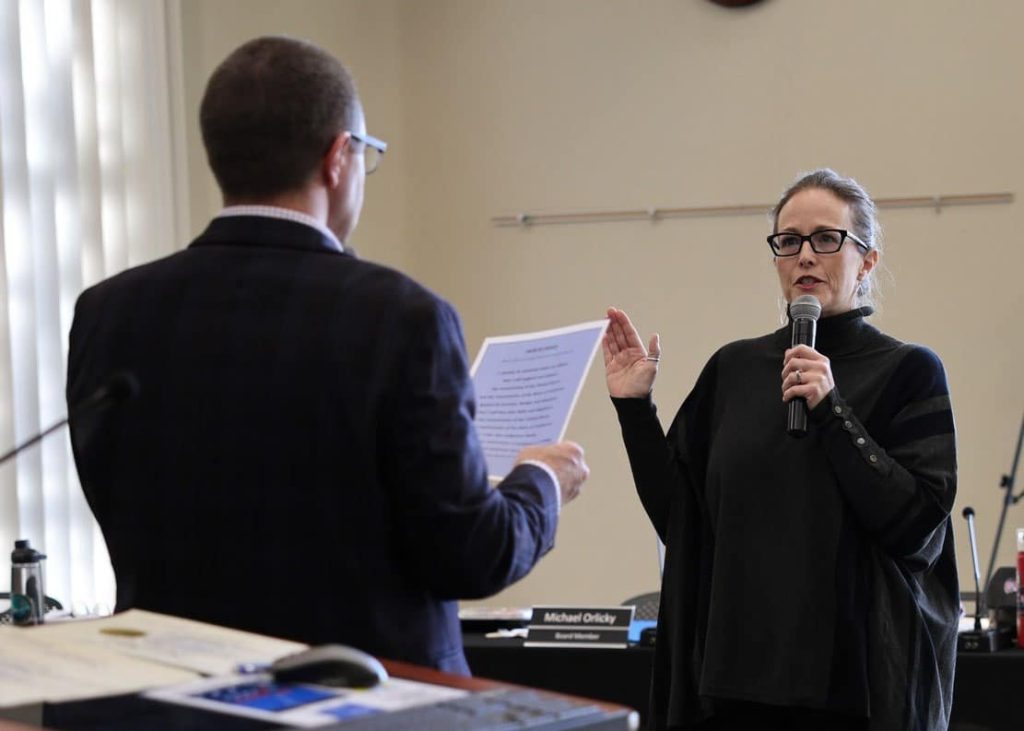
LaBarbera threw her hat in the ring to join the SCOE Board as an elected trustee back in 2024. She led a successful campaign that November, securing the highest number of votes amongst a slew of candidates for three open seats.
Her victory immediately became controversial when LaBarbera made it clear she would take on the new SCOE role without stepping down from her seat on the Anderson Union High School District board, another elected role. In the coming months, questions emerged about the legality of holding both of these positions at the same time, including whether they were legally compatible. Under California law, two election positions are considered incompatible if one has direct supervision over the other, can audit the other or if the two offices present a “clash of dualities and loyalties.”
Backed by legal counsel, LaBarbera defied calls from some community members, along with the powerful California Teachers Association, for her to step down from AUHSD — staunchly denying that it was inappropriate for her to sit on two school board positions at the same time. She has noted that SCOE does not directly govern individual school districts, although it does maintain a role in some of their processes and financial oversight.
For about a year, little shifted. LaBarbera sat on both boards, occasionally recusing from decisions where she saw a conflict in her dual roles. Then in March of 2026, LaBarbera was appointed by the SCOE board president to fill a vacancy on yet another school board — the Cascade Union Elementary School District — after a wave of resignations left it without enough members to function.
Soon after, Carr, the former educator, filed an application for what is called a “quo warranto” regarding her dual roles at SCOE and AUHSD. It’s a specific legal action an individual can file against a politician with the attorney general’s office. Once filed, the state reviews both the quo warranto application and any response from the accused before determining a legal opinion about the two offices’ potential incompatibility.
Yesterday’s opinion from the attorney general’s office grants Carr the right to sue LaBarbera under the guidance of state prosecutors. A superior court judge would ultimately decide whose argument carries more weight, that of Carr — supervised by the state — or that of LaBarbera.
The state’s argument
The state’s opinion, which was written by Deputy Attorney General Heather Thomas, made the argument that AUHSD falls within SCOE’s jurisdiction.
She said that SCOE has oversight over AUHSD because it “ensures that all Shasta County school districts are fiscally responsible, providing financial oversight, accounting and payroll services.”
Thomas cited a past quo warranto opinion, in which the attorney general’s office determined that a dual membership on a charter school district board and county board of education were incompatible. Using that as a framework, Thomas opined that this legal ruling opened the door for serious questions about the compatibility of LaBarbera’s dual roles.
Thomas then responded directly to LaBarbera’s defense of her dual roles, including the school board member’s claim that she can recuse herself from either board as needed to address possible conflicts. That claim, Thomas pointed out, is an admission of the inherent possibility of conflict in LaBarbera’s roles, which would itself be enough to disqualify her — as the law doesn’t require that there must be a demonstrated conflict in the roles, saying only that the roles are incompatible if there “may” be such a conflict.
Thomas also took issue with LaBarbera’s assertion that taking legal action to remove the school board member from her role — when she only has a few months left in her AUHSD term — would be costly and serve no public purpose.
“We disagree,” Thomas said firmly. “There are months left in LaBarbera’s term with the School District Board, and thus the question of conflicting loyalties remains ongoing.”
LaBarbera’s legal defense claimed that Carr’s quo warranto was personally and politically motivated. It noted that in 2023, LaBarbera voted against Carr’s appointment to fill a vacant role on the AUHSD board.
In response, Thomas stated that the attorney general’s office does not attempt to determine the personal motivations of the parties involved, as any person is legally entitled to mount a quo warranto challenge regardless of their background.
Instead, Thomas wrote, “we focus upon the public interest as our paramount concern.”
Do you have a correction to share? Email us: editor@shastascout.org.
Comments (7)
Comments are closed.
Bet there’s bigger political fish to fry in LaBarbera’s large frying pan. Look for her name on some upcoming state-wide office.
So, LaBarbera actually holds three government positions simultaneously. The conflict of interest is immediately apparent to anyone who doesn’t share her political agenda. Shasta County Office of Education contracts with every school district in Shasta County. That dynamic places her on the board of the entity offering the contract and the one accepting it. Shortly after her election to the SCOE board, in her role with AUHSD, she voted to terminate the contract with SCOE that provided Community School status to Anderson High. She should have recused herself from that vote because of the conflict of interest, but didn’t. Was her choice political? I think so.
She was recently installed as a member of the Cascade BOARD because of mass quitting.
She’s a scofflaw, like all of her kind. Laws are valid and should be enforced if they protect her interests at the expense of others. Laws are invalid and can be ignored if they protect the interests of others at her expense. Their morality and political philosophy distill down to one core principle: Might makes right.
That district is a mess, partly because of LaBarbera and the Moms for Liberty lunatics. Thankfully, it seems to have run it’s course.
Selah
Good. I think this community has had their fill of her nonsense.
The Anderson Union High School District has held at least one votes recently to declare that LaBarbera is no longer a member of the board because she apparently has acknowledged publicly that she does not live in the district and has not for a year or two.
But only two members thought the board should follow the law as clearly spelled out in the Government Code that an office becomes vacant if the person holding it no longer lives in the jurisdiction.
Is it weird to expect a school board to follow black-and-white law?