
In Response to Proposition 36, Shasta County Sheriff Proposes Plan for New “Corrections and Rehabilitation Campus”
The Sheriff’s proposal would create a new low-security facility where people would serve time during the day while living at home. The proposal has broad support from supervisors but so far lacks critical details such as a budget and funding sources.

“Accountability” was the central theme of a new custody plan presented by Shasta County Sheriff Michael Johnson at the January 14 Board of Supervisor’s Meeting.
The presentation was listed on the Board’s agenda as a discussion of Proposition 36 but Johnson used the opportunity to float the idea of a new “Corrections and Rehabilitation Campus” that would create space for more people to enter Shasta County’s carceral system. An influx of new sentencing is expected under Proposition 36, which is also known as the “Homelessness, Drug Addiction, and Theft Reduction Act.
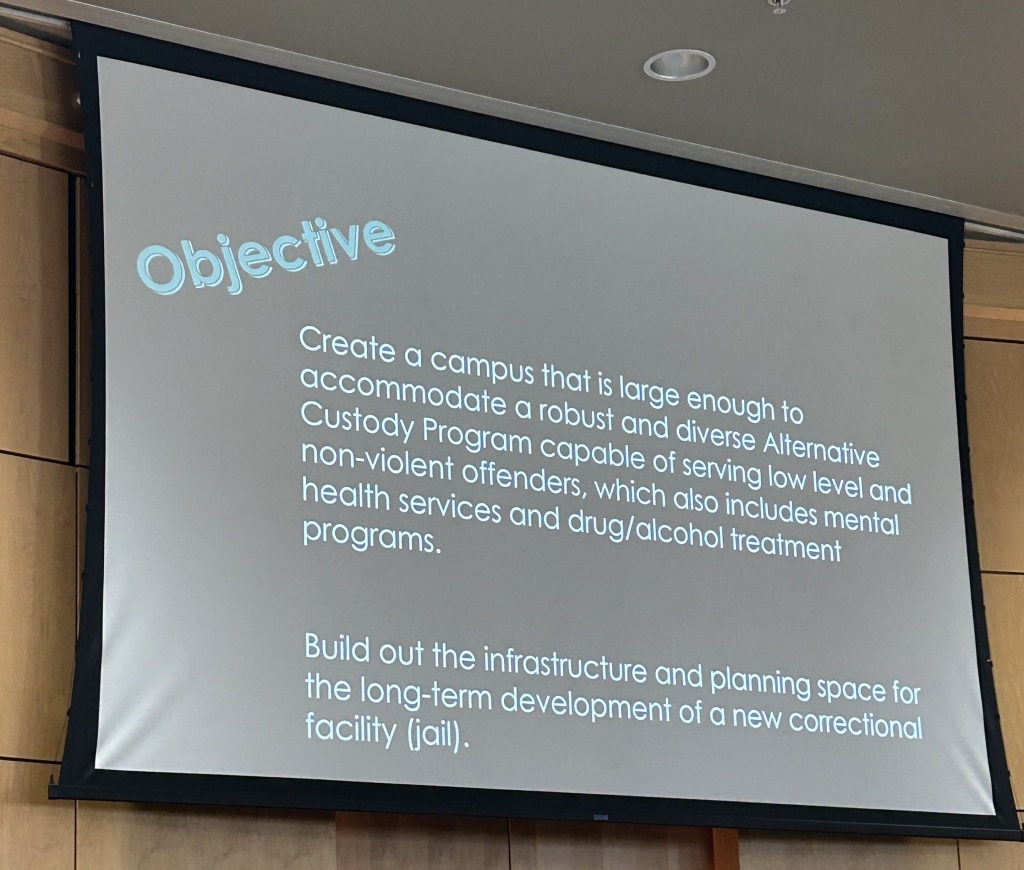
“The objective of this presentation is to create a campus that is large enough to accommodate a robust and diverse alternative custody program serving low-level and nonviolent offenders,” Johnson prefaced.
According to California’s Legislative Analyst’s Office, Prop 36 will increase California counties’ local criminal justice costs, likely by tens of millions of dollars annually. Concurrently, the law reduces the amount the State is required to spend on related resources such as mental health and drug treatment, school dropout prevention, and victim services.
The passage of the statewide ballot measure, which became law on December 18 2024, is the latest event to galvanize Shasta County politics around a familiar and recurring conversation: funneling more taxpayer money towards rebuilding and expanding an ailing jail system.
“One thing is an absolute, across the board,” Sheriff Johnson declared about Prop 36. “It’s going to impact county jails and it’s going to impact custody.”
Proposition 36 was supported by 81.6% of voters in Shasta County (and at least a simple majority in every County in California). It reshapes retail theft and drug related charges, increasing the classification of certain charges from misdemeanors to felonies.
Resurrecting elements of California’s three-strikes policy (which was amended by voters to address significant issues in 2012), Prop 36 recategorizes the formerly misdemeanor charges of both drug possession and retail theft of any amount under $950 as felonies, but only if the person charged has two prior convictions. For example, if someone steals a loaf of bread from a grocery store and has two prior convictions for certain theft crimes, they can be charged with a felony under the provisions of Prop 36.
The law also creates a new court process to charge some repeat drug offenses as “treatment-mandated felonies,” meaning those who agree to and complete treatment can have their charges dismissed. Otherwise they’re likely to face up to three years in a state prison.
As of December 2024, there were already 91,358 Californians behind bars. Despite California ranking 36th in nationwide per capita incarceration rates, the state still imprisons more people than almost every other functional democracy in the world. According to the California Public Policy’s January 2024 factsheet, about 76% of people incarcerated in County jails have not been convicted and are awaiting arraignment, trial, or sentencing.
Meanwhile, in-custody deaths are at historic highs across California, despite the fact that the State’s prison population has decreased in the past decade. An inevitable increase in the state’s prisoner population could certainly have financial and operative ramifications on the Justice system, yet the Prop 36 makes no financial provision to support new County infrastructural demands.
Johnson did not specify what “nonviolent, non-serious offenders” he foresees serving out their sentences in the proposed alternative custody program. While those sentenced under Prop 36 may indeed have committed a non-violent and non-serious crime, they will be classified as felons under California law.
In Shasta County, pleas for a new jail have served as a catch-all solution to Shasta County’s crime, sheltering, substance use, and mental health crises for years. The task has added resonance now.
According to Briona Sisneros, a Community Education Specialist for the District Attorney’s Office, the County has filed 31 new cases under Prop 36 since the law went into effect in mid-December. So far, those cases have resulted in two felony convictions with the other 29 still pending.
During his presentation yesterday, Sheriff Johnson first acknowledged the pressing demand for more jail beds, before assuring the Board that his presentation would focus on something different.
“First and foremost, the number-one option that is best for us to deal with our incarceration and accountability problem in this county is either a new jail or expanding beds,” he began. “That is the option that we all wish we could proceed with.”
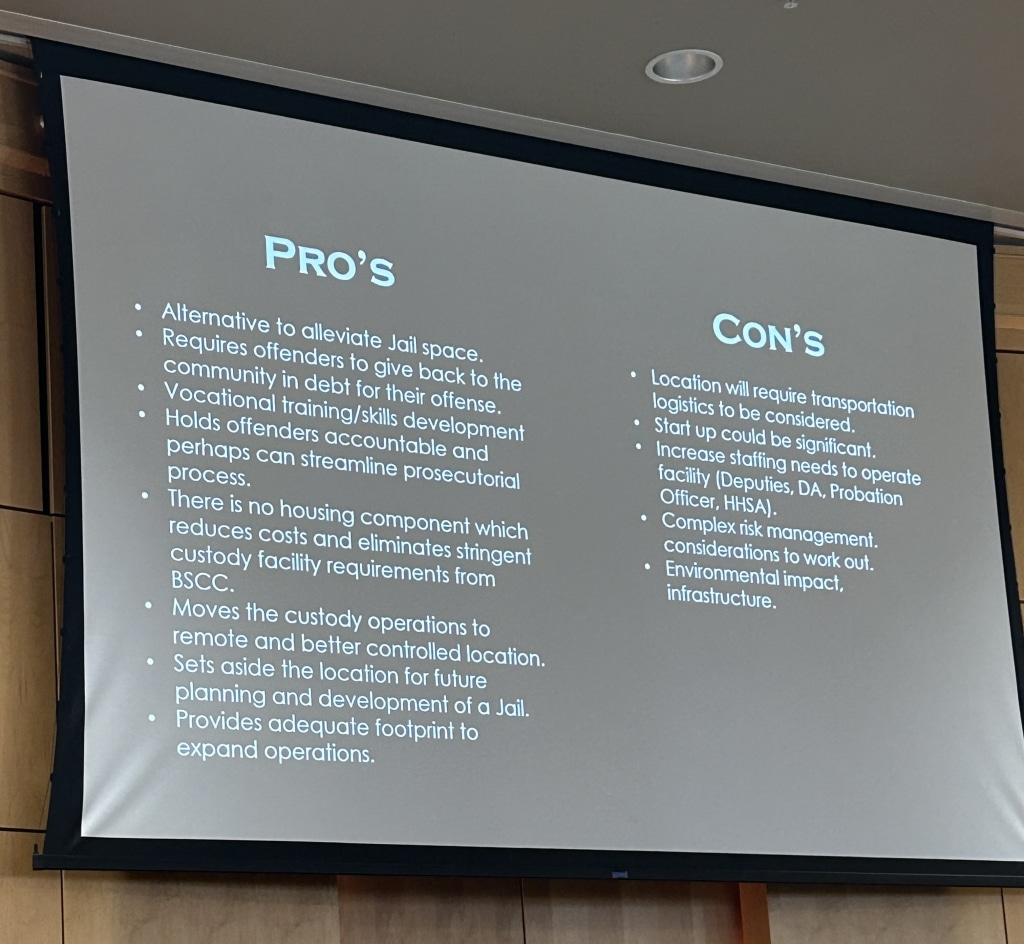
Given that there’s simply not enough money to support that effort, Johnson’s loose proposal expanded upon the County’s existing Alternative Custody Program (ACP), through which incarcerated people provide labor to clean up cemeteries, maintain roads, and grow fruits and vegetables to help offset the jail’s operating cost.
“If we can double, triple, quadruple that farm, it would be phenomenal,” Sheriff Johnson remarked.
Sheriff Johnson’s alternative custody model would ostensibly redirect people who have committed low level and non-violent crimes out of overcrowded jails toward a physical campus where they would participate in a number of vocational training and community work projects, which would potentially include farming, hazardous fuel reduction, wood cutting, a culinary program, and an auto mechanics program, among others.
As to where such a facility would be located, Johnson said he spoke with Redding City Manager Barry Tippin about possible locations for the proposed campus–but reiterated that Tippin “did not make any promises” about allocating City properties toward Johnson’s project.
The Sheriff presented three possible location options, including his favorite, a 90-acre parcel located off Route 273 close to Redding’s wastewater treatment ponds, and abutting the Sacramento River, at 7251 East Side Road.
While Johnson provided specifics related to location details, he offered little in the way of financial information to back the plan. He explained that the current ACP’s operating budget is $3.68 million annually which is used to provide programs for “100 people… at any given time.”
Those numbers indicate an average annual cost per person of just under $37,000. Johnson did not cite a start-up cost for proposed new site, an annual operating cost for the associated facility, or any estimate of how many individuals would be placed there.
His proposal also included on-site mental health and substance use services although he emphasized that such services, and the financial sources that could potentially help pay for them, are “not in my wheelhouse”.
One supervisor asked about the use of Proposition 1 funds to support the development of mental health services for the project. In response to a question after the meeting, Deputy County Executive Officer Erin Bertain told Shasta Scout “there might be some opportunity to use Prop 1 funds for the treatment part of the project, saying, “it will certainly be one of the areas that we’ll look for potential funding.”
Supervisors could also seek to tap opioid settlement funds, which can be used to expand substance use treatment in jails, to cover portions of the ACP budget, Bertain said. She specified that opioid funds cannot be used for any portion of the programs that have to do with criminal enforcement.
“Opioid funds also could not be used for training programs,” Bertain wrote by email, “unless those programs were for individuals recovering from substance use disorders. There is some ability to wrap services around individuals who are in recovery to help them advance in their life (i.e. housing) and training programs would qualify.”
One of the proposed benefits of Johnson’s ACP expansion is that it would “allow families to stay together” and “jobs to be continued so an offender’s financial obligations may be met.” Details such as how they would reach the facility each day if they lack transportation; if and how those serving time in ACP will be compensated for the work they perform; and how many hours they would work per week, were not mentioned.
Another clear concern, whether people will show up to the facility as directed, was addressed briefly by Johnson. He said he’d send out a team to find and arrest those who don’t. The statement leaves questions about how the County would then incarcerate people who evade their time in ACP, given the jail’s lack of available bed space.
While the Sheriff’s proposal provided little more than a hopeful vision, Shasta County’s five-member County Board enthusiastically supported the idea. Supervisors Kevin Crye and Chris Kelstrom offered the strongest statements of approval.
“Have you ever seen Jerry Maguire when they said, ‘you had me at hello?’” Crye asked the Sheriff before he had even finished his presentation.
“You had me at hello.”
Do you have a correction to share? Email me: editor@shastascout.org.
Comments (9)
Comments are closed.
Related Articles

Updated: Brooke Fire grows to 366 acres
Evacuation orders and warnings are in place for almost a dozen zones across the Bella Vista area.
Two Forest Service employees released safely after 15 hours held hostage in Shasta-Trinity National Forest
After a long standoff yesterday, two Forest Service employees being held hostage at Gumboot Lake in Siskiyou were safely released. Local agencies in Northern California, alongside law enforcement agencies across the state and nation, worked to respond to the crisis.

A third of Shasta’s jail deaths in recent years have been ruled suicides. A policy change could save lives
Two dozen people have died while incarcerated at the Shasta County Jail over the last six years. A review of postmortem investigations indicates more intensive monitoring of high-risk individuals could prevent deaths.
so, I am wondering if the opioid funds awarded to Shasta County could help with a program like the Sheriff is suggesting. I haven’t really heard much about what the final resolution was as to what programs Crye deemed worthy.
Justme: Yes, from what Shasta County Deputy CEO Erin Bertain said (documented in our story) those funds could possibly help with a project like this.
What a crappie idea. We are sick and tired of this kind of lenience for criminals. If 71% if current inmates are awaiting trial, put the money toward the prosecutions and get them done. Anyone who is on his or her third conviction needs to be in jail or prison. Make the state reopen the minimum security prison in Susanville. At least that prison had training programs, including firefighters, for the prisoners. Incarceration during the day is ridiculous.
Marilyn: Your point is taken. I would point out that people who are arrested are not yet “criminals” or “convicted”. They’re innocent until proven guilty. A right to a speedy trial is a foundational American principle, however what the justice system views as speedy and what we do are two different things.
This sounds very similar to what Siskiyou County has done. It was a community service program operated by the Sheriff’s Department. The inmates did cleanup along the roadsides etc. I think the difference was, these guys were incarcerated at night at the jail. I have often wondered why we don’t have such a program here in Shasta County. Our roads, for example, along Airport Drive, are so littered and unsightly. I understand we taxpayers pay $30K per homeless person each year in Shasta County. I think that is a lot of money and we need to take a good look at where that money goes and how it is used because something is not working.
Barb: The cost of not housing people (in ER visits and police response) is often higher than the cost of housing them, which I have always found of interest, although most in the unsheltered community require some kind of specialized support which is an additional expense. Housing people in prison facilities is usually the most costly option, estimated at an average cost of $133,000 per person per year in 24/25.
Keep what we have and use it. No more spending. No more debt and excuses for debt.
Leniency and fluffy little rehab rehabilitation ideas is what has gotten us to this point. Criminals know when they’re amongst sheep! We need serious Incarceration and a jail four times larger than you think! The community can have gracious and inviting idea ideas for law abiding citizens, but it should be exactly the opposite for criminals! We can’t put up with this liberal left bullshit anymore! Throwing good money at bad ideas is precisely where we are today.
Typical MAGA response. The Sheriff is intelligent enough to understand the problems, and develop a very good goal with clear objectives towards a solution. But Mr. Stadille, perhaps you can explain this.
Like mist citizens in our county, MAGA is very concerned about crime and criminals. Correct? So how is it that? MAGA supports and voted for a convicted sexual abuser that a judge actually called a rapist, and a 34 count convicted felon criminal for any office, let alone president of the United States? Seems a bit hypocritical there buddy.