
Underground Good: Ray Van Diest
“Public libraries serve all people without distinction. I speak in grandiose terms, but I really believe this: libraries help sustain civilization.”
Ed Note: This Opinion piece is part of our Underground Good series, which focuses on providing a window into the mindsets of ordinary people doing good work in their community. It’s written by sociologist, coach and consultant Sharon Brisolara. You can find the rest of our Underground Good series here. Want to nominate someone? You can do that here.
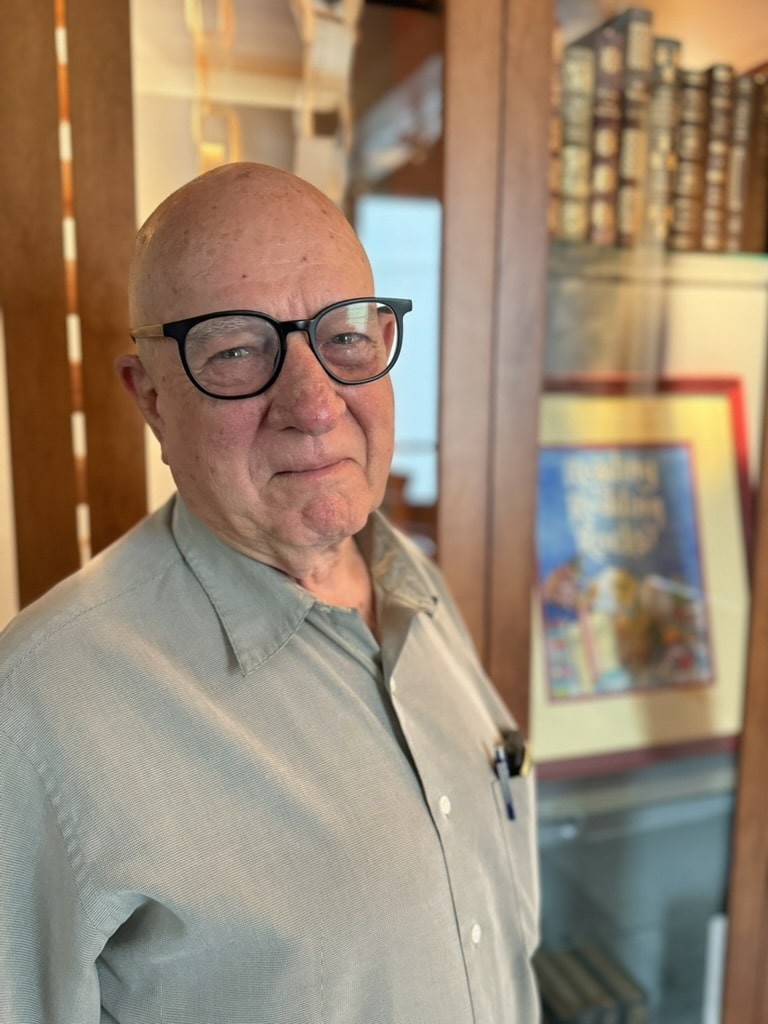
You may not know Ray Van Diest, but if you use the Shasta County Library or one of its many services, you have likely benefited from his work. After years of service first as a teacher and then in various staff capacities at libraries in California and Arizona, Ray has retired – although it might be more appropriate to say “rewired” – and become involved with the Friends of the Shasta County Library (FOSCL), where he currently serves as President.
When we spoke, Ray’s good humor and passion for learning were palpable and I got the sense that his involvement with FOSCL went deeper even than the activities he shared. I left our interview inspired, ready to apply for a FOSCL membership, and with a connection for books for my family’s Little Free Library. That’s really the hope of this column, to connect with the goodness that surrounds us and to feel moved to take small steps towards expanding the good we do in our daily lives.
May you, too, come away with ideas, resources, and a growing sense that there is much good happening around us, beyond our awareness.
Ray, we usually begin our conversations by having people introduce themselves to our readers in whatever way they wish. What would you like to share about yourself?
I’m a recovering schoolteacher of some 40 years. After teaching, I became a librarian. At first, I was a school librarian on the Navajo Reservation in Arizona. Then I found a job in Redding, California as a children’s and youth librarian for the Shasta County Libraries.
Those were the happy days before the California state budget went over the cliff and the library in Redding closed – in 1989 or so, near the time the Berlin wall fell. This was also shortly after some students at Shasta High had firebombed the school’s administration building, and burned the school library to the ground, following a football game in the late 1980s. Fortunately for me, one of the principals in the Shasta Union High School District waltzed in the door and asked me to apply for a job.
I was hired to assist Gwen Knaebel, the SHS Librarian, in the bibliographic work of rebuilding the Shasta High School Library. That was an exciting prospect. When I worked in Arizona, someone had firebombed the Monument Valley High School (MVHS) administration and library buildings, too. Since I had experience of reassembling the MVHS library under my belt from about eight years prior, I had some knowledge of the complexity of the job.
All in all, I spent 40 or 45 years in the classroom and at library reference desks before I retired. Libraries and education have stayed in my heart, though. I’ll probably never recover from that; it’s a lifelong passion with me. The older I get, the more I realize that whatever future our species has on this planet depends tremendously on nurturing the young. Nurturing the old is important, too, but the young are the ones where I think it’s most important, existentially speaking.
So I pitch in now, volunteering to help a 501(c)3 nonprofit called Friends of Shasta County Libraries or “FOSCL”, which sounds like “fossil” – kind of like me! I pitch in with helping run our Saturday sales; I spend time behind the bookstore cash register, and I help sort donated books as they come in, for resale. It’s a lot of fun for me and it fills in the time.
The older I get, the more I realize that whatever future our species has on this planet depends tremendously on nurturing the young. Nurturing the old is important, too, but the young are the ones where I think it’s most important, existentially speaking.
Ray Van Diest
Can you tell us a little more about FOSCL? I think a lot of readers will know that it exists but may not really know what the group does.
We’re a small nonprofit organization with about 260 members. Annual dues are anywhere from $15 for students and seniors, up to $25 or $30 for families.
We raise most of our money through our first Saturday of the month book sale, our bookstore sales, and gifts from generous donors from the community. The money we raise helps extend public library services by supporting library programs such as the Summer Reading program, literacy programs and various adult programs. We use the funds to what we can to enhance local government budgets for libraries.
There are many other volunteer duties at the library aside from what FOSCL members do. I don’t know how many full-time equivalent hours volunteers contribute to the library overall, but it’s massive. Jobs like shelving and sorting and repairing books definitely contribute to the library’s effort to serve the public.
Given your experience, what do you see as the role of a library in a community?
A library is basically an educational institution rooted in the community. Schools, of course, are our first line of educational defense, but they can’t do everything.
Public libraries serve all people without distinction. I speak in grandiose terms, but I really believe this: libraries help sustain civilization. They show a basic faith in the human ability to learn and to adapt. Libraries provide resources to help people learn about whatever topic they are interested in. It might be romance novels or it might be nuclear code. Whatever motivates an individual to want to know something or to entertain themselves, libraries help sustain that impulse in humanity. To me, learning is the only salvation we’re going to have moving forward in these fraught times. You can’t stick your head in the sand, you need to go forward and face the challenges that humanity must adapt to and overcome.
There is definitely also entertainment in the library. I find myself less and less able to decide what to consume in television land. When I hold a book or listen to a book while walking on the River Trail, I have no trouble making that decision.
What are some of the other resources that the library offers?
The Shasta County Library Literacy Program provides tutoring in mathematics, history and government- whatever people need- as well as citizenship tutoring, where volunteers help people prepare for their citizenship exams.
Of course, everything depends on the student and some people are motivated while others aren’t. It’s exciting to see the light go on. I have only one student right now. but she is so encouraging. She’s a young lady in her early 50’s. That won’t seem so young to some people, but to me, it’s like being 20-something. She’s very motivated to learn English. She’s studying out at the college and tutoring in Spanish, and she plans to become a legal interpreter for people who don’t speak English very well yet. That’s important because in our country, not being able to speak English fluently has consequences.
How much or how often are you working with people who come into the library with questions?
I do answer questions for people when they come in or phone in. Sometimes they phone the bookstore but ask Shasta Library questions. I know enough about the Shasta Library to be able to answer basic questions: open hours and locations, stuff like that. I refer them to the reference desk if they have a research question.
You can get all kinds of odd questions. About 30 years ago, one young lady came in when I was working on the reference desk at the old library across town. She wanted to learn how to make a bear trap. It turned out that she had a boyfriend who was harassing her, and she wanted to make a bear trap to deal with him! I remember thinking, ‘What?!’ The trap I found for her involved tree log construction…not appropriate for your front porch.
Libraries have been in the news a lot with groups wanting to ban particular books or decide what content is available to whom. I’m wondering what you have seen related to that in Shasta County and your thoughts on that dynamic.
I got quite worked up in the fall of 2023 during Banned Books Week. I came into the library and saw the banned books displays and thought, we have got to do something about this. Thinking of it from a reader’s perspective or from my own selfish interest, I want access to everything. I don’t want someone else coming in and asserting their moral authority to tell me, ‘You can’t have this one.’
When I talked to someone in library administration, they said, ‘We’ve never had anybody try to ban a book in this library.’ And here we are a year later and I just asked again and the administrator said, ‘Nobody’s tried to ban books in any of the three branches.’
My attitude about school libraries is different – they’re the parents’ province. It’s not up to some outside moral authority to come in and tell me what my child can and cannot read. I will tell my child what to read if it’s important to me to do that. It should be the parents in control, not some random community member who thinks they know what is good for all children.
How do you address the concern that some people voice about individuals who are unsheltered gathering at the library? What’s the role of the library as an institution for all community members?
I have great sympathy with the unhoused and do not resent or fear them. The fact that people are living on the street says something about our society and how far we are actually willing to go to make sure that people are safe. All people, not just those of us with a paycheck. There may be erratic behavior, even here in the Shasta County Library. But we have a security guard, and it’s a safe place for housed people. It should be a safe place for the unhoused as well. If only we had 20 showers and beds where people could nap! But that’s not the library’s province.
I have heard the complaints. In fact, the library did a community survey one or two years ago and that was a concern. I hope I don’t prejudice anything by saying that quite often those complaints come from older adults – people who could be prey and feel they might have to be careful. I have to be careful, too. I’ve become afraid of heights in my old age. So I understand the feeling of being unsure and under threat. But the Shasta Library is a safe place, and the administration goes to great lengths to provide for safety here.
From your experience, when those who are low-income or unsheltered come here, how do they use the library?
A certain amount of sleeping tends to happen, but our security guards patrol both outside and inside the library. I fell asleep on the couch in the children’s room, I don’t know, two years ago, and the security guard had to rouse me and say, ‘Hey, you’re not allowed to sleep.’ I was just tired one day and sat down to read. So, it’s not just a certain demographic that can fall asleep here.
There’s a jigsaw puzzle on a table over there, and people come to work on it. Some come in to look at the newspapers and magazines or read books in their favorite section of the library. I’ve even seen people writing. Literacy still exists! And some of them come in to freshen themselves up a little bit in the restrooms. The janitorial staff goes to great lengths to keep things clean in that regard.
Libraries provide so much more than books. What services or programs are offered by the library that people might not know about?
I’ve embarked on a language learning journey as a form of mental calisthenics because I’m forgetting a lot of English words. I use Duolingo to learn Italian and French, and the library added a similar app called Mango – where I started Latin a couple of weeks ago. I’ve always wanted to learn Latin. They even have Greek, but then you’ve got to make a choice between the ancient Greek of Homer and Socrates and Demotic Greek, which is spoken by the Greek people. I had trouble making that choice, so I went for Latin.
Recently, someone from the Redding Area Bus Authority (RABA) came to our Library Director, Jared Tolman, and asked if they could have books to create little free libraries in their buses. They brought us some baskets. Each metal basket holds about 15 books and each bus – about 40 – has a little free library at the front of the bus. During the last four to six weeks they have replenished those little free libraries on buses with over a thousand books.
Do people bring in books when they take one?
Not necessarily. They’ll take them. Which, bless them – good for them! We have a whole wall of Little Free Library books in the back workroom that those with verified Little Free Libraries can come in and select from for their box. RABA has gotten into that and has created a very successful program to get books out into the community.
If people were interested in learning about volunteering in the library, what would you tell them?
There are opportunities at both the library and with the Friends of Shasta County Libraries (FOSCL). FOSCL has an organizational website with a button on the homepage that says volunteer. You can click on that button and you get a form to fill out with your name and contact information.
FOSCL volunteers sort incoming donations for the sales that happen the first Saturday of every month. There’s a continuing need there. You can also volunteer behind the cash register. People of a certain advanced age tend to be our board members, so there’s a continuing need for more of them because sometimes the ox goes lame and can’t work anymore. So, we have board member positions, too.
The Library Foundation is another group which is working to put together an endowment for this library. Among the ways they do that, other than asking for donations, is to sell donated books of higher value, say, $20 and above, through Abe Books.
You can also sign up to volunteer for the library. If you would like to be a Storytime volunteer in Anderson or Burney, you can apply to do so by filling out that form. You can volunteer to shelve books too. We have a lot of circulation going on, and our volunteers are the main ones who re-shelve the books. There is some training: you’ve got to know the alphabet and understand categories.
There is also an interesting table in the back work room that’s a book repair station. People train in basic book repair and construction and extend the life of some of the books that we don’t want to buy again. That’s good. And there’s an open volunteer position in the library for a computer class assistant.
What does it mean to you to be part of supporting the county’s library?
It means there’s hope for the future in the present political climate. I tend to get very discouraged, but the library, for me, is a place of hope for the future. I remember thinking when I was in high school, ‘Man, the adults have really goofed this world up. My generation is going to do a better job.’ Well, here we are. I’m putting all of my bets on the children and the youth. They’re the ones who will continue humanity.
I just took a trip to the Canadian Rockies, and I realized again that, in geological terms, we’re here for a second, and then we’re gone. We think we deserve to be eternal, but we’re just here for a very small time. Our lives are, in a sense, in geological terms, insignificant. Humanity is worth saving. And libraries are, for me, the hope of saving humanity, where once someone graduates from high school, if they want to go on to university or not, that’s their choice. But if they have some bright idea to invent a new mousetrap, they can start their research and inquiry in the library.
How can coming to a library and selecting books contribute to that development of curiosity?
Curiosity can develop anywhere if you’re lucky, and sentient and aware. But coming to the library also doesn’t necessarily have to always be that utilitarian. I think that the spark of hope is there. Some people, all they want is to read that detective novel or adventure story, and that’s fine. There are billions of us on the planet, and out of those billions, some percentage will catch onto some salient subject and pursue it. But it doesn’t throw shade on the rest of us who are just out there enjoying life.
I write book reviews for the Friends of the Library’s quarterly newsletter, so I do a fair amount of reading. And I have a friend I read out loud to, who interrupts me with questions I can’t answer.
Is there anything I should have asked you that I didn’t, or anything else that you would like to say?
Just making the connection that libraries are an extension of education. That’s a very big subject, and it’s important. We pay too little attention to it. My humble opinion is that schools are the truest defense department and should get more of the billions that go to missiles and guns. I understand the need to protect the world, but real protection is going to come from intelligent people inquiring into the future, and libraries serve as a place where that can happen.
Do you have a correction to share? Email us: editor@shastascout.org.
Author

Comments (6)
Comments are closed.
Related Articles
Underground Good: Sara Hoxie
‘Will had so much energy and love to give. He’d walk into a room, and his personality would drive everything there. He kicked up a lot of dust, and we’re just not going to let that dust settle.’
Underground Good: Enora Ilboudo
“Aside from clothes and food, sometimes we’ll hear from people who don’t feel connected to their families or need to talk to someone and don’t have anyone else they can go to. People are finding their community here at the center and that keeps me motivated when I’m working here.”
Underground Good: Steve Woodrum
“As a poll worker … you notice that many people, when they come through the doors, all of a sudden, they change. They become more dignified. You can see that they are getting ready to vote, and they rise to the occasion.”
Thanks for this good news! Just what we need.
This is a very heartwarming article. Thank you, Sharon Brisolara, and thank goodness for the wonderful people who fund and run the Shasta County Library (and libraries worldwide) and for folks like Mr Van Diest. And yes, education is the best defense of democracy and should be funded aggressively!
Just one thought. Ordinary people? Nope. One of the biggest mistakes we all make is labeling, well-meaning as it might be. folks are tired of being called “average, every day, or ordinary.” I also think that’s been a massive mistake of the so-called upper echelons of the so-called “Left.” We are all “exceptional” in our own way, sometimes good, sometimes not so good.
Thank you for the warm read in troubled times!
Ray is a community gem.
What a wonderful man to have in town! We are lucky to have him at our library
What a wonderful article! A real adventure in spreading the bounty of the library! Thank you so much
Thanks for this article! It’s encouraging, and it’s also great to hear about Mr Van Diest. I remember him from the early 90s when my kids enjoyed stories with him and other interactions as well. Glad to know he’s still at work. It’s also great to know a bit more about volunteer opportunities. Keep up the good work!