
Library Literacy Program Expands Access to Learning Across Shasta County, Regardless of Background
The Shasta Public Library system provides a myriad of free adult services. Some cater specifically to immigrants as they work to acclimate to a new home.

“Where is your workplace?” Shae Darling asked her class of eight adult students, as they huddled around a table in the computer lab at the Redding branch of the Shasta County Library several weeks ago.
“My workplace is the street,” responded Aurelio Pachon Velasquez, a Colombian man in his late sixties.
“The street?” Darling responded, with a look of bemused skepticism. She rephrased the question. “What do you do, what is your job?”
“I drive Uber,” Aurelio said, indicating that technically, he wasn’t mistaken when he said his workplace was “the street.”
Darling used the opportunity to explain to the small class that the question of “where you work” shouldn’t be taken literally, as it’s just a different way of inquiring what someone does for work.
The process of teaching first-time English learners simple sentence structure reveals the subtle complexities that native speakers rarely consider. In tandem, the way Darling’s students grasp hold of the linguistic concepts of English is similarly informed by the different structures of their own mother tongues.
Her current students’ first languages include Spanish, Mandarin, Lao, Thai, Hmong, Nepali, Ukrainian, and Russian. For some of Darling’s South and Southeast Asian students in particular, English may be their third or fourth language.
Darling is an Adult and Family Literacy Coordinator at the Shasta Library. Her work is part of the larger statewide California Library Literacy Services program, which funds literacy and English language projects at libraries around the state.
Only 7.7% of Shasta County’s population speaks a language other than English at home. But that number still makes up approximately 13,000 local community members, many of whom may eventually seek out the services of Darling and her colleagues. For some, learning English one of the first and most important steps they’ll take towards becoming American citizens. Contrary to popular belief, the U.S. naturalization test requires a basic command of English, and exemptions to this rule are rare.
But the primary reason people sign up for Darling’s English classes is much more simple.
“They want to be able to talk to their neighbors. They want to be able to talk to people in the store. They want to be able to function in society.” Darling explained, pointing out how demoralizing the inability to express oneself in a new language can be.
Within every non-English speaker in Shasta County is an individual with a rich interior world, one that’s often lost in translation given their current context.
“Language shapes everything,” Darling explained to Shasta Scout during an interview a few weeks ago in a Shasta Library conference room around the corner from where she teaches.
For instance, Darling said, language structures how one visualizes the passage of time; in English, linearly, along a horizontal axis. This contrasts with Mandarin speakers, who tend to conceive of timelines as vertical, corresponding with their writing system. Language can also reflect whether a culture is generally more individualist or collective, depending on whether the subject or object in a sentence is prioritized, Darling explained, continuing to share language facts with fascination. There is no exact translation of the word “evening” in Spanish, for instance. And pronouns, she said, vary widely among different languages. In contrast to the limited use of he/she/they pronouns in English, some of the most widely spoken languages in the world have no gendered pronouns at all.
Indeed, scholarship has shown us how language actually works to construct reality, often in culturally specific ways. As an English teacher, Darling said, her own understanding of reality is constantly reframed through classroom interactions with her students.
“What I took for granted as being the way humans do things,” she reflected, “is not accurate.
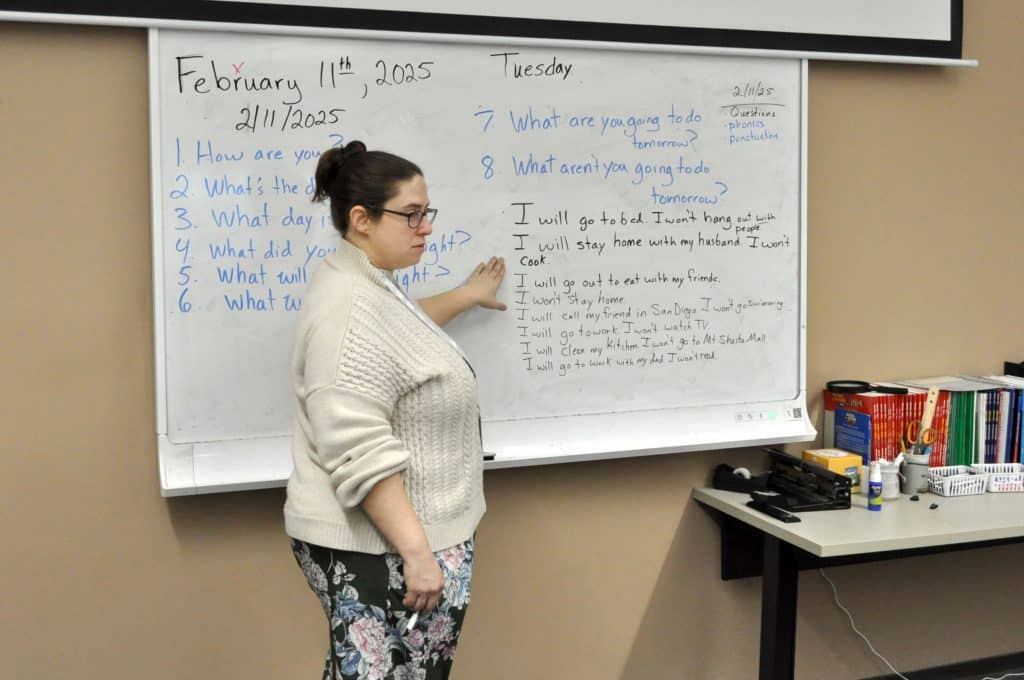
In class, Aurelio came across as unassuming, even shy, answering questions quietly in his beginner’s English. But when interviewed in Spanish, his whole personality shone through.
The entire family, Aurelio, his wife Elida Trujillo–69 years old–and his adult daughters Karen and Sandra Pachon, both in their 30’s, attend Darling’s classes every week. Karen and her mother moved to California from the verdant mountains of Montenegro, Colombia in 2015. Unlike the rest of her family, Karen is nearly fluent and became a naturalized citizen in 2022. Her father and younger sister Sandra joined them just recently, after nine years apart.
“We have been here for five months, and we’re really happy,” Aurelio said.
When asked why they decided to leave Colombia as a family, Elida said her daughter Karen “has an American heart.” She described the difficulties of finding work in her home country, where she says one needs the right “political affiliations,” or nepotism, to land a steady job.
Economic opportunity is among the top reasons people from Latin America immigrate to the US, especially from countries like Colombia that have been devastated by decades of the so-called war on drugs. Elsewhere in the region, millions of ordinary people have borne the brunt of chronic government corruption, civil wars (in tandem with CIA–backed coups and massacres), neoliberal trade policies, and US–led sanctions in Cuba, Venezuela, and Nicaragua.
Citizenship Tutoring
In conjunction with her English education, Karen also sought out tutoring for the naturalization test that’s required for citizenship. After her father and sister have lived here for the required five years, and reached a certain level of English proficiency, they plan to take the test as well.
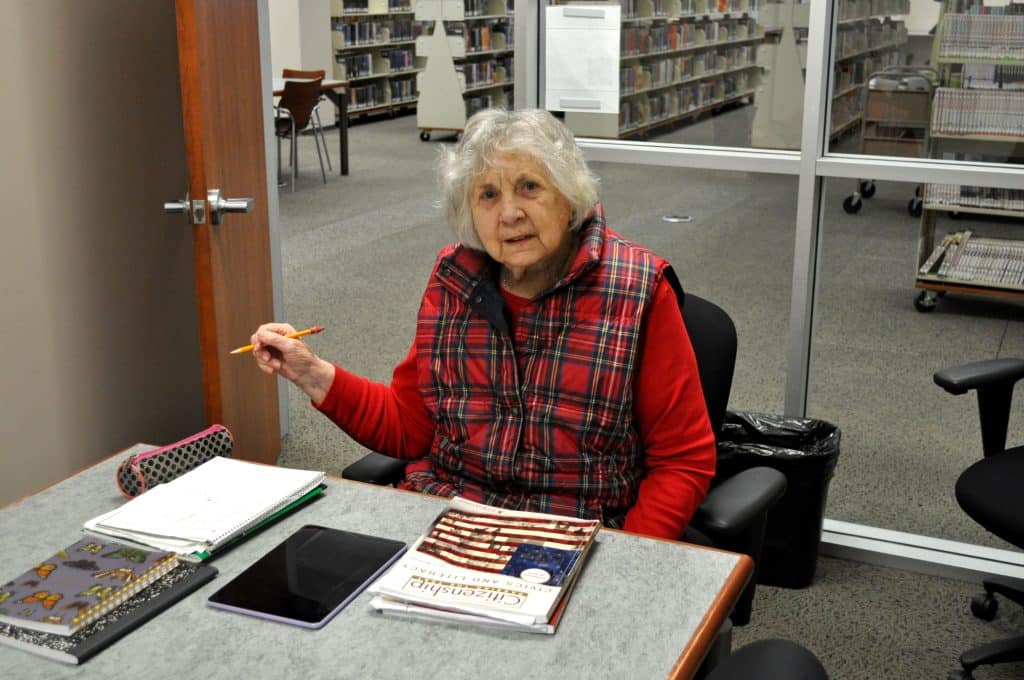
“I get livid,” said Juniata Bartalos, another library tutor, when asked how she responds to the misguided notion that the process toward becoming a U.S. citizen is too easy and widely accessible. She pointed to an iPad, exclaiming over how often she’s embroiled in political debates on Facebook. The 84-year old retiree’s volunteer role at the Shasta County Library is to prepare people ahead of their naturalization tests.
Bartalos, the granddaughter of Hungarian immigrants, moved to Redding 22 years ago from San Jose. “Coming from the Bay Area, I was used to having all kinds of people around me,” she said. Tutoring immigrants has been a way of retaining the diversity she found in the environment she grew up with. Like Darling’s students, Bartolos’ learners hail from all over the world. Given the difficulty of the United States naturalization test–not to mention the fact that it’s conducted in most applicants’ second or even third language–she believes that most Americans–born citizens would fail if they tried.
“Who wrote the Federalist Papers? Who started the first free libraries? Who did the U.S. buy the Louisiana Purchase from?” Bartalos chirped, flipping through her naturalization textbook as she read out some particularly obscure examples from the 100 questions someone may be asked when taking their test in Sacramento.
“I learn something new every time I go through this book with someone,” she said.
Investing in Literacy
While English language learners are among those served by the California Library Literacy Services grant, the program is also designed to provide critically important support to native English speaking adults who struggle with reading and writing skills for other reasons.
It’s work that’s consistent with the larger ethos of Shasta County’s public library system, Interim Shasta Library Director Julia Parson told Shasta Scout by email.
“Access to knowledge and lifelong learning are fundamental to a thriving community,” Parson explained, sharing the commitment of library staff and volunteers to expanding access to knowledge for all.
“By supporting adult learners we strengthen families, enrich our local workforce, and promote a culture of lifelong learning throughout Shasta County.”
Do you have a correction to share? Email us: editor@shastascout.org.
Related Articles
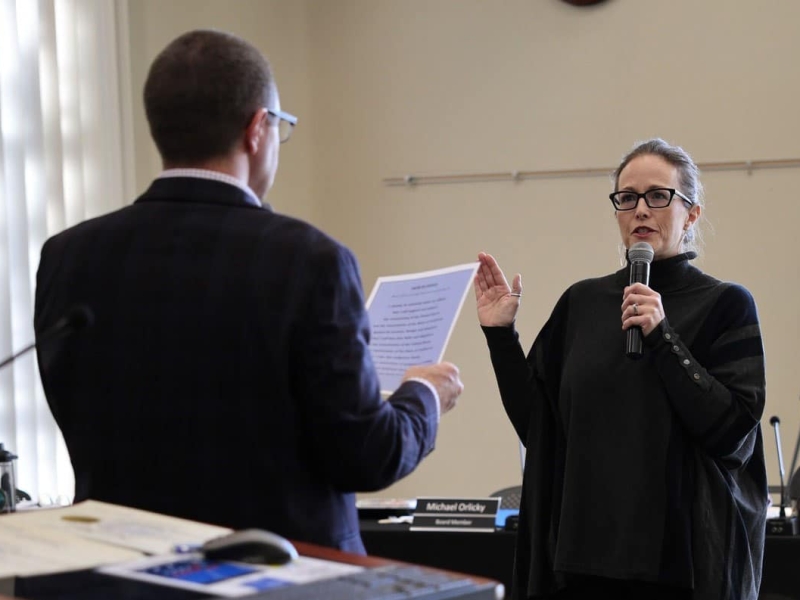
After most recent school board appointment, Jackie LaBarbera faces new legal challenge
A community member has submitted a legal challenge to the state over the dual roles school board member Jackie LaBarbera has held since January 2025. The challenge was submitted not long after LaBarbera was temporarily appointed to a third school board role last week.
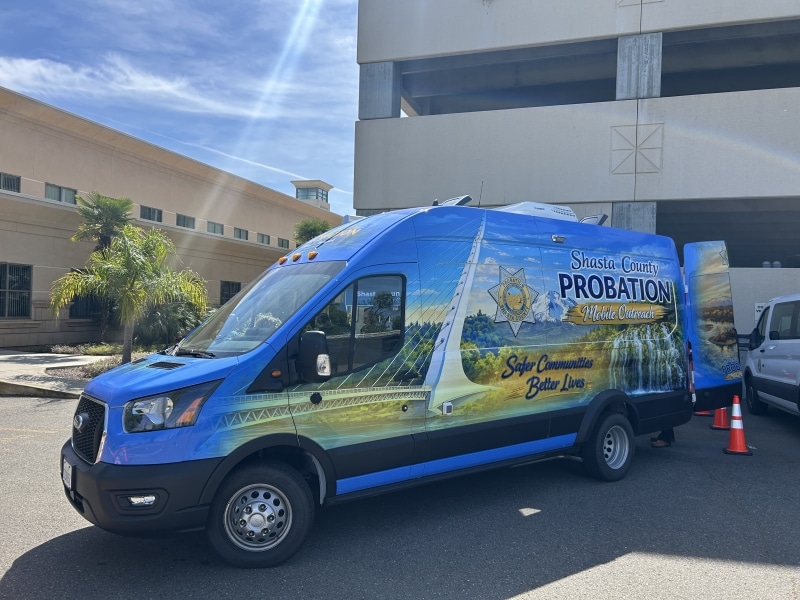
Shasta launches Mobile Probation Vehicle program to remove barriers for those living in rural areas
The MPV will be used to provide services to people who are unhoused or live in rural areas to help them successfully comply with the terms and conditions of their probation. It’s funded by a more than $280,000 state grant.
Shasta announces measles outbreak is over, 10th case was misdiagnosed
The Shasta County Health and Human Services Agency announced the end of Shasta’s measles outbreak yesterday. The outbreak contained nine cases total.