
Neighbors Fiercely Opposed to Hawes Farm Expansion as Board Considers Zoning Applications… Again
Greg and Nikola Hawes have been out of compliance with permitting at the property for many years. If approved, the dual zoning applications would do two things: help the Hawes finally comply with County law and give them permission to significantly expand.

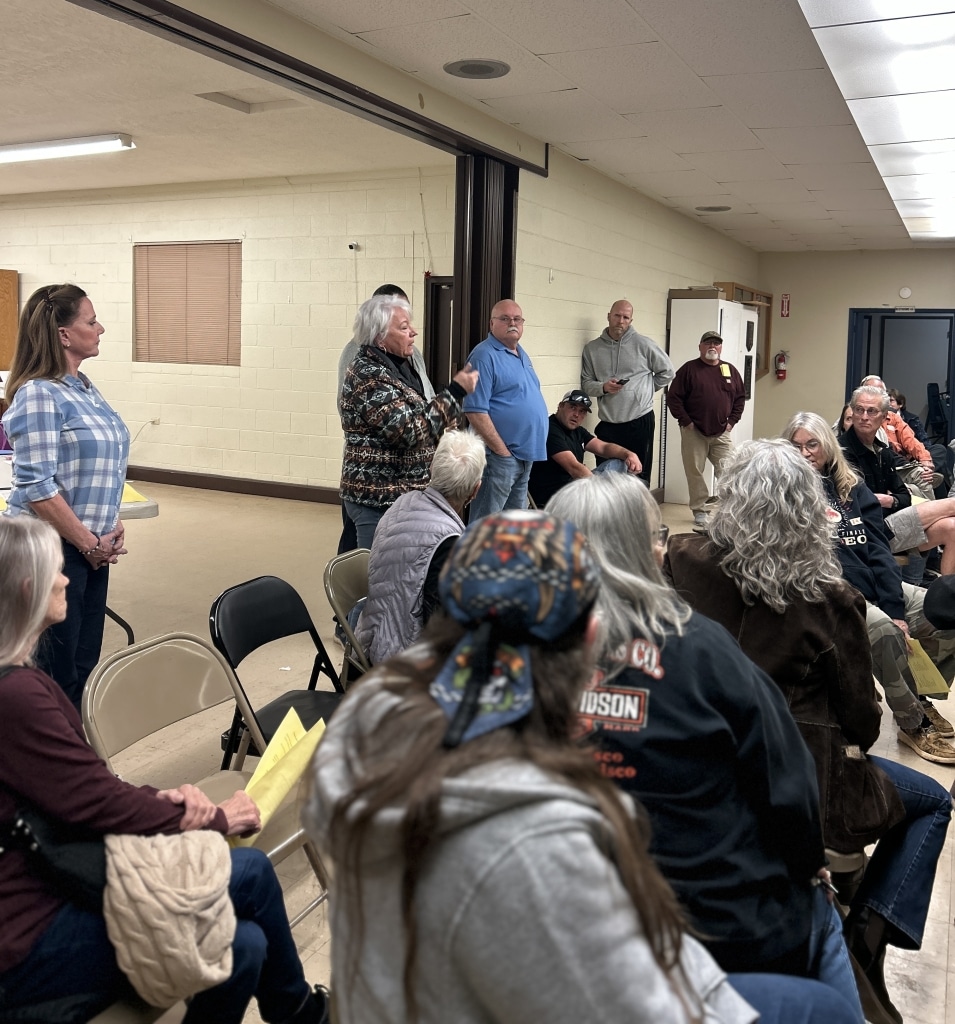
On January 30, about 60 community members gathered at the Grange Hall in Anderson to air their concerns about two zoning applications that will appear before the Shasta County Board of Supervisors this Tuesday, February 25
The applications are for property managed by Greg and Nikola Hawes, the couple behind one of Shasta County’s long-standing institutions. Hawes Farm, located near the intersection of Dersch and Deschutes, hosts a popular autumn tradition that includes a corn maze, pumpkin patch, and haunted house.
The Haweses hope to receive two zoning updates, one that would legalize their current eight-acre operation and a second that would authorize expanded operations on an additional 137 acres of the property, including some that edges the Sacramento River. That second zoning update would extend operating hours and allow the property to be used for concerts, music festivals, theme park activities (including rides up to 75 feet high), rodeos, overnight RV camping and a bed and breakfast.
Portions of the Hawes Farm operation have been out compliance with County code for more than ten years. At an August 2023 Planning Commission meeting Shasta County Assistant Director of Resources Adam Fieseler told Commissioners he was instituting a stop-work order to prevent ongoing violations at the farm that could affect the public’s safety.
But Planning Commissioners still voted 3-0 last August to move the farm’s dual rezoning applications forward to County Supervisors. Commissioners said at the time that they felt updating zoning would provide an opportunity for the County to better ensure zoning compliance. Neighbors have expressed ongoing concerns that the violations are an indication the Haweses shouldn’t be trusted with expanded operations.
County Supervisors are expected to make a final decision about the Hawes Farm zoning tomorrow, February 25. Last time the Board sought to discuss the matter was in October 2023. Three Supervisors recused themselves, making it impossible for the item to move forward. Since then, two of those supervisors have left office, but Board Chair Kevin Crye, who previously recused on the topic, remains. His stated reason for recusal in 2023 was that his company had business with Hawes Farm.
Hawes told Shasta Scout on Friday that he expects the Board to vote 5-0 in support of the zoning application, saying Crye should be able to vote because his former recusal was “just a misunderstanding” last time around.
“He was having a whole lot of people trying to recall him from the Board and it was just chaos in his life at that time,” Hawes said during a phone interview. “He was just afraid of making the wrong choice. It was to step aside and not create controversy… ”
Crye has not responded to Shasta Scout’s request to confirm or deny Hawes’ explanation, or explain whether he plans to recuse at tomorrow’s meeting.
How Do Neighbors Feel?
At the Grange Hall meeting in January, Hawes Farm’s neighbors expressed deep concerns about its possible expansion. Their tone was collaborative as they spoke to the two Shasta County Supervisors invited to the event, Corkey Harmon and Matt Plummer.
Neighbors appear united around two separate goals regarding the different zoning applications. They encouraged County Supervisors to green-light rezoning that brings the farm’s current uses into compliance. But they opposed new uses for the property or expanding the acreage designated for commercial use.
Hawes neighbor Mark Arsenault moderated the January 30 community meeting while his wife Lori Arsenault greeted people at the door and fielded questions from the back of the room. The Arsenaults live directly across the river from Hawes Farm. Like many others at the meeting, they repeatedly emphasized their support for the Hawes family and their interest in protecting good neighbor relations while reiterating their concerns about the noise, light, traffic and environmental impacts of an expansion.
Some, like Ginger Solido of the nonprofit Exodus Farms, are also concerned about fairness in how the County handles land use issues. Solido spoke at the community meeting, saying she operates her nonprofit for a meager nine hours a week and serves only a limited pool of participants, but still has to meet significant County land use requirements in order to develop her site.
“I am putting in a permanent bathroom… structure, because I can’t do my nine-hour-a-week farm program with a porta-potty”, Solido explained. “When I drive by Hawes and there are 20-something porta-potties lined up. That is not equity… it is (about) who you know.”
Others, including Lori Arsenault, worry that Hawes may sell the land at some point after it’s been rezoned. While that’s something Hawes denies any intent to do, many are not convinced.
“We also need to be aware that the other potential here is that he passes this rezoning,” Lori Arsenault said, “but then he sells off acreage to other corporations and conglomerates to make money,” she said. “Once that zoning happens, he is legally able to do that, and it’s a concern.”
Some community members are also worried about the lack of a significant environmental review. In July 2023, Shasta County’s Department of Resource Management produced a limited environmental review that concluded in a “negative declaration,” a term that indicates a finding that no substantial harm to the environment is expected by the planned development and thus the issue does not require further environmental studies.
The report says, among other things, that a bald eagle nesting site located 0.5 miles from the project is “unlikely to be impacted by the proposed project.” Shasta Environmental Alliance (SEA) Director David Ledger, whose correspondence to the County is included in the limited environmental report, says he found the County’s environmental analysis completely insufficient.
In an email to SEA supporters, Ledger summarized his concerns succinctly: “Terrible biological survey, does not meet CEQA (California Environmental Quality Act) standards.” In a lengthy letter to the Board, Ledger laid out his environmental concerns more in-depth, including that the biological survey was conducted in a single day, whereas CEQA requires multiple visits, including some during the appropriate growing seasons.

Greg Hawes Responds
When asked why his permitting isn’t up to date, Hawes had a variety of explanations. He told Shasta Scout some of his projects were initially compliant before state law changed, while others were “just temporary builds” that the County now wants to become more permanent. In other scenarios, Hawes continued, he complied with state permitting rules but didn’t realize he had to also follow County code.
Hawes said expanding Hawes Farm is necessary for its long-term viability, because the instability of farming these days means more of his business needs to rely on agritainment.
“Farming in general,” Hawes said, “the family farm… is dying out throughout the country. It’s hard to make it just farming from the dirt on a small scale. So, many people have gone to agritainment or other uses to keep their farms. That’s my reason for starting this — to be able to diversify to keep the farm in the family.”
Hawes responded to Shasta Scout’s summary of neighbors’ concerns by saying conversations like this “are a negotiation —nobody is happy in the end but it’s a compromise and I didn’t think there was any give and take (from neighbors) in the process.”
Mark Arsenault strongly disagrees.
“We’re supportive of the family,” he told Shasta Scout by phone today. “Hawes Farm is great for the school kids, it’s great for families that might want to come out for the afternoon. But we don’t want to see concerts, we don’t want to see overnight camping, we don’t want to see events up till midnight … and the neighbors don’t want to see this expand into a 147-acre amusement park.”
During the community meeting, Plummer asked the community members in the room what it would look like for them to be happy with the outcome of the Hawes zoning application. Most seemed to agree on the idea of keeping Hawes Farm much as it is, but legally compliant — a working farm with seasonal events as opposed to something closer to a theme park.
“I think keep it agricultural,” responded one woman who didn’t share her name. “My kids were raised going to Hawes Farm. And honestly, I think (the planned expansion is) a big slap in the face. This community has supported that family all these years, and now they want to turn it into something that Palo Cedro is not.”
Hawes’ rebuttal is that many of his neighbors’ worries will never come to fruition. He says County Resource Management staff told him back when he wrote up his proposal to ‘basically put in everything you can ever dream of…otherwise you’ll have to go back and do it again.’
“That’s why,” Hawes continued, emphasizing that he doesn’t have big expansion plans, “I put in there things that I don’t ever dream of doing but maybe my kids or my kids’ kids do. It’s very expensive to do these (planning processes) so that’s why I put all that in.”
Hawes also told Shasta Scout that the zoning applications are basically an all-or-nothing thing. Either the Board approves, or denies. The staffing report makes it clear that the agenda includes two separate applications – one for the current eight-acre operation and another for the 137-acre expansion – which could receive different votes from Supervisors.
Do you have a correction to share? Email us: editor@shastascout.org.
Author

Related Articles

Newly launched bus line will connect Shasta riders to Sacramento
Gold Runner’s Route 5 will expand local riders’ accessibility to Red Bluff, Orland, Williams, the Sacramento airport and Sacramento itself. From there, a wide variety of travel connections are available.

Shasta elections official’s claims stir agitators, prompt more county pushback
Claims made by Shasta ROV Clint Curtis over recent weeks, including references to “suspect ballots,” have prompted a few local supporters to push for action from both the sheriff and the federal government.

With impending departure of finance director, Redding sees yet more turnover in city leadership
Yesterday the city announced Greg Robinett is vacating his role as finance director, but will continue serving in his elected position as Redding’s treasurer. This is the fifth vacancy to emerge among Redding’s government leadership this year alone.