
New Wolf Pack in Shasta brings California Total to Ten Packs
The new wolf pack is confirmed to have at least two wolves.
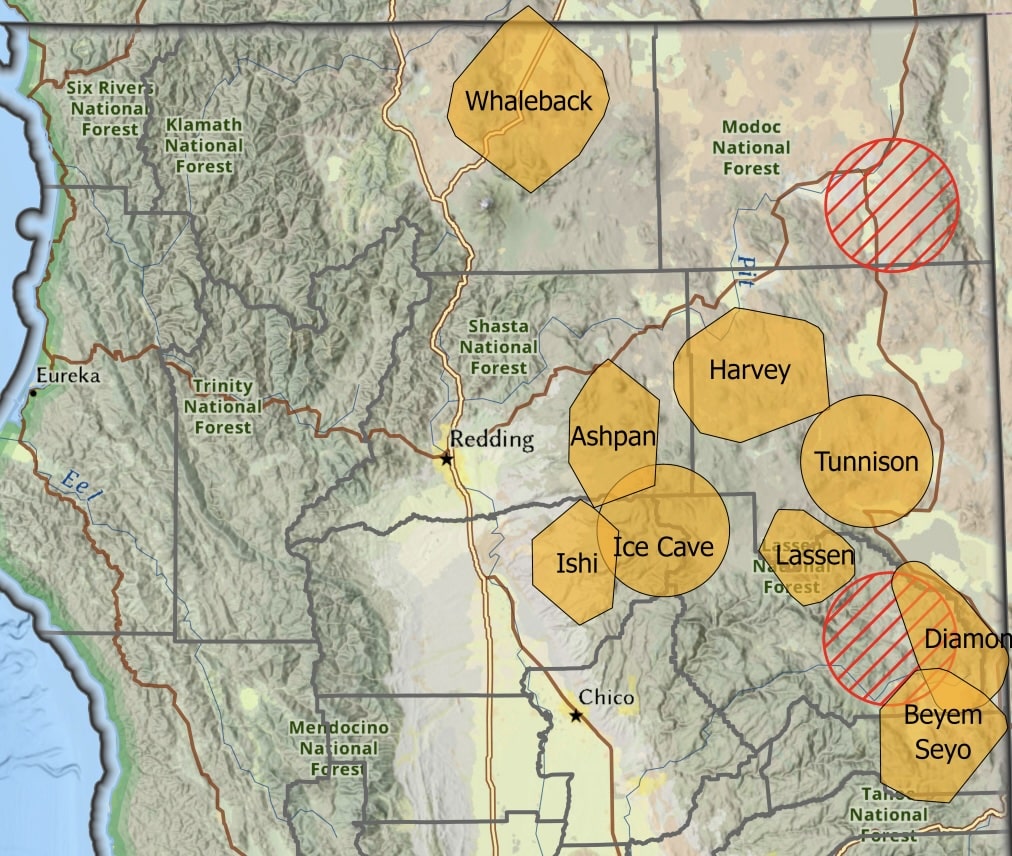
On May 27, the California Department of Fish and Wildlife confirmed three new wolf packs in California. They include the Ashpan Pack in Eastern Shasta County, which consists of at least two wolves.
The other packs are the Ishi Pack in Eastern Tehama and the Tunnison Pack in Central Lassen. Atogether, the new packs bring the total number of wolf packs in California to 10. Fish and Wildlife officially labels wolf groups as packs after detecting two or more wolves in a specific area within six months, or recording evidence of breeding. The three newly defined packs each met this criteria during the first quarter of 2025.
Fish and Wildlife’s Wolf Management Update for the first quarter of 2025 also identified additional areas of new wolf activity that are being monitored in Modoc and Plumas counties but do not yet meet the definition of packs. The department is also surveying areas of suspected wolf presence in Butte and Kern counties, informed by reported sightings, potential livestock kills, DNA and tracks.
California’s localized extinction of wolves occurred around the 1920s, from human hunting. In 2011, a gray wolf crossed into the state from Oregon reestablishing the presence of wolves in California and in 2015 California’s first modern wolf pack was identified.
While Fish and Wildlife monitors gray wolves in California, the state was not responsible for reintroducing the species to the region. Instead, the establishment of new packs and the entry of new wolves into the state are part of a natural process known as “dispersing.” Wolf packs typically only have one breeding pair, so as pups mature they leave to find a mate, either joining or starting a new pack in a new geographic area.
The announcement of newly identified packs in the state follows an update from Fish and Wildlife on May 15, sharing a new mapping system to help inform the public of last known wolf locations. The system is intended to help livestock producers know if a tracked pack may be in their area.
On May 13, the Shasta County Board of Supervisors voted to declare a county-wide state of emergency due to perceived safety threats from the presence of gray wolves. Two cattle have been killed by wolves in Shasta this year, and one injured. Wolves rarely approach or attack humans, in the last 125 years, only two humans have been killed by wolves across all of North America.
Do you have a correction to share? Email us: editor@shastascout.org.
Author

Comments (5)
Comments are closed.
Related Articles
As gray wolves reemerge in Shasta, humans look for ways to address threats to livestock
Long eradicated from Northern California, gray wolves are reappearing — but their new habitat also means new threats for ranchers whose livestock provide easy prey. Efforts are being made at the county, state and federal levels to find solutions that allow for coexistence between people, their livestock and wolves.

Shasta board removes Kerns as planning commissioner amid contentious debate
County Counsel Joseph Larmour said Planning Commissioner Steve Kerns was being removed without cause. Supervisors who attempted to delve into what was behind Kerns’ removal received pushback from the county’s attorney.

Council members make clear: No plans for data center in Redding
After Circle 6 Consulting recommended the council consider a data center project in Redding, council members expressed their disapproval of such a plan. There’s little word yet on how the efficiency study Circle 6 produced will be used by the council to improve city finances.
Thank you for letting me know where the wolfpacks are. I have an unregistered 30-06 that grampa left me when he past. Also, wolf meat is good in stew. I have a great native American recipe.
Jen writes, in part, “I have seen firsthand cattle left to die after they were missed in a round up, at least three died one-year because they got stuck in the mud at the banks of the only water source available to them. ”
Perhaps we should declare negligent ranchers to be a “county wide state of emergency”?
Of course wolves have not attacked humans in the past 125 years because the threat of wolves did not exist in Calif. those who think society needs wolf packs would probably support alligators in Lake Shasta.
This is definitely a manufactured crisis by people who want an excuse to hunt wolves. Hopefully they aren’t allowed to.
I think it is an important to note for those reading this who are unfamiliar with cattle practices, Ranchers turn their cattle out on thousands of acres and many times they are left unattended for months. Some may die giving birth, go lame and die from uncared for injury’s, lack of water etc. I have seen firsthand cattle left to die after they were missed in a round up, at least three died one-year because they got stuck in the mud at the banks of the only water source available to them. I am confident more cattle die every year from these types of reasons than they ever will from wolves. This is a made-up emergency, and we should all see it as that and move on until the ranchers crying wolf are willing to address the bigger picture.