
Four years later, still no updates to Redding’s tree ordinance
An update to how Redding protects trees was started in early 2021. City staff say the process should finally be complete by the end of 2025.
“If you don’t want anything to change, have a large committee do it,” Aaron Hatch says.
When Hatch was appointed to the Redding Planning Commission in 2021, the topic of updating the city’s tree ordinance came up during one of his very first meetings. But by the time his four-year term ended in April, he still hadn’t laid eyes on a draft of proposed updates.
Redding’s current tree ordinance has been in place since the 1990s; it’s a set of standards and regulations describing how the city manages the cutting and planting of trees in the community. The last update to the ordinance was made in 2006
Under the current ordinance, individual community members must get a permit to cut down any tree six inches or wider, or face potential fines up to $2,000. When it comes to residential, commercial and industrial projects, Redding’s current ordinance lays out specific planting requirements to ensure that developers replace some of the trees cut down during the building process.
But some say that’s not enough.
Interest in updating the ordinance became a council topic in 2021, when the development of Costco and Save Mart off South Bonnyview led to massive clearing of wooded lots. The asphalt-paved lots that now house the two shopping centers used to be filled with native oak trees, providing shade and habitat for other organisms. Very few trees now remain.
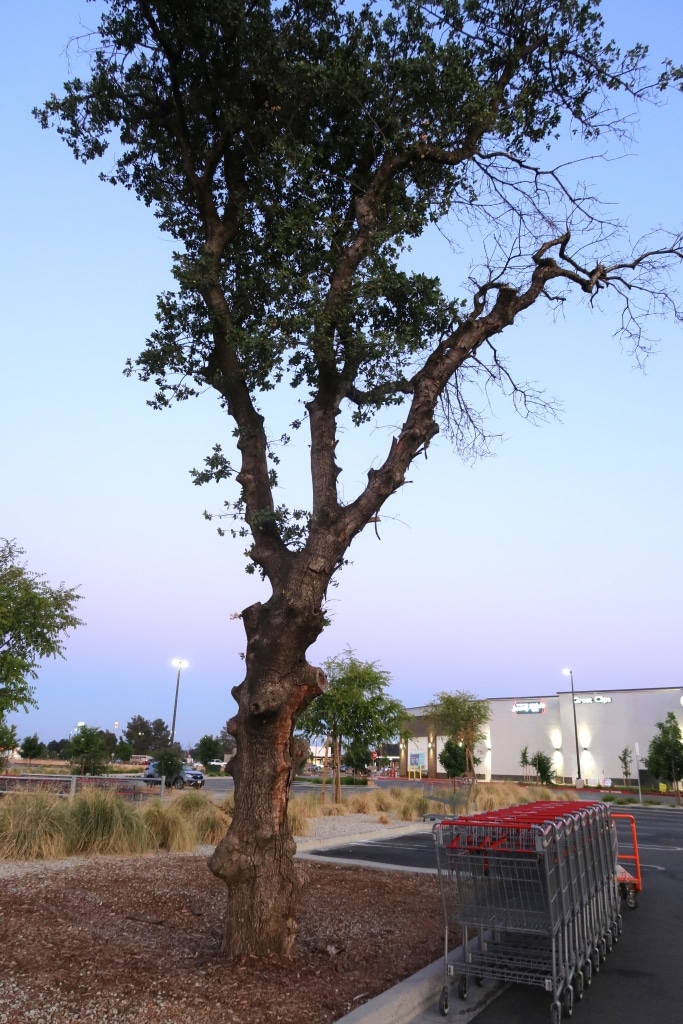
Photo by Heather Taylor.
Redding’s council was spurred to action not only by the clear-cutting itself, but by the response of local residents who produced a petition with more than 850 signatures – and started a campaign of comments, letters, and emails.
When the council revisited the topic in May of this year, council member Erin Resner, remembered how the aggressive removal of trees for those two projects shocked her and others on the council in 2021. She said they were united in a determination to avoid a repeat of that kind of environmental damage by establishing updates to the city’s tree ordinance, with “teeth.”
It took almost another year before the council finally formed an ad hoc committee to recommend revisions to the existing ordinance. And another year later, in 2023, the committee finally met, gathering six times between January and May to discuss potential ordinance updates.
The group originally consisted of 15 people, including Hatch, two other planning commissioners, members of Reddings’ Community Services Advisory Commission and other community figures like David Ledger, a long-term Shasta environmental organizer, and Rocky Slaughter, part of K2 Development’s team.
The committee’s recommendations finally went to the Redding Planning Commission in January 2024. Members of the committee advocated that an update to the ordinance should increase penalties for cutting without a permit, modify replanting requirements for developers to prioritize taller trees that contribute to a canopy and put in place a mitigation fee to be levied on developers when they remove certain kinds of trees.
Are updates needed?
In big picture terms, former Commissioner Hatch says, a tree ordinance is meant to ensure that when trees are cut down to facilitate development, others trees are planted or preserved by the developer to compensate.
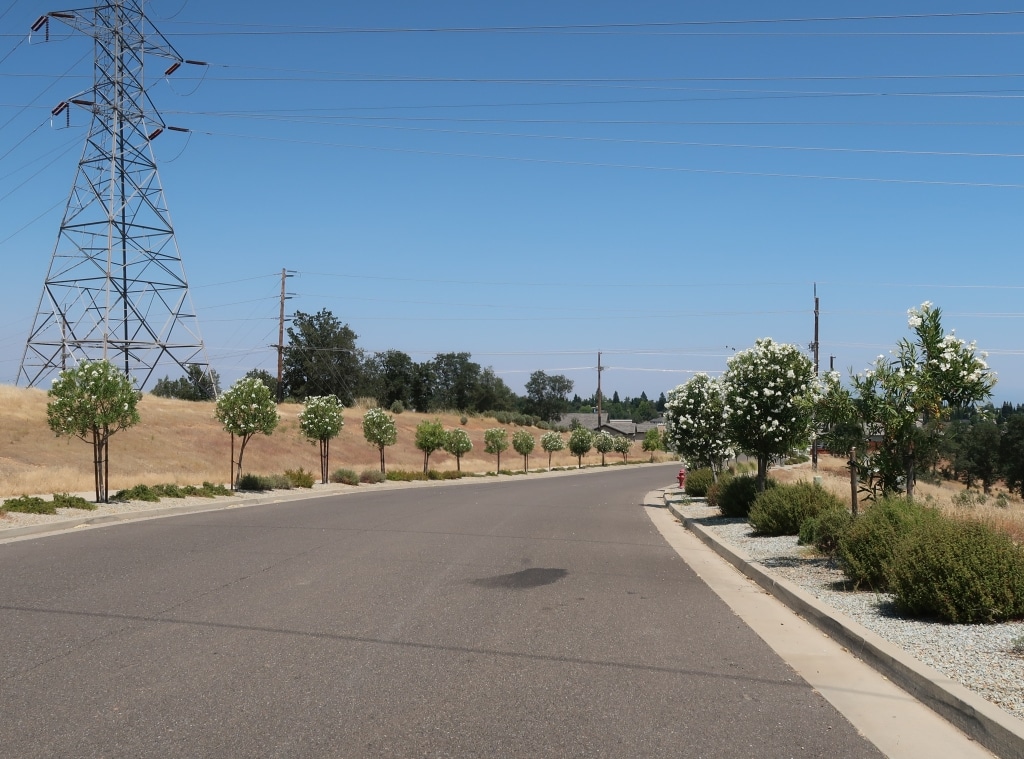
He pointed to some older Redding neighborhoods, like the Sunset area in West Redding, as good examples of where mature trees were preserved during development, leading to tree-lined shady streets. In contrast, he noted the more recently-developed Salt Creek Heights, where many of the small trees planted along the road after development are more the size of large decorative shrubs, unlikely to ever provide a shade canopy effect because of the varieties chosen.
In a city as consistently hot and sunny as Redding, shade is a valuable commodity, one that Ledger, former president of the Shasta Environmental Alliance, advocates for. Over time, he has conducted his own experiments to document the impact of shade trees. Measuring temperatures around Redding, Ledger said he has recorded up to 10 degrees difference between places with and without shade trees.
A study by the U.S. Geological Survey between 2016 to 2019 resulted in similar findings, documenting that trees in hot, dry areas produce dramatic cooling effects. The study highlighted the opportunity to reduce air temperatures through a healthy shade canopy, especially alongside the construction of new buildings, which increase heat.
Redding boasts some of the greatest percentages of sunny days in the nation, which come with sometimes extreme, dry heat. Last July, the city recorded a record-breaking high of 119°, in the middle of a multiple day stretch of temperatures over 110°.
Fees vs Incentives
“If we can’t preserve them, let’s replace them. If we can’t replace them, let’s pay a fee so the city can do it,” Hatch said, summarizing his focus for how the city should approach updating its tree ordinance.
Ledger agrees. During his work with the ad hoc committee he pushed for mitigation fees – a payment that developers could make to the city in exchange for removing certain protected trees. The fees are sometimes referred to as “in lieu fees,” as they are payments made in lieu of preserving specific trees. Fees collected by the city could then be applied to planting and maintaining other trees to offset the harm caused by development.
A similar fee structure is already in place in the City of Shasta Lake, which requires planting three trees for every native oak removed, or making a payment to a city fund designated for the planting and maintenance of other trees instead. Chico also has as a fee starting at $505 per tree for removing trees six or more inches in diameter, Ledger said.
Slaughter, another member of the ad hoc tree ordinance committee, is the chief operating officer and general counsel for K2 Development Companies. Instead of punitive fees that could raise costs for homebuyers, he advocates for incentivizing developers by providing impact fee credits in exchange for either working around existing trees or planting more to replace those that are cut down.
“Incentives can make all the difference,” Slaughter told Shasta Scout via email. “Developers would define entire projects around the preservation of trees if there were adequate credits for doing so.”
What’s taking so long?
When Redding’s council finally received a presentation on suggested updates to the tree ordinance this May, more than four years had passed since elected officials first asked for the update. The presentation included the ad hoc committee’s recommendation that developers be charged fees if they remove certain kinds of trees.
City attorney Christian Curtis’ presented more information on that idea, focusing on recent cases across the country where broad development fees have been challenged.
California’s Mitigation Fee Act sets specific guidelines for local agencies that impose fees on the public. The act requires that fees be designated to a separate fund and that information about the fund is made public. It also allows people to request an audit to confirm a fee is reasonable.
Any new fees implemented as part of an update to Redding’s tree ordinance, Curtis warned the council, would need to directly mitigate a specific harm, and the associated revenue must be used specifically to address that harm. For example, if the council decided the problem was tree loss, he said, staff time would need to be allocated to implement a new tree-planting program in response.
Curtis cited a Michigan case, where a tree ordinance was invalidated by the courts for lacking an individualized approach. He also referenced a Palo Alto case involving in lieu fees for parking, where the city failed to meet reporting requirements for California’s Mitigation Fee Act and was required to refund unspent money.
In discussion, city council members Mike Littau and Tenessa Audette expressed support for the kind of incentive-based program local developer Slaughter has advocated for, while Resner asked about the potential to continue exploring the fee option that Hatch and Ledger have encouraged.
Ultimately, the council unanimously tabled the idea of implementing a new fee, and requested to review other suggested tree ordinance updates by the end of summer, a timeline Redding’s Planning Manager, Lily Toy said city staff are on track to meet.
“We have high hopes the city will have an updated Tree Management Ordinance in effect before the year’s end,” she said.
Asked about what has caused such lengthy delays on the tree ordinance update, City Manager Barry Tippin cited a full workload, saying city staff have prioritized updating the city’s Short Term Rental Ordinance, General Plan, and Riverfront Specific Plan instead.
The whole process has deeply discouraged environmental activist Ledger.
“Redding does not care about trees – the city doesn’t,” Ledger told Shasta Scout over a phone call. “They could care less about shade trees, just development.”
Do you have a correction to this story? You can submit it here. Do you have information to share? Email us: editor@shastascout.org
Author

Comments (12)
Comments are closed.
Related Articles
Could Shasta’s elections official actually hire Tina Peters?
The answer is complicated and would involve factors at both the county and statewide levels.
Redding shows up: Hundreds of volunteers power Ironman 70.3 Northern California’s debut
Nearly 750 people volunteered for the Ironman 70.3 Northern California, a number that impressed both Redding officials and those from Ironman. Volunteers saw the race as a way to put Redding on the map in a positive way.
California requires county jails to meet minimum standards. That hasn’t prevented Shasta’s high rate of in-custody deaths
Shasta’s jail has consistently passed most aspects of state inspections amid a worrying level of deaths. A close look at the state’s standards — and the California board responsible for examining deaths in jails — shows key gaps in oversight.
As stated by so many others, thank you for the article on the tree ordinance issue. As one of those who gathered some of those signatures from citizens asking for a tree ordinance several years ago, at that time it felt like there was hope and that Redding was going to head in the right direction. It no longer feels that way.
It seems that the city council got their predominantly developer majority and it’s full steam ahead for urban sprawl, destruction of the natural environment and disregard for what the people want.
I go to Redding as little as I can get away with. It’s hot, overpaved and overdeveloped and sprawled in every direction. It’s a very unattractive city.
In a few years, people will look back at the elected officials we have now (city, county and federal) and ask what in the hell were they thinking?
The City of Redding seems to be in no particular hurry to honor its residents’ wishes when it comes to preserving trees but there is little delay for new developments that sacrifice trees. Trees provide essential habitats for many species, in addition to providing shade!
I’ve been in Californian small towns and big cities that have incredible shade canopies. Not only the cooling shade but the welcoming atmosphere that trees create. We are blessed to have valley oaks here. Majestic and amazing. Sadly they are not cultivated and cared for in this town. So much could and should be done for the next generation.
Thanks for the article. So many people have worked long hours to try to change things with regard to the tree ordinance. It would be nice to eventually see some results, a tree ordinance that would require mitigation for destroying Redding’s tree canopy, and which might stop its destruction in the first place.
A good tree ordinance is something that the city of Chico and the city of Sacramento have implemented. Tree ordinances must have an emphasis on replanting same species of native trees that was cut ( to prevent any one of ornamental trees in city tree plant list being planted instead). Tree ordinances must be overseen by an arborist and code enforcement implemented if we want to stop continued reduction of our native trees in our city. Ordinances must require replanting of same native oak specie that was cut down to maintain native oak diversity. Arborist can oversee tree removal permits and make recommendations on trimming and other conservation methods.
The City Of Shasta Lake has never replanted any native oak trees to this day and many have been felled.
The argument of Rocky Slaughter from K2 to have incentives for keeping large native trees for developers is very troubling and I believe untrue. Had we used this argument to offer logging companies incentives to keep large trees standing we would have no old growth forests left. Would anyone accept an argument that developers will adhere to building codes only if incentives are given? I doubt this, only with ordinances and laws can we uphold needed protection for people snd the environment!
K2 asked to be exempted from the tree ordinance in Shasta Lake City (which the city planner granted them) when they built low income housing. They also received 1 million dollars from the taxpayers funded Greenhouse Gas Reduction Fund and cut 18 large, beautiful native oak trees.
Why should we care about Native Oaks? Large oaks preserve soil and air moisture, reduce flooding, reduce heat islands, offer 550 species habitat or food, need no watering once established, live up to 500 years, filter our air from pollutants and increase humane wellbeing.
Something that is consistently overlooked in the discussions about replacing, or supposedly mitigating the loss of large, existing trees from logging or to build more is how long it takes for trees to grow large, even in the best conditions. Also, grown trees sequester an incredible amount of CO2 in their soil and bodies, wherever they grow . The amounts of sequestration are irreplaceable for decades or longer. Illustrative graphic of the thousands of trees it requires to replace one large tree is here: http://www.thebattlecreekalliance.org/climate.html
Shade, shade, shade! Removing trees is stupid in so many ways. And replanting with redwoods, oleanders and crape myrtles exacerbates the stupidity. Leave the majestic oaks and other native trees and build around them. It costs more but we need to put our foot down on this.
Grateful for this long awaited update. Thank you Heather Taylor. And thank you to all the members of the Tree Committee. I sure would like to see an ordinance in place as they have in Roseville (where I lived) or our neighbor, Chico. Why can’t we use one of those cities’ plans with a couple of adjustments? And what do the developers really think about penalties or credits? What does it cost a developer to remove a big oak tree for example?
Looking forward to the next chapter.
There is no way the current city council will require developers to mitigate for the removal of oak trees as many California cities do such as Chico, Roseville, Santa Rosa, Shasta Lake, Sacramento, Citrus Heights and many more. Taxpayers yes, developers no. The current council majority does not care about trees.
The Tree City, USA designation from the Arbor Day Foundation that Redding frequently touts as their concern for trees is just greenwashing for the continuing cutting down of Redding’s tree canopy without replanting replacement trees elsewhere. Walk around much of downtown Sacramento, Tree City USA where they have planted one million trees and you will find tree covered streets and sidewalks. Try walking on Placer, Cypress, Hartnell, Churn Creek or Eureka Way and many other streets in Redding and you will find plenty of sun and little shade, except for next to City Hall.
I contacted the Arbor Day Foundation and was told by a State of California representative at Cal Fire that the Tree City, USA designation was written so that any city in the United States could qualify. Redding meets that low bar.
David, I appreciate you as an advocate and SME for the environment and for a responsible tree plan for our city of Redding. The time has come. We see multiple instances of ” set it and forget it.” Pave it over, collect the rents, and to hell with shade and the natural world. This is glaringly evident at Shasta Mall, Placer Heights , Cypress Point, the new Bechelli center x Churn Creek, and the new Holiday center on Hartnell where multiple oaks were removed and replaced with a few shrimpy 24″ box trees. I predict many won’t make it. They won’t make it because they will not have sufficient irrigation and/or will be stunted and perish due to the nursery stakes being left on and the green nursery tape slicing into the cambium layer.
I can’t see how things will improve without a combination of incentives and fees. Leaving developers to do the right thing is just wishful thinking. There has to be basic accountability to integrate all the needs of the area. That said, I generally do not spec most native plants as they are not really suited to commercial landscape environments with a few notable exceptions. Trees are different but even there planting a stand of, say, single trunk Ceanothus and thinking they’ll survive establishment with little to no water is wrong. Or look at the Redwoods planted along Shasta view. I almost crashed when I saw these Coastal species from the Santa Cruz mountains planted along the side of the road in our hot dry high semi -arid climate zone. When I asked the City Council who approved that, all I heard were crickets. The key to remember is drought resistant does not mean no water is needed. Soil prep and excellent drainage are essential for all plants and especially natives. I’ve already noted multiple newly planted Lavenders failing at Holiday. The establishment period after planting is critical and extra water with multiple cycle starts are needed for root penetration. I have always tried to stay away from calling out drip on a commercial landscape installation. There’s no way to see leaks, coverage, or plugged drip until the plant is failing due to drought stress. That’s why these businesses need to have a proper licensed contractor come out weekly to maintain the landscape and at least twice yearly for irrigation systems checks (tune ups) where all of the valves are tested and leaks are detected. Much easier to do with spray than drip. Bubblers are much more effective and better than drip for shrubs and trees.
David, I appreciate the leadership example you’re setting and I look forward to further collaboration in the future as we work for a responsible tree plan with incentives and “teeth” but also educational components.
Thank you, Heather and Scout, for shining a light on this important quality of life item that affects all of us.
Ordinance should dictate NATIVE trees, and if a planted tree dies. they have to replace.
Stop with the redwood trees and non-native trees. Have McConnell Arboretum grow the species that are drought tolerant and local since you can’t just go to local garden center for native species.
Also- make stores with asphalt parking lots put in a solar arrays. Protective parking for customer cars underneath.
Great article Heather! I’ve been trying to follow what’s happening with the Tree Ordinance from the beginning and have always felt in the dark to some extent. The light you shine on this long process finally brings it into crystal clarity. Thank you so much!