
Opinion: What We Lose If We Lose the Sáttítla Highlands National Monument
Trump’s “Energy Emergency” Threatens Endangered Species, an Enormous Aquifer, a Sacred Place of Peace—And So Much More
This essay was originally published by Zócalo Public Square and is republished here with permission.
The newly designated Sáttítla Highlands National Monument, which encompasses 224,676 acres in Northern California’s Modoc, Shasta-Trinity, and Klamath national forests, is home to bald eagles, black bears, salmon, trout, and many threatened, endangered, or rare species of plants, insects, and animals. It is also home to massive underground volcanic aquifers that supply water to millions of people. While the Sáttítla Highlands is not well known, its ecosystem impacts millions of Californians, including farmers who use the water to feed the nation.
Sáttítla—which means “obsidian place” in the Ajumawi language—includes part of the ancestral homelands of the Pit River (Ajumawi–Atsugewi) and Modoc Peoples (Mo Wat Knii–Mo Docknii) and is central to the spiritual beliefs and cultural practices of a number of other local tribes, including the Karuk, Klamath, Shasta, Siletz, Wintu, and Yana. Sáttítla is central to the creation stories of the Pit River Tribe, and is critical to their spiritual and cultural practices, including vision quests, the gathering of medicinal plants, spiritual training, and purification ceremonies.
President Biden designated Sáttítla Highlands as a national monument in January 2025, just days before he left office. This designation, in theory, prevents industrial energy development and harmful commercial interests, including clear-cutting of forests and hydraulic fracturing.
Barely four months later within a wave of administrative actions privatizing and exploiting public land (including the Declaring a National Energy Emergency Executive Order, the Unleashing American Energy Executive Order, and the Executive Order on the Immediate Expansion of American Timber Production, among others), President Trump issued a memorandum pushing to rescind the monument’s protected status as a means of combating a national “energy emergency.” When asked about the effort to rescind the monument’s status, then-White House spokesperson Harrison Fields noted that Trump pledged to “liberate our federal lands and waters to oil, gas, coal, geothermal, and mineral leasing.”
So I knew I had to include this place in a series of trips I was making through eight Western U.S. states to national lands at risk of losing federal protection. Over the course of 10 months, I traveled to 40 national forests, monuments, parks, and other designated public lands, from Washington State to New Mexico. I collected field recordings, made short videos, took photographs, and wrote poetry. I set out to document these lands before they were lost or irrevocably altered. What I learned was just how devastating these losses would be to all Americans.
I headed to Sáttitla, which is a six-hour drive north from San Francisco, in June. On the road, I passed lumber trucks, tall Ponderosa pines, skinny young firs, and oak saplings.
I wanted to find Medicine Lake, a sacred site and place of healing for several tribes that sits in the summit caldera of the Medicine Lake Volcano, which covers an area nearly 10 times that of Washington’s Mount St. Helens. For approximately two decades, the U.S. government has designated much of the land surrounding the lake a Traditional Cultural Property District, which means that the appropriate Native American tribes must be consulted in project and program planning, but it does not necessarily restrict development on these lands.
The highway was nearly empty as I drove. Turning onto a road marked by hand-nailed signs claiming to lead me to Medicine Lake, I realized I had radio reception, but I could only find one station. They were playing “Africa” by Toto, a song whose inane lyrics ascribe an almost holiness to an imagined version of a real place. As I struggled to find Medicine Lake, I debated the merits of a camp appreciation of the song or if silence might be better.
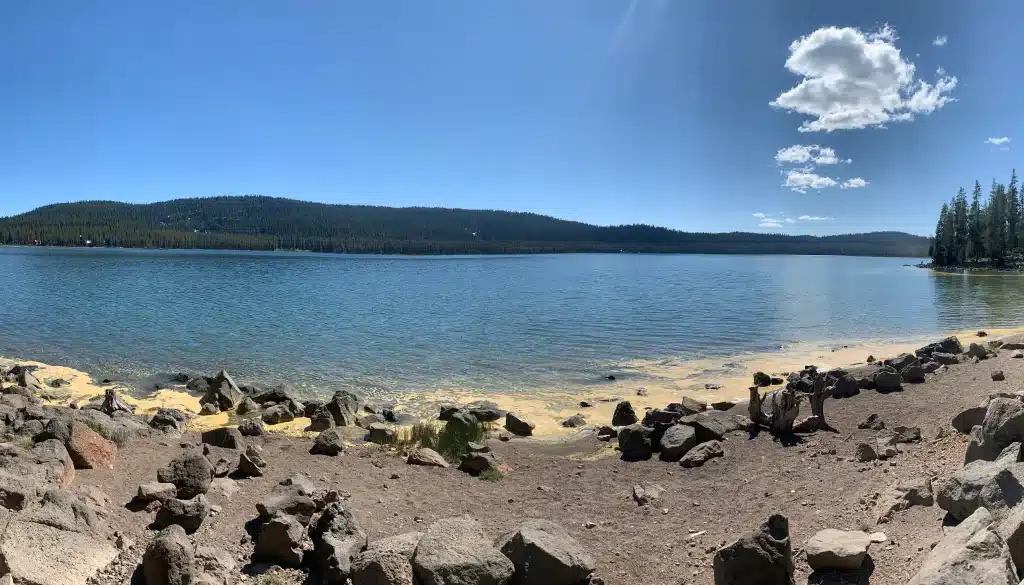
When I finally parked near empty cabins at Medicine Lake, it seemed like I was alone, save for one person fishing in the distance. Lava rock, small golden-mantled ground squirrels, red-winged blackbirds, chipping sparrows, and dwarf mistletoe growing on much of the abundant pine made it feel as if I had stumbled onto a secret—a secret with basic toilets and camp sites.
I hiked briefly into woods that hugged the water. Tiny chipmunk squeals overtook the bird sounds, small periwinkle butterflies and infant moths mixed in the air, and small mammal scat dotted the trail. Eventually, I came upon other people, mostly there to camp and fish. As I walked along the shore of the lake, I came across a grandmother and granddaughter collecting tadpoles. When I remarked that the water was warm enough for swimming, the grandmother reminded me of how dire and recent our drought years are: Two years ago, she recalled, the water was so low that she and her husband were able to walk the perimeter of the lake.
This is a striking aspect of Sáttítla Highlands that most people do not see—the porous volcanic rock that filters rain and snowmelt into one of the biggest underground aquifer networks in the United States. These caverns—which store as much water as California’s 200 largest surface reservoirs— supply water to the state’s largest spring system. I have been its unwitting beneficiary much of my life, as a teen in Sacramento and as an adult living in the Bay Area.
Beyond the aquifers, Sáttítla Highlands is home to 19 plants and dozens of animals and insects considered threatened, endangered, or rare in California, including the whitebark pine and the rare talus collomia, the northern spotted owl, Cascades frog, long-toed salamander, Townsend’s big-eared bat, and Sierra Nevada red fox, as well as the Franklin’s bumblebee, which has one of the most limited geographic distributions of any bumblebee in the world.
The Trump administration’s attempt to rescind Sáttítla’s National Monument designation will put all this life at risk. In addition to devastating areas of cultural importance for Indigenous tribes, millions of people throughout the West will feel its effects on our water, our air, and our climate.
Nowhere in the monument is there signage explaining the small miracles of freshwater stored and distributed through these aquifers, nor telling of the biodiversity that leads to, among other benefits, better soil health, increased carbon storage, improved flood control, and improved air and water quality. Nowhere is there mention of the oxygen that mature trees produce. One mature tree can produce enough oxygen for four people a day.
I thought of some of this as I walked around the lake, but I also noticed the people around me interacting with nature. The girl laughed as she scooped cups full of tadpoles to admire then release. Watching her, I remembered how this kind of engagement led my cousin to become a marine biologist and me to write of the beauty and sustenance such lands offer. I wondered if the people seeking to end the protection status of this land understood all that is at risk.
This essay was originally published by Zócalo Public Square and is republished here with permission.
Related Articles

Underground Good: Enora Ilboudo
“Aside from clothes and food, sometimes we’ll hear from people who don’t feel connected to their families or need to talk to someone and don’t have anyone else they can go to. People are finding their community here at the center and that keeps me motivated when I’m working here.”
Opinion: Healthcare and Food Benefits are at Risk in Rural California. Will the Governor and Legislature Act?
The need for health care, behavioral health treatment, and food assistance will not disappear because federal funding drops. The burden simply shifts downstream to counties — forcing cuts to emergency rooms, food banks, sheriff’s deputies and already-overwhelmed local systems.
Underground Good: Steve Woodrum
“As a poll worker … you notice that many people, when they come through the doors, all of a sudden, they change. They become more dignified. You can see that they are getting ready to vote, and they rise to the occasion.”