
Anti-ICE protest in response to killing of Alex Pretti draws hundreds in Redding
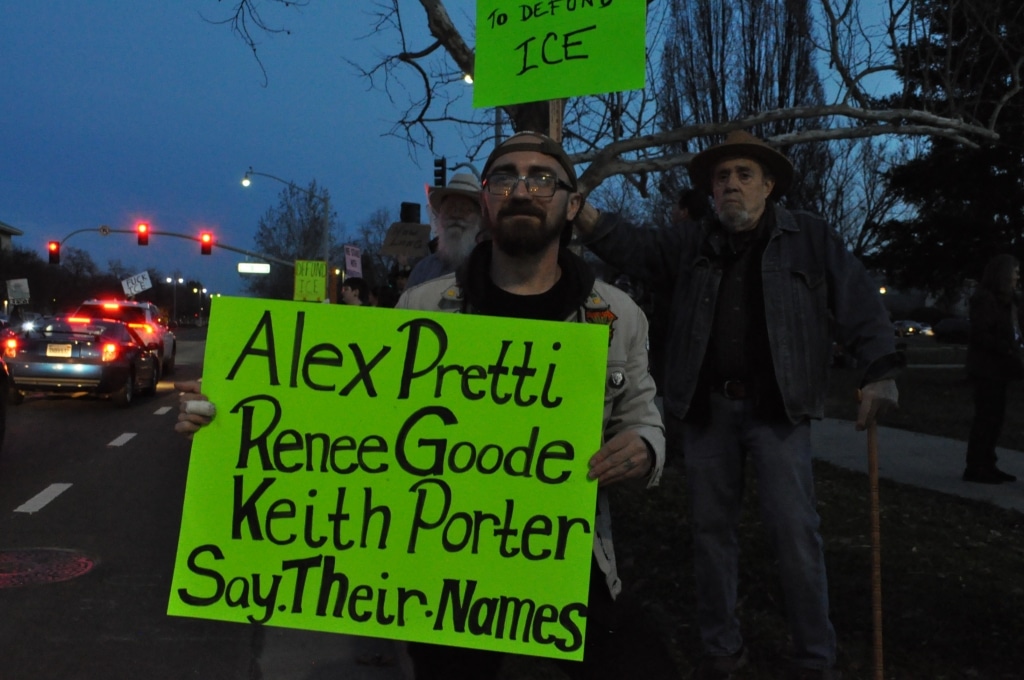
The protest was organized by a group called Redding Resistance. Hundreds showed up to hold signs, listen to speeches and sing as they called for an end to ICE action in Minnesota and across the United States. Speakers included conservative candidate for Shasta supervisor, Tim Garman.
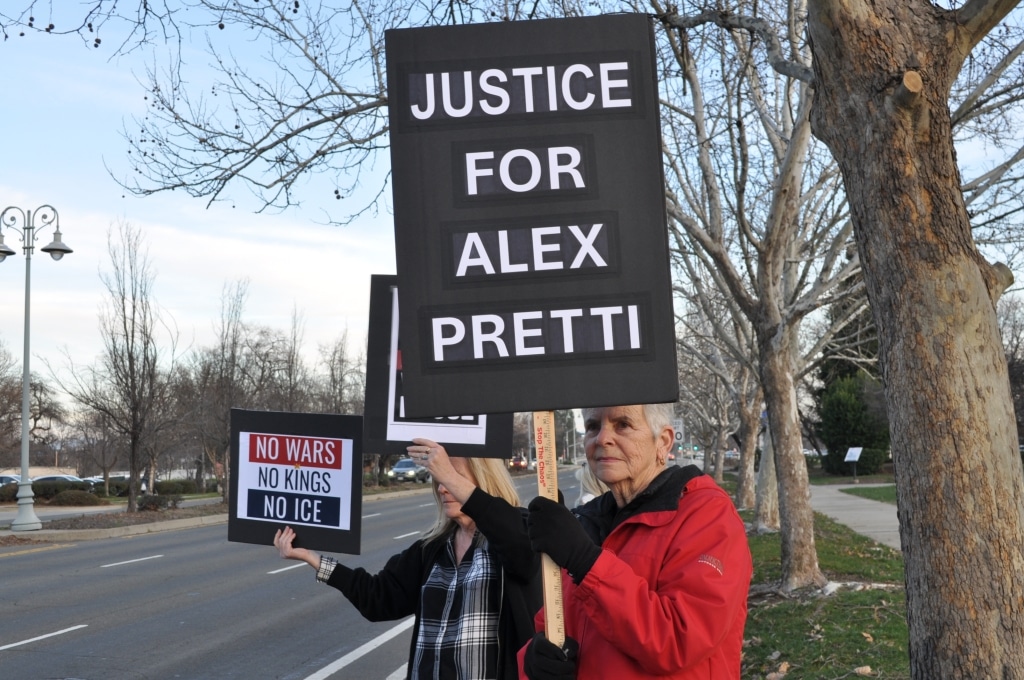
A nonstop stream of steady honking accompanied the shouts and calls of protesters as vehicles passed a group of about 450 standing in front of Redding’s City Hall last night. There were no visible counterprotesters or law enforcement agents on site during the Monday protest, which remained peaceful.
The event was organized by the group Redding Resistance in response to the shooting of Alex Pretti by a federal immigration official on the streets of Minneapolis over the weekend. Pretti, an American citizen, was an intensive care nurse who worked with veterans. Early statements by Trump administration officials attempting to legitimize his shooting do not match bystander videos of the event.
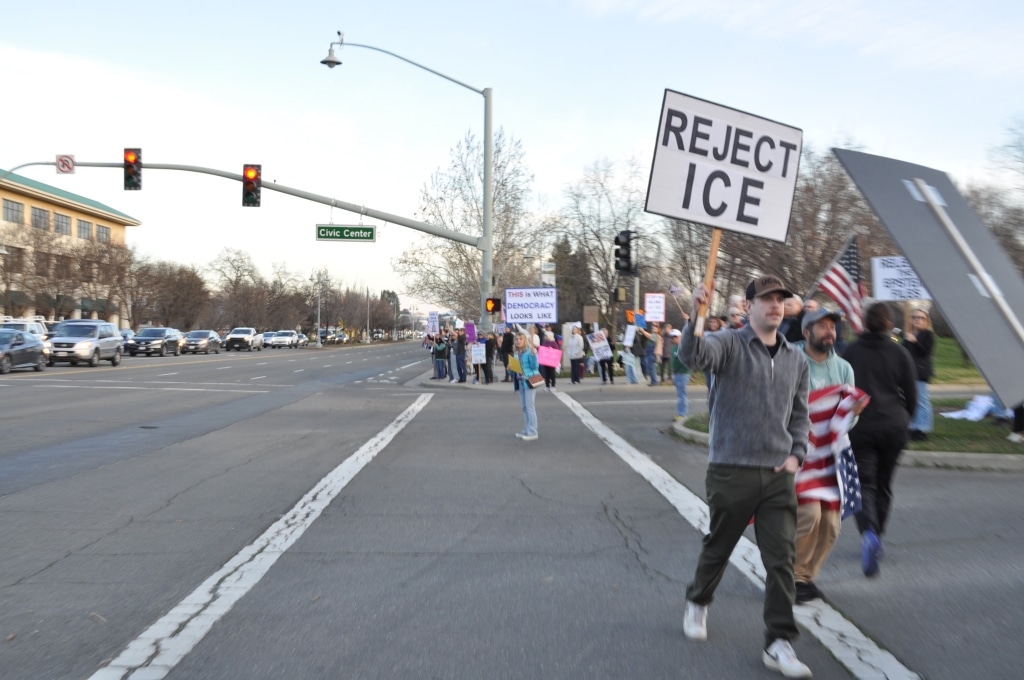
Silver-haired Marti Weidert stood on the protest line as she spoke to a reporter, saying she came to the event to find fellow community members to communicate with about what’s going on in America right now. She said some of her friends have told her not to talk to them about politics because it upsets them, and that’s left her feeling alone as she’s processed recent national news.
“I feel better now,” she said. “There’s strength in numbers. When we’re isolated we’re weak, but together we can make a difference.”
Megan Owens, the pastor of Pilgrim Congregational Church in Redding, was among those who spoke at the event. She said she was wearing her clerical collar to show that there are Christians who oppose the actions of ICE.
“Where are the Christians?” Owens asked rhetorically, echoing a question she’s heard from others. “I don’t know where all of them are, but this one is here. This one is here standing with people of other faiths, standing with people of no particular religious faith to answer the call to come to the trenches, to do what we can to raise our voices against tyranny.”
It was exactly one year ago, Owens reminded the crowd, that female bishop Mariann Budde called on President Donald Trump to have mercy on those who are afraid in her sermon at the National Cathedral.
“Bishop Budde spoke truth to power when she asked this administration to have mercy,” Owens said. “She was accused of being divisive … and she famously said, ‘I will not apologize for asking people to have mercy.’”
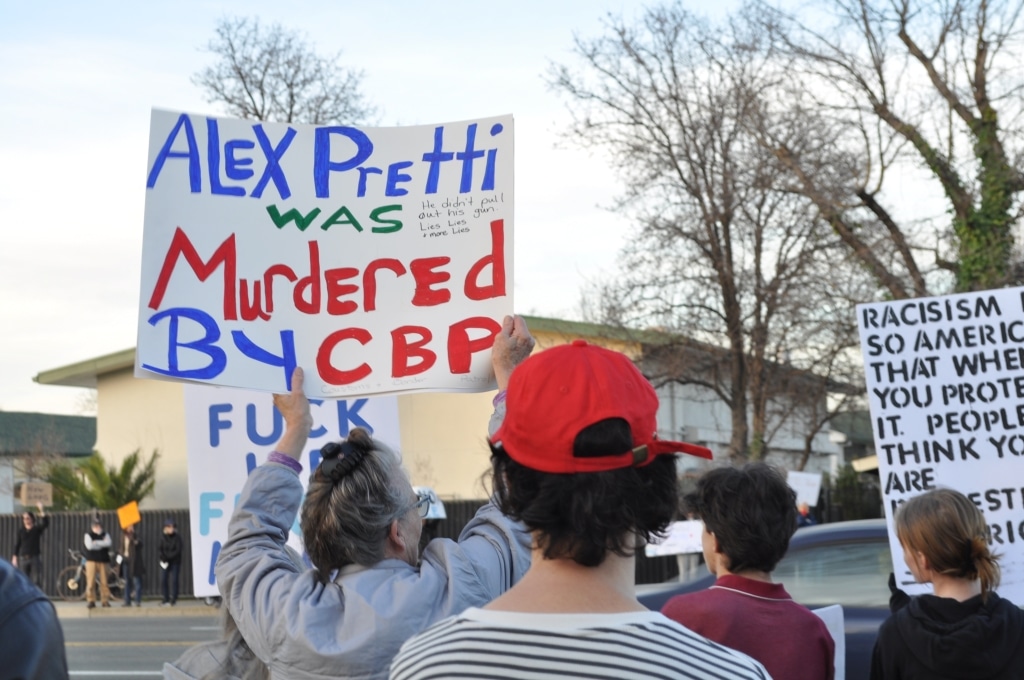
Pit River Tribal member Awi Gustafson also spoke at the rally telling participants if they’re not Wintu, they’re immigrants to this territory. He referenced how California land was stolen from Native peoples by the actions of armed agents of the state.
“While we cannot change the past, we should use it to inform the future,” Gustafson said. “It’s important to not lose hope. If the Wintus and Native people can survive genocide, I know all of us can and will survive this Trump regime,” he added, invoking the names of Pretti and Renee Good — who were both recently killed by federal agents in Minnesota — and saying he will stand for them as he would for any of his family members. “This is me fighting for not only my Native people but my entire country,” Gustafson added.
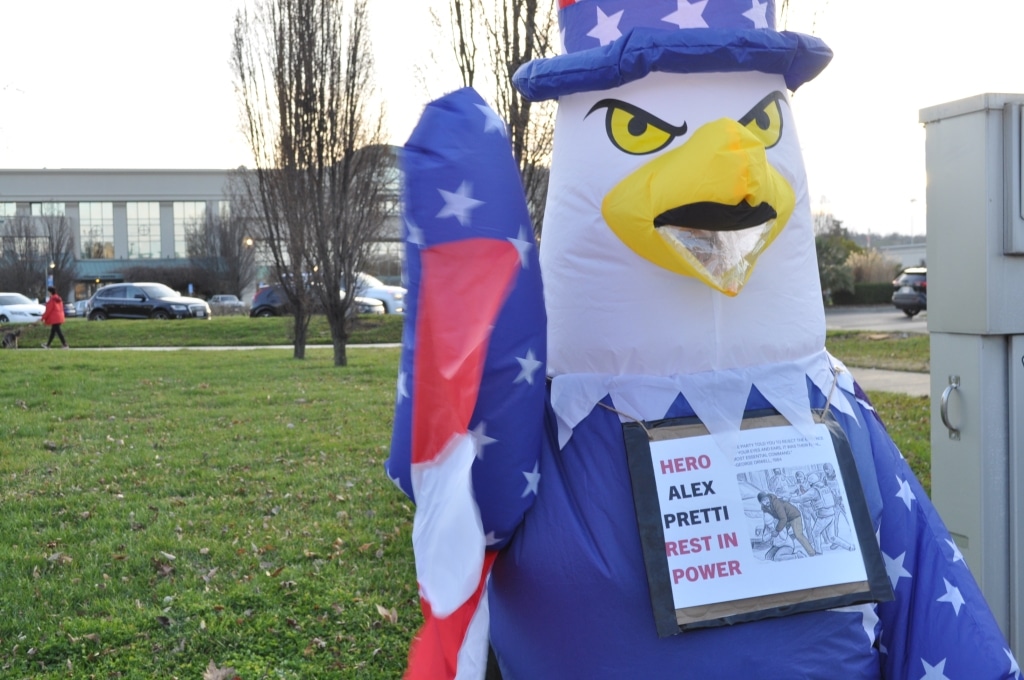
Several local political candidates also spoke at the event, including Rose Penelope Yee who’s running for Congress and shared her experiences growing up in the Philippines under dictatorship.
Former Shasta Supervisor Tim Garman, who hopes to win a seat on the county board again this year, also spoke, sharing a message from Redding City Council member Dr. Paul Dhanuka who’s called for an independent investigation into the killing.
“I watched footage of the shooting involving Alex Pretti,” Dhanuka wrote, “and I can’t get it out of my head. … It’s difficult to process what I saw. No matter who someone is, our country needs serious reflection, transparency and answers. Situations like this shake trust, and the public deserve clarity and accountability.”
Garman, who was originally elected as supervisor in Shasta amid his protest of COVID-19 mandates, said the message perfectly expressed his own views on the recent shooting.
Do you have a correction to share? Email us: editor@shastascout.org.
Author

Comments (28)
Comments are closed.
Related Articles
LaBarbera resigns from Anderson Union High School District Board
The school board member stepped down one day after the state authorized a lawsuit against her for the second time this year. She could still face legal action.
Curtis says he won’t appear in federal court tomorrow to testify
The elections official received a subpoena earlier this month to testify before a federal grand jury and bring June election ballots with him. He said he confirmed today he won’t have to go but did not explain who had informed him he was released from testifying.
Redding council to open recruitment for a new city manager
The council is contracting Rocklin-based recruiter Ralph Anderson & Associates to run the recruitment. It’s a decision met with mixed opinions by council members, some of whom wanted to offer the role to the city’s interim manager.
its’ time to put pressure on Simpson U. leaders to cancel and move the Turning Point event , now scheduled for Feb 7 at the Civic, to the gym at Simpson, where they can use their own security instead of forcing the RPD , at taxpayers expense, to cover any situation at the Turning Point event. Not to mention the 17 yr old Simpson U student and his liability risk factor should something happen. It’s in Simpson Us leaders lap to bring this under control before any occurence, be pro-active on this one. It’s called preventive action. And drop the anti-LGBT lingo on FB, what is your problem ? But, then again this has been Turning Points mantra since inception.
I was wrong about your not posting some of my “hot-button” remarks. The similar, shorter of my comments is because the first one disappeared from my screen. I am Elizabeth Andrade and not the Elizabeth who posts with only her first name. Thank you and chef’s kiss.
https://www.zerohedge.com/political/now-you-will-know I don’t expect any of my content to get approval. Boomers, for the most part, were the recipients of excellent schooling in Redding 50 years ago. We learned in history classes how awful Bolshevism was. It remains horrific today. It was at the forefront of virtually every war fought after the 1900’s. Now there are “color revolutions” to fulfill the same goals. With Communism, only the very top echelon are rewarded financially by design. The useful petty tyrants are quickly replaced once they’ve done the dirty work. Truly that model espoused by Claus Schwab will be used here in the US- “You will own nothing, “eat bugs” and be happy”. Most happy will be the monsters who enslave and reap 99.99 percent of any profits to be made. Capitalism, at least, gave people from every walk of life a chance to achieve financial success. China will build the same type of highrise apartments they built for Chinese citizens for Americans with the land purchased from Gavin Newsome- the type that allow them to weld shut the doors the during the next pandemic. Do you remember the screams from the skycrapers from those not allowed to leave their apartments for food? The social credit system being developed for Americans by the Chinese at the behest of leadership here will be implemented. Those who laughingly bring up the “Red Scare” of the 50’s are playing a cynical game and are completely disingenuous. Watch classics like “Dr. Zhivago”, “The Killing Fields” and “The Year of Living Dangerously”, to fill in the blanks of our apallingly deficient present day school curriculum. None of what I write here will change anyone’s mind. Something has happened to the ability for most people to think critically, make logical deductions and actually imagine outcomes based on their own observations.
You won’t be approving my last comments so, in order to fill in the blanks of the woefully inadequate school curriculum in the US, watch “The Killing Fields”, “The Year of Living Dangerously” and “Dr. Zhivago”. The one world government is on its way with the hijacking of the American mind. Those who bring up “the red scare” as though there never was such a thing to be worried about are disingenuous in the extreme. For good measure, watch the remake of “The Invasion of The Body Snatchers” some in the comments section here as well as in the previous incarnation of “Anewscafe” give the Donald Sutherland character a run for his money.
https://www.youtube.com/watch?v=FFL5XPMVJng Were illegals running the illegal abandoned Reedley lab at the time of this report, still filled to the brim with biohazards in beakers, boxes, petri dishes, etc.? Live mice had the run of the place and SARS was among the diseases festering there. First, you’d have to be interested and concerned enough to care. And then you’d have to use your ability to rationally figure out how incredibly dangerous this is, as it was also swept under that proverbial rug. The power to the lab was cut and nothing was kept on ICE, that’s for sure. You can also find out if it is true that A. Pretti had used violence against ICE almost two weeks prior to his showing up the final time with a g__ in his waistband. Word is he kicked out the tail light of a federal vehicle. There’s power of a moment in history like that of Nancy Pelosi taking the knee for an “adjudicated”, armed criminal, doped up and trying to pass a counterfeit $20. Previously, Georgie Boy held a g__ to the stomach of a pregnant woman while his friends ransacked her dwelling……….. Minneapolis o b v i o u s l y never recovered while Mrs. Walz let the smell of burning tires waft into her home, Portland became a hell-hole and Seattle lost lives in the “summer of love” meanwhile your own state and home of bungler, Grabsome Newstuff, who, let’s be polite, was not able to a c c o u n t for 24 billion of your very hard-earned tax dollars. And so it goes.
“to call to an end ICE actions.” = calling for an end to the Declaration of Independence, the Constitution, and the rule of law, police, sheriffs, etc. Just sayin’ the truth. Disguises are coming off people, the shaking and exposing, also the reset will continue.
I invite you to attend a course in Political Science – you could attend right here in your community at Shasta College. You may also find it helpful to read the Bill of Rights and write out Amendments I, II, VI, and IX, Section 1. If a college education feels too daunting, you can explore YouTube. This allows one to watch short videos without feeling overwhelmed. A glance at Habeas Corpus would be insightful!
It’s always a good idea to attain higher education at a Western certified college who’s yearly certification is on file and should be available to all students. Some colleges/universities are private and may not have to adhere to such. Even knowing our laws of the US, does nto gurantee protection, it seems, just like in the bible, there’s the ‘interpretation factor’.
is it still called gaslighting, when you’re just making shit up that no one believes?
Just saying….. It’s not about ICE. The adjudicated rapist – 34- count felon is using ICE as his Gestapo. As Hitler did in Germany, the point is to use people of color, “immigrants,” as his reason to commit fear and violence; attacking immigrants is not simply to create a white nation, and to terrorize Americans into accepting the domination of MAGA Republicans. It’s called white nationalist facsim. And you can thank us for creating the law to demand the Gestapotake their disguises off and expose the face of fascism.
I like what Tim Garman has to say. I also appreciate his support of the LGBTQ+ community. He will have my vote in his election.
Thanks, Redding Resistance, for organizing this event, and to Scout and other media outlets for covering it. Over the last six months, thousands in Redding have protested the unconstitutional and illegal war waged against America by the Trump administration. And to be clear, “immigration” is merely a cover for Trump’s fascist vision of authoritarian control, a War of the American People.
Trump, a racist, sexist, convicted felon, and court-adjudicated rapist, along with his white nationalist Steven Miller, who echoes Nazi-style propaganda and authoritarian, anti-immigrant views, have been desperately eager to find a reason to invoke the Insurrection Act of 1807, targeting American cities, especially Minnesota.
Using ICE, The Border Patrol, Pam Bondi, Kristi Noem, and Gregory Bovino, who like Trump, lie, cover up, violate courts, breach the US Constitution, and use doublespeak to blame the victims for the Minnesota murders and call the shooters “the victims,” their gamble is that there are Americans who love Trump and will, like with the Epstein Papers, support his ICE cover-ups and War on the American People, or that we are so consumed with worry about the spiraling cost of living, crumbling infrastructure, and failing education systems that we’ll just accept Trump being Trump. Nope.
Meanwhile, it’s looking very good for the midterms. Trump’s net job approval among independents is at a negative 40 percentage points, with 27% approving and 67% disapproving. The 34-count convicted felon has approval ratings of 37% and disapproval ratings of 60%. 57% of Americans strongly disapprove of the way that ICE is handling its job, 58% say Trump has gone too far in using the power of the presidency and the executive branch, and gutting federal programs, 57%. And to stop the War on the American People, we will vote the Trump supporters out of office. See you at the next rally for America!
I forgot to remind everyone that Tim Garman was a pathetic joke as Supervisor. He was never a true ally for Mary Rickert and actually became a puppet for Patrick Jones as evidenced by his ridiculous environmental survey of PJ’s proposed gun range. Tim went out to Millville Plains and walked around, as if he was an expert in anything other than walking around. He voted for Jones effort to install the gun range because he had been promised PJ’s support on Tim’s effort for a supervisorial pay raise (which they betrayed him on–so not only is Tim Garman corrupt, spineless jellyfish, he is also a rube).
I fully support president Trump’s efforts to remove illegal aliens from our country. Pretti shouldn’t have brought a loaded gun to an active law enforcement scene. Hopefully others will learn from his mistake.
Gee, what about your 2d Amendment right to carry a gun everywhere? And your 1st Amendment right to petition the government for redress of grievances?
You do realize that most of the people “removed” were legally present and complying with the immigration check-ins and immigration court appearances or were within status? Or don’t you and just want brown people taken away by ill-trained thugs playing army?
This isn’t my America. I fervently hope it isn’t yours.
We have to get these people out. It’s going to be messy. Don’t interrupt law enforcement activity.
So you support warrantless searches? Unlawful breaking and entering? Deporting people without due process? Killing Americans who are deemed by ICE to be domestic terrorists? Throw out the 2nd amendment that allows citizens to possess a legal firearm with valid concealed carry weapon permit? Did you complain about the traitors who brought AK’s and AR’s to the deadly J6 insurrection? If not, you are a total hypocrite. I call people like you 5th Avenue types. They are the only Trump supporters left.
BG, these people don’t belong here. I call people like you naive.
“This year will be turbulent, yet fruitful.” The shaking and exposing will continue, and then the Reset for righteous ways. I concur with your comment, NC because I know the Truth.
100%
Yep. Me too, NC. Where’s the concern for all the American citizens who have been assaulted and killed by the undocumented criminals? Why can’t some see that I.C.E. is a good thing instead of protesting the law enforcement? Unbelieveable!
Bingo. It’s more difficult to gauge the negative impact illegal immigration has had economically– specifically on social and educational services.
It’s even worse you’re hiding behind an abbreviation name, when bootlicking this hard.
Not to mention as more videos released, it’s proving how liberal outlets jump the gun big time! They have an ultimate history of doing this every single time. We will find that this idiot killed himself! Don’t forget one thing for sure these left radical groups funded by an American living in China by the name of Singham are investing in the downfall of America. This type of behavior is not going to be tolerated. I would highly recommend that news outlets, such as this one speak out when true accounts of what happened come out visually! Have a nice day.
That’s funny Jon. There have been about five video sources now that all show that ICE was in the wrong.
And for the love of God, this has nothing to do with conservative versus liberal. This has to do with right versus wrong.
The killing of Alex Pretti by federal immigration agents in Minneapolis has become a defining flashpoint in a deeply polarized moment. Public outrage, protests, and legal challenges following the death of a U.S. citizen during a federal operation have revived urgent questions about the use of force, civil liberties, and federal authority over local communities. Yet the broader danger is not that the United States is on the brink of civil war. It is that unresolved domestic escalation, if mishandled, can erode legitimacy at home while weakening America’s strategic position abroad.
This moment unfolds against a critical backdrop: persistently high civilian firearm ownership. Data since Q4 2025 shows that Americans continue to purchase firearms at historically elevated levels, with adjusted background-check estimates consistently exceeding one million likely sales per month despite modest year-over-year declines. This does not indicate organized rebellion, but it does raise the consequences of miscalculation. In an environment where protests, law-enforcement encounters, and viral misinformation intersect with widespread gun ownership, even isolated provocations can spiral into tragedy faster than institutions can respond.
Compounding this risk is the role of agent provocateurs—actors who seek to escalate conflict rather than resolve it. These can include ideological extremists, criminal opportunists, online agitators, and, as history has shown, government agents who cross the line from lawful infiltration into provocation. Past abuses have left a legacy of mistrust that magnifies suspicion today. The true danger is not omnipresent orchestration, but feedback loops: provocation triggers fear, fear triggers overreaction, and overreaction validates the most extreme narratives on all sides. In such conditions, belief alone can destabilize behavior, regardless of facts.
From a geopolitical perspective, this is precisely where America’s rivals benefit. China and Russia do not need to engineer U.S. unrest to gain from it. Prolonged domestic escalation tied to immigration enforcement and civil rights weakens U.S. coherence, distracts leadership, and fractures alliances. For Beijing, visible American turmoil supports its narrative that liberal democracy is chaotic and hypocritical, undermining U.S. moral authority in the Global South and complicating consensus on Taiwan. For Moscow, U.S. instability feeds cynicism, erodes Western unity, and blunts sustained support for Ukraine. Chaos and overreaction alike serve their interests.
The strategic irony is stark: whether escalation leads to disorder or to an aggressive federal crackdown, America pays a price. Legitimacy erodes, trust declines, and democratic norms are strained—outcomes that adversaries can amplify without firing a shot. The way forward is neither denial nor forceful suppression, but institutional restraint, transparency, and accountability. Thorough investigations, clear legal standards, disciplined law enforcement, and responsible protest leadership are not signs of weakness; they are instruments of national strength. In a heavily armed society under global scrutiny, legitimacy is the decisive asset. Preserving it is not only a domestic necessity—it is a geopolitical imperative.
While the diatribe edging, oh so close to a novel might be appreciated, a pithy response and solution are at hand and should be discussed without bloviating!
* illegal immigration
* fraud at the very highest levels
* payments from abroad to rioters
* dishonest media coverage
* gaslighting from the liberal left
* massive cover-up from the governor and mayor
* telling the truth helps
Shasta Scout, thank you for covering this event. It’s heartening to see citizens coming together to peacefully express their reactions to the disturbing actions of ICE/CBP agents in Minneapolis.