
Here’s What You Need To Know About Water Releases From Shasta Dam
Some community members have expressed concerns that the Bureau of Reclamation may be releasing more water than necessary during recent precipitation events. Doing so, they worry, would reduce the amount of water being stored for next year’s irrigation needs. Reclamation Area Manager Donald Bader says the irregular timing of water releases may be what’s confusing the public.
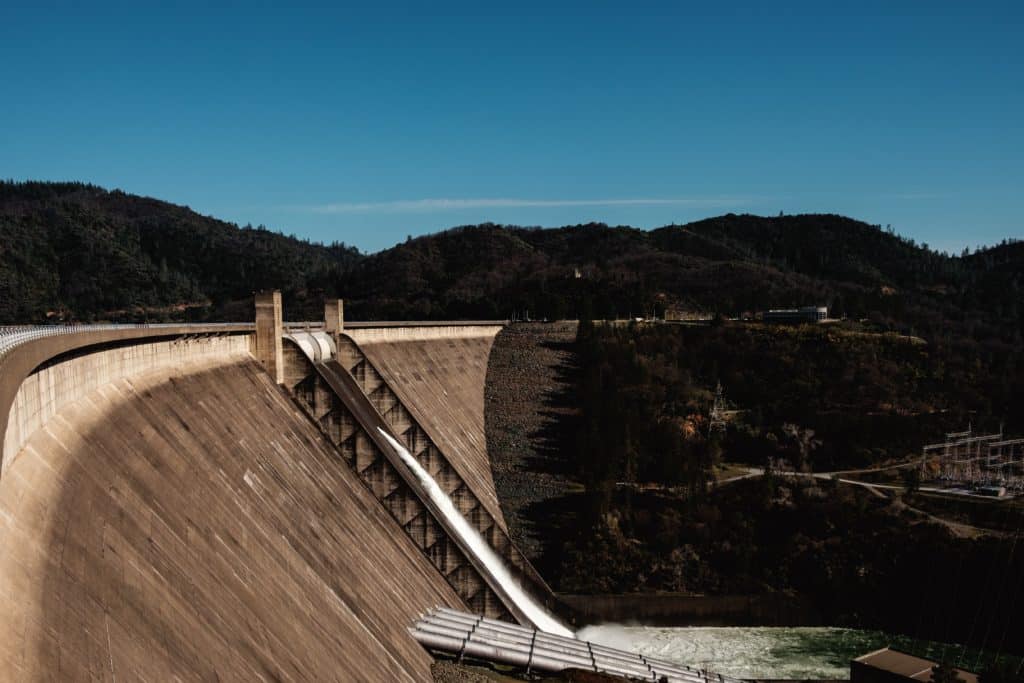
Like much of California, Shasta County has received drenching storms over the past week.
That influx of precipitation means careful monitoring of the state’s man-made water infrastructure which includes the Central Valley Project, a 400-mile-long network of dams, reservoirs, canals, and hydroelectric power plants that’s central to managing California’s water.
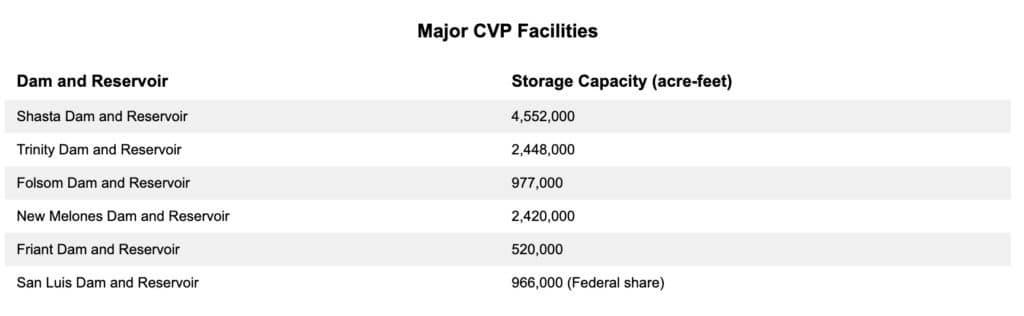
In Shasta County, the federal Bureau of Reclamation (“Reclamation”) began construction of the Central Valley Project’s keystone facility, Shasta Dam, in 1938.
The 652-foot high cement dam holds back water from the Sacramento, Pit, and McCloud Rivers that would otherwise flow unimpeded down the Sacramento River.
Storing water behind the Dam in the Shasta Reservoir allows federal officials to release this valuable resource only when the government determines it’s most needed.
That’s particularly important to users within the Anderson Cottonwood Irrigation District, or A.C.I.D., whose summer irrigation allocations come from Shasta Reservoir. Over the last week, some community members have used the A.C.I.D. Water Users Association Facebook group to express concerns about water releases from Shasta Dam since winter rains have started.
In response, Shasta Scout reached out to Donald Bader, Northern California Area Manager for Reclamation, which manages Shasta Dam. Here’s what we learned.
How Is Water From Behind Shasta Dam Being Used?
Bader says balancing competing demands for Shasta Reservoir water isn’t easy because of the number of federal and state laws and water contracts that regulate how Reservoir water is used and when and how it can be released.
Releasing water via Shasta Dam serves multiple purposes, including managing flood risk, generating hydroelectric power, and providing access to water for environmental benefit and agricultural use.
“We got our contractual allocations,” Bader said, “But we’re also obligated to meet all the regulatory environmental needs. We got demands coming from all directions.”
How Much Water Is Released During Winter Months?
From November through February each year, state law requires Reclamation to manage water in the Shasta Reservoir in a way that supports the release of a minimum of 3,250 cubic feet per second (CFS) (average) daily into the Sacramento River. That daily minimum was set by California’s State Water Resources Board’s Order 90-5 in 1990. It’s intended to protect fish and wildlife downstream of the Dam.
Importantly, Order 90-5 dictates water releases not from Shasta Dam, but from the smaller Keswick Dam.
Water released from Shasta Dam flows into the Keswick Reservoir before reaching the 157-foot Keswick Dam nine miles downstream. Keswick serves as an “afterbay” dam, allowing water managers to regulate Shasta Reservoir water releases in a way that ensures a consistent flow of water downstream into the Sacramento River for environmental benefit.
“It’s really the only reason Keswick was built,” Bader explained, “to be a regulating reservoir. A lot of your big dams have the same setup.”
A.C.I.D. General Manager Jered Shipley describes Keswick’s regulatory effect this way:
“If you think of Shasta and Keswick as one big Dam . . . Keswick is the onramp to the freeway. . . . (the two reservoirs are) essentially one large reservoir with a regulating point.”
Notably, daily average water release rates from Shasta Dam may vary as long as releases from Keswick Dam remain constant at the 3,250 CFS required by law.
Water Releases Are Measured By Speed, Not Volume
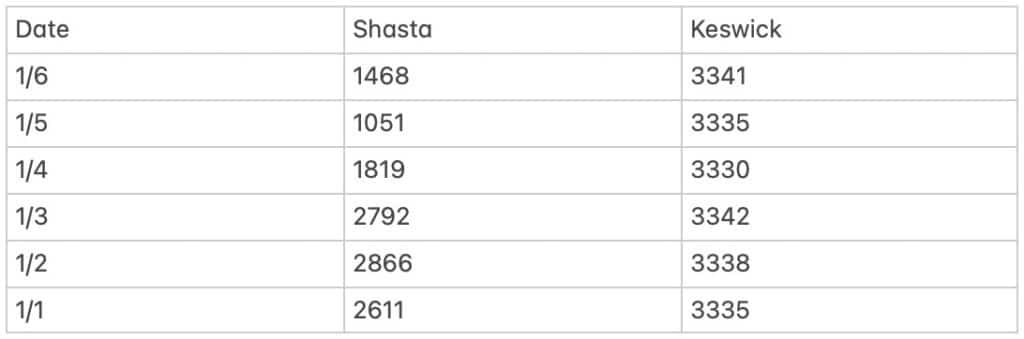
Those increases in power needs across the grid, said Berry, are what result in surges of water releases from the Dam. Releases from the Shasta Reservoir may flow much faster than the minimum average daily release of 3,250 CFS but it’s important to remember that they only occur for a relatively short period of time.
While Keswick Dam is releasing water at a constant 24-hour rate of 3,250 cubic feet per second, Shasta Dam is releasing water only intermittently but sometimes temporarily at much higher flow rates.

For community members trying to monitor water releases from the Shasta Reservoir, understanding how the two Dams release water at different times and flow rates to create a consistent volume of water moving downstream can create significant confusion. The occasional higher-flow-rate water releases from Shasta Dam can easily be misinterpreted as implying a greater total volume of water released over a 24-hour period.
It’s important to remember that cubic feet per second or CFS is a measurement of flow rate, not volume, which is why data from Reclamation showing fast CFS rates does not necessarily indicate high volumes of water released. The total volume of water released in a day is a function of both how quickly it is released and for how long. Keswick Dam’s minimum daily water release, 3,250 CFS, equals a total daily water volume of 6446 acre-feet. An acre-foot is roughly the volume of water needed to cover a football field to a depth of one foot.
For those who’ve fished at Keswick Reservoir, Berry says, the differences in the speed and timing with which the two Dams release water can be seen in the dramatic changes in Keswick Reservoir levels.
“Sometimes you’ll head out fishing and when you come back several hours later through the same channels there’s huge rocks everywhere that were underwater when you started out,” Berry explained. “They’ve turned off the valve at Shasta Dam but at Keswick the water is still releasing at a constant rate like it always does. And that drops the level of the Keswick Reservoir.”
What about Water Releases For Flood Control?
As of January 7, Shasta Reservoir has risen to 37% of capacity; an increase of 3% just over the last week.
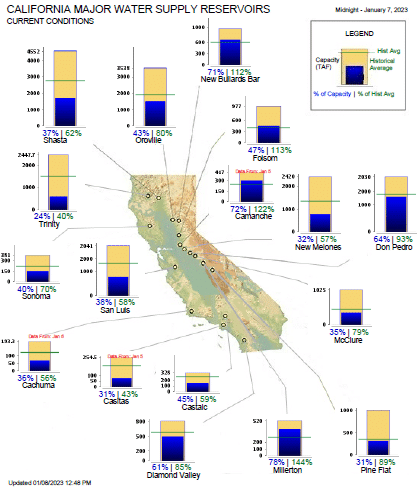
But it’s not until the rains raise Shasta Reservoir levels into the 70 – 75% percent of capacity range that Reclamation will institute flood operations, Bader said. Flood operations require Dam managers to work hand-in-hand with the Army Corp of Engineers, which manages flood control for California’s dams and rivers.
Careful timing of increased releases from both Dams is necessary to insure water releases protect those downstream, Bader said.
“We have a flood curve from the Army Corp of Engineers that we follow when we go into flood ops,” Bader said. “We’re managing the flow of water, timing it so it doesn’t increase flooding (too much) downstream.
Keswick Reservoir is primarily fed by releases from Shasta’s Reservoir, but also receives water from other sources. While no increased releases from Shasta Dam are planned, significant increases in side flow from those other sources may result in higher water releases from Keswick over the next few days and weeks, Reclamation Public Affairs Officer Mary Lee Knecht said.
That won’t change Reclamation’s intent to save as much water behind Shasta Dam as possible, for summer use, Bader said.
“Sometimes we have to release a little bit more on a day or two . . . (but) we’re saving every bit of water for storage that isn’t needed for that minimum release.”
Do you have a correction to this story? You can submit it here. Do you have questions or comments? Email us at editor@shastascout.org
Author

Related Articles
Wintu people say proposed reforms to a state list of tribes is erasure, threatens their homelands
A state commission’s proposal to remove Wintu and other federally non-recognized tribes from a consultation contact list would leave cultural sites vulnerable to destruction, tribal members say, and represents a form of unconstitutional discrimination.
Decision on city financing for the Ironman competition tabled by Redding City Council
The council’s decision followed a tense discussion on financial spending. The item will be brought back into discussion on Feb. 17. An Ironman official says he’s not concerned about the delay.
Shasta man had illicit marijuana grow and underground bunker in addition to illegal weapons, CHP says
A press release from the California Highway Patrol alleges that Michael Kamfort was operating an illegal grow when he was arrested on weapons charges, including manufacturing a “ghost gun,” on Tuesday in Anderson.