
Shasta County Elections Will Incorporate Both Voting Machines And Hand Counting; Costs Remain Largely Unknown
Supervisors are moving towards an elections process that doesn’t yet have legal parameters in place: a full manual tally of the County’s votes. Last Thursday, April 6, Supervisors also spent $800,000 of the County’s General Fund money to pay for a new electronic voting machine system in order to comply with state and federal voting rights laws.The County’s full cost for recent changes to the election process is still unknown.

Last week, the Shasta County Board of Supervisors finally chose an electronic voting machine system to replace the County’s contract with Dominion Voting Machine Systems.
They’re going with Hart Intercivic, an Austin-based company that’s one of only three voting machine systems that are approved for use in California.
The three-year contract with Hart included the purchase of seventy-five accessible voting machines and other election hardware, software licenses and services at a cost of just under $1 million.
During a March 28 presentation to the Board, Karen Clakeley, Hart’s Executive Director of Market Development, told Supervisors that her organization is excited to partner with the county to ensure a “secure, transparent, and honorable (voting machine) system.”
“You should be proud of the work that is done here in Shasta County today,” Clakeley continued. “Really some of the best practices and best standards that we have in the industry.”
Supervisor Patrick Jones and some members of the public have repeatedly expressed concerns that all electronic voting machine systems could facilitate election fraud by allowing access from outside agents, including, some say, Chinese government officials.
On April 6, Terry Rapoza, an activist with the secessionist State of Jefferson movement, told the Board he’s convinced that voting machines are dangerous to democracy.
“There’s a tremendous problem with the machines,” Rapoza said.
“They can be programmed in a certain way, that’s been proven. The programmers have control. We’ve all heard of the back door, the back door to these machines can be controlled by China. They’re all made in China. The chips are made in China.”
While there’s no indication that Jones has changed his mind about the safety of electronic voting machines, it’s clear he’s become convinced that the County’s legal safety depends on using them.
State and federal voting rights access law, including the Help America Vote Act or HAVA, protect the rights of people with disabilities to vote privately and independently. And those laws require the use of at least one electronic ballot marking devices at each precinct.
Disability Rights California is a state-wide nonprofit that has been advocating for the rights of Shasta County voters with disabilities since the Board canceled the contract with Dominion in January.
Fred Nisen, Managing Attorney for the DRC’s Voting Rights Access group, told Shasta Scout by email last week that the Board’s newly established contract with Hart Intercivic represents forward movement towards fair voting access for all.
“Under the circumstances,” Nisen wrote by email, “this is a good outcome for voters with disabilities. We will continue to monitor the situation closely.”
Paying for the contract with Hart required an amendment to the County’s General Fund budget to allow for an additional $800,000 more than was previously budgeted for the elections process.
Shasta County Auditor Nolda Short told the Board the money to pay for election’s funds would come from whatever part of the General Fund budget the Supervisors decide to take it from.
Notably, supervisors did not discuss how increased election spending would impact other General Fund priorities before voting.
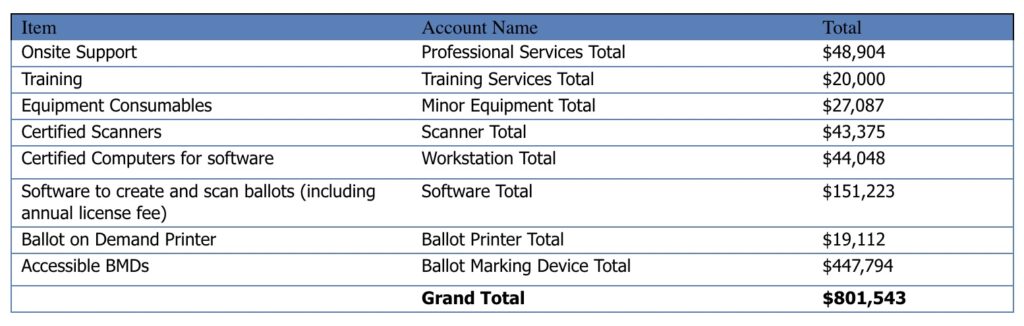
Last Thursday, County Auditor Short also told the Board it’s not yet clear how much additional County costs will be incurred by the decision to hand count. She told Shasta Scout by email later that it’s been difficult for County departments to estimate those costs because so little is known still about how the process will work. That’s because there’s still not an approved process under California law for how to conduct a County-wide manual tally.
During statements to the Board on March 28, California’s Deputy Secretary of State, Susan Lapsley, indicated that the Secretary of State’s Office is working on drafting regulations for the process. Once those regulations are released, Shasta County will have to approve a policy that meets them and pass State certification in order to be utilized.
Supervisor Tim Garman reluctantly voted for the increased elections cost but reiterated his former statements that his fellow supervisors have “put the cart before the horse” in this process.
“I just want to say that I have no idea where the money for this is going to come from,” Garman said, referring to the additional $800,000 of General Fund monies the County will spend on elections.
”I don’t know what this (hand counting process) is going to do and we don’t know where this (this hand counting process) is going to end up,” Garman continued.
“But we have no choice at this point but now to support the Registrar’s office and approve this and get the money to them so they can do what they need to do. And somehow we’re going to have to figure out how to pick up the pieces because I can tell you, and you all know it, that the MyPillow guy is not going to fund any part of this. Let’s be real.”
Garman was referencing previous promises by Supervisor Kevin Crye that MyPillow CEO Mike Lindell would help fund the County’s financing of a hand counting process as well as any legal action that resulted from it.
Some members of the public asked about the Lindell funds, as the Board prepared to vote on additional election spending. So did Supervisor Rickert, whose repeated and pointed questions finally elicited an answer from Crye, who said there’s been no need for Lindell’s funding because the County has pursued an above-board process and is not at any legal risk.
“We’re not going to get sued,” Crye said, likening fears of voter disenfranchisement to fears of drowning ten miles from a lake. “I have complete confidence working with Ms. Darling (Allen’s) office.”
Rickert said the Supervisors decision attempts at fixing an elections system that was never broken in the first place is not only frivolous spending but one that puts the rights of all voters at risk.
“Trust is a word that comes up frequently in this board room, Rickert said. “And I just want to say, I want to get it on the record that I don’t trust hand counting. It’s been proven, it’s not as accurate, it’s not as safe as machines. . . . “
“I’m really deeply concerned,” Rickert continued, “about the efficiency and timeliness of a hand counted election. We have a huge population and it’s my understanding that there’s no other County of this size that would undertake this procedure by hand counting versus machines.”
“And I feel like you’re almost, kind of, setting up the elections office to fail,” Rickert said, “and I’m truly troubled by that.”
If you have a correction to this story you can submit it here. Have information to share? Email us: editor@shastascout.org
Author

Related Articles
California lawmaker James Gallagher announces run for Doug LaMalfa’s seat in Congress
The assemblyman was speculated to be a frontrunner for the late congressman’s seat. He’s running with the support of the late Congressman’s wife.
Activist Jenny O’Connell-Nowain says she’ll accept jail time for disrupting a public meeting
O’Connell-Nowain was convicted by a Shasta County jury about a month ago. Today, a county prosecutor recommended that she be placed on informal probation which would require her to agree to follow county meeting policies, something she was not willing to do.
Shasta HHSA Director calls for fewer meetings of a mental health board tasked with overseeing some of her work
The Mental Health Alcohol and Drug Advisory Board is a state-mandated group that provides advisory oversight of county mental health programs. During an informal meeting yesterday, county staff strategized about how they feel the board should function.