
First A Racist Slur, Then Protest: First Amendment Rights Take Center Stage In Shasta County Board Meeting
Local justice organizations are criticizing Shasta County Supervisor Patrick Jones for allowing the use of a racist slur during public comment earlier this week. They’re also concerned about his subsequent decision to have a Black man removed from the meeting after he protested the racist speech. Jones said his decisions are backed by the First Amendment and Board policy. Here’s what the First Amendment says, and why it matters.
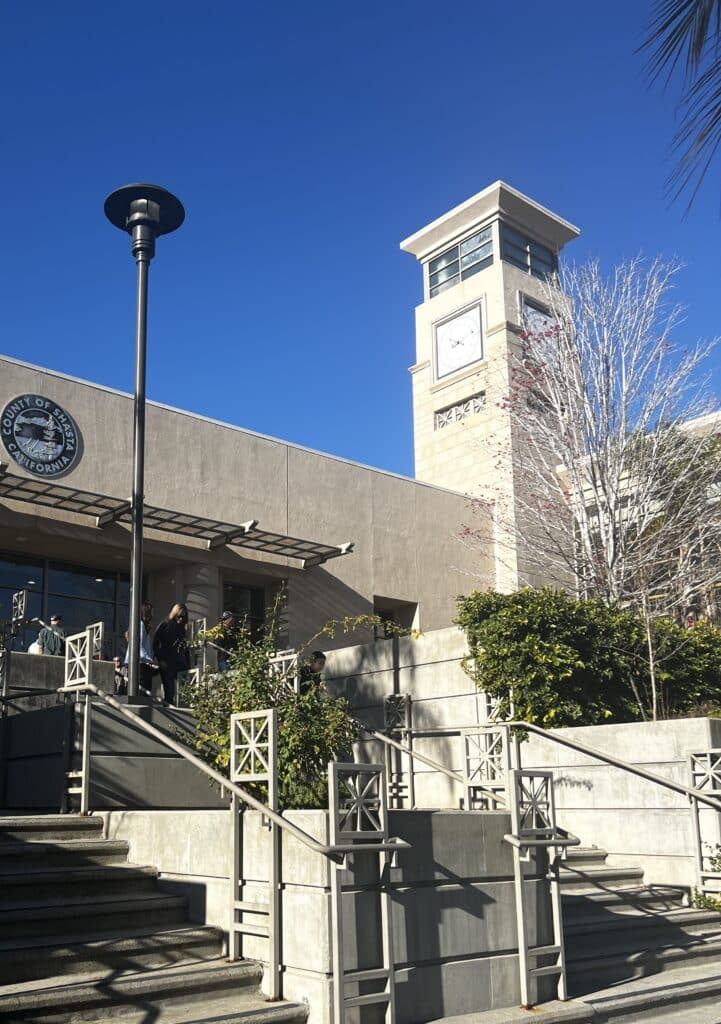
Alex Bielecki is a frequent public speaker during Shasta County’s public meetings.
But at the Board’s last meeting, as Bielecki spoke to the Board about whether to amend County zoning codes to allow for tiny home permitting, he veered into racist speech.
“I’m not a fool. I’m not a n*****,” Bielecki, a White man, told the Board, using a racist slur as he explained how he came to his position on the topic. His statement was met with immediate gasps from the public, to which Bielecki responded with an emphatic, “That’s right!”
In the front row, Nathan Pinkney, a Black man who’s become well known in Shasta County for his local political activism, immediately spoke up.
“Shut the hell up,” he said loudly to Bielecki as several other voices in the room yelled out similar sentiments. “Shut up.”
“Make me,” Bielecki responded, flashing his middle finger at Pinkney.
Since the May 30 meeting, Shasta County Supervisor and Board Chair Patrick Jones has come under fire for allowing Bielecki’s use of the racial slur in the public forum. A decision, he says, which was dictated by the First Amendment’s free speech protections.
His intentionality about protecting Bielecki’s First Amendment rights stands in sharp contrast to a decision he made later in the meeting, to have Pinkney removed from the Board room after he verbally protested Jones’ handling of the racist slur incident.
Jones said the decision to have Pinkney removed from the meeting was based on a Board policy against disruptive behavior. But Pinkney’s right to attend the meeting is also protected by the First Amendment, and California’s Brown Act.
Those two decisions by Jones, first to allow racist speech by a White man during public comment, then to remove a Black man for protesting that speech from the Board floor, have triggered widespread community outrage in Shasta County.
On Wednesday, May 31, several local justice groups, including the United Way of California, the Shasta Equal Justice Coalition, and Shasta County Citizens Advocating Respect (SCCAR), released statements about the events, calling on community leaders to promote civil discourse that protects community members from hate and violence.
Some of those statements said the decision to allow the use of a racist slur in a public meeting was wrong.
But David Loy, Legal Director at the First Amendment Coalition, who spoke to Shasta Scout by phone yesterday, says Jones was right to have protected Bielecki’s freedom of speech when he used the racist slur during public comment.
“No matter how offensive or hateful it may be,” Loy say, “If he’s talking about a particular agenda item, and he’s on topic to that agenda item, then the Board is not allowed to censor or silence him simply because of the way he discusses it or the viewpoint he expresses.”
“The First Amendment does not have an exception for so-called hate speech,” Loy continued, “or speech which is profoundly offensive.”
While Bielecky’s use of a racist term was obviously “vile, despicable, and revolting,” Loy said, it’s also speech that’s clearly protected by the Constitution and important to allow in public settings.
The First Amendment doesn’t allow the government to define or outlaw hate speech, Loy said, in part because what is considered hate speech can change depending on who is in power.
“It’s very dangerous to give the government the power to define speech,” Loy explained. “Because it gives the government power to silence dissent, critique and protest.”
That’s where Jones likely went wrong, Loy said, by silencing Pinkney’s protest against the hate speech under the guise of keeping order.
The details of situations like these are very important, Loy said, because First Amendment rights in public meetings hinge in part on the balance between the public’s right to free speech and their right to conduct public business without disruption.
In order to remove someone from a public meeting the Board chair has to first warn the individual, and give them an opportunity to stop disrupting the meeting, Loy explained, which Jones did.
But officials also have a responsibility to protect the public’s right to be at the meeting, unless the disruption they are causing is actually making it impossible for the government to do business.
“Under Government Code section 54957.95,” Loy said, “A person can be removed from a meeting (but only) for actually disrupting, impeding or rendering infeasible the orderly conduct of the meeting.”
“That’s a pretty high burden,” Loy added, saying removing Pinkney from the meeting was only appropriate if his protest from the floor of the Board room was significant enough to actually disrupt the public’s business.
“From a First Amendment perspective,” Loy explained, “People have a right to attend and participate (in public meetings) and a First Amendment right not to be excluded unless they disrupt the meeting. Not every minor interruption rises to the level of a continual and substantial interruption that makes it impossible to run the meeting.”
Furthermore, Loy explained, if Pinkney was removed from the Board room for a level of disruption that others have engaged in without being removed, he’s also had his First Amendment rights violated in a second way, known as “viewpoint discrimination” or “unequal enforcement.”
Viewpoint discrimination comes in when policies are unequally enforced by public officials, which has the effect, intended or not, of providing unequal protection for certain people, viewpoints, or kinds of speech.
“If they’re routinely tolerating other forms of outburst . . . that’s a very troubling set of facts,” Loy said. “It suggests the possibility that (Board rules are) being selectively enforced against someone who objected to racist speech . . . which would constitute unequal enforcement.”
“If you’re going to have rules,” Loy continued “they have to be a) valid and b) equally applied across the Board.”
It’s also important to remember that while speech may be protected legally, that doesn’t make it acceptable ethically or morally, a distinction drawn by Shasta County Deputy CEO Mary Williams, who responded to a request for comment sent to newly appointed County CEO David Rickert.
In her emailed statement, Williams said Shasta County is committed to both protecting free speech and fostering an environment of safety and respectful communication.
“We firmly condemn the use of profane and discriminatory language during public comment sessions,” Williams wrote, alluding not to the legality of the speech, but its appropriateness in civil discourse.
“We believe in creating an atmosphere where all participants can express their views in a respectful manner,” Williams continued. “We encourage individuals to engage in civil discourse while exercising their right to free speech.”
Jones did not take a similar stand during the public meeting, focusing on free speech protections but failing to address the racist speech as destructive and reprehensible.
His failure to do so was a serious mistake, says Susan Wilson, who sits on the Board of Shasta County Citizens Advocating Respect (SCCAR).
“Any and every member of the BOS should have acted immediately to caution Alex Bielecki regarding the use of the word in the Chambers in the BOS meeting,” Susan wrote to Shasta Scout by email.
“It is my sincere hope that the members of the BOS and their staff have a discussion about how to address this issue if it should come up again, and to take steps to keep it from coming up again if possible. This is an ideal time for David J. Rickert, our new Chief Executive Officer, to help our Board of Supervisors develop some standards of decorum for their meetings.”
Shasta County’s Board policies already prohibit the use of “threatening, profane or abusive language which disrupts, disturbs or otherwise impedes the orderly conduct of the Board meeting.” Those policies also allow the Board Chair to remove from the chamber any person who is disruptive to the meeting.
But Board policies don’t take precedence over California’s Brown Act, or the First Amendment, Loy emphasized. And those policies may not be valid if they violate individual rights to free speech and public meeting access.
Instead of stopping offensive public speech Loy explained, the Board’s best recourse is to stand up to that speech with verbal rebuke.
“The Chair, the Board, the (public) is free and encouraged to share their point of view,” Loy said. “Speak back to the commenter saying you may have the right to say that but we don’t think you should.”
“That’s how the First Amendment works,” Loy continued.
In a May 31 statement about the incident, the Shasta County Equal Justice Coalition called on local leaders to offer that kind of active rebuke to racism, saying failing to do so will limit Shasta County’s progress towards justice.
“The SEJC envisions a Shasta County where there exists equity and justice for every community member, inclusive of all identities, backgrounds, or circumstances.”
“That possibility is constrained when derisive speech . . . remains unchallenged. Particularly in public forums where critical decisions about public safety, education, and well-being are discussed.”
If you have a correction to this story you can submit it here. Have information to share? Email us: editor@shastascout.org
Author

Related Articles
ROV Curtis claims scheduling issues are preventing him from complying with state law to shred November 2024 ballots
The ballots were supposed to be retained only through Sept. 5, but they still haven’t been destroyed, allegedly due to a series of scheduling missteps and delays.

As gray wolves reemerge in Shasta, humans look for ways to address threats to livestock
Long eradicated from Northern California, gray wolves are reappearing — but their new habitat also means new threats for ranchers whose livestock provide easy prey. Efforts are being made at the county, state and federal levels to find solutions that allow for coexistence between people, their livestock and wolves.

Shasta board removes Kerns as planning commissioner amid contentious debate
County Counsel Joseph Larmour said Planning Commissioner Steve Kerns was being removed without cause. Supervisors who attempted to delve into what was behind Kerns’ removal received pushback from the county’s attorney.