
Judge Sets New Hearing Date in Lawsuit Against Shasta County Elections Office
A second day of witness testimony intended to support Laura Hobbs’ claims that Elections Office errors impacted her race, ended without closing arguments. The county’s attorney said he will ask the judge to dismiss the case or issue a judgment without trial.
An attorney for Laura Hobbs finished initial questioning of witnesses during a hearing in the Shasta County Superior Court on Wednesday, June 12, but so far no ruling has been released in the case.
The hearing relates to a lawsuit filed shortly after the March 5 election, in which failed candidate for supervisor Laura Hobbs claimed that elections errors affected the outcome. She lost to Allen Long who received fourteen votes more than the 50% plus one vote needed to win the primary. He’s scheduled to take the supervisor seat currently held by Tim Garman, early next year. Hobbs has asked the courts to invalidate the primary results instead, and allow the race to go to a runoff in the fall.
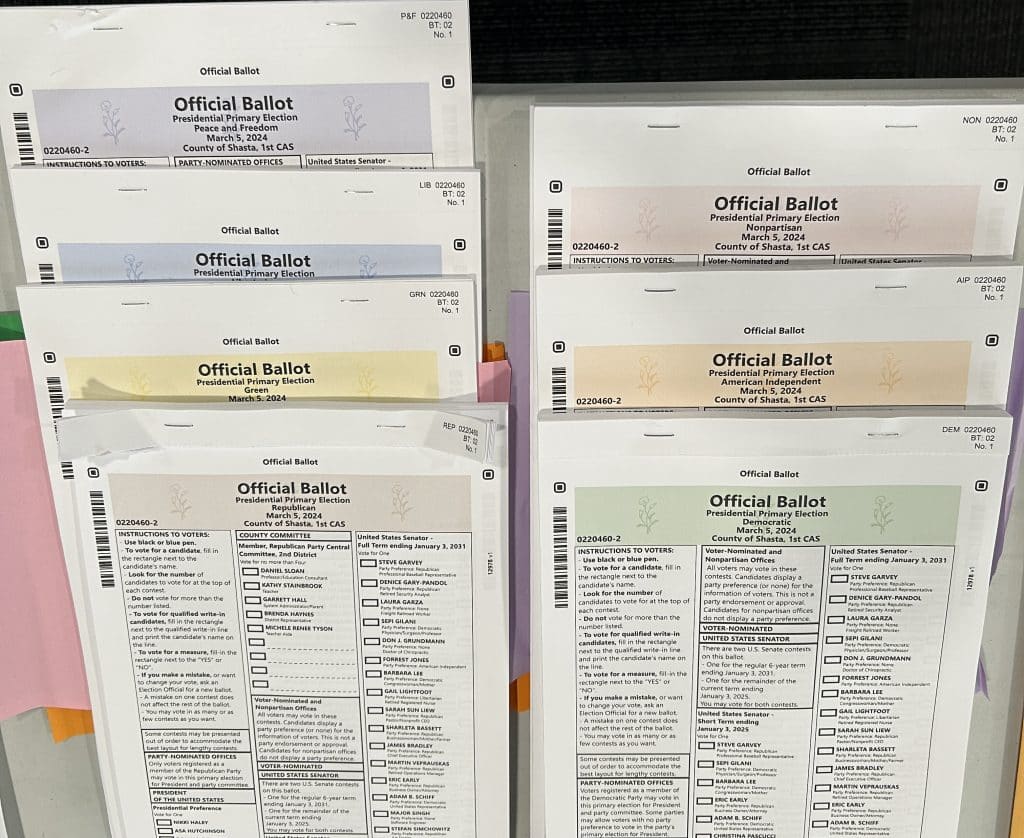
Alex Haberbush, the Long Beach attorney who is representing Hobbs in the case, interviewed eight witnesses over the two day hearing. Their testimony touched on a wide range of potential election concerns, but only documented evidence of one error, related to the random alphabetization draw used to determine the placement of names on the ballot.
About four hours of witness testimony was provided by Assistant Shasta County Clerk and Registrar of Voters Joanna Francescut, who acknowledged what her attorney had previously told the courts, that she and her staff had failed to correctly apply the random alphabetization system on the March 5 Shasta County primary ballot.
The error that occurred on the March 5 ballot became more clear during Francescut’s cross-examination. There are two different random alphabet draws used on California ballots, one that’s determined by the Secretary of State’s Office and another which is determined at local elections offices.
Counterintuitively, Francescut testified, the local random alphabet draw is not supposed to be used to determine the placement of names for most local races. Instead, placement of names for the board of supervisor races is supposed to be determined by utilizing the state’s random alphabet draw. The correct use of randomized alphabetization on ballots in California is not a hard thing to understand, she said, but it goes against many people’s idea of how the process should work.
For the March 5 primary, Francescut said, election staff incorrectly applied the local random alphabet draw instead of the state one to local races across the ballot, including the one Hobbs lost. The mistake is something Francescut says should have been caught during ballot proofing by her and other supervisors, but wasn’t. Hobbs argued in her lawsuit that the incorrect placement of her name impacted the outcome of the race because she appeared farther down on the list of names than she would have otherwise.
Haberbush did not present any expert testimony related to whether that error might have affected the race’s outcome, or by how much. Instead, he sought testimony that might provide evidence that the name misplacement showed negligence by staff, or was intentional. Both Francescut and Anna Rodriguez, another elections employee who testified, said the misplacement was an unintentional error.
In response to questions, Francescut said several special circumstances affected the complexity of ballot development earlier this year. The March 5 election was only the second time she knows of that the Shasta County Elections Office has been responsible for the layout of ballots in-house. The first was for the November 7, 2023 special election. Layout of the March 5 election was much more complicated, Francescut testified, and included thirty-five different ballot versions compared to two in the special election. New election laws that took effect January 1, Francescut added, also significantly affected the layout and wording of ballots. That new wording was where her focus was during proofing, Francescut said, when she failed to catch the error.
Other Testimony
Other witnesses called to the stand included Steve Umfleet, a retired data scientist who has made a “serious hobby” of studying data related to elections, including Shasta County elections. He offered general information related to his review of a spreadsheet of audit logs from the March 5 election. Attorneys argued over whether Umfleet should be offering testimony in the case and Judge Stephen Baker asked Haberbush at once point why Umfleet’s opinion on audit logs should carry any more weight than that of “the paper boy down the street.”
Haberbush and his co-counsel Deborah Pauly also questioned four election observers: James Burnett, Antonia Palacio, Ralene Stein and Richard Gallardo.
Burnett, a retired research librarian from Shasta County, said that his observation of machine ballot counting showed what he felt were surprising anomalies in the process of ballot counting. He said out of the thirty-eight ballot batches he observed being machine counted, the majority needed to be re-run through the machine. He was also surprised by the way those batches were identified by number when they were re-run, he said. No testimony or evidence to corroborate or help explain Burnett’s claims was provided.
Stein, a homemaker and homeschool educator who traveled from Sonoma County to observe part of the 1% manual tally in Shasta County, told the court that policies at the Elections Office made direct observation of ballot markings during the recount, impossible. She acknowledged that she did not know if the law is supposed to provide her that direct access during the 1% tally.
Palacio, a retired retail worker and current caregiver from Shasta County said she was unable to engage during her observations at the elections office because she couldn’t see or hear what was happening. She also could not recall in which month the elections occurred without being reminded by Pauley.
Gallardo, a former military law enforcement officer living in Shasta County, said he observed poll workers failing to have two poll workers working together each time ballots were handled prior to delivery to the Elections Office. He also said he saw poll workers fail to seal the large box that smaller sealed ballot batches were placed in prior to delivery. No testimony or evidence to corroborate Gallardo’s claims was provided.
Due to the length of witness testimony, attorneys did not have time to submit final arguments in the case within the two days allotted for the hearing. Instead, they were told to submit final briefings on the case before June 19 in preparation for what could be a final hearing on June 25 at 9 a.m.
The county’s attorney said he will ask the judge either to dismiss the case or issue a summary judgment in the county’s favor, instead of allowing the case to go to trial.
Do you have a correction to this story? You can submit it here. Do you have information to share? Email us: editor@shastascout.org
Author

Comments (14)
Comments are closed.
Related Articles
Meet Erin Resner for Shasta’s District 1 supervisor
There are three candidates running for Shasta County’s District 1 board seat. Erin Resner says she’s running to give the public an alternative to current Supervisor Kevin Crye.
Registrar of voters accuses Vermont activist of harassment at Shasta County Elections Office
Steve Dodge was in Redding to speak at a nonpartisan election-related event. Hours before the event began, he approached ROV Clint Curtis at the elections office, probing him repeatedly with questions while filming. Curtis called the police, referring to the incident as a “conspiracy to intimidate voters.”
Cascade Union Elementary School District fills two of three vacancies, restoring a working board
The Cascade Union Elementary School District recently lost three of its five board members, prompting the Shasta County Board of Education to temporarily appoint Jackie LaBarbera. The board is functional again but it’s unclear when LaBarbera will step down.

Undervotes and overvotes are still cast ballots, but not cast votes. “Ballots” and “votes” are not used interchangeably, even if the election software incorrectly assumes so. I would again point you to §15154(c).
I am not saying ballots with undervotes and overvotes are not cast ballots. I am saying that EC 8140 includes the words that the ballots are “cast for candidates for that office.” And, I believe all county elections officials interpret this to mean that cast ballots that do not have a vote marked for a candidate for an office are not a ballot cast for a candidate.
We are just going to have to agree to disagree until a court is asked to rule on the meaning of this statute.
Jay D. Not sure how you manipulated your count of the Statement of Votes cast, but here’s what I have for D2, March 5, 2024. Voter Registration: 23,278. Ballots Cast: 11,713. Turnout: 50.3. Allen Long-5410. Laura Hobbs-2063. If you subtract carefully you get 3347 as the difference between Long & Hobbs. to me that’s a clear win for Mr. Long. Even if you count the under and over votes , it’s not going to make a diff. In fact Mr. Long won both the City of Redding and County precincts. Was it because of his non-partisan sane and sensible approach ? And not the use of the partisan word MAGA on Hobbs signage ? There will be no run-off. See you at the swearing in of Mr. Long at the first meeting in January 2025.
You found the right numbers. The only way to “win” election in a primary is to get a majority of BALLOTS CAST (election code 8140). A majority of the 11,713 ballots cast is 5,857, but Long got only 5,410.
The top 2 candidates should therefore go on to compete in November’s general election just like all the other primaries where one candidate has a large lead but not >50% of ballots cast…
It pains me to see so many good people reflexively backing the ROV’s multitude of mistakes out of a misguided notion of protecting election integrity rather than protecting actual election integrity by simply following the law.
Mr. Dagget:
EC 8140 says:
“Any candidate for a nonpartisan office who at a primary election receives votes on a majority of all the ballots cast for candidates for that office shall be elected to that office.”
An undervoted ballot is not a ballot cast for a candidate for the office. The Registrar of Voters did not make a mistake by excluding undervoted ballots in its calculation.
Undervotes are defined in the Elections Code Division regarding the conduct of the canvass and recounts, as follows:
EC 15342(f)(4)
“For purposes of this subdivision, ‘undervote’ means a ballot on which a voter failed to cast any vote for a specific office or failed to cast the maximum number of votes permitted, as detected by an electronic, mechanical, or other vote-tabulating device.”
The election code uses “ballot” and “vote” as two distinct things.
§11385 says the recall candidate with the highest number of VOTES wins.
§15450 says the general election candidate with a plurality of VOTES wins.
§8140 doesn’t say plurality or highest number of VOTES, it says “votes on a majority of all the BALLOTS cast”
§15154(c) further reinforces the legislature’s intent by saying explicitly overvotes & undervotes shall not be counted as VOTES, but the BALLOTS shall still be counted.
Skipping the general election is an incredible privilege for a primary candidate (one not granted until §8140 was created in 1994) and the legislature clearly intended for that privilege to be bestowed only on candidates who received support from a majority of voters voting in that district. Allen Long fell short of that threshold.
Mr. Daggett:
You are only quoting a portion of the statute.
EC 8140
“Any candidate for a nonpartisan office who at a primary election receives votes on a majority of all the ballots cast for candidates for that office shall be elected to that office.”
If a ballot does not have a vote marked for one of the candidates, then it is not a ballot cast for a candidate for the office. If a voter wrote the name of an unqualified write-in candidate on their ballot, then it is not a ballot cast for a candidate for that office.
I understand you want to read it differently by stopping at the word “cast.” But I believe every county elections official in the State of California reads this statute to mean that undervoted ballots are not included in the calculation. If you find a county elections official who agrees with you, please let me know.
“She lost to Allen Long who received fourteen votes more than the 50% plus one vote needed to win the primary.”
13 more votes, not 14. There were 10,792 votes counted so he needed half (5,396) plus one (5,397). He received 5,410 so subtracting 5,397 = 13
And if you want to be most accurate, Allen Long really only got 48.6% of ballots, not 50.13%, and probably should be going to a runoff anyway. There were actually 11,129 ballots cast in District 2, not 10,792 (337 “undervotes” were left blank and excluded).
Jay: Have you fat-checked your percentages with the Elections Office? What do they say?
You can see the numbers on page 68 of the official statement of vote ( https://assets01.aws.connect.clarityelections.com/Assets/Connect/RootPublish/shasta-ca.connect.clarityelections.com/Election%20Results%202000-Present/2024/0305/Full%20SOV%2003.05.2024.pdf ).
5,410 out of 10,792 votes counted = 50.13%
5,410 out of 11,713 ballots cast = 46.19%
8140. Any candidate for a nonpartisan office who at a primary election receives votes on a majority of all the ballots cast for candidates for that office shall be elected to that office.
(Last night I incorrectly said 11,129 ballots – a tally I got after manually summing 337 undervotes recorded during from the hand tally of district 2. But that was only a partial recount/audit; there were actually 917 undervotes and 4 overvotes in district 2 ).
I wish you would have hit on one take away in the Gallardo testimony.
He was asked directly, under oath if he had a concealed firearm on him the day he was there, which was the same day he pepper sprayed Nathan Pinkney and according to Pickney, RPD took a weapon off him.
Gallardo said “No”
Could be very interesting if other facts come to light.
Thank you Annelise. I can’t begin to tell you how much I appreciate your reporting. Keep up the good work.
I have lived and voted in District 2 for 45 years. I and many of my friends voted for Allen Long to represent us on the BoS. We are satisfied with the outcome of the election. Hobbs fails to understand that we don’t want her on the BoS representing District 2. She claims to have a fairly good education but can not accept this simple fact. Hobbs you lost!
Much ado about very little, at taxpayer’s expense.