
Across California, Data Gaps Related to Career Education May Contribute To Local Workforce Shortages
Coordination is in progress, but no one knows yet how well the money being poured into career education statewide is helping to fill labor needs for high priority fields, region by region.

Over recent years, California Governor Gavin Newsom has pushed significant funding towards high school career education, increasing the number of students enrolled in career pathways. The state’s current data, shared via the California School Dashboard, and College and Career Measures Report, focuses on how many students are involved in career education programs but doesn’t capture how well that education is working to resolve workforce gaps.
It’s an issue of great importance to the residents of Shasta, a rural, far northern California county with a population of about 180,000, where less than 24% of adults age 25 and older obtain a four-year degree. The steep sociopolitical barriers to university education that Shasta County students face, as well as critical labor shortages, particularly in the education and healthcare industry, increase the need for strong pathways between career education programs and workforce needs, county-wide.
Charlie Hoffman, who has spent the last eighteen years as the Superintendent of the Shasta-Trinity Regional Occupational Program, thinks Shasta County is succeeding overall at career education — due in large part, he says, to the area’s natural-resource-based economy and the community’s value for blue-collar work. But Hoffman says he finds California’s current lack of data requirements connecting involvement in career education to workforce-related outcomes, alarming.
“After all,” Hoffman explained. “You always get more of what you measure.”
Or don’t measure.
On a sunny afternoon last November, Hoffman strode through a variety of indoor and outdoor learning spaces at the Redding ROP campus, providing Shasta Scout an up-close view of students participating in classroom experiences that are designed to make them employable straight out of high school, while still giving them the option to attend college.
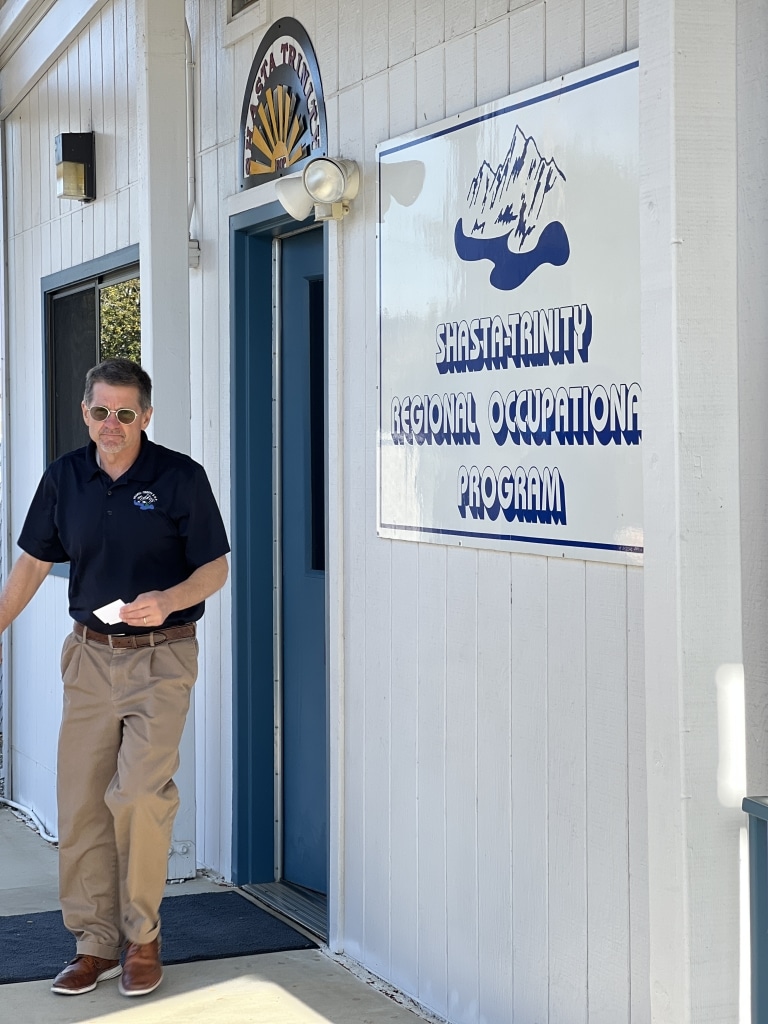
More than a decade ago, Regional Occupational Programs (ROP) like Hoffman’s, which had been part of California’s educational landscape for forty years, lost direct state funding as part of the rollout of California’s Local Control Funding Formula (LCFF). The Shasta-Trinity program still exists today due to direct support from six school districts, and new streams of state grant funding for career education.
Under LCFF, California began sending career education money straight to school districts, instead of ROP’s, leaving the decision for how to use that funding up to local boards. Some Trinity and Shasta County districts chose to stick with the ROP model, using their distribution of state funds to continue to support Hoffman’s program. Others, including Shasta Union High School District, decided to leave the ROP model and design their own in-house career education program.
Changes in the funding process for career education gave local districts more control but it also gave them more responsibility, without the same structure and accountability ROPs have been held to.
State law has long required ROP’s to meet documented labor market demands and develop career education programs in consultation with advisors from business, government agencies, trade organizations, and local workforce investment boards. Hoffman says his ROP uses employee advisory boards that include local industry representatives. The boards meet at least annually, sometimes quarterly, to help the ROP decide how to tailor its tracks towards workforce demands. In the automotive technology track, for example, Hoffman says feedback from the employee advisory board pushed the ROP to begin certifying students in two high-demand areas: brake light repair and smog checks, specifically to help fill local workforce needs.

Jim Cloney is the Superintendent of Shasta Union High School District (SUHSD). He told Shasta Scout he’s happy with a 2011 board decision that allowed SUHSD to design and implement its own in-house career education programs. More than 2,000 of SUHSD’s approximately 4,000 students are now enrolled in career education at SUHSD, the district says.
But Cloney acknowledged that SUHSD struggles to connect students from many of its career education tracks with local workforce jobs. For SUHSD students, a new collaboration between Reach Higher Shasta and the Shasta SMART Workforce center will help provide an initial connection for sixteen local students who will participate in paid internships in education and healthcare this summer. But the need for such initiatives highlights one of the biggest challenges of career education, finding ways to connect education experiences at a variety of educational institutions with local workforce gaps across broad, regionally-specific industries.
It’s a monumental task that requires strong state and regional coordination. California’s beginning to acknowledge gaps in that coordination, and the related data. The state recently announced the Master Plan for Career Education, which will establish regional career councils made up of workforce, education and employer representatives who will be responsible for distributing career education funding. The Plan will also be used to launch an information system that includes regional data for career education.
Anne Stanton, President of the Linked Learning Alliance, which works to connect youth to college and careers, said initiatives like the Master Plan for Career Education provide hope for change. When it comes to tracking what career education tracks are implemented by region, and how well those career education pathways are helping students fill workforce gaps, Stanton agreed that the state doesn’t have much to work with, yet.
“But I think there is growing understanding,” Stanton told Shasta Scout, “that it is very valuable to have this kind of information.”
The Master Plan will help determine which core metrics will be used for, among other things, promoting stronger career-education-to-workforce pathways throughout the state. California will work to track this data using another in-process initiative, the Cradle-to-Career (C2C) data system. Soon-to-launch C2C data analytics dashboards will “provide critical information to identify trends in education and workforce outcomes,” California says. The state hopes to track a number of different data sets, including high school learning experiences and local workforce needs.
C2C is largely focused on an electronic transcript for Californians that will capture learning experiences that occur in a variety of settings. But tracking how those experiences are contributing to filling local workforce gaps is another task, and one that may prove to be much more difficult.
The data itself is difficult to access, said Dr. Steve Klein, a Senior Expert in Career Education and Workforce Development for the Oregon-based nonprofit Education Northwest. Speaking to Shasta Scout by phone last week, Klein, who has over thirty years of experience working with federal and state agencies to design performance accountability systems for career education, said difficulty in collecting the data related to student outcomes in the years after they leave school is a problem not only in California, but nationally.
Tracking data from educational sectors into the workforce, Klein explained, requires using a unique student identifier like a social security number, which may raise security concerns, or using a complex “fuzzy matching process” like a mixture of name, birth date, and high school to create identifying profiles that can be tracked over time.
Klein also said it’s important to remember that which data California chooses to focus on will really matter, especially if that data is used to incentivize outcomes. For example, if you reward schools for how many students graduate with industry-certified credentials, Klein explained, you’ll likely end up with more students who end up specializing in a specific career track during their high school years, which could be positive but will also limit their opportunity to explore other learning options.
“I’m not against measuring outcomes,” Klein said, “but I think that we should be cognizant that what we measure is what people focus on. If we focus on getting a small number of students to achieve a given outcome (like industry credentials), we may lose the opportunity to have impact on a much larger group of students.”
Klein’s comments echo the mantra of Shasta County’s Reach Higher initiative, “Every Student, Every Option“, which focuses on graduating students who are prepared for whatever path they choose next in life be it college, a career, or the military.
It’s a fundamentally important goal, but in Shasta County the future of the community may rest on even more, the ability to direct high school career education programs towards meeting critical local workforce gaps. Otherwise, without the foundation of community essentials like adequate access to healthcare, it may be hard to convince today’s students to stay in the region to become tomorrow’s professionals.
California’s promised statewide systems of regionally coordinated career education and workforce data, could help.
This is the second story in a two-part series on rural education and the workforce. You can read the first story here. This reporting is part of a collaboration with the Institute for Nonprofit News‘ Rural News Network, and the Cardinal News, KOSU, Mississippi Today, Shasta Scout and The Texas Tribune. Support from Ascendium made the project possible.
5/16/24 4:45 pm: We have updated the story to correct an inaccurate reference to SUHSD’s total student population. We’ve also corrected a reference to the Reach Higher motto.
Do you have a correction to this story? You can submit it here. Do you have information to share? Email us: editor@shastascout.org
Author

Related Articles
Wintu people say proposed reforms to a state list of tribes is erasure, threatens their homelands
A state commission’s proposal to remove Wintu and other federally non-recognized tribes from a consultation contact list would leave cultural sites vulnerable to destruction, tribal members say, and represents a form of unconstitutional discrimination.
Decision on city financing for the Ironman competition tabled by Redding City Council
The council’s decision followed a tense discussion on financial spending. The item will be brought back into discussion on Feb. 17. An Ironman official says he’s not concerned about the delay.

Shasta man had illicit marijuana grow and underground bunker in addition to illegal weapons, CHP says
A press release from the California Highway Patrol alleges that Michael Kamfort was operating an illegal grow when he was arrested on weapons charges, including manufacturing a “ghost gun,” on Tuesday in Anderson.