
Anderson City Council passed a social media policy last week. A First Amendment expert has concerns
Knight First Amendment Institute staff attorney Jake Karr said Anderson’s new policy brings up constitutional questions, though whether the policy is actually unconstitutional or not is complicated.
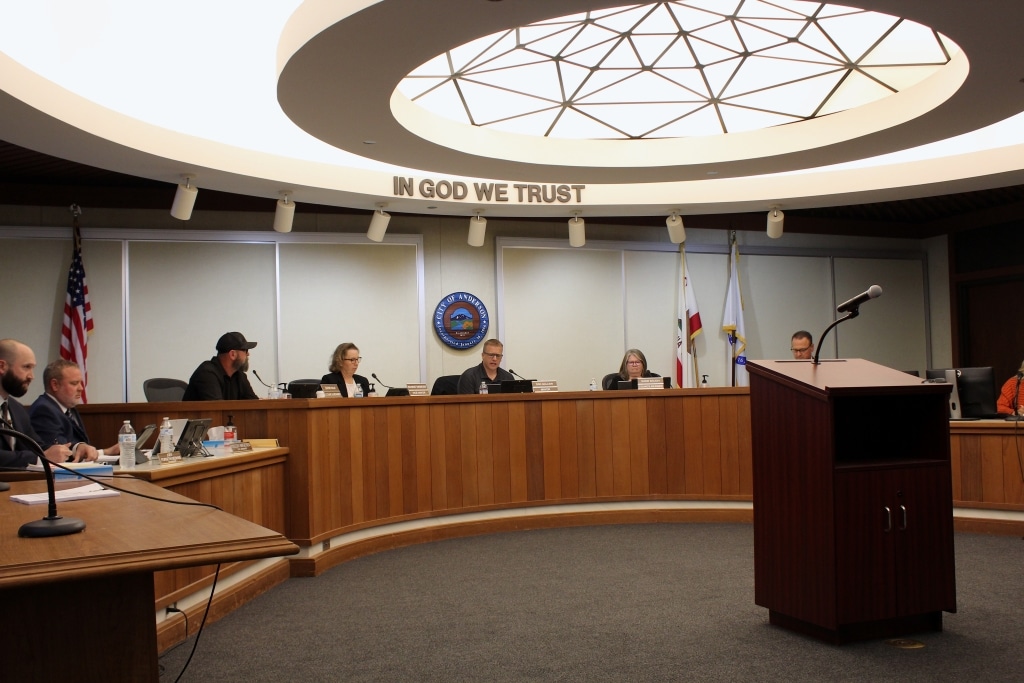
The Anderson City Council passed a social media policy last week that outlines guidelines for public officials and city staff when it comes to social media use.
But a First Amendment expert has concerns about the policy’s constitutionality.
City staff brought the drafted policy to the council on March 3, where it passed 4-1, with council member Darin Hale casting the dissenting vote. The policy was created in the wake of controversial posts made by Hale on his personal Facebook page, where he accused a local flight school of participating in Chinese espionage without proof. After the accusations, an official with the school reached out to the city asking leaders to adopt a policy related to statements by public officials.
Shasta Scout’s reporting about the social media policy last week highlighted the flight school’s response to the policy and how Hale’s comments have allegedly impacted the school. But it also brings up First Amendment concerns.
The newly-approved policy states that if a council member posts about city-related matters on their accounts, they have to clarify whether they’re speaking in their private or official capacity. It also prohibits public officials from using their personal social media accounts to speak on behalf of the city unless they’re authorized to do so.
The document was met with opposition from Hale at last week’s meeting, where he claimed that the provisions concerning public officials’ ability to speak on behalf of the city, and the requirement to state which capacity they’re speaking in when posting about city-related matters, are unconstitutional.
“You cannot stop someone from speaking, and you cannot force them to say something, period,” Hale said. He added that he will be refusing to clarify whether he’s speaking in a personal or official capacity on every one of his personal social media page posts discussing city matters.
Jake Karr, a staff attorney at the Knight First Amendment Institute at Columbia University, said the provisions Hale is concerned about do, in fact, pose concerns for city officials’ First Amendment rights.
“As much as the city has latitude to impose a policy on the use of city social media accounts by city officials and elected members of the city council,” Karr said, “they have much less latitude to try to impose restrictions on those same city officials’ use of their personal accounts.”
But First Amendment law is not black and white, Karr said, and deciding whether policies like these are unconstitutional or not can be complicated.
Anderson City Manager Joey Forseth-Deshais was unable to be reached for comment for this story.
What does Anderson’s social media policy say, and is it constitutional?
Anderson’s new social media policy comes after IASCO Flight Training Operations Manager Miranda Vorhis requested the city council to adopt such a policy in response to Hale’s unproven claims against the school and its students. Vorhis told Shasta Scout in an interview for a previous story that she hoped such a policy would curtail claims from public officials like Hale’s from being made in an official capacity.
“I’m pleased that the council voted in favor of adopting that policy,” she told Shasta Scout after the policy was passed. “I’m concerned that they’re going to have issues enforcing it, and I’m hoping that they have some kind of plan in place to be able to do that because, as Mr. Hale said on multiple occasions, it’s a policy, not a law, so he already stated he doesn’t intend to follow it.”
The seven-page policy document approved by the council explains that the purpose of the policy is to “ensure that the City’s social media channels best serve the needs of the community and meet legal standards,” as well as establish “oversight, administration, and management guidelines for departmental use of social media to further the goals of the City.” It applies to elected and appointed officials and other city staff.
The policy includes guidelines for social media accounts that officially represent the city, as well as the personal social media use of city officials. During last week’s meeting, Hale mainly took issue with a provision under a section of the policy that discusses city officials’ personal social media use, which is labeled, “Private versus Representative Capacity.”
“City Officials shall not use their personal Social Media accounts to speak on behalf of the City, unless authorized by the legislative body to do so,” the provision reads. “In communicating City related matters on their Social Media account, City Officials shall clarify when they are speaking in their private capacity and when they are speaking on behalf of the City.”
Hale said instead of requiring these actions by public officials, the city should just recommend them.
First Amendment legal expert Karr was provided with the social media policy before the meeting. In an interview with Shasta Scout prior to the council’s discussion, he said when he first read the social media policy, this section gave him pause.
Karr explained that he thinks the city has good intentions in making sure the public knows when an official is speaking in their official or personal capacity, but “it gets a little bit tricky when the city is trying to sort of mandate what officials or employees can and can’t say on their personal accounts.”
He also said that the phrase “City related matters” used in the policy is both broad and vague, making it difficult for officials to know when a personal post of theirs could trigger the disclaimer requirement.
However, he wrote by email after the meeting, he understands the desire for the policy because “the City has an interest in preventing public confusion over whether officials are speaking on behalf of the government or only in their personal capacities.”
But, he said, “if this policy is interpreted to require officials to provide a disclaimer on every single post ‘related’ to the City on their personal social media accounts, that would present a closer constitutional question.”
A compromise the city could make, Karr said, is to have public officials clearly designate their personal accounts as personal and require a disclaimer only when they’re posting in their official capacities on behalf of the city.
But Karr wasn’t just concerned with this specific section of the policy. He said another setting of the policy related to content standards contains wording that’s too vague. That wording prohibits certain city social media site content, as well as some public comment content. According to the policy, content and comments that can be removed include:
- Profane or threatening language or content;
- Sexual content or links to sexual content;
- Content that promotes, fosters, or perpetuates discrimination on the basis of race, creed, color, ancestry, age, religion, gender or gender expression, marital status, national origin, medical condition, military or veteran status, physical or mental disability, or sexual orientation;
- Solicitations or commerce, including but not limited to, advertising of any nongovernment related event, or business or product for sale; e. Conduct or encouragement of illegal activity;
- Information that may compromise the safety or security of the public or public systems;
- Content that violates a legal ownership interest of any other party;
- Potentially libelous or defamatory comments; and
- Private or personal information published without consent.
Karr said some of these content-based restrictions, including “Information that may compromise the safety or security of the public or public systems” and “Potentially libelous or defamatory comments,” are too broad and not well defined, opening up the policy to constitutional questions because of how those terms could be interpreted by different parties.
Overall, Karr said he thinks it’s a good idea for governmental bodies — like city councils — to have clear rules governing social media use, both for public officials and members of the public. He also said that it’s best practice for officials to be clear when they’re speaking in their personal or official capacity, which often means having distinct, separate accounts for government and personal business.
“I think that the more content, generally speaking, that the government or city would allow on their social media platforms, the better,” he said. “But it’s really important to just be transparent about what the policies are and make sure that members of the public understand — and officials and employees themselves understand — what the rules of the road are.”
Do you have a correction to share? Email us: editor@shastascout.org.
Comments (9)
Leave a comment
Related Articles
New Redding manager announces ‘assault’ style overhaul of city operations
During what was originally planned as a press conference about city electric rates, Redding’s recently-hired city manager William Tarbox announced a “new era” in Redding’s governance. Council members haven’t yet met publicly to discuss such a plan but some say they’re on board.
Get ready for California’s 2026 primary. Your questions about voting, answered
Get answers to your election questions ahead of California’s June 2 primary election.

No state funds for proposed True North Behavioral Health campus
State funding wasn’t awarded to build a proposed behavioral health campus that supporters said would have met intersectional county needs. Local leaders say problems have been identified and solutions are still needed.
Darin Hale is equivalent to the Anderson cities council village idiot.
The City of Anderson’s new social media policy should concern everyone who believes in the Constitution and the fundamental right to free speech.
The First Amendment to the United States Constitution clearly states that government shall make no law abridging the freedom of speech. That protection is strongest when Americans speak about their government, public officials, and matters of public concern.
Yet this new policy attempts to regulate what elected officials can say on their personal social media accounts if a post involves what the city calls “city related matters.” That phrase is so vague and broad that it could apply to almost anything. Streets, taxes, public safety, schools, city services, development, budgets, and public meetings all involve the city. Under this policy, an official could be forced to attach government mandated language to their own personal speech.
That raises serious First Amendment concerns.
The Supreme Court has made it clear that speech about government lies at the very heart of the First Amendment. In New York Times v. Sullivan, 376 U.S. 254 (1964), the Court held that debate on public issues must remain uninhibited, robust, and wide open.
The government also cannot force people to speak in a particular way. In West Virginia State Board of Education v. Barnette, 319 U.S. 624 (1943), the Supreme Court ruled that government cannot compel individuals to express messages dictated by the state.
This policy also attempts to allow removal of comments that officials consider “potentially defamatory” or that they believe might affect public safety. Those terms are dangerously vague and could easily be used to silence criticism. Courts have repeatedly ruled that government social media pages used for public communication can become public forums where viewpoint discrimination is unconstitutional. Cases such as Davison v. Randall, 912 F.3d 666 (4th Cir. 2019), make that clear.
In America, the answer to speech we disagree with is not censorship by government. The answer is more speech.
Government exists to serve the people. It does not exist to regulate how the people or their elected representatives speak about public issues.
Policies like this are exactly why the Constitution exists. The First Amendment protects our right to speak freely about our government without permission, without disclaimers, and without bureaucratic oversight.
Frankly, it is hard to understand how any city council would consider adopting a policy with such obvious constitutional problems. It is even harder to understand how any attorney would approve language that invites legal challenges and undermines the very freedoms they are sworn to uphold.
Free speech is not optional in America. It is a constitutional guarantee.
Sure, Mr Hale can say as much stupid stuff as he wants to. Doesn’t mean he SHOULD say it.
He can say his fill of dumb stuff, but shouldn’t be surprised when there is a lawsuit against him because he has caused actual damages to a local business with his slander. (Because let’s be real, neither he, nor any of the sheep that follow him, have provided any type of proof or evidence of his claims.)
So yeah, I support his constitutional right to blather away.
Agreed. And any document afterward is just adding extra confusion and an other grab of new power over someone. It’s a courtesy issue I’m hearing among a collaborative body of teamwork where it could have been privately asked for the sake of Ll that a simple mention of “in my personal opinion I think” on the flight school issue as an example is why we would like it to be clear and known you are taking full responsibility for your assumptions and or factual findings. Not a statute it needed a polite mention really.
I don’t see how this is complicated, if Mr. Hale accused the school of something without backing it with facts, seems like a civil matter. The school could sue Hale for libel/slander (but not the city) if the assertion was made on his private social media and caused the school to lose business. The city can impose certain things as a policy for employee standards (for example, nurses opining on Tik-Tok they would deny care or deliberately harm conservative patients, could get them fired or in trouble with licensing).
You elect morons, you get morons…
Lol. Well said.
Question to Anderson City Council Mayor: Did you or any council member suggest that there be a first reading before asking the city clerk to imbed it in city regulations ? While I agree with the intent, a first reading, before a final vote, might have fleshed out a more clear and constitutional accepted piece of work. Mr. Hale should also apologize and correct any of his statements to the flight school. If its students were a problem being alledged Chinese spies, this would have been fleshed out long ago by local FBI agents. if the school can prove financial hardship because of Hale’s comments, then a possible lawsuit would be the way to go. The council should also consider censuring him for this faux pas, or he should simply resign as councilmember.
You mean like when the FBI fleshed out Nidal Malik Hasan? Oh, wait, no he ended up doing the 2009 Fort Hood shooting. Or like Tamerlan Tsarnaev? Oh wait, no he did the Boston Marathon Bombing. So maybe Omar Mateen, the 2016 Pulse nightclub shooting? Again, nope! The FBI knew about all these individuals beforehand and did nothing.