
Heeding the Call of Tribal Leadership, Shasta Community Takes Stand Against Energy Giant Repsol over Fountain Wind Project
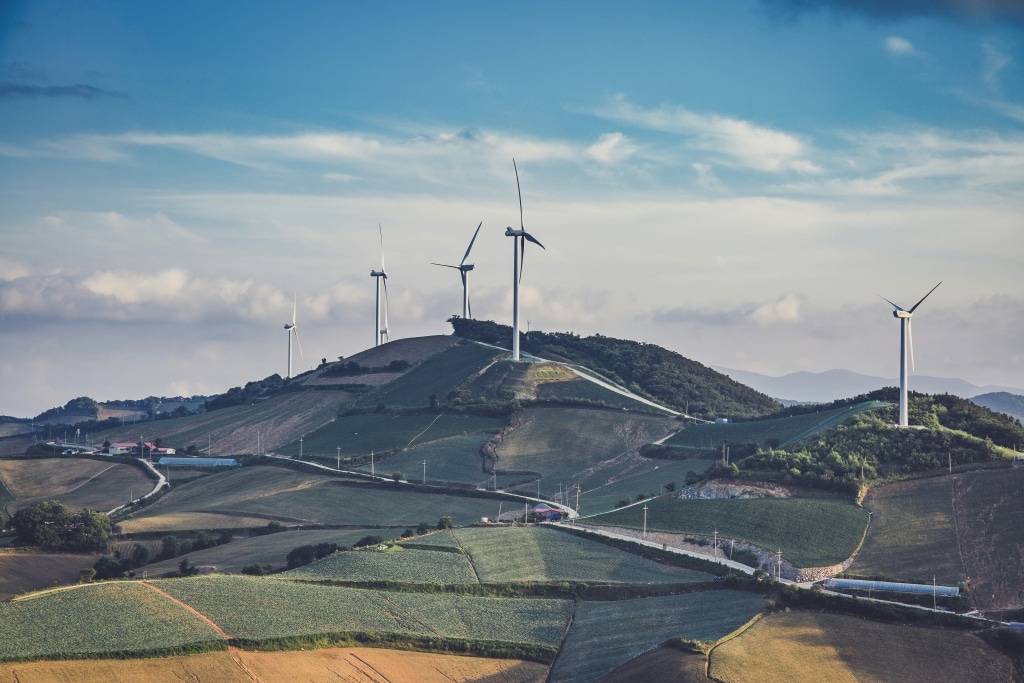
Staff from the California Energy Commission found that a proposed renewable energy plant in eastern Shasta County would irreparably damage the cultural and biological landscape. During a public meeting facilitated by the CEC, representatives of the energy corporation were lambasted by a cross-cultural coalition of both Tribal and non-Tribal community members.
“I say to these developers,” Jesse Rouse began, “go home.”
Rouse, who is the Ilmawi cultural representative of the Pit River Nation, spoke virtually before a crowded conference room on the afternoon of Tuesday, May 20.
Her audience of more than 60 included Tribal leaders, elected officials, scientists, anthropologists, attorneys, corporate representatives, and everyday people, all of whom gathered at the Red Lion Hotel in Redding this week. The meeting was held to allow the California Energy Commission (CEC) to gather public feedback in response a newly-released draft environmental impact report (EIR). The CEC’s report seeks to assess how a potential energy project known as Fountain Wind would affect the ecological, economic, and spiritual health of the region, the ancestral home of the Pit River Tribe.
The results of the CEC’s environmental report do not bode well for the multimillion dollar corporation that hopes to build Fountain Wind. The project was formerly managed by the Texas-based company ConnectGen, which was bought by Repsol Renewables in 2023, for $768 million. Repsol Renewables is a subsidiary of the Spanish energy and petrochemical company Repsol, which owns both renewable and fossil fuel energy plants across the United States.
The companies behind Fountain Wind have been trying to get approval for the project to be built in eastern Shasta for years. In 2021, Shasta County’s Board shot down the proposed wind plant twice. The decision came after sustained resistance to the project by a grassroots coalition involving Pit River tribal leaders and others, who began organizing nearly a decade ago.
The County’s opposition to the project, and the Board’s vote against it, was assumed to have ended the matter. That changed in 2022, when Governor Gavin Newsom passed Assembly Bill 205. The new law incentivizes green energy by placing review for projects like Fountain Wind under state rather than local control. Under the new lawFountain Wind’s leadership was able to file a new application with the state in January 2023, placing the future of the project in California’s hands rather than Shasta County’s.
Since that application was filed, the CEC has now conducted its own independent assessment of Repsol’s project and come to an independent conclusion that supports Shasta County’s original decision, finding that Fountain Wind’s costs will outweigh its benefits.
During this week’s meeting, multiple CEC staff members presented the Commission’s findings. Four representatives of Repsol responded, urging the state to reconsider its tentative decision. The meeting concluded with public comments from 40 members of the public, including seven who spoke in favor of Fountain Wind.
That feedback will inform how the CEC moves forward. But the exact date that Fountain Wind’s fate – and the fate of the intermountain communities that live around the proposed facility site near Burney — will be decided, is yet to be determined.
Impact That Can’t Be Mitigated
The CEC’s 1200–page environmental report probed Fountain Wind’s likely impact from numerous perspectives ranging from effects on bird migration patterns to risks of wildfire and affects on the local Tribe.
Reviewing Fountain Wind from various environmental angles, the assessment sought to determine if the project meets the requirements of the California Environmental Quality Act (CEQA). Where applicable, the CEC used the EIR to make recommendations to Repsol on how to amend aspects of their application to meet the standard of the law.
According to the report, the project as its designed now would cause irreparable harm in a number of significant ways. Those impacts include damaging effects on biological resources, cultural and tribal resources, forestry resources, wildfire safety, land use and architecture, and visual resources – or, more simply put, beauty.
On the topic of how Fountain Wind would affect the Pit River Tribe, the EIR notes 32 cultural resources in the area of Fountain Wind, five of which qualify as significant.
The CEC’s Assistant Tribal Liaison and anthropologist Gabrial Roarke noted that construction of the project would defile sites of archeological significance, including human remains near Montgomery Creek. He characterized the impact of installing the 610 foot wind turbines as likely to have an “uncommonly severe” effect on places that have been of importance to the Pit River Tribe “for time immemorial.”
CEC’s environmental report also included significant concern related to the wind turbines impact on fire response. Brett Fooks, the CEC’s Safety and Reliability Manager found that the project would not have an impact on ground fire operations, but would significantly impact aerial drops of fire retardant in the extremely wildfire prone area.
Throughout the presentation, Fooks and several other presenters for the CEC also reiterated a fundamental concern — that the Fountain Wind Project continues to violate local ordinances that ban wind energy development in Shasta County.
Repsol’s Rebuttal
Three representatives from the energy corporation spoke in defense of the Fountain Wind project, imploring the CEC to reconsider parts of the environmental review. The first was Henry Woltag, an engineer who serves as Repsol’s Western Development Director. Woltag focused his remarks on the importance of approving green energy projects in California, speculating about the potential chilling effect that denying the Fountain Wind project at the state level might have on wind development across California.
“In the face of anti-wind sentiment that has been stoked by the current political environment,” Woltag remonstrated to state staffers, “the CEC needs to take bold action now.”
To dispute the CEC’s concerns about fire suppression, Repsol brought in Shane Lauderdale, a former Chico fire chief and consultant with the Redding–based company Pyroanalysis. His core argument centered around the idea that ground access to a blaze is far more important than aerial access.
“Aircrafts are amazing,” Lauderdale asserted, but “they do not control fires, firefighters do.”
Anne Mudge, a San Francisco-based attorney who represents Repsol on Fountain Wind, dismissed the CEC’s EIR as a “one-sided, exaggerated environmental assessment,” minimizing the findings by saying “every renewable energy project has some form of environmental footprint.”
Calling wind turbines “majestic,” Mudge also disputed the CEC’s assessment of the environmental costs of the project noting alleged “discrepancies” in the EIR when compared to what’s noted in environmental reports for the adjacent Hatchet Ridge Wind Farm.
An issue that Mudge did not contest was the impact Fountain Wind would have on the Pit River Tribe’s sacred places. But, the attorney said, the project owner had repeatedly attempted to reach out to the Tribe to discuss how to soften the impact of the project.
Pit River Tribal member Brandy McDaniels took issue with that claim in her own public comment.
“The outreach to the Tribe by Henry Woltag and ConnectGen (Fountain Wind’s former owner) resulted in them misquoting my Tribe, using our name in misleading promotional materials… trying to make it appear as if we support the project which we never have,” said McDaniels, who serves as the Madesi Band’s Alternate Cultural Representative for the Tribe.
Mudge also suggested that prioritizing Indigenous peoples’ stewardship over their land could undermine successful efforts to combat climate change statewide.
“(If) we deny projects on the basis that they will have an impact on Tribal cultural landscapes that were once part of ancestral homelands,” Mudge declared, “we may never, ever reach our climate change goals, because the entire State of California was once an ancestral homeland.”
That remark by Mudge was directly addressed by another Pit River Tribal member, Louise Davis, during public comment.
“Yes, this is all California. California is all Indian Country,” said Davis, the Cultural Advisor for the Redding Rancheria. “But 60 years ago we couldn’t, as a Tribe, come and fight for it… And today we do, and today you see that our tribe is totally against this development.”
Some Support and Many Grievances
Much of the pushback towards Fountain Wind came from members of the Pit River Tribe. Agnes Gonzalez (Pit River, Madesi Band) asked if there was a confirmed purchase agreement for the energy that will be farmed and stored by Fountain Wind’s turbines.
“It remains unclear whether a buyer for the energy even exists”, Gonzales said. “We must ask, who is the energy for?”
Woltag has lauded Fountain Wind’s capability to power 80,000 homes in California (roughly the size of Redding), but exactly where the power created by the project would be utilized was never addressed during the meeting. According to the CEC, Fountain Wind would be connected to PG&E’s electrical grid. The EIR makes clear that the power generated by the project will not specifically be designated for local use.
The aforementioned McDaniels, who has been instrumental in the Tribal response to Fountain Wind for years, expressed concern over the construction of a new energy generation project that won’t positively impact local people. She described the “third world conditions” some Pit River members continue to endure despite their current proximity to existing energy infrastructure.
“Our homelands are crisscrossed with power lines that we don’t benefit from,” McDaniels said. “We still have Pit River people that live without running water and electricity. Many promises have been made and broken to my people, but still we carry the heavy load and burden, and it doesn’t seem to stop.”
Monica Super (Pit River, Hammawi Band) added her voice the plea, challenging the notion that “Californians somehow deserve our endless sacrifice,” when the Pit River People “did not create this energy crisis.”
Meanwhile, 20 year old Awi Davis Gustafson (Pit River, Itsatawi Band) questioned whether the project would have even been considered if it meant the demolition of a church, or the exhumation of veteran graves.
Non-native critics of the project included supervisors Kevin Crye and Corkey Harmon, and former supervisor Mary Rickert. Other generational ranchers, foresters, and neighbors also shared their fears, informed by different aspects of the environmental report.
Multiple members of the Shasta Planning Commission also weighed in, including Steven Kerns, a former firefighter representing District 3 who listed the many natural resources the County is home to including, most importantly, “our people.”
“We can talk about how much power it generates and all this kind of stuff,” Kearns said. “But can a project protect our citizens?”
Support for the Fountain Wind project was clearly the minority position. But multiple members of the public stood to speak on behalf of moving the project forward. A local labor union representative spoke positively of the millions of dollars in investments and jobs that would come to the county as a result, while others shared their belief that projects like Fountain Wind are a necessary step in the wake of climate change.
By 4 pm, after five hours of weighty discourse, the only clear outcome of the meeting was proof positive that the majority of Shasta County locals remain at an impasse with industrialists. With the CEC leaning strongly against certifying Repsol’s bid to build the project, it appears likely that the saga of Fountain Wind will soon come to an end.
Then again, the public has thought that before, twice already.
Do you have a correction to share? Email us: editor@shastascout.org.
Comments (2)
Comments are closed.
Related Articles
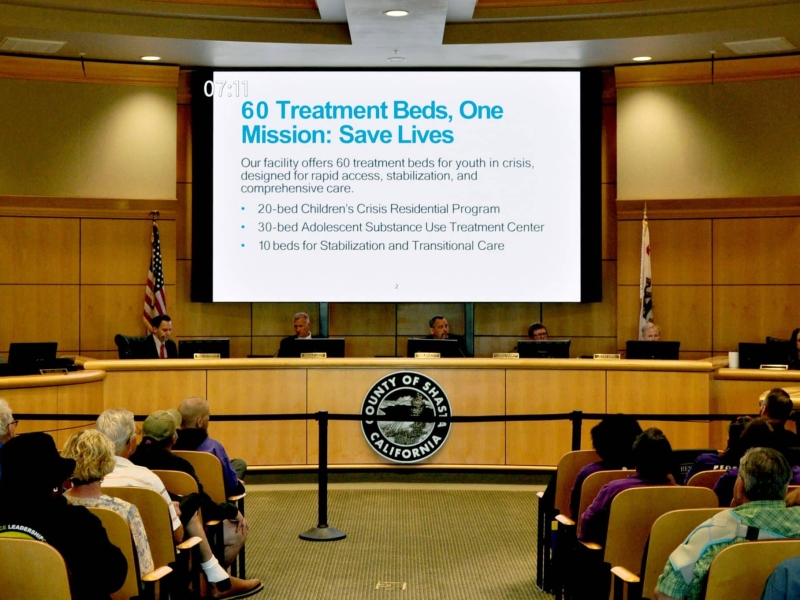
Future of Anderson-based youth behavioral health facility uncertain, despite conditional awards of millions in state and county funds
The news of one stakeholder’s withdrawal from the Pathways to Leadership project was announced after Anderson Council member Mike Gallagher and other community members expressed concerns about alleged misrepresentations on grant application materials. A second stakeholder has not announced whether the project will move forward.

Bethel Church chooses third-party group to investigate abuse allegations made against leader Ben Armstrong
The church announced last week that it chose Sintra Group Professional Investigations to conduct an investigation into clergy abuse allegations made earlier this year about Armstrong. The firm doesn’t list experience with this type of investigation on its site.
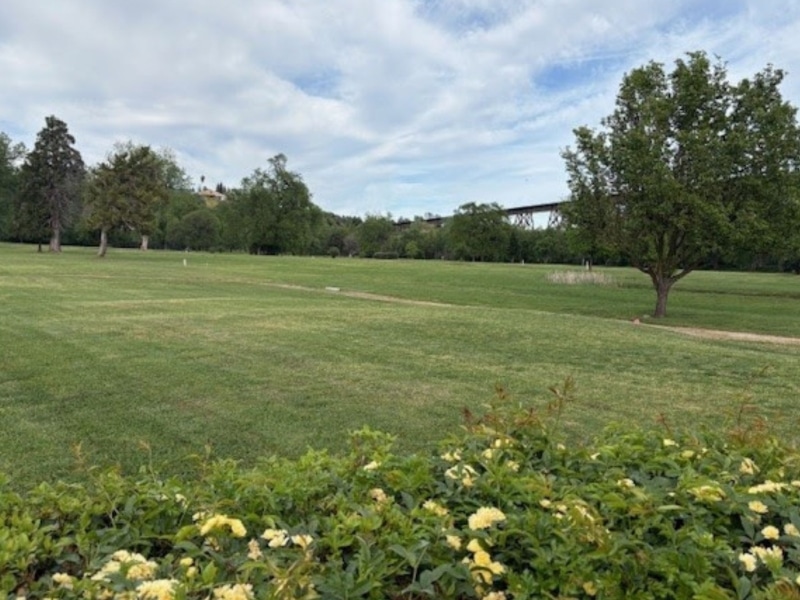
Lake Redding Golf announces reopening and new driving range
The golf course has been closed the past several months while its owner, The McConnell Foundation, figured out improvements and changes to the site.
One only need to watch the first season of Landman to truly understand wind turbines and their ultimate effects! Ha!!! Billy Bob Thornton gets it right!
Thank you for this report.