
Coyotes: Fair game or in need of protection?
Coyotes are plentiful across Northern California, and current regulations allow for the hunting and killing of coyotes with few restrictions. When the California Fish and Game Commission recommended giving coyotes more protection, the proposal drew outcry.
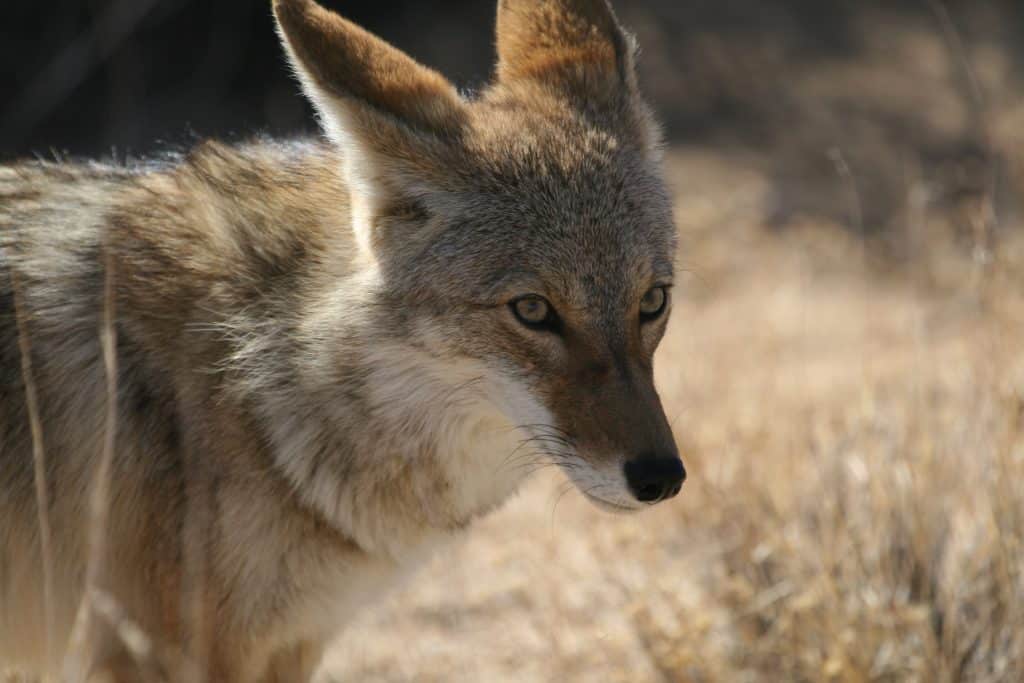
Coyote territory ranges across the entirety of California, and residents who haven’t seen one have likely heard them howling or listened to a story about a friend or family member’s encounter.
Often presented as tricksters in folklore, coyotes are intelligent, curious and very adaptable to survive in many habitats. They can also present challenges for agriculture and livestock producers by killing livestock and destroying property.
On May 15, at a California Fish and Game Commission meeting in Sacramento, community members from across the North State discussed their concerns about coyotes. Some likely attended the meeting in response to a request by a group of rural county sheriffs, including Shasta County Sheriff Michael Johnson, who has encouraged members of the public to voice their concerns.
The meeting revisited a specific legislative action that drew attention earlier this year, a proposal to reclassify coyotes – which are currently categorized as non-game animals. That action was procedurally blocked before a vote on the matter, after Assemblywoman Heather Hadwick and Senator Megan Dahle wrote a letter to the commission noting that insufficient time for public notice had been given and calling for a complete review of the recommendation.
Reclassifying coyotes statewide would trigger additional restrictions to hunting or killing them, limiting the means by which ranchers could respond to threats to livestock from the animals. Current statutes allow an unlimited and “indiscriminate” killing of coyotes. This means that there is no specific season for hunting coyotes, as there is for animals like deer or bears, and no limit on the number of coyotes that a person can hunt annually.
While there are significantly fewer current regulations on hunting coyotes compared to other animals, there are still some requirements that must be met before killing one. A valid hunting license is required to kill a coyote, and the action must occur either on land authorized for hunting, on one’s own land, or on other private land with permission of the property owners. Local ordinances regarding the appropriate use of firearms must also be followed.
The purpose of a public meeting held by Fish and Game Commission meeting two weeks ago was discussion and public comment only, no proposed changes to regulations were brought forward. Commissioner Darius Anderson began the meeting by calling for transparent, science-focused and respectful solutions to the complex topic.
The commission has identified the needs around the issue of coyote management as protecting livestock, minimizing unnecessary lethal action toward coyotes, protecting humans and pets, preserving recreational hunting opportunities and maintaining the ecological role of coyotes.
As the meeting turned to public comment, many speakers focused on the protection of livestock and humans, and the preservation of rural and agricultural livelihoods. Elected officials from Modoc, Glenn, Sierra, Tehama, Lassen and Siskiyou counties all appeared at the meeting in person and spoke against any changes to current regulations.
Sierra County Sheriff Michael Fisher, who said his speech was also on behalf of the Shasta County Sheriff and others unable to attend, urged the commission not to cede to what he called “ideological” pressures that ignore lived realities of rural Californians.
One member of the public, Kasey DeAtley, who raises cattle in Lassen and Shasta counties, told the commission she has a “love-hate relationship” with coyotes. She said the animals are useful to help manage squirrel populations, but present real challenges to livestock safety during calving season or in winter when other food sources are scarce.
Current law, DeAtley said, gives her the tools to manage coyotes that keep coming back to the herd or harming her animals but that’s something she’s worried about losing if there’s a change to regulations, as has been proposed.
DeAtley’s comments were representative of many of the agriculture and livestock producers who spoke. Their comments centered on a sense of responsibility to their operations along with some concerns that non-lethal mitigation approaches to coyote management might be expensive or ineffective. One of the primary concerns mentioned was that changes to coyote policies might require community members to have first documented the loss or harm of pets or livestock before killing a coyote.
Other concerns about damage from coyotes were also voiced. Glenn County District 3 Supervisor Tony Arendt said he was concerned that coyotes could prey upon goats put out to graze in an effort to lessen wildfire risks. Two separate agriculture producers also mentioned that coyotes regularly destroy their irrigation systems, which can be costly and time-consuming to repair. Coyotes have been known to chew on irrigation lines and while some farmers leave out buckets of water to provide easier drinking options, there is a possibility that some of the destruction of irrigation lines is driven by coyote’s playfulness and curiosity making it more difficult to curb.
While many speakers advocated to keep current statutes — which allow mostly unregulated hunting of coyotes – some members of the public voiced dissent.
A speaker from the Mountain Lion Foundation who described himself as an outdoor enthusiast said he did not support “oppressive regulation” but would still like to see some protection for coyotes so that they are not shot simply for walking through a field. He asked for policies to not only consider the needs of those with an economic interest in the issue, but also the desires of people who value wildlife and want to see coyotes have a “fighting chance.”
Camilla Fox, the founder and executive director of Project Coyote, told the commission that current regulations do not represent the wishes of most Californians. She cited a national survey conducted in collaboration with her organization that found a majority of respondents supported restrictions on killing predators. Fox also noted that the current regulatory model that allows coyotes to be killed year-round, including during breeding season, doesn’t follow the commission’s own policy which emphasizes recognizing the ecological value of predators .
The commission’s policy is not law, instead it provides the framework commissioners use as they make decisions and issue public statements. According to the commission’s predator policy, best practice would be to consider non-lethal and humane control methods while also minimizing adverse predator effects on humans and property.
Currently, coyotes continue to spread across the nation, living in both cities and rural areas. But rising populations of gray wolves – a natural predator of coyotes – may help reduce the spread of coyote populations, both through predation and competition for similar resources.
For now, state statutes regarding coyote management remain unchanged as the state works to balance complex needs. Members of the public who experience interactions with coyotes and other wildlife can file a wildlife incident report, if desired.
Do you have a correction to share? Email us: editor@shastascout.org.
Author

Comments (5)
Comments are closed.
Related Articles

The fate of the Civic Auditorium may be decided this week. Here’s what you should know
The Civic needs between $1.4 million to $1.6 million in additional annual funding to keep its operations going, according to the organization that runs the event space.

Active measles case in Shasta County, officials urge vigilance and immunization
A patient with newly-diagnosed measles is being kept in isolation to prevent the spread of the highly contagious illness. Community members who might have been exposed during the patient’s eight-day contagious period are being contacted by Shasta’s public health staff.

Killing of armed Minneapolis protester Alex Pretti ignites 2A debate in conservative Shasta County
Second Amendment supporters in Shasta County including some with connections to a local militia, weigh in on topics including the right to carry at protests and the federal government’s current approach to immigration enforcement.
Cindy and I resided along the river between Anderson and Cottonwood. We’ve been here for more than 49 years.
Over that time, we have had from three to five coyote packs in the area.
Some years ago, a few neighbors started shooting the coyotes and the packs disappeared. Suddenly, we were overrun by deer. They ate everyone’s gardens and yards to ruin.
I finally convinced our neighbors to stop shooting coyotes. We now have two and sometimes three packs in the area and the deer problems have gone away.
Remember what happens when we allow just a few small regulations! Remember the Democrats are in control of legislation. Their mantra is just get on the bus and we’ll make changes as we go. We go from gay marriage to mutilating children! Coyotes, wolves, are very destructive. However, those who live in the city have no clue. They vote on emotion only. They’ve never lost animals or livelihoods to aggressive animals like coyotes and wolves.
Remember, human beings are the top of the food chain no matter what
We go from gay marriage to mutilating children! The topic is about coyotes, and you threw this absurd comment in.
You moved into the coyotes and wolves territory. You brought in your domestic pets, who should be protected and be inside your home.
Ranchers should know they are surrounded by wildlife. That is a part of ranching, there will be losses. All businesses have a loss. Do you want to kill thieves as well as coyotes, and wolves?
I don’t know that the statement, “Coyote’s are plentiful here”, is accurate. 65 years ago there were packs of Coyote’s that would ‘sing’ every night. You could hear them from miles away and as one pack began getting to the end of their song another pack in a different location would begin theirs. There were a full variety voices with some being very distinct and totally identifiable over weeks and months. That was before hundreds of thousands of acres of wildlife habitat in our region was reduced to tree farms.
They regularly take cats, and attack dogs around Clover Creek x Shasta View and the neighborhoods around. You can hear their little yip and then bam the pet is gone. I’ve seen them in midday running along Shasta View. I do not believe they belong in suburban neighborhoods.