
Who Belongs at the Top of the Food Chain? Debate Ensues Over Wolf Management in Shasta County
Gray wolves maintain balance in the local ecosystem. But what happens when they threaten the livelihoods of ranchers, whose cattle make easy prey? Two cattle kills have been confirmed by the state in Shasta County since 2025 began.
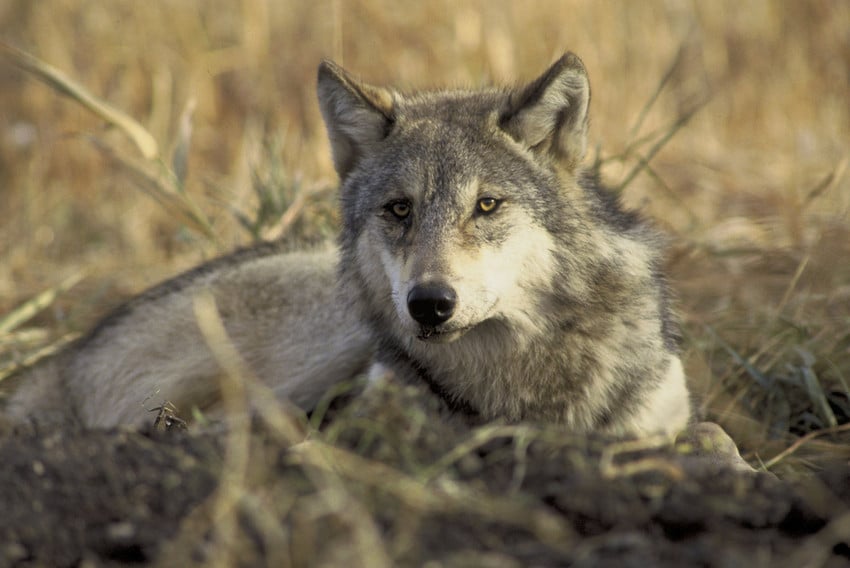
What is the role of natural predators in a modern world, especially alongside humans who may view them as a threat to their safety or way of life?
This question drew local attention on Tuesday, May 12, as the Shasta County Board of Supervisors declared a county-wide state of emergency due to safety threats from gray wolves.
The Board of Supervisors also approved a draft letter to the California Department of Fish and Wildlife, stating that the presence of gray wolves – which are protected as an endangered species on both the federal and state level – poses a threat to the livelihood and safety of rural residents.
According to the letter, wolves in Shasta have been undeterred by basic preventative measures, and are reproducing faster than expected. Supervisors have requested more aggressive assistance from Fish and Wildlife, including removing or relocating wolves determined to be problems.
A Fragile Ecosystem
Amaroq Weiss, a Senior Wolf Advocate with the Center for Biological Diversity, sees wolves not as a problem, but rather a piece of the local environment’s larger tapestry. Weiss is a biologist and a former attorney who has focused on wolves since the late ‘90s. She said both her scientific and legal experience have informed her work in conservation.
Speaking to Shasta Scout over Zoom last week, Weiss said wolves are a valuable piece of a healthy ecosystem. Predator wolves keep grazing elk and deer on the move, which in turn allows vegetation time to regrow. The vegetation then provides habitats for other creatures like beavers and birds who build dams that create conditions for frogs and fish to thrive. Without predators to keep elk and deer moving, over-grazed areas can erode, Weiss explained, causing muddy conditions that are incompatible for keystone species like Chinook salmon whose decline contributes even more significantly to the wider ecosystem..
Former Shasta County District 3 supervisor Mary Rickert, who has worked with cattle as a ranch manager and owner for over 40 years, also has concerns about a balanced ecosystem. Speaking to Shasta Scout by phone this week, Rickert said that the presence of wolves can cause harm by decreasing cattle grazing, leading to overgrown grasslands. This could lead to increased fire risk in an already risk-prone county.
Rickert said she is not anti-wildlife, but “pro-protecting our cattle” explaining that her operation is certified humane, and emphasizing awards received over the years for land stewardship, wildlife support and conservation.
The letter and declaration approved by the Board of Supervisors’ last week voiced similar concerns from cattle ranchers describing the presence of wolves as an “imminent threat to local livestock producers and the families living and working on affected rural properties”, and calling out a lack of effective protection against what some see as a real and present danger.
Shasta County Wolfpacks
Wolves do kill valuable livestock in Shasta County. In February, Fish and Wildlife confirmed two heifers had been killed and one injured in Eastern Shasta County.
Rickert’s operation, Prather Ranch, has only experienced confirmed wolf attacks in operations within Siskiyou County, though Rickert said she feels it is “just a matter of time” before activity will increase in Shasta. Over the years, Rickert said, Prather Ranch has experienced 20 confirmed wolf kills, and possibly other predatory action, some of which can be difficult to confirm. For example, she said, only 160 calves were born to a herd of 200 cows last year, which was lower than expected. With an operation spanning thousands of acres, Rickert explained, it is hard to know whether wolves killed some calves before they could be discovered, or if the stress of wolf presence caused fertility issues or pregnancy loss.
Fish and Wildlife investigates reports of wolf attacks, using evidence including tracks, DNA, satellite locations of collared wolves, bite analysis and eyewitness reports to determine if the attack was caused by wolves or other factors.
The visual analysis allows Fish and Wildlife to name and monitor different packs that hunt in the area. Some of these wolfpacks include the Harvey Pack in eastern Shasta and the Ice Cave Pack in southern Shasta County.
As of the end of 2024, Fish and Wildlife had identified increasing California wolf populations, including at least five breeding pairs across the state. Per the latest quarterly update from Fish and Wildlife quarterly — released in 2024 — two adult wolves and two pups were observed as part of the Ice Cave Pack in August of last year, while the Harvey Pack had a reported minimum of three adult wolves and seven pups at the time. While Fish and Wildlife releases quarterly wolf news updates, the first quarter report of 2025 has not been published as of May 21, and not every update includes the numbers of each pack.
While California’s wolf populations are growing, Weiss said population numbers fluctuate and it is not uncommon to see the birth of litters of pups cause numbers to rise in spring and summer, only to have a reduction in the fall and winter as some of those pups die throughout the year. Additionally, wolves breed relatively infrequently, compared to pet dogs that can go into heat every six months.
“Pups are only born once a year, in April, and the first year of survival is literally a test for survival for pups,” Wiess said, explaining that mortality rates for young wolves are high. “As a general rule of thumb, I would say that of a litter that is born in April, it is not unusual for 50% of them to be dead by the end of December.”
On the topic of managing the population of surviving wolves, Weiss said relocating or even euthanizing “problem” wolves could perpetuate the very problems that cattle ranchers are attempting to mediate. If an entire pack is removed from an area, other predators may fill the void. If only several wolves are killed, and they are the pack’s more experienced hunters, the remaining wolves may resort to feeding more quickly on livestock rather than their more typical fodder of deer and elk.
“The science also shows that if you kill wolves to resolve conflicts, you don’t resolve the conflicts over the long haul,” Weiss said. “If you, for instance, kill an entire pack, you might not have conflicts at all for another year or two, until a new pack moves in.”
Weiss emphasized the importance of understanding wolf behavior but said she recognizes that changes are difficult when people have become accustomed to living without wolves for many decades. She emphasized that while many people are afraid of wolves it’s largely due to the fear of the unknown, as wolf attacks are relatively rare in modern history.
“Wolves are fearful of people; they really don’t want to have anything to do with people,” Weiss said. “It’s important to realize that in all of North America in the last 125 years, from the Arctic all the way down through Mexico, only two people have been attacked and killed by wolves, one in Alaska and one in Canada.”
What Can Livestock Owners Do to Prevent Attacks?
Now that several breeding pairs have consistently been observed in the past years, Fish and Wildlife’s wolf management plan has moved to “phase two.” As announced in an April press release, this phase includes both actions to conserve the wolves and support for the communities they now inhabit.
Some recommendations from Fish and Wildlife include removing food sources such as livestock carcasses or bone piles which can draw wolves to a property. Hauling food waste away from the areas where living animals graze, or burying it immediately, is advised.
“Hazing”, a means of discouraging wolves and other predators from preying on livestock, consists of techniques like loud noises and spotlights, often activated by motion, that are meant to frighten predators away without causing injury, thus conditioning them to avoid an area. A challenge of this approach is that it may require consistent maintenance, including moving and repositioning equipment, to remain effective as wolves become conditioned to the effect.
Livestock guardian dogs can also be useful, if costly, solution. For example, the University of California Cooperative Extension estimated the initial cost of a livestock guardian dog starts at around $1,500 with annual operating costs of $600 per year, per dog. After that investment, there is still a chance the dog may not be compatible for the situation, at which point the process – and costs – would begin again. Additionally, Fish and Wildlife says wolves have occasionally killed livestock guardian dogs if they outweigh or outnumber them.
Range riders can be of great help, not only to watch for wolves, but also keep an eye on cattle to monitor and remove any who are sickly or struggling. range riders monitor herds. But they involve increased human presence, another significant expense.
Rickert said she is a firm believer in behavioral conditioning to keep wolves away, and would be interested in seeing stronger methods of discouraging wolves such as using rubber bullets that would inflict pain but not kill. As far as dogs, she said, an operation the size of Prather Ranch would require multiple canines for protection and each would become another responsibility for her operation to manage.
All in all, Rickert explained, it’s immensely challenging to monitor every cow, especially across wide and difficult terrain.
“It is virtually impossible to cover the landscape to be sure they are safe”, Rickert said.
Meeting Human Needs
To counteract the negative effects of wolf populations on livestock producers, Fish and Wildlife offers a compensation plan through which confirmed or probable wolf kills are eligible for reimbursement.
From June 2023 to March 2024, Fish and Wildlife ran a trial of a three-pronged plan, where direct loss reimbursement was only one facet. The other two prongs provided proactive distribution of non-lethal deterrents as well as cash funds to assist livestock producers for any indirect costs that arise as a result of grazing herds in known wolf territory.
While the three-pronged program was generally successful, it was also an expensive solution. As of March 2024, the money had ran out for the pilot program, and only applications for direct loss reimbursements are currently being accepted.
While Rickert said her ranch has received reimbursement for confirmed kills, she called the solution a bandaid, saying the funds don’t cover the whole cost of loss from wolves. The hidden cost of wolf attacks, Rickert said, include elevated cortisol levels that affect herd health and fertility.
Wolf kills also impact the emotional health of ranchers, Rickert explained, describing the troubling and painful experience of watching animals suffer in shock and pain before dying. California needs more options to help, she said.
A New Tool
Last week, Fish and Wildlife provided an additional tool intended to aid livestock producers and the public, the wolf tracker map. It includes the last known location of all collared wolves in California, demonstrated by a cell on a map, which the agency describes as “small enough to show changes based on typical daily movements and be helpful to livestock producers, but large enough to protect exact wolf locations.”
Fish and Wildlife has also partnered with The California Wolf Project, a research initiative from UC Berkeley. One of the tasks of the project is learning the patterns of how wolves hunt livestock, with a goal of determining the factors that may lead to an attack. This year, project organizers plan to conduct interviews with livestock producers to inform this research.
Matthew Hyde, the postdoctoral researcher leading the livestock depredation task said researchers are looking to “include a broad range of livestock producers and their experiences with wolf conflict”, including the experiences of those in Shasta County.
Do you have a correction to share? Email us: editor@shastascout.org.
Author

Comments (1)
Comments are closed.
Related Articles

Congressional District 2 hopefuls court Shasta voters ahead of June primary
Candidates for California’s District 2 congressional seat — which will represent Shasta under newly-drawn Prop. 50 lines — appeared in Redding for a forum last night. The audience questioned candidates about immigration, voting rights, the environment and how much time they’d spend in Shasta.

Documents show the Shasta Sheriff’s Office attempted to enter an agreement with ICE last year. Doing so would have violated state law
The sheriff’s office took actions to enter what’s known as a 287(g) agreement with ICE last May, but the process appears to have been halted. ICE’s 287(g) program, which gives local and state officers immigration enforcement authority, has been making national headlines.

After the resignations of three board members, Cascade Union Elementary School District gains a new one: Jackie LaBarbera
Following a dispute with the superintendent, the majority of CUESD board members resigned over the last week. Shasta County Office of Education Board President Michael Orlicky has appointed SCOE Board Vice President Jackie LaBarbera to fill one of the empty seats, ensuring a quorum.
I’m surprised there are no comments. Wolves usually bring out “Little Red Riding Hood” hysteria. Here is my perspective.: Natural ecosystems need wolves. And, Ms. Wiess is correct. Wolves not only keep a balance but improve habitat for multiple species and plants. Just look at what wolves have done for Yellowstone Park. They improved vegetation, health of ungulate populations, and even created better fish habitat. So, I think we need wolves. They were here first by the way, long before cattle were everywhere. I know and like the Rickerts but they need to find a way to live with wolves. Two wolves died this year with reimbursement doesn’t seem like a big loss to me. I wonder how many cattle have died from weather and disease in that time. I believe The California Wolf Project will find ways to deter wolves from preying on cattle. I would think solar powered motion sensors of some kind could deter them. The fear of wolves attacking humans is baseless. The Board of Supervisors should do a little research to discover practically zero attacks on humans in the last 125 years. Finally, the Wolf Tracker Map by the DFW is a bad idea. Wolf haters could use it to shoot wolves. Thanks for publishing this very informative article.