
Debate over Tobacco Licensing Fee Reveals Tensions in Redding City Council
The council was united in its goal of curbing the crisis of teenage usage of tobacco products, but disagreed on approaches to a solution. Following a heated discussion, members asked city staff to draft a new ordinance that will impose a local licensing fee on all businesses that sell tobacco.
For months, the Redding City Council has been considering how to curb tobacco use among local teens. The scope of the issue was made clear at Tuesday’s city council meeting, when multiple recent high school graduates attested that their school bathrooms had turned into makeshift smoke lounges, with smoke alarms going off periodically throughout the day.
At the June 17 meeting, the council considered two different ordinances that regulate tobacco retail sales, sparking a debate on the most effective strategy to prevent sales of tobacco products to teens. The term “tobacco products” includes but is not limited to, cigarettes, cigars, chewing tobacco, hookahs and, of greatest concern to the council, “e-cigarettes” or vapes.
City officials debated whether to leverage steep licensing fees and intense code enforcement on smoke shops only, or impose a broader enforcement plan and cheaper licensing fee on any business that sells tobacco products, including gas stations and mini marts.
Amidst the discussion, a heated argument erupted in which one council member insinuated that another council member’s past political donors – including gas station owners – might be influencing their vote.
Ultimately the council majority opted for broader enforcement, which will apply to any business that sells tobacco products in the city. Now city staff will redraft an ordinance to fit these criteria, and bring it back before the council at a future meeting. The one dissenting vote came from council member Tenessa Audette.
Two approaches to curbing teen tobacco use through ordinances
The first option for the ordinance, and the one recommended by city staff this week, would have required only “tobacco oriented businesses,” mainly smoke shops, to obtain a license to sell tobacco products, at an annual cost of just under $5,000 dollars. The alternative ordinance, which ended up being the preferred choice of the council, will charge an approximate $1,000 fee annually to all businesses that sell tobacco — though this exact price tag is subject to change until the ordinance is approved.
The number of “tobacco-oriented businesses” responsible for paying the more expensive fee would have been only around 29, according to city records. The council’s chosen option will spread the cost across the approximately 119 retailers that sell tobacco within city limits.
Existing state law already assesses a $265 annual fee on any business — including gas stations, grocery stores and bodegas — selling tobacco products. This state fee will remain in effect with the city’s additional local fee being added on top.
Many other municipalities across California also charge tobacco retailers for an annual license. But based on data from the Policy Evaluation Tracking System, both of the proposed city fee options are on the higher end of the spectrum when compared to other places in California, especially those in the North State. For example, Oakland’s license is priced at $1,500, while in Siskiyou, the fee is $76, and in Plumas, there is none.
The fees will be used to pay for a full-time neighborhood preservation officer as part of the Redding code enforcement team, along with a half-time administrative assistant. City documents did not detail the salaries of either position. The city’s ordinance is also expected to also lay out further restrictions on future businesses, such as prohibiting locations within 1,000 feet of a “youth-oriented facility” or within 500 feet of another smoke shop.
Who is to blame for underage tobacco sales?
In 2024, according to data from the California Department of Health, the North State had a relatively low rate of tobacco sales to underage youth, But in the year prior, DOH found that Shasta County had the highest rate of teens with self-reported tobacco use in all of California, at around 41%.
Stacy Larson, Redding’s Assistant City Attorney, presented the recommended ordinance that focused exclusively on smoke shops. That recommendation, she said, was based on extensive field work and directly responsive to the council’s requirements, based on past decisions regarding tobacco regulation.
“We knew that we needed to try to regulate the most noncompliant of the tobacco retail businesses, and based upon all the data and presentations,” she said, “that has been the smoke-vape shops, historically.”
This underlying assumption that smoke shops are the root of the problem greatly informed the city’s approach to crafting the recommended ordinance. However, during the public comment period, Shasta County’s Tobacco Compliance Specialist Debbie Burkett suggested the opposite.
“There’s a misunderstanding that tobacco law violations are only happening at tobacco-vape shops, and that’s simply not true. They’re happening across the board with all businesses,” Burkett said.
According to the public heath department’s tobacco compliance data from April and May 2025, gas stations and mini-marts made up the bulk of the noncompliance incidents, but none of the businesses listed as noncompliant were actually caught selling to minors.
Instead the vast majority of the noncompliance listings relate to retailers selling flavored tobacco products, an attractive option for younger smokers that’s forbidden under California law. Other common offenses included not having the required state tobacco license at all, or improperly displaying compulsory STAKE Act signage.
Assistant city attorney Larson said her data showing noncompliance comes mostly from smoke shops stems from “police decoy operations” conducted by the Redding Police Department.
RPD Chief Brian Barner confirmed this and clarified for Shasta Scout that the surveillance was conducted at various businesses that sell tobacco within the city, including smoke and vape shops as well as mini-marts, and included inspections for all kinds of violations including under age sales as well as illegal products.
Manvir Singh, a local convenience store worker who spoke with Shasta Scout after the meeting reiterated the distinction between the different kinds of noncompliance.
“There’s a difference between things getting banned today and you not having time to get them off your shelf… and selling to minors or selling vapes,” Singh said, adding that he did not necessarily oppose a blanket licensing fee on all tobacco retailers, but took issue with the way that some members of the public had framed a “wide variety” of violations during the meeting.
“They made it seem like everyone’s out here selling to kids.”
Tenessa Audette, the lone voice who advocated for assessing a fee on smoke shops only, felt similarly. She was adamant that the original, staff-recommended ordinance would have more effectively addressed what she believed to be the main source of underage tobacco use: smoke shops.
“The city has chronic offenders of illegal activity at vape/smoke shops,” Audette emailed Shasta Scout before the meeting. “That greater effort and monitoring [needed to respond to] illegal behavior comes with a cost to pay for it.”
But other council members and community members who spoke during public comment disagreed.
“I genuinely cannot fathom why any elected official would oppose a Tobacco Retail License (TRL),” or a general license on all types of businesses that sell tobacco, Erin Resner wrote to Shasta Scout by text. “We’ve seen data presented in public meetings showing that TRLs dramatically reduce illegal sales of tobacco to minors.”
The initiative to increase regulation of tobacco sales in Redding predates the current council. In September 2024, the last council, which included Audette, heard a presentation about tobacco use among county teens and instructed city staff to begin the process that led to the most recent proposed ordinance.
Former city council member Kristen Schreder, who served as a council member from 2014–2022, spoke in favor of the initiative during public comment at that time, in an attempt to push things forward, Since then, she said, she has worked closely behind the scenes with former council member Mark Mezzano and county public health staff, who also spoke in favor of the generalized tobacco licensing at Tuesday’s meeting.
Consistent with the majority of the council, Schreder told Shasta Scout that she much prefers the alternative option the council eventually chose.
An implied conflict of interest?
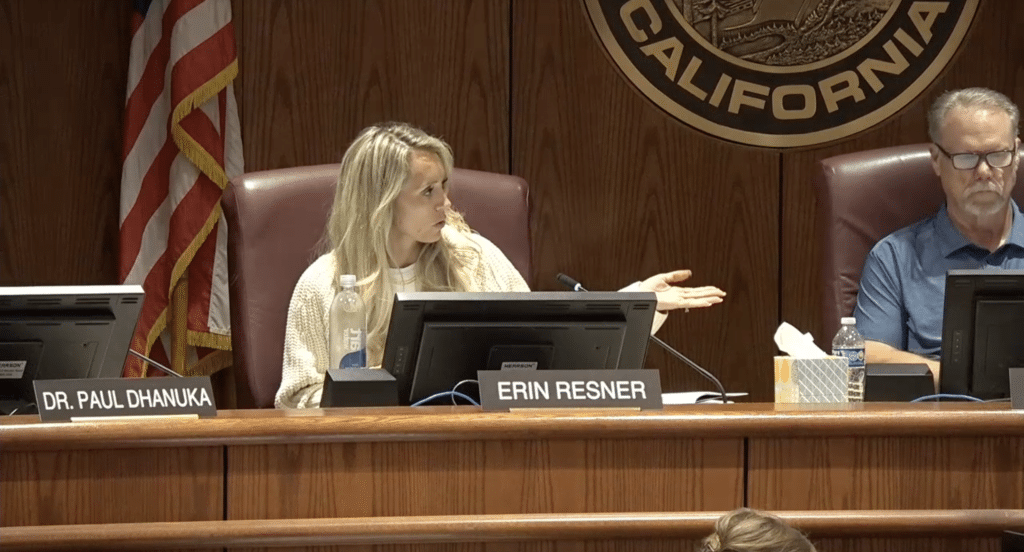
As the debate between council members devolved, with four on one side of the issue and Audette on the other, council member Resner posed a simple, yet probing, question to Audette.
“Is there a reason why you specifically, out of the four of us, care only about vape shops?” Resner said to Audette.
Audette first pointed out the potentially protracted process of choosing the approach not recommended by staff, given that the ordinance would have to be redrafted, delaying action. Then she reemphasized her belief that focusing on vape shops was the most effective means of shielding minors from tobacco products.
But Resner was not deterred.
“Did you take money from [tobacco] retailers during your last election?” she followed up.
“No,” Audette was quick to answer. “For city council, no, I didn’t take any money.”
Her statement was followed by a long pause in the chambers.
Resner broke the silence. “That’s not the last election you were in, and that’s not the last campaign.”
Resner was referring to at least three campaign contributions to Audette’s 2024 state assembly campaign from local gas station owners; $750 from JKSD Mini Mart in Redding, $1,000 from Maruti in the City of Shasta Lake and $500 from the Chevron in Anderson.
Audette, realizing Resner’s implication, seemed too stunned to speak. Later, after the council had cast its vote, she referred to Resner’s remark publicly as a “horrific accusation,” pointing out to Shasta Scout later that she’s also received money from Resner herself.
“[Resner] gave me $1,000 for that race,” Audette said, referring to her state assembly candidacy. “So if her logic is that I, for whatever amount would have changed my vote, I didn’t change it for her, and she gave me $1,000.”
Do you have a correction to share? Email us: editor@shastascout.org.
Comments (2)
Comments are closed.
Related Articles
Bethel apologizes for failing to take appropriate action after alleged sexual misconduct by Christian ministry leader Shawn Bolz
In a statement this week, Bethel senior leaders Bill Johnson and Kris Vallotton acknowledged they didn’t do enough when one or more alleged victims confided in them.

Local flight school says espionage claims by Anderson City Council member undermine community safety
Anderson Councilmember Darin Hale has made claims on social media that IASCO Flight Training is a security risk to America due to its training of Chinese students. The school said such unfounded claims, made amid national tension over immigration enforcement, put its students at risk.
Wintu people say proposed reforms to a state list of tribes is erasure, threatens their homelands
A state commission’s proposal to remove Wintu and other federally non-recognized tribes from a consultation contact list would leave cultural sites vulnerable to destruction, tribal members say, and represents a form of unconstitutional discrimination.
I’m surprised they didn’t consider consider charging the tobacco shops a bigger fee.
Wait, whey, whey….wait…receiving a campaign contribution from an individual is not the same as from those 3 listed in the article. Don’t confuse the contribution issue, Ms. Audette. A more apt word of ‘stunned’ would be hand-caught-in-cookie-jar.