
Fall River School District Faces Financial Pressure Amid Decreasing Enrollment, End of Pandemic Funding
Like other school districts across California, Fall River Joint Unified School District is scrambling to avert potential financial deficit as public schools experience both decreasing enrollment and an end to federal COVID funding.

4.29.24 12:46 pm: We have updated the story to clarify that one position was eliminated, although no staff were terminated.
Fall River Joint Unified School District’s March 12 Board meeting began with business as usual, including an announcement from student representatives praising a recent art fair and the athletic teams’ triumphs.
The room’s atmosphere shifted, though, when Teresea Spooner, Fall River’s longtime Chief Business Officer (CBO), segued to a more consequential matter. In statements to the Board, Spooner cautiously yet firmly announced a looming financial predicament that, according to her calculations, simply cannot be ignored: an approximate operating deficit of $2.5 million in the next academic year.
Her statements prefaced a Board agenda item that could have resulted in the elimination of approximately eight staff positions for cost savings, a recommendation made by Spooner and District Superintendent, Morgan Nugent. Their recommendation to cut positions was voted down by the Board. It’s a decision which leaves Fall River staffing intact but doesn’t address the District’s looming fiscal crisis.
In a recent interview with Shasta Scout, Spooner explained the series of events that have brought Fall River to its current financial dilemma. They include an end to one-time pandemic funding and decreasing enrollment, which together have posed a serious challenge for the District’s ability to maintain its current staffing levels.
According to Spooner, the District added 17 full-time employees as extra support staff, using federal funds using pandemic funding administered to schools throughout the nation. Now, with the discontinuation of federal pandemic revenue, she said, the District is struggling to rebalance its budget.
“No one likes to cut, no one likes to reduce,” Spooner said to those in attendance at the District’s March 12 Board meeting. “You can add programs and add people, but you have to be able to recover from it when you need to.”
Concurrently, the Fall River District has been adjusting to declining enrollment. The District lost approximately 53 students between the 2019-2024 school years, a result of parents choosing charter or homeschooling instead of traditional public schools, as well as a relatively low population of full-time home-owner residents in Fall River, according to staff members who spoke at the meeting and afterwards.
The drop in enrollment significantly impacts revenue. That’s because, across California, the Department of Education (CDE) uses each school’s average daily attendance (ADA) data to calculate a significant portion of school funding.
“If I did a quick calculation of funds received that are ADA driven, I would say we would get around $16,000 per student which would equate to approximately $848,000 loss (from declining enrollment),” Spooner said. “A broad projection would lend to a loss of 4.38% (from loss of) attendance in five years.”
According to the District’s profile, Fall River, located in rural area within eastern Shasta County, serves approximately 1,160 students from kindergarten through 12th grade. According to the District’s website, Fall River comprises two elementary schools, two junior-senior high schools, two continuation high schools and one community day school.
Both during the March 12 meeting and later in an interview with Shasta Scout, Spooner said she had urged former leadership to think past the pandemic years while stimulus funds were still flowing. Since no changes were made earlier, she explained, the District is now faced with significant cuts to rebalance the budget as COVID funds halt.
“And there was the missing link. We didn’t have a recovery plan,” Spooner continued. “We kept thinking, ‘well, we’ll just do a little here and a little there and then we’ll get there’, but we haven’t done really much of anything to get there. And that’s where we are.”
During the Board’s March 12 discussion on whether to cut staff, Board members offered few comments, only chiming in at times to elaborate upon statements by Spooner and respond to school staff.
The staff report suggested cutting approximately seven teachers as well as a campus groundskeeper and potentially an administrator, the latter of which would assume a teaching role instead. The Board declined to terminate any staffers although one administrative position was eliminated, with that administrator moving to fill a teaching role instead. Board members did not offer any real comments as to why they chose not to make more staffing cuts, or what alternatives they had in mind to mitigate the pending budget crisis.
Superintendent Nugent, who only assumed his role in July spoke to Shasta Scout after the meeting. He highlighted the lack of sustainability in one-time federal funds, specifically addressing COVID dollars provided to the state’s public school system at large.
“Some schools decided to use those funds on different projects, some schools spent a lot of money on personnel, and unfortunately one-time money is unsustainable, especially if you have a declining enrollment across California,” he said. “It’s almost a double-whammy for districts having a declining enrollment and hiring staff with one-time funds, so we’re having to go ahead and get those rebalanced.”
“There are times anywhere you’re not going to have everyone on board,” Nugent continued, addressing community pushback to reduction in forces. “This time they [the Board] decided to go ahead and not take away those positions.”
March 15 was the final deadline for districts statewide to notify staff members of layoffs, meaning the Board’ vote on the 12th closed the door to additional terminations this year. The only exception, according to Nugent, would be staff termination resulting from disciplinary issues which could occur later.
At this month’s Apr. 9 meeting, which a reporter from Shasta Scout attended virtually, no notes were shared regarding how the District would proceed to navigate its looming fiscal crisis. To put the approximately $2.5 million pending deficit into perspective, Fall River’s 2024-2025 budget is only about $16 million according to the District’s First and Second Interim Budget Report.
According to Nugent, District staff are looking to modify school transportation, technology purchases and curriculum to try to shrink the budget as much as possible.
“There’s still some [bus] routes that are not full,” Nugent said. “Basically for a mile of driving a bus is $5.50. So for us if we can go ahead and use vans for sporting trips or some of those other ones, that cost drops all the way down to $0.90.”
Nugent also stated that Fall River, like most school Districts, purchases different sources of curriculum for a variety of subjects and grade-levels.
“Some of those [curricula] are not being utilized,” he said. “So we’re making decisions based on similar programs that we already have in place to minimize duplication or replication.”
Fall River’s financial predicament appears to reflect a larger trend regarding the effect of declining enrollment and loss of COVID funding on the nation’s public schools. Several districts within Shasta County are reportedly struggling to rebalance their budgets amid decreasing student enrollment and a halt to COVID funds. Layoffs have also been reported across the state – including in Oakland, San Francisco and Pasadena.
In addition, Nugent addressed how a lack of affordable housing for those who reside in Shasta County, and California at large, has contributed to declining enrollment in the state’s public schools, saying many local homes in the Fall River area are being bought up as vacation properties.
“A lot of our homes are also second or third homes for people who don’t reside in the community. It makes it hard for people to raise a family up here,” he said. “It’s a (losing) situation for us when we have such a beautiful place to be and have amazing teachers and programs, but it’s harder for families to stay in California or in our community… and then we have to make cuts.”
Spooner, the District’s Chief Business officer, is also retiring at the end of the 2024-2025 school year. In a recent interview with Shasta Scout, Spooner stated the District recently hired her replacement, however she fears they will lack the experience to face Fall River’s finances alone.
Despite these obstacles, both Nugent and Spooner expressed a deep desire to achieve a balanced budget as soon as possible, without external interference from the county or state, and without shedding personnel.
“We’re going to continue to do the best we can for our students and continue to develop a plan on how we address the budget shortfalls,” Nugent stated. “We will work tirelessly to do the best for our community, students and staff.”
Do you have a correction to share? Email us: editor@shastascout.org.
Author

Related Articles
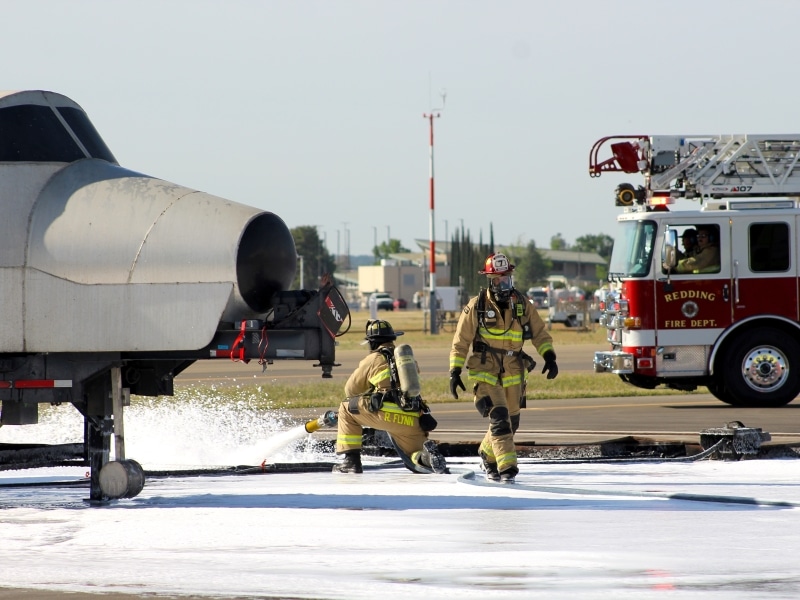
Redding Airport conducts full-scale emergency exercise to test disaster-readiness
The Mass-Casualty Incident training held last week was a “big success,” said airport Manager Andrew Solsvig. Organizers worked with local emergency personnel and airport staff to train for situations such as a plane crash or other major accident.

Cascade Union Elementary School District without functional board after resignations by three trustees
Last week the district superintendent allegedly strayed from the specifics of a board-approved raise while bargaining with a teachers’ union over pay increases. In response, three of the five trustees — including the board president — have resigned, leaving Cascade Union without a functional board.

Shasta’s League of Women Voters announces candidate forums for June primary
The Shasta branch of the national nonpartisan organization has scheduled four candidate forums this spring. The public is invited to bring questions and hear directly from candidates running for a variety of roles.