
From the Hindu Kush to the Cascade Range: Hamid’s journey to America
Through remarkable circumstances and the assistance of a few local community members, the Ghulam family left Afghanistan to settle in Redding, California. They’re one of only three local Afghan families. Under new federal rules, more are unlikely to arrive anytime soon.
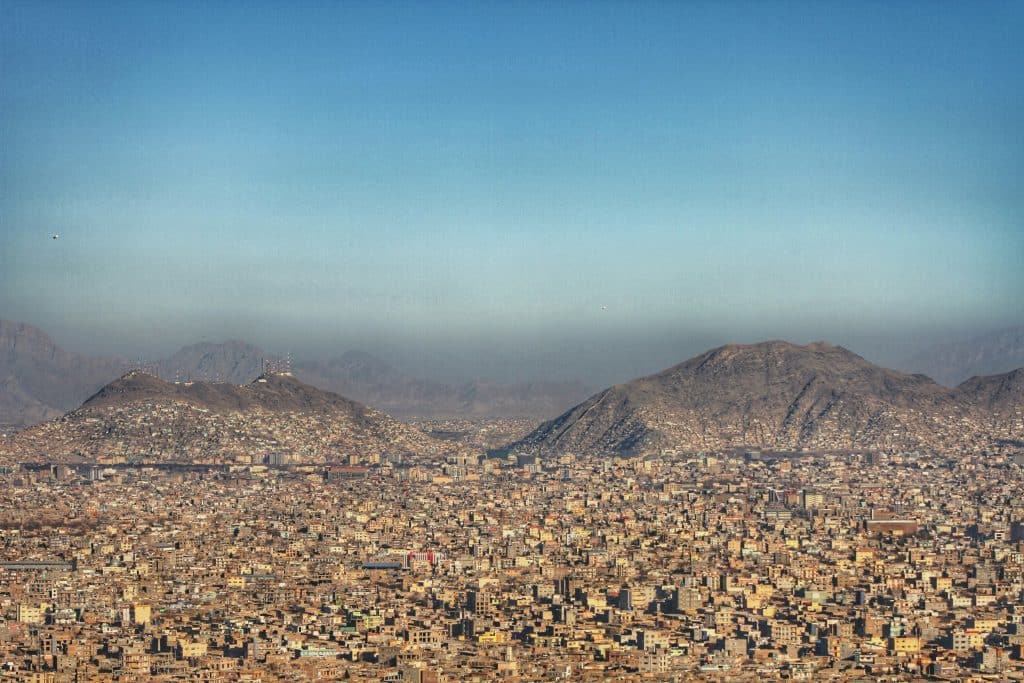
Editorial note: The names of the Ghulam family have been changed, due to concerns about the shifting regulations on Afghan immigration to the United States.
In Spring of 2024, Hamid Ghulam experienced an extraordinary stroke of luck. He won the lottery, but his reward wasn’t monetary. Instead, the 30-year-old native of Kabul received the news that he would be leaving Afghanistan for America with his wife and infant daughter. What he didn’t know yet was that he would eventually end up in Shasta County, sponsored by a group of locals he hadn’t yet met.
In 2023, the year Hamid applied, the State Department made some 55,000 “diversity visas” available to people living in countries with historically low rates of immigration to the United States. The program is free to apply for, and uses a randomized system to issue the visas. That year there were 9.5 million applications for diversity visas worldwide. Hamid was one of the 2,724 Afghans selected through the process.
Requirements to submit an application include the equivalent of a high school education and/or recent work experience that requires a certain standard of training. In Hamid’s case, he worked for the Department of Transportation in Afghanistan and before that with different NGOs that provided food and shelter to Afghan nationals. His home country is still dealing with the destabilizing fallout of decades of Russian and American military occupation as well as the ongoing battles of local factions.
Hamid shared his story with Shasta Scout from a modest and sparsely furnished apartment, leased to him through a personal connection he made via the Redding Refugee Sponsor Circle (RRSC). His wife is part of Afghanistan’s minority of Uzbek speakers, and is not yet proficient in English but she chimed in anyway throughout the interview speaking in Dari, one of the official languages of Afghanistan. Her responses were translated into English by her husband.
The Redding Refugee Circle is supported by volunteers who work together to crowdsource resources for new arrivals coming to the area from conflict zones. Just before his interview with Shasta Scout, Hamid and his family had been given a ride to the grocery store via the Refugee Circle. Through a combination of community members and public services, the family of four has been able to get by despite the chaos of an international move. Since the time of their interview, his wife gave birth to another child, and Hamid has begun working a retail job.
“I’m very happy to have [the sponsorship circle],” Hamid said. “They help me with each and every thing.”
He was born in 1994, the year the Taliban began to make headway in its fight for territory against the Mujahideen, a loose coalition of Islamic warlords financed by the CIA to defeat the Soviets. After the Taliban was victorious they imposed a cruel theocratic regime from 1996 until 2001. That’s when the U.S. invaded, intent on destroying the Afghan militant network accused of harboring Al-Qaeda, the organization responsible for the 9/11 attacks in New York.
A month before Hamid’s seventh birthday, American fighter jets dropped the first bombs over the cities of Kabul and Kandahar, a response to the destruction of the Twin Towers. A decade later, Osama Bin Laden was located and executed in his compound hundreds of miles away in a city in Pakistan, a U.S. ally. Ten years after that, two decades of bloodshed finally came to an unceremonious, and brief, end.
Thousands of murdered civilians and trillions of dollars were spent, as history has demonstrated, with the American military’s presence serving as only an interlude. Following the Biden administration’s disastrous withdrawal of American troops from the country in 2021, the world watched the next generation of the Taliban rise from the ashes. So did Hamid, witnessing his new government reimposed some of its most infamous social restrictions on women’s work, study and participation in public life. Those restrictions, in tandem with continued U.S. sanctions, continue to cripple the country’s economic development.
“Now,” Hamid said, “every person in Afghanistan, they are in danger. Lack of an economy is a kind of danger. When you don’t have food, that is a danger.”
The Ghulam family has found stability in their new life through the help of the Redding Refugee Circle, but only after a long and precarious process that began the moment Hamid first received his good news. After all, winning the visa lottery doesn’t come with a one-way ticket from Kabul to America.
There is no American embassy in Afghanistan, and though Hamid had been selected for the diversity visa, he would have to cross the country’s eastern border into Pakistan to receive his documents and a new passport. From the vantage point of international law, in order to be officially designated a refugee at all, one must first leave their homeland to take refuge in another. Once the U.S. has determined that someone is not “firmly resettled” in a foreign country after fleeing their own, they can be considered a refugee.
The first leg of the Ghulams’ journey out of Afghanistan began in Islamabad, the capital of Pakistan as well as the location of the nearest American Embassy. As a result of years of war in Afghanistan (of which Pakistan played no small part), the neighboring nation initially hosted generations of Afghans. But in recent years, the Pakistani government has gone to extraordinary measures to deport Afghans – even those born in Pakistan. As such, Afghans in Pakistan, whether temporary or long time residents, are subject to immense discrimination, harassment, and arbitrary detention at the hands of local police.
Hamid attests personally to difficulties that included being extorted by corrupt officers during his family’s six-week stay in the Pakistani capital while the family sorted out their immigration process with the American embassy. To make matters worse, the family were staying in Islamabad when riots erupted in response to the jailing of former Pakistani Prime Minister Imran Khan. This presented further obstacles in their ability to move freely around the capital amid a major police crackdown. Bridges and road closures were common as riot police were accused of firing live ammunition at demonstrators. Despite the chaos, Hamid was determined to make his visa appointment, which he believed was his only chance at escape.
“Nothing is impossible in this world, everything is possible!” he said, summing up his mindset during the process.
Unable to take a car to the embassy, he found a bike. Two weeks later, both he and his wife received both their visas and passports. They flew from Pakistan to Turkey, then to San Francisco, and finally Sacramento, one of the biggest hubs for Afghan immigrants in the United States. They stayed there for 20 days, while behind the scenes, the Redding Refugee Sponsorship Circle made arrangements with their partner organizations to prepare for the Ghulams’ arrival.
The genesis of the Redding Refugee Sponsor Circle
In 2022, when the first reports of Russian war crimes emerged from the besieged cities on the Ukrainian front, retired Redding local Nikki Blum reached out to several Ukrainian Orthodox churches.
“I just was so horrified that I thought, I have a guest room, somebody could come and stay there. And so that’s what started it for me,” she said. In retrospect, she described this moment as well-intentioned but naïve. No one took her up on that initial offer to stay at her home, and knowing what she knows now, she’s thankful. Instead, she created the nonprofit Redding Refugee Sponsor Circle, a more formalized way of helping refugees settle in the Redding area – including families fleeing Ukraine.
As a model for its operational structure, the secular RRSC has looked toward larger faith-based refugee sponsorship organizations like Church World Service (CWS) and Hebrew Immigrant Aid Society (HIAS). The latter was founded in New York over a century ago to help Jews escape antisemitic violence both under the Russian empire and during the Holocaust. Through crowdsourcing, fundraising, and some personal connections to local social services, RRSC is able to provide recently resettled families with the necessities to survive. Many members of RRSC are retired, Nikki said, and have the extra time and income to share with others.
Through workshops and other resources provided by more well-established refugee resettlement organizations, Nikki explained how her approach to charitable work has changed since she first made those cold calls at the onset of the Russian invasion. “I learned, for example, that not being paternalistic was a big deal. You need to learn boundaries,” she reflected.
“I had started out saying, ‘our’ Ukrainians. I mean, just linguistically, that’s very paternalistic. They don’t belong to us in any way,” she said. Nikki learned to discern the difference between doing something for a family, versus what she believes RRSC’s role should be, doing with them.
The Ghulam family’s entrance into the care and support of the Redding Refugee Circle relied on a second stroke of luck. Before Hamid came to Shasta, RSCC had initially been expecting to host a family from Venezuela, vetted and connected to them by CWS. But at the eleventh hour, the Venezuelan family’s travel authorization was canceled. At that point, RSCC had already gathered all the trappings to modestly furnish an apartment. That’s when Kamran Shahnaz, a local smoke shop owner and fellow Afghan suggested to Nikki that Hamid move instead. As it turned out, Hamid was having difficulties landing a job in Sacramento and Kamran is a distant relative.
And so Hamid’s small family arrived, bringing the number of Afghan families in Shasta to three. Now the Ghulams are at the beginning of another journey, taking initial steps towards becoming American citizens. It’s a path that the Shahnaz family of five, who helped bring Hamid to the Redding area through their connections, started about a decade ago.
In Afghanistan, the 40-year-old Kamran was a headmaster at a private school in the city of Qunduz, before he began his career as an interpreter for the U.S. Army. In conversation with Shasta Scout, he recalled a traumatic moment in 2010 when the vehicle he was riding in was blown off the road by an improvised explosive device.
“So my vehicle was blown up, it broke my back and leg and injured lots of people.”
Eventually Kamran was approved for a special visa to immigrate to the United States. He got his start working in a smoke shop owned by a friend in Eureka and after four years he saved up enough money to start his own business in Shasta County. Only last year was was Kamran finally able to return to Afghanistan and see his extended family for the first time in seven years.
“It was a little bit scary, but we tried to be safe,” he said, given that the Taliban is known to target people who had previously worked with the U.S. army.
The Ghulam and Shahnaz families represent stories of tentatively successful Afghan immigration. But over recent months, President Trump has blocked immigration pathways for thousands of Afghans hoping to relocate to the United States. His administration has also ended temporary protected status for refugees who had already immigrated to the United States, rendering even those who worked with American soldiers in their past life vulnerable to deportation.
Those policy changes have drawn sharp criticism from veterans, prompting President Trump to promise that the U.S. government would do more to protect Afghan allies while reiterating former President Biden’s bungling of the U.S. withdrawal in 2021. But on June 4, Afghanistan was included in a list of countries whose citizens are now banned from entering the country, at least for now.
9.29.25 2:33 pm: We have updated the story to obscure one personal detail that could be identifiable.
This story is part of “Aquí Estamos/Here We Stand,” a collaborative reporting project of American Community Media and community news outlets statewide.
Do you have information or a correction to share? Email us: editor@shastascout.org.
Comments (2)
Comments are closed.
Related Articles
Recent flooding closed Cal’s Books. This group of young people is working to bring it back
In December, after Cal’s Books was flooded with two feet of water — and thousands of books were damaged — its owner decided to close the store permanently. Now a team of 20-year-olds has a plan to save the beloved store.
Board majority faces off against Supervisor Plummer on liaison positions, supervisor raises
During the board’s first meeting of 2026, Supervisor Matt Plummer was removed from a number of pivotal liaison positions.
The Doug LaMalfa I covered: Authentic, cranky and deeply caring
After the sudden death of U.S. Rep Doug LaMalfa, a CalMatters reporter who covered him for 20 years reflects on his life and legacy.
Thanks so much for this story. Sorry it had to be so ‘anonymous.’ Blessings to the Ghulam family!
Welcome to Shasta County!