
Good News Rescue Mission receives over $2 million in opioid settlement funds
Both the county and the state are betting the organization can build on its current faith-based approach to homeless services to successfully operate a licensed residential substance use treatment facility.
After only a few minutes of discussion at yesterday’s board meeting, four Shasta supervisors unanimously agreed to grant $2.2 million in opioid funds to the Good News Rescue Mission. Supervisor Matt Plummer recused, citing connections to the project.
So far, Shasta County has received about $14 million in settlement funds, staff say, and is projected to receive an additional more than $25 million doled out over the next 15 years.
The Mission is a local faith-based organization that’s been providing services to the unhoused community for more than 50 years. This will be the organization’s first foray into the world of medically-assisted treatment for substance use disorders. The nonprofit plans to contract with a third-party provider to facilitate medically-assisted substance use disorder (SUD) services at the residential facility.
The county’s $2.2 million will be paired with $17.8 million from California’s Behavioral Health Continuum Infrastructure Program (BHCIP). The Mission will use the money to build a 75-bed residential facility to provide Medi-Cal certified SUD treatment on a 30-, 60- and 90-day basis. It’s slated to be completed in 2027 and will be built in downtown Redding at 3131 Veda St., around the corner from the Mission’s current campus.
The funds from the county and state will also help construct an outpatient Medi-Cal certified treatment program, designed to meet the needs of about 250 of the unhoused population. Those services will be provided at a day resource center the Mission is building in cooperation with the city of Redding, which could become operational as soon as September 2026.
A proposal letter shared in preparation for the board’s vote yesterday outlines the Mission’s assessment of the need for the dual substance use treatment facilities, noting that among Medi-Cal users in California, Shasta County has the highest rate of adult substance use disorders of any county — nearly double the state average.
The Mission stated that only two facilities in Shasta currently offer Medi-Cal certified residential SUD facilities, with a total of 104 beds. No analysis was provided of how many beds might actually be needed in the county. Since SUD treatment is voluntary, patients must choose to both enter and stay in treatment, meaning the number of those who would utilize treatment beds is likely much lower than the number affected by SUD.
More than 50 years of experience, but new to the medically-assisted treatment field
The Mission’s facility is slated to include licensed care for both low-intensity and high-intensity residential clients, the latter of which includes those with co-occurring mental health disorders. In order to comply with state licensing rules for adult alcoholism or drug recovery facilities, the Mission will have to ensure the way the facility operates meets the evidence-based standards of the American Society of Addiction Medicine.
That differs from the Mission’s current approach to recovery, which includes overtly faith-based recovery and sober living programs that include periodic drug testing and a “zero tolerance” approach to relapse. The organization’s site says that clients will be required to show their “enthusiastic participation” in “Bible classes, church involvement and other forms of spiritual training” as part of the recovery program.
Other policies listed online indicate that clients are forbidden to engage in romantic or sexual relationships, must turn in all electronic devices and must report any money received during their time in the program and spend it only as allowed by Mission guidelines. Clients are also prohibited from seeking outside employment but must work for the Mission for up to four hours a day, the organization’s website says, as a form of therapy.
Neither Anderson nor the Mission’s communications director, Justin Wandro, replied to a request for comment for this story. But Anderson has previously clarified for Shasta Scout that there will not be faith-based requirements for participation in the residential and outpatient programs that are paid for with public funding.
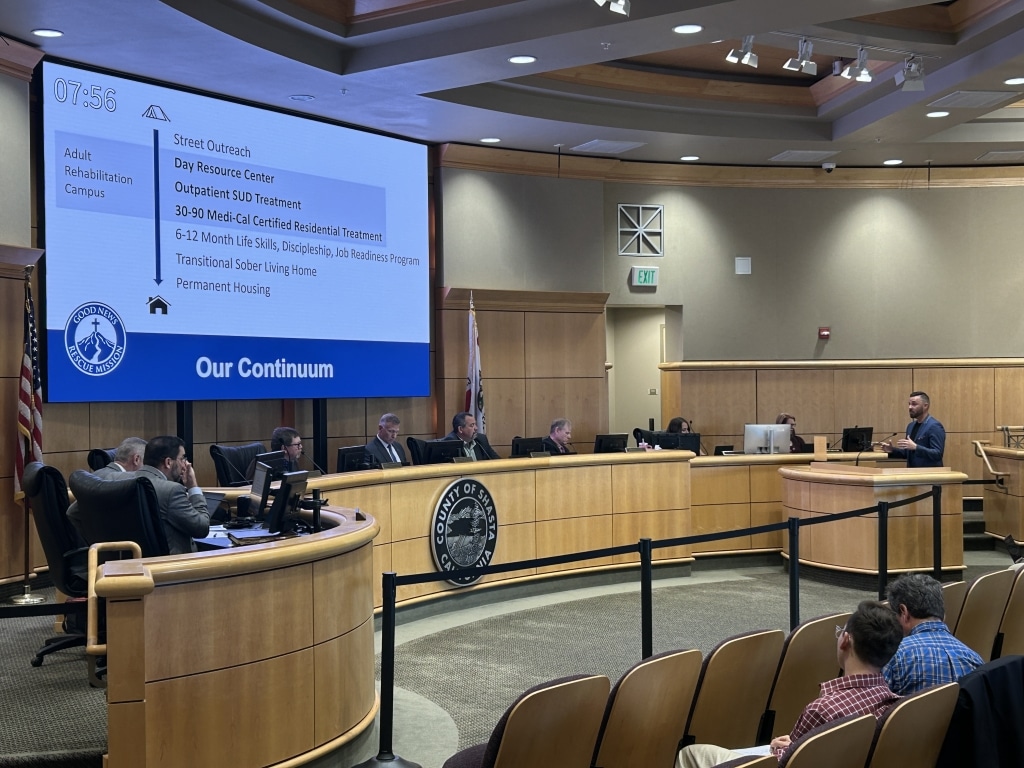
On Tuesday, Anderson’s presentation painted a bright picture of the Mission’s process to draw in a treatment-resistant clientele. Street outreach at homeless camps will build trust, Anderson said, bringing clients first to a day center and then into participation in the residential SUD treatment facility. Once enrolled in residential substance use services, the Mission will ensure clients are provided with medical supervision, case management and life skills — including employment opportunities, Anderson said.
He added that upon completion of residential treatment, clients will be transitioned to interim housing programs like the Mission’s 17-bed microshelter site, where they’ll receive continued case management and employment assistance. From there, he pledged, the Mission will work to ensure clients have access to permanent housing. The Mission’s roadmap for success as envisioned by Anderson will include “wrapping community around” clients to reduce the likelihood of relapse and returns to homelessness.
“You will see a huge, huge transformation in our community as a whole,” Anderson promised, saying the Mission’s roadmap for hard-to-reach clients “ensures people won’t go back to the street.”
The $2.2 million granted to the Mission will come from Shasta County’s pot of opioid settlement funds, which were received through legal settlements with opioid manufacturers. So far, Shasta County has received about $14 million in settlement funds, staff say, and is projected to receive an additional more than $25 million doled out over the next 15 years.
Thus far, the staff report indicated, the the county has committed a little over $4.6 million of those funds to projects that include youth substance use prevention services and a series of vending machines set up across the county to grant easier access to Naloxone, which can reverse potentially-fatal overdoses.
11.20.2025 7:03 a.m.: We have updated the story to correct a reference to the Mission’s years in operation.
Do you have information or a correction to share? Email us: editor@shastascout.org.
Author

Comments (8)
Comments are closed.
Related Articles
The fate of the Civic Auditorium may be decided this week. Here’s what you should know
The Civic needs between $1.4 million to $1.6 million in additional annual funding to keep its operations going, according to the organization that runs the event space.
Active measles case in Shasta County, officials urge vigilance and immunization
A patient with newly-diagnosed measles is being kept in isolation to prevent the spread of the highly contagious illness. Community members who might have been exposed during the patient’s eight-day contagious period are being contacted by Shasta’s public health staff.

Killing of armed Minneapolis protester Alex Pretti ignites 2A debate in conservative Shasta County
Second Amendment supporters in Shasta County including some with connections to a local militia, weigh in on topics including the right to carry at protests and the federal government’s current approach to immigration enforcement.
Not a fan of Goodnews Mission it all about making people having the worst time of their lives bend the knee to their faith or get nothing at all service wise.z
Plus, many don’t get treatment because of it’s unsanitary conditions with recurring bed bugs among other things, and the absolute refusal to have or build a pet boarding area, a person is turned always from the shelter if they have a pet. Sometimes a pet can show more love to a person in a day that entire lifetime with people. The Mission wants a person totally dependent on them.
For the non-professional staff at a treatment center to use their faith to gather their energy and sense of direction is fine.
Proselyting as a component of treatment is not.
Any course of treatment that necessitates prayer and professing in a christian faith should not be receiving public funding.
Well said Larry
Do the rescue mission and its related projects still require attendance at a Christian service or a Christian prayer before recipients can participate?
Haven’t done that for years
My concern is with the religious requirements Good News Rescue Mission uses. Many of the needy prescribe to different beliefs than Good News’s denomination, and many have avoided the Mission because of that. I don’t believe that preaching to heal is successful unless the person chooses to participate in that faith option. Will there be treatment and living options for those who don’t want the faith component? I didn’t get an answer to this question from Supervisor Plummer, but that was months ago and maybe ther is a provision for a nonfaithbased treatment option now. Please respond.
Conditions at the Mission are awful; the nepotism here and the obsession with zero-tolerance, faith-based approaches is harmful. There was no running water available during the day for multiple months this summer; we were using portable toilets that were poorly maintained, and drinking from unsanitary water jugs that weren’t filled often enough. I’ve never seen Jonathan Anderson. He does not interact with people here and I think that shows in the poor policy decisions we have to live with. The need for addiction counseling and other mental health services is very real, but this organization is a poor vessel for delivering them. The city and county should be putting resources into a secular, research-based suite of tools to help people into housing and healthcare. The microshelter project is a good start, but it’s so limited. The insistence on using people in these programs as free labor is disturbing. Some people will succeed with it, but many more will fail. They’ll have no money to show for their labor, only sore backs, increased anxiety, and slightly elevated privileges. We need a better system. It would be a good thing for the community as a whole.
Good News Rescue Mission is a quality organization with proven results. This is a good decision by the Board of Supervisors. Thank you, Chairman Crye, for bringing this forward.