
Good News Rescue Mission Will Use Prop 1 Funds to Build Substance Use Rehabilitation Campus in Redding
California’s Department of Healthcare Services will provide the faith–based nonprofit almost $18 million to build both inpatient and outpatient substance use treatment facilities. The state’s due date for project completion is January 2027.
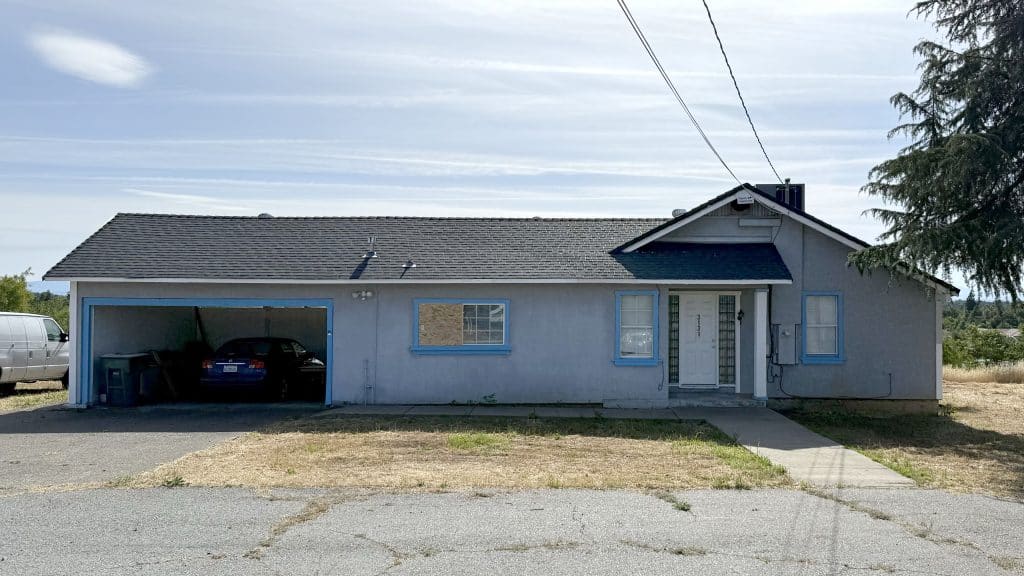
On a quiet residential street up the hill from their main facility on Market Street in the heart of downtown Redding, staff from the Good News Rescue Mission gathered with reporters and community members last week to discuss a monumental future plan.
“This house is actually going to be demo’d,” said Justin Wandro, the Mission’s Director of Community Partnership & Development, as he gestured to a blue ranch-style home behind him on Veda Street. It’s “where we will be building the three-story substance use disorder facility.”
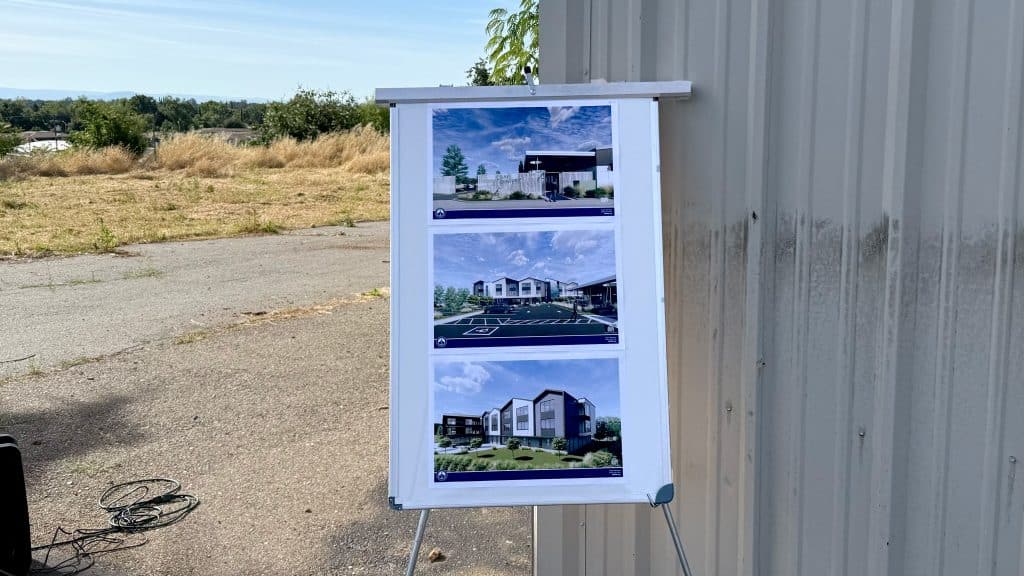
Wandro said the new state-funded 28,000 square-foot complex will have 75 beds, half for men and half for women, where patients will live while undergoing short-term intensive medically-supervised substance use treatment for 30, 60, or 90 days. After completing their initial program, patients will have the option to pursue the Mission’s 12 month faith-based recovery program, or seek further resources elsewhere.
“These are public funds. There is no faith based requirement,” the Mission’s Executive Director Jonathan Anderson clarified, in response to questions.
The funds being awarded to the Mission for the project’s construction are the result of Proposition 1, which authorized more than $6 billion for distribution across the state to provide infrastructure for mental health and substance use treatment.
The Mission is using the funds to build a substance use treatment facility. In addition to the new in-patient facility, the funding will also support infrastructure development for outpatient substance use treatment. Outpatient services will be housed at already-in-process day resource center the Mission is building with a different set of state of government funds, state money distributed in the form of a forgivable loan from the City of Redding. The outpatient facility will provide “basic services for people, showers, laundry, storage, access to case management, job training and outpatient drug and alcohol recovery services,” Wandro said.
Potential patients for both will be referred through other medical facilities, family members, self-referrals, service providers, or the Mission’s own outreach team, “who go out into the encampments and onto the street” to meet with the unhoused, Wandro explained. He told Shasta Scout that Mission will prioritize patients with Medi-Cal, though there will be space for those with private insurance or none at all.
Overall, the Mission’s vision is a “whole campus model,” designed to be “dignifying” and “beautiful,” Anderson said, describing the site as communal with a cafeteria, classrooms, and a lounge. The proposal was submitted with the help of former Redding council member Joshua Johnson who’s also the Mission’s Construction Manager.
The state Department of Health Care Services is distributing the funding as part of the Behavioral Health Continuum Infrastructure Program (BHCIP), which provides financial support for regional organizations and facilities that treat Californians affected by substance use, mental illness, and homelessness.
Proposition 1, which amended the former Mental Health Services Act into the Behavioral Health Services Act, prioritizes those most affected by mental illness, and expands the previous act to include treatment for substance use disorder (SUD).
Funds are for Capital Expenses
Importantly, Anderson explained, the $17.8 million from the state is only the funding needed to get the proposed campus off the ground.
“All of the money that we’re receiving is all for capital,” he said. “None of the money is for operations, and so we still have to do fundraising and figure out program reimbursements and things like that to keep all of our facilities operational.”
Developing services for a fully operational medical facility will be a major shift for the Mission. Currently, the nonprofit organization provides medical services only two days a week through a contractor, Shasta Community Health’s Center’s HOPE (Health Outreach for People Everywhere) program.
HOPE’s manager, Amber Middleton, told Shasta Scout the clinic at the Mission is able to provide primary care, urgent care, psychiatric support, case management, and referrals to other drug treatment programs. HOPE medical providers also prescribe patients suboxone, a drug used to manage opioid dependence by reducing cravings and withdrawal symptoms.
Middleton mentioned that the HOPE program can only provide suboxone to those at the Mission who are not enrolled in the organization’s faith-based drug and alcohol recovery program. Suboxone for those clients, Middleton said, is not allowed per the Mission’s policy. Wandro did not respond to a request to connect Shasta Scout to the recovery program manager for more information about the Mission’s approach to recovery.
According to the state’s grant eligibility guidelines, applicants who submit for the funding must have access to a site that is “shovel ready,” meaning the applicant either owns or controls the site where they intend to build. They must also present a viable business plan, be able to serve Medi-Cal beneficiaries when the facility opens, base the site plan on local data and have support from the county they intend to serve. Shasta Scout has requested the Mission’s grant application materials from the state via public record request and is pending a response.
The Mission was not the only local recipient of this round of funding. According to DHCS’s data dashboard, Visions of the Cross, another faith based organization in Shasta also received funds. Those funds will allow Visions of the Cross to develop a 60-bed expansion to their existing residential substance use treatment program for adults. The funds received by the Mission and Visions of the Cross are part of the first round of BHCP funding.
A third group is currently applying for second-round BHCP funds, to develop an additional behavioral health facility. That application is due in September. The application process is being led by Kimberly Johnson, the CEO of Arch Collaborative. In an email to Shasta Scout, Johnson expressed excitement about the Mission’s new funding saying the facility the Mission plans to build will help bridge some of the critical gaps she’s been concerned about. While the Mission’s facility will provide ongoing treatment options for rehabilitation, Johnson said, the ad hoc committee she’s working with hopes to obtain funds to construct a facility that will provide urgent response and crisis triage for substance users.
Accessibility
In the past, the Mission systematically turned away people whose names appeared on an internal “no services list”. Last year, Mission staff cleared that list and updated policies to remove some of the previous barriers to shelter.
For example, guests could previously only stay at the Mission for 30 days at a time, but can now shelter for up to 180 days. The Mission has also implemented an “amnesty” program which allows guests to place substances in a lockbox while sheltering, rather than being turned away. Since the policy changes, Anderson says, more people have been staying at the Mission. But barriers to shelter at the facility remain relatively high. Pets are not allowed on the residential campus and people must be able to ambulate without assistance to stay there.
When asked if there would be any barriers to access at the new facility, Anderson said the facility is designed for “anybody who has a substance use disorder,” saying potential patients will be screened by medically-credentialed staff.
Do you have a correction to share? Email us: editor@shastascout.org.
Comments (3)
Comments are closed.
Related Articles
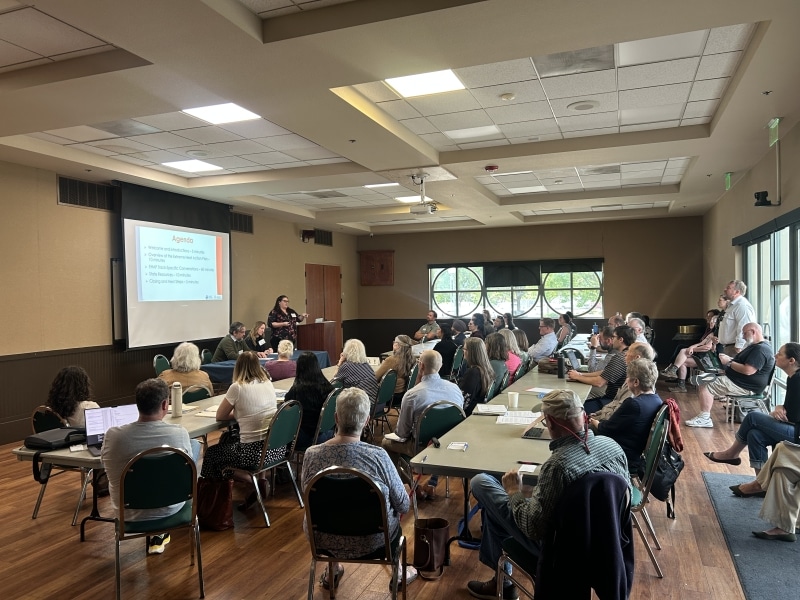
State officials visit Redding to discuss update to California’s Extreme Heat Action Plan
Officials with several state agencies held a listening session in Redding today. They asked community members to weigh in on topics connected to extreme heat, including appropriate services, resilient infrastructure, nature-based solutions and how to increase public awareness of risk.
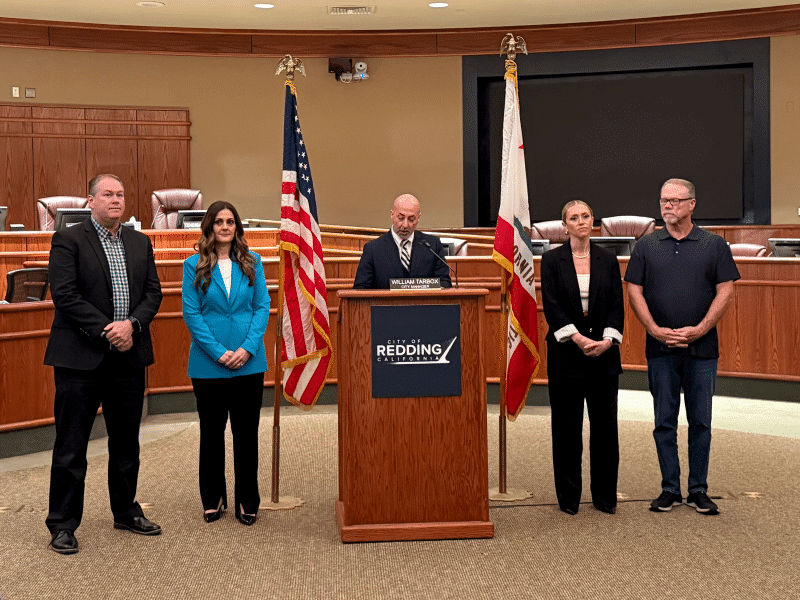
New Redding manager announces ‘assault’ style overhaul of city operations
During what was originally planned as a press conference about city electric rates, Redding’s recently-hired city manager William Tarbox announced a “new era” in Redding’s governance. Council members haven’t yet met publicly to discuss such a plan but some say they’re on board.

Get ready for California’s 2026 primary. Your questions about voting, answered
Get answers to your election questions ahead of California’s June 2 primary election.
While is is recognized by most individuals that treatment centers are a necessity to handle substance abuse within a community; it’s also reasonable to question the GNRM director and staff how they’ll handle those clients who happen to be part of the LGBTQ+ community and have a substance abuse issue. Will their biblical position comport with California’s anti-discrimination laws ? GNRM will be using public funds, of which LGBTQ+ citizens are contributors. While I’m glad to see GNRM has loosened some of their regs, but denying a protected class of individuals will not be tolerated. And while you’re at it, please find a way to accommodate one’s pet, they can be a lifeline for those on the streets.
Suboxzone is a very addictive drug as well! This will attract a lot of opioid users to Redding! So while I have faith in the Mission and its efforts, people need to monitor the progress with a microscope.
This is a much needed addition to Shasta County. We really need a mental health hospital though. One that specializes in severe mental illness. Substance use is often a self medication tool for underlying mental illness, but without professionals to address those underlying illnesses the program won’t work for the severely ill.