
Justice and Public Safety Forum Provides New Insights Into Shasta County Challenges
The forum included presentations by Shasta County’s top criminal justice officials from a number of different agencies. While some presentations provided expected information, others shed new light on current challenges.
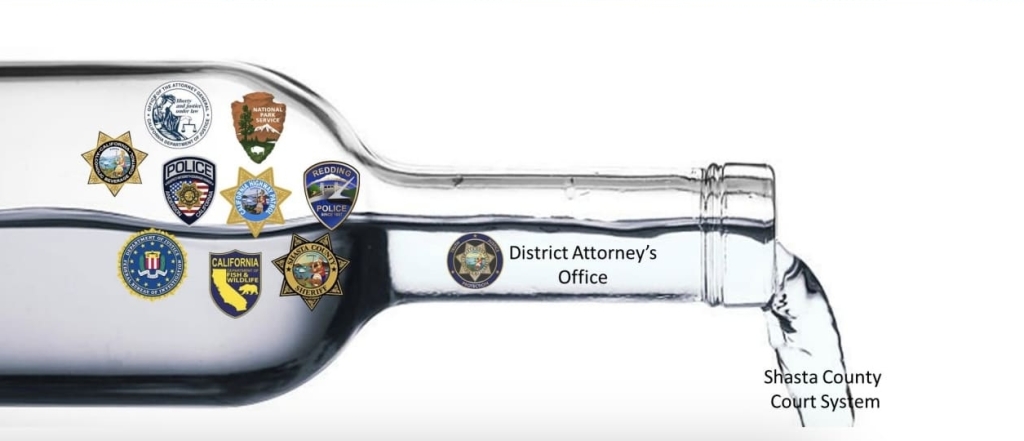
A forum coordinated by Supervisor Kevin Crye has helped set the foundation for new understanding and decision-making between different areas of the government, when it comes to public safety.
The public meeting included presentations by the County’s District Attorney, Public Defender, Chief of Probation, and Sheriff as well as the CEO of Shasta County’s Superior Court and the Redding Police Chief.
Law Enforcement Needs
During brief remarks, Redding Police Department Chief Brian Barner said his central need is funds for staffing. Focusing on changes within RPD due to an impending $5 million budget deficit, Barner said staffing losses will affect the agency’s ability to enforce against low-level “quality of life” crimes related to the unhoused community, as well as RPD’s ability to proactively address retail theft. The public’s top demands for enforcement, Barner said, relate to homeless camps, retail theft, and traffic.
The Shasta County Sheriff also shared a presentation, saying his biggest challenge continues to be adding jail capacity, while acknowledging that the money to fund a new jail or jail expansion is not available. In the absence of such funding, Sheriff Michael Johnson said, he’s focusing on strategies that can decrease congestion in the jail. Those include contracts with other counties to hold Shasta County inmates in their jails. He’s also working to ensure that suspects who are incompetent to stand trial are identified early in the incarceration timeline, so their time in the local jail is reduced. And he’s pursuing strategies related to sentencing, in which the County either seeks a lighter sentence that allows for just electronic monitoring or pushes for a sentence that results in state prison rather than county jail time. Meanwhile, Johnson continued, he’s continuing to work towards the idea of an expanded Alternative Custody Program.
There was no presentation from the City of Anderson’s Police Chief. The City of Shasta Lake, which contracts its law enforcement services via the Sheriff’s Office, also did not provide a presentation.
The Needs of Criminal Justice Attorneys, Including Prosecutors and Public Defenders
Shasta County’s District Attorney, Stephanie Bridgett, gave the longest and most in-depth presentation. Describing the DA’s Office as the bottleneck of the criminal justice system, Bridgett said it’s imperative for the County to invest additional funds in the prosecutorial process in order to see more public safety results.
Using data to back her claim, Bridgett compared Shasta to counties with similar numbers of judges and counties with similar number of felony filings. Her comparison data was drawn from the statewide Judicial Council Report for 2024.
In counties with a similar number of judges, Bridgett said, Shasta’s DA Office has a 30% higher workload for both prosecutors and legal staff. That comparison gets even worse when it comes to counties with similar felony filing rates, who typically have more than double the number of prosecutors and legal staff as Shasta does, Bridgett explained.
“When we look at those counties with a similar workload,” Bridgett continued, “we have 20 prosecutors. They have, on average, 50. We have 10 secretaries supporting them, they have on average 26. So we are trying very hard to do the same amount of work with half of the staffing…”
Using a fire fighting comparison, Bridgett said limited funding for the DA creates a situation similar to trying to fight wildfires with only a single staffer and vehicle. To make matters worse, she said, both retention and recruitment are an ongoing struggle for the DA’s Office. She asked the Board to take action in support of public safety by increasing both pay and retention bonuses, approving more budgeted positions, and updating the classification for legal staff.
“So it really comes down to what you want,” Bridgett emphasized. “I want to do what we can to protect our community and aggressively prosecute cases.”
On the other side of the court trial process, the Public Defender’s (PD) Office works to meet the Constitutionally-protected legal defense needs of those without adequate financial resources. During her presentation, newly-appointed Public Defender Ashley Jones told the Board her office also lacks staffing.
Using county comparisons and research from a National Public Defense Workload Study, Jones said Shasta County needs almost double the number of public defenders currently budgeted for, in order to meet workload demands. The PD’s Office also faces significant recruitment and retention challenges, she said, asking the Board to amend the terms of the Office’s hiring bonus, provide competitive pay, and increase the budget for staffing.
The work of the Public Defender’s Office, Jones emphasized, is an important aspect of Shasta County’s overall public safety picture. Aspects of her Department’s work, she explained, address the root causes of criminality and provide services that actively reduce recidivism. The PD’s Office also reduces unnecessary pretrial incarceration, freeing up jail space.
Where the Courts Fit In
A succinct presentation by Shasta County Superior Court CEO, Melissa Fowler-Bradley, shed significant light on what many believe is the current lack of judges appointed to the Shasta County Court. Fowler-Bradley said she personally agrees that there’s a judge shortage here, but the paths to improve that situation are limited.
“The Superior Court is funded by the state of California,” Fowler-Bradley said. “Although our operations are on the rise, our funding is not. When the state has budget problems, as it has had this fiscal year,” she continued, “our funding is reduced even when our workload grows.”
Noting that Governor Gavin Newsom reduced trial court funding by 8% this fiscal year, Fowler-Bradley said the Shasta Superior Court’s overall funding is down $1.2 million this year, a situation which directly impacts services.
In the last year alone, she continued, almost 45,000 cases were filed in Shasta County Superior Court. That’s in addition to all the existing open cases in the Court’s jurisdiction. The workload per judge in Shasta County is the fourth highest in the state, she said, with case loads having increased by more than 18% since 2021.
But solving that problem requires state intervention, she explained.
“The Court can’t add additional judges, and the County can’t create more judges, even if they wanted to fund them,” Fowler-Bradley said. “Only the legislature in California decides the number of superior court judges in each county.”
The policy-making body of the judicial branch in California is called the Judicial Council, she said, and the law requires that the Judicial Council provide the legislature with an assessment on the need for new judgeships in the superior courts. That assessment is based on three-year workload data that is provided by the counties in every November of even-numbered years. The Judicial Council has not yet reported that data to the legislature, she said, because the data is skewed by the impact of the COVID pandemic.
“So it was determined to wait a year in order to provide more accurate measurement of court workloads,” Fowler-Bradley continued.
Once the assessment is provided to the legislature, she said, they must decide whether to add judgeships. If a member of the legislature proposes to do so, they must introduce a bill which must then pass both houses, with associated funding attached, in order to eventually result in new judges being allocated to the courts.
In September 2023, Fowler-Bradley noted, the legislature passed Senate Bill 75 which authorized 26 new judgeships statewide but did not include funding for those positions. Had those positions been funded by the legislature, she said, those judges would have been allocated to courts state-wide based on workload.
“SB 75 was not the first time that the legislature recognized the need for additional judgeships and declined to fund them,” she explained, and “will remain intact until the legislature takes action to replace it with another bill or funds SB 75.”
“If the Bill is ultimately funded”, she continued, “Shasta’s workload would be prioritized along with the 57 other superior courts, and we could receive another judge.”
“There is no other way to add a judge in Shasta County,” Fowler-Bradley emphasized.
What About Probation?
Shasta County’s Chief Probation Officer, Traci Neal, explained to the Board during her brief presentation that the work of Probation staff focuses on providing supervision and preventing repeat offending by those with criminal histories. Her department’s biggest challenges, Neal explained, include making contact with clients in order to provide necessary services.
“Often, offenders are entrenched in criminal thinking and behaviors for decades,” Neal explained. “They don’t know any different way.”
She said Probation Officers utilize evidence-based practices as they work to engage resistant clients in Probation services. For example, she said, officers will often pick up clients in order to ensure they meet court dates or show up for treatment as they work to help those under their supervision change long-entrenched ways of living.
Housing is another significant challenge for the Probation Department, Neal said, explaining that the need for housing surpasses available options, especially for those with the increased barrier of a criminal history. In particular, she said, there is a high need for sober transitional housing and permanent supportive housing.
“When offenders are homeless,” Neal explained, “it’s harder for them to engage in structured treatment and supportive services, which increases the likelihood that they will engage in criminal activity impacting the community, public safety and leading back to jail.”
Neal did not make any requests of the Board but did mention that additional challenges for her Department include state funding streams that have not kept pace with required probation services and a challenging case management system.
Next Steps
The meeting was informational only. No votes were taken and Supervisors commented only briefly in response to the multiple presentations before concluding the meeting due to time constraints.
While Board Chair Crye began the meeting by saying he was humbled by the opportunity to have so many public safety officials in the same room to coordinate on shared problems, he ended it by indicating that he believed some of the information shared by those officials might not be true and would have to be confirmed. He did not note any specifics.
Supervisor Chris Kelstrom used his comments to thank Fowler-Bradley for her remarks.
“I’d really like to appreciate you coming in today and explaining some things”, Kelstrom told the CEO of the Shasta Superior Court. “Because honestly, for the last several months, I kept hearing that it was lack of judges, lack of judges, lack of judges, and these things kept getting kicked back out on the street. And obviously, we all know, we can use more judges. I mean, we can use more everything. But it sounds like the court systems are going pretty good over there.”
Supervisor Corkey Harmon said the information shared about the lack of judges in Shasta County provided an indication that the Board could have some impact by sending a letter to the state, maybe signed by all of the County’s public safety officials, with information about how a new judge could help meet the County’s needs.
Leaning on his career law enforcement background, Supervisor Allen Long zeroed in on the bottleneck at the District Attorney’s office, saying he’d like to find a way to address that and other public safety issues through the strategic plan he and Supervisor Matt Plummer have been working to bring before the Board.
“My hope is that public safety comes out at the top of our strategic plan,” Long said, “and then we can allocate resources according to the strategic plan and the priorities for our county.”
Public safety officials will convene again soon for a follow-up meeting that would allow Board members to ask questions of department heads and provide a ongoing venue for further discussion with the public. That meeting will most likely be scheduled within the next 60 days, Crye said, in order to provide needed discussion before budget decisions mid-year.
Do you have a correction to share? Email us: editor@shastascout.org.
Author

Related Articles

Shasta County Public Health identifies sixth site of possible measles exposure
The Ninja Coalition is the latest site listed by the county where community members might have been exposed. The public is encouraged to remain vigilant for measles symptoms and update their MMR vaccinations if needed.
Local chapters of Turning Point USA will host a “faith night” amid looming protests
The conservative youth organization’s event, scheduled for Feb. 7, is the latest flashpoint among ongoing political debate in the county.
Disaster declaration by federal administration makes loans possible for December flood victims
The city and the federal Small Business Administration will host a Disaster Loan Outreach Center for several weeks to help individuals and businesses affected by the flooding apply for loans. It opens Feb. 6.