
Measures C and D Will Help Shape the Future of Shasta County’s Board
Measure C is relatively simple. Do you support term limits as a path to healthier governance? Measure D is more complicated. Do you want to put the power to decide who fills a board vacancy in the hands of just some of the county’s people? We explain. You decide.
2.20.24 10:45 pm: We have updated the article to clarify that Measure D does not become operative until January 1, 2025, leaving the power to fill a vacant board seat in Governor Gavin Newsom’s hands until that date.
Shasta County voters will have the chance to vote on two measures as part of their March ballots. The first, Measure C, allows voters to choose whether to institute term limits for county board members. The second, Measure D, gives voters the option to change how county board vacancies are filled by making Shasta a charter county.
Both will shape the future of how Shasta County is governed, but Measure D has the power to do so more quickly and decisively. If passed, Measure D would shift the balance of representation in Shasta County.
Here’s what you need to know.
What’s a ballot measure?
A ballot measure, also known as a proposition, offers the voters the opportunity to decide for themselves whether to make something law. In other words, ballot measures offer voters the ability to participate in direct, rather than representational, democracy.
Why are ballot measures used?
Some issues cannot, by law, be decided by the people’s representatives, and instead must come directly to the people. Other issues end up on the ballot as a way for legislators to bypass making a direct decision.
In the case of Measures C and D, both issues require a direct vote of the people to become law.
What is Measure C?
Measure C was placed on the voter’s ballots by a decision of the Shasta County Board of Supervisors in April 2023. If approved by voters, Measure C will limit county board members to two terms in office.
Shasta County supervisors serve four-year terms. Measure C means that supervisors would not be able to serve more than two terms, or a total of eight years in office.
Importantly, while Measure C will take effect immediately, it won’t affect Shasta County’s current supervisors in the same way it will affect future supervisors. Current supervisors, or any supervisor who takes office before January 1, 2025, will be allowed to serve two additional terms beyond their current term.
That means if Supervisors Patrick Jones or Mary Rickert are reelected during the March primary or November general election, they will be allowed to serve an additional two terms in office. Jones has already served one term and Rickert, two terms.
Why do some people support/oppose Measure C?
In general the debate on whether or not to instate term limits comes down to whether the voter has a greater value for political experience and stability or for ensuring a constant inflow of new ideas and perspectives.
In Shasta County, some previous supervisors have served many terms in office. For example, former supervisor David Kehoe served twenty years in office before being defeated by Joe Chimenti in 2018. And former supervisor Leonard Moty served twelve years before being recalled in 2020.
Supporters of Measure C say limiting board terms will encourage elected officials to learn and take action more quickly on the issues they care about, by ensuring their time in office is limited. Supporters also think term limits will make county board elections more competitive and diverse. Supervisors Jones, Kevin Crye, Chris Kelstrom and Tim Garman, support Measure C.
Opponents of Measure C emphasize that voters can limit the term of any supervisor at any time, simply by voting them out. They worry that term limits could disqualify an elected official whose policies are respected by the people, even if there was not another well-qualified official interested in running for their position. Supervisor Rickert opposes Measure C.
What’s Measure D?
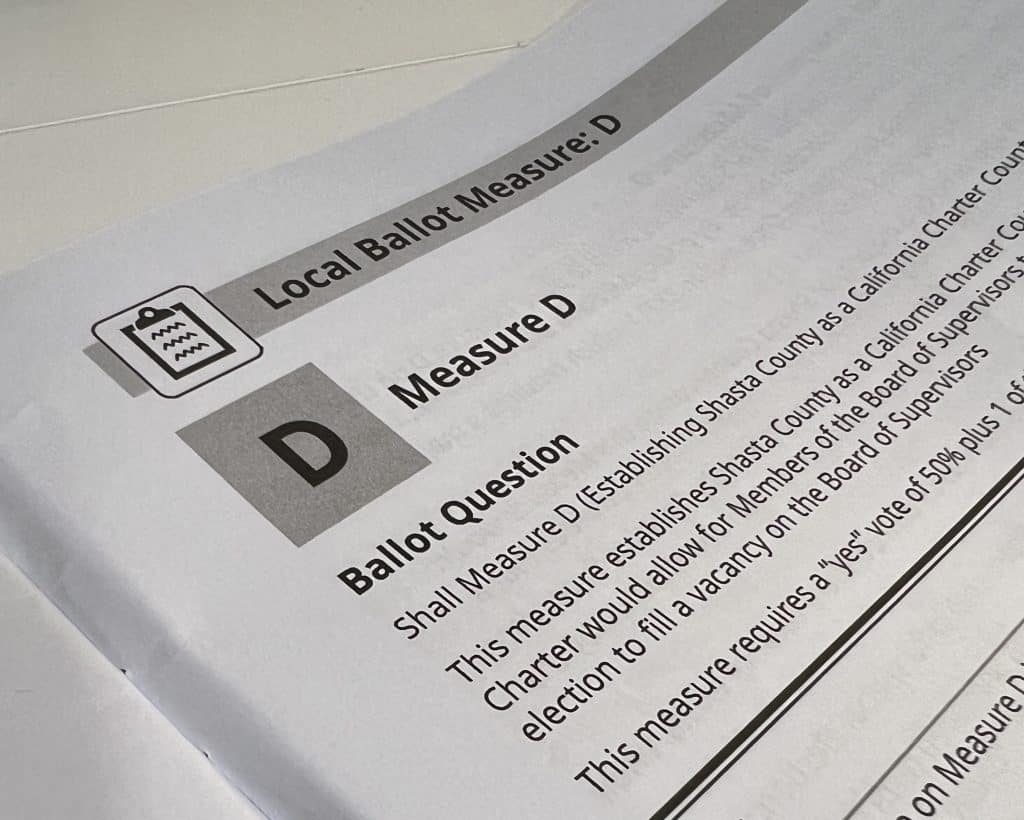
Measure D was placed on the voter’s ballots by a November 2023 decision of the Shasta County Board of Supervisors. If approved by voters, Measure D will make Shasta a charter county. It will also change how vacancies on the the county board are filled.
California has two kinds of counties: general law counties and charter counties. Most California counties are general law counties, meaning that they follow the state’s general laws for counties. In contrast, charter counties are those where the voters have agreed to a specific charter that changes the county’s laws in specific ways. Different charter counties across California have different specifics to their charters.
In Shasta County, Measure D calls for a one-issue charter. If passed, Shasta County will continue to abide by the rules of a general law county in every other way but the one issue specified in Measure D, how a vacancy on the board of supervisors will be filled. Under California law the Governor is allowed to appoint a replacement to fill vacancy on the Board of Supervisors. If Measure D passes and there is a vacancy on the board, supervisors would be empowered to vote to decide whether to fill the vacancy by a special election or by an appointment of the board.
Amending Shasta County’s charter to add additional issues would require another vote by the people on those specific issues.
Why do some people support/oppose Measure D?
Measure D is about two things. It’s about whether the county should become a charter county, but it’s also about how Shasta County will fill vacancies on the board of supervisors.
Measure D is a legal path to changing how Shasta County fills board vacancies. Supervisor Kevin Crye, who suggested the idea, says it’s also about returning power to the local people by bypassing a recent California law that allows the governor to fill county board vacancies.
But Measure D adds an additional complexity for voters to consider. That’s because the supervisors who put this measure on the ballot did not choose to give full control to the people by specifying that a vacancy on the board of supervisors would prompt a special election. Instead they left the power in the hands of the board who will decide whether to appoint a board member themselves or call a special election to let voters decide.
So while Measure D brings control over filling board vacancies back to the county level, it does not give direct power back to the voters whose representation is most affected by a vacancy. In this way, Measure D may be seen as disenfranchising those voters whose district is affected by the board vacancy, by giving their power to choose a candidate to representatives chosen by the voters of other districts.
If Measure D passes, it will not become operative until January 1, 2025, which means if Supervisor Kevin Crye is recalled, Governor Gavin Newsom will still have the power to fill his vacancy. If Newsom does not fill the board seat before January 1, 2025, the supervisors of Districts 2,3,4 and 5 would have the power to fill Crye’s vacancy. Allowing Newsom to choose who fills a board vacancy can also be seen as a form of disenfranchisement of those voters most affected by the vacancy. But it does not shift the balance of power to other voters within the county in the same way that Measure D would.
Shasta County supervisors Jones, Crye and Kelstrom support Measure D. Supervisors Rickert and Tim Garman opposed it.
Other Resources:
We have closed comments on this post due to ongoing back-and-forth non-constructive discussion. Have questions, concerns, or comments? Reach out to us: editor@shastascout.org.
Author

Comments (9)
Comments are closed.
Related Articles
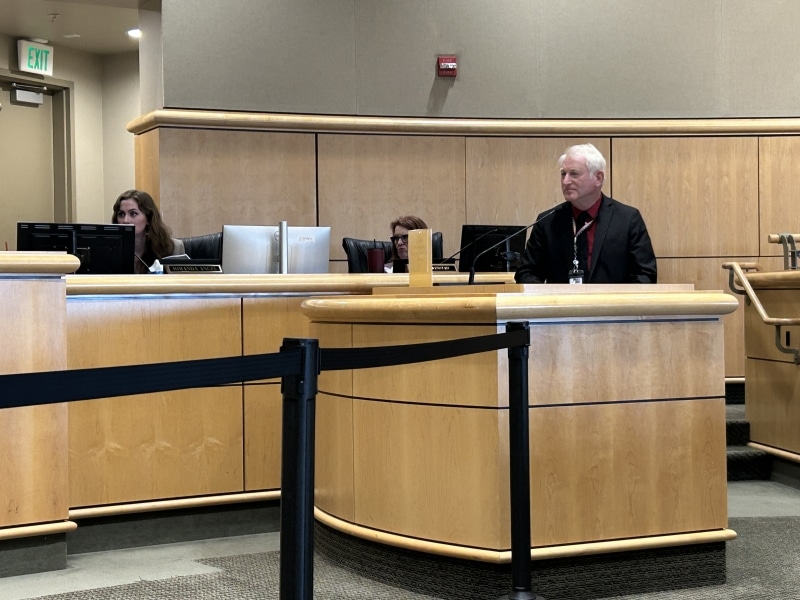
Shasta won’t fund election official’s representation amid legal challenge to ballot measure
Curtis asked the board to hire Trump-connected attorney Peter Ticktin in hopes of ensuring the amendment makes it to ballots. A majority said no.

Among a slew of conservative candidates running for local nonpartisan offices, Shasta GOP endorses select few
The Shasta County Republican Central Committee recently made public endorsements of candidates in local offices, including supervisor and registrar of voters, both of which are nonpartisan positions.
Anderson City Council to consider adopting social media policy following member’s controversial posts about local flight school
The discussion comes after council member Darin Hale made numerous claims on his personal Facebook account attempting to link a local flight school to Chinese espionage. The school has called the claims unfounded and said they undermine community safety.
Annelise, this is really well written, factual, non-biased reporting. You educated me so that I can make a more informed decision. I can’t thank you enough.
The charter county Measure appears to me to be a choice between two awful options. I cannot imagine many people wanting the governor to make decisions for us.
However.
Say we apply the concept that if it seems too good to be true, it probably is.
This current Board majority’s idea that THEY should make the decision for us is unacceptable.
Especially in light of the fact that they could have crafted the Measure to allow we, the People, to vote in our own replacement.
Consider: Why wouldn’t they want to give us the right to choose our own replacement after we vote to recall someone?
Why purposely propose to take away the voter’s right (OUR rights) to choose our own replacement?
They are politicians. They do not want us to be able to choose. If we recall someone they like (aka someone who votes on their side) then they can just appoint a replacement who will vote the same. And all of the work of the people who VOTED to recall someone would be nullified!
What if we give them this power and they choose a replacement that District doesn’t like/want? This Board regularly ignores comments, questions, even pleas of those they disagree with. I believe the majority has demonstrated they could care less what the voters want. They regularly do whatever they want whether it is against the rules, fair, or even polite.
How likely would it be that a Charter status would be reverted back to General Law? What other powers could the Board sneakily give themselves as a Charter (instead of giving it back to the voters)? How much damage could be done before the People could take back power from the politicians? Whether it is the MAGA majority, or an extreme liberal majority, or a majority that are members of one organization, that majority would surely select a like-minded replacement, regardless of the makeup of that District.
I don’t see this Measure D put before us as a safe option. I would like to see a measure on the next ballot that takes the choice of a recall replacement away from the Governor, AND puts it in the hands of the voters – not other politicians.
Don’t be fooled, Measure D is a simple ruse. Jones, Crye, Kelstorm, and their Cartel of extreme-far-right supporters say they only want to restore power to the people; they are lying, and they’re also counting on voters being stupid! Measure D takes all power to vote away from the citizens (voters) and puts it in the hands of their extreme far-right Cartel. Like Putin Tin-Horn Dictators, they want this anti-democratic authoritarian tool so they can fire and or hire supervisors they want, when they want, bypassing the American process of citizens electing their representatives by themselves! The Cartel knows Shasta County will never be the secessionist State of Jefferson they dream of. But becoming a Charter County is a way the J.C.K. Cartel can reshape all county departments and replace all county employees who don’t support their authoritarian, secessionist State of Jefferson dream! County governance is supposed to be non-partisan. Jones, Crye, and Kilstorm are hard far-right. Measure D is just a dictatorship in sheep’s clothing. Don’t fall for this nightmare. Make Shasta County Safe and Sane Again! Vote No on D!
You just like the state making all the decisions!
The vote on Measures C & D should be no-brainer for voters. Vote YES on term limits and on becoming a Charter County.
We have term limits for US President (2 terms) and the CA legislature. We don’t need career supervisors.
Being a Charter County will allow the Board to appoint a replacement or call a special election to fill a supervisor position that becomes unexpectedly vacant. Why would you want the Governor to be involved in a local issue such as this? The citizens can voice their opinion to the Board of who they would like appointed to fill the position, or they can demand a special election.
Yeh. It really makes you think, huh? Maybe no term limits can make the every day citizen kinda lazy: “Oh, let those in office make the decisions. I’m too busy.”
Jones, crye and Kelstrom all support Measures C and D.
What’s in it for them?
The smart bet is to vote against the two measures.
Chad: I’m not making a comment on how anyone should vote on these measures. However I would encourage you to stay focused on policy, not people. Sure, the fact that people you don’t trust support something might mean its a bad choice for you. But then again, it might not. I think voting against anything your political opponents support increases the destabilizing polarization our society is already experiencing too much of. Just my two cents.
Amen, Annelise. We, individually, must still investigate and find the knowledge to make a wise choice.
Attaboy!