
Pit River Tribe Celebrates Designation of Sátíttla Highlands as One of Two New National Monuments
Monument status will provide increased protection for hundreds of thousands of acres of unspoiled wilderness that have been threatened by geothermal extraction. Pit River Tribal members say the federal designation will also promote Native healing.

On January 7, 2024 the sun rose over 848,000 acres of California wilderness that’s been newly protected from the encroachment of industrialists.
The land includes the sites of two new national monuments that were just signed into law by President Joe Biden as part of the America the Beautiful initiative. The new monuments federalize Chuckwalla, close to Joshua Tree National Park, as well as Sátíttla Highlands in California’s far north.
The newly-designated Sátíttla Highlands National Monument straddles parts of the Modoc, Klamath, and Shasta-Trinity National Forests, on land surrounding the behemoth dormant Medicine Lake volcano. The area, known as the Sátíttla wilderness, is bejeweled with unique geological formations and sacred to both the Pit River and Modoc peoples.
“It’s literally the location of our creation narrative–it’s holy lands,” Brandy McDaniels (Pit River, Madesi Band), the Sáttítla National Monument Lead for the Pit River Nation, told Shasta Scout. For McDaniels, this victory, like Sátíttla’s new designation, is monumental.
“Governor Gavin Newsom has an initiative about truth and healing, right? But I say truth and healing cannot begin if we’re constantly fighting to protect our sacred lands,” McDaniels emphasized, noting the many structural challenges her community faces living in the shadow of the history of California’s forced removal and extermination of Indigenous peoples.
“You know, we have a lot of horrific genocidal traumas, terrible things that were done to our people,” McDaniels reflected, “but this is one less burden to take off of our future generations, so they can actually try to use these areas as intended… to actually heal.”
For Pit River citizens involved in this effort, Sátíttla’s triumph is part of an international struggle to protect endangered habitats, which McDaniels says she observed firsthand at this year’s COP16 climate summit.
“It’s really dire,” she said of worsening environmental conditions, adding that the Pit River Tribes stands in solidarity with other communities globally who are working to protect their own intact ecological areas that, like Sátíttla, act as important buffers to climate change.
Biden’s decision to protect Sátíttla Highlands is the latest development in the Pit River Tribe’s ongoing legal struggle against exploration and development by geothermal energy companies, which dates back to the 1980s. In the past, geothermal energy companies have leased land around Sátíttla from the Bureau of Land Management–at times, illegally, and at great cost to the health of the forest, the Tribe says.
According to a January 7 White House press release, Sátíttla’s national monument status will not affect “valid existing rights” for use of the land, which include ongoing hazardous fuels reduction (the removal of dry tinder that contributes to wildfires) and military training. The press release does not explicitly mention geothermal exploration but a statement by the U.S. Forest Service, says “mining on federal lands will continue” but only if “found to be a valid existing right.”
It was only fifteen months ago that Pit River leadership filed paperwork after determining that establishing Sáttítla as a national monument would likely be the most effective avenue to legally protect the area, which is also known as Medicine Lake, as a national monument.
A spokesperson for Protect Sátíttla, Jen Dickson, said she could not provide details about the Tribe’s ongoing litigation against geothermal energy companies for legal reasons but confirmed that no new development is expected to be permitted on the grounds of Sátíttla, under the new monument status.
Beyond the Tribe, supporters of the effort to make Sátíttla Highland a national monument have included a diverse coalition of other organizations including the California Native Plant Society, California Trout, Trout Unlimited, and Backcountry Horsemen to name a few, according to David Ledger, the President of Shasta Environmental Alliance (SEA), a local nonprofit environmental group.
Ledger said activists were galvanized to support the effort in large part by concerns about the profound effects further energy exploration and infrastructure development, could have on the land. Despite the fact that geothermal energy is considered renewable and generally thought to be less harmful than fossil fuels, environmental groups contend that its extraction in Sátíttla–which involves drilling deep into the Earth to access heat used to generate commercial electricity–endangers the environment by risking the release of hazardous chemicals into one of California’s most important aquifers.
Current exploratory drilling could have led to Sátíttla becoming the site of major drilling and a geothermal power plant, Ledger said, hastening the deterioration of a critically important natural habitat.
“Not to mention”, Ledger added, “the land was stolen from the Pit River Tribe.”
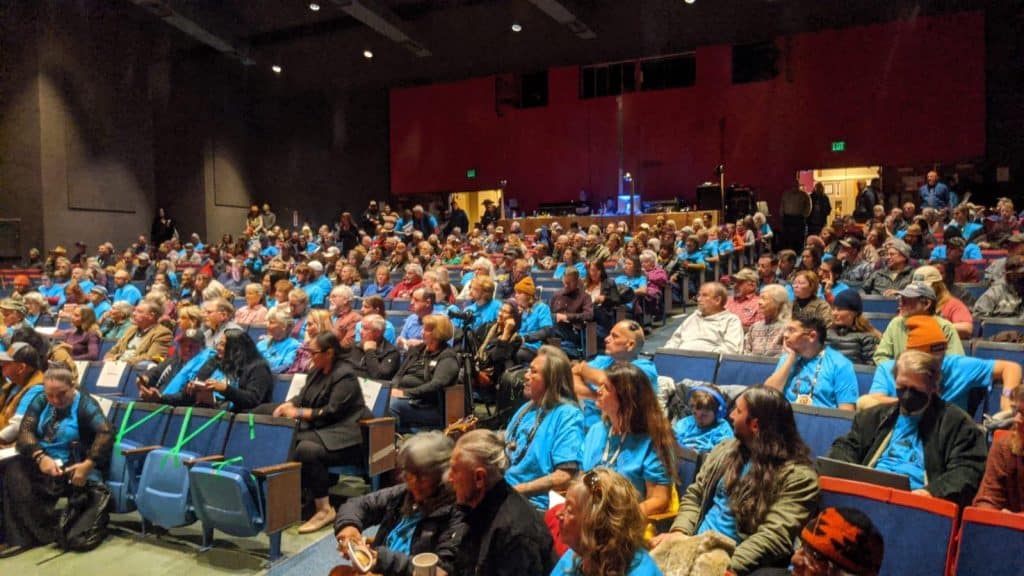
Since November 2023 when the Pit River Tribe first mobilized the monument petition, thousands of individual signatories and hundreds of businesses have pushed the Federal government to protect Sátíttla. Last month, over 500 people attended a U.S. Forest Service listening session in Weed, California, with many of them speaking in support of the Tribe’s effort.
The designation of the new national monument also bears significance for scientists and outdoor recreation enthusiasts, by bringing Sáttítla’s biome and profound beauty under new federal protections.
That’s an important step, said Nick Joslin, who works at the environmental nonprofit Mount Shasta Bioregional Ecology Center (MSBEC) as a Forest & Watershed Watch and Community Fire Resiliency Programs Manager. But, he explained, it’s not the end of his organization’s work to protect the sacred land.
MSBEC has been a co-plaintiff alongside the Pit River Tribe in past litigation over the preservation of Sátíttla. With federal protections now in place, MSBEC is working toward state protections as well, Joslin said, explaining the importance of Medicine Lake as a vital water source that feeds into Fall River, Shasta Lake, and by proxy, the Sacramento River. Even as a national monument, visitors will still be permitted to use boats and snowmobiles on the land which, he explained, will further degrade the water’s purity.
“The monument is . . . we’re getting very close to frosting on the cake,” Joslin said, “but at the state level you can get an Outstanding National Resource Water (ONRW) classification which further limits activities that degrade water sources.”

Radley Davis (Pit River, Ilmawi Band), who’s a part of the Sáttítla Highlands monument team, said it’s important to note how Natives have historically been excluded from conversations about land stewardship–whether at a governmental or environmental level.
“I’ve seen scientists struggle with interpreting spiritual narratives from our Tribe, particularly,” he explained. “We felt a little we were betrayed by scientists… they just could not grasp traditional knowledge, they could not grasp our epistemologies.”
While Davis wouldn’t go so far as to say the recent actions have set a precedent, he thinks it’s possible the Native–led movement to monumentalize Sáttítla might represent the tides of change.
“Let’s just say that we are definitely shining a light,” he said.
Throughout the process of designating Sátíttla as a national monument, Tribal sources said, the Pit River Nation has worked closely with the US Forest Service and moving forward, the Tribe plans to remain extremely involved in the stewardship of the land. Pit River people are developing a “resource management plan” that could incorporate Indigenous forest management methods such as cultural burning and canopy diversification into future management.
“Folks are coming around to realizing traditional practices are a really good thing,” McDaniels explained. “We look forward to continuing the partnerships that we’ve been building with the Forest Service and other agencies to responsibly manage these lands.”
Do you have a correction to share? Email us: editor@shastascout.org.
Comments (7)
Comments are closed.
Related Articles

Appeal court pauses Shasta judge’s ruling in election ballot measure case
Election staffer Laura Hobbs has successfully appealed a temporary restraining order, allowing a controversial ballot measure she helped champion to move forward. If approved by Shasta voters, the measure would amend the county’s charter to implement local election practices that would violate state and national law.
Flight school official says multiple international students have withdrawn enrollments after Chinese espionage claims by Anderson council member
After advocacy by IASCO Flight Training Operations Manager Miranda Vorhis, the Anderson city council adopted a social media policy Tuesday night. But she said there’s already been measurable harm inflicted upon the school.
Council defers decision on REU rate increases; approves open alcohol containers during Kool April Nights Cruise
The council agreed to honor a request from REU to take more time for more public outreach, given low attendance at recent workshops used to explain the rate increase.
Great article…I encourage readers to click on the link ‘cultural burning and canopy diversification’…this explains in detail how and why native tribes kept the forests from doing what they do today, ravage themselves and surrounding communities.
The colonizer declared the colonized land shall forever be owned by the colonizers and frozen in history, but the colonized still rejoiced?
If it were my tribe, I’d rather it have the ability to buy the land back and use the land as it saw fit — like any other sovereign nation…
Mahmoud: And if you and your people made that choice would you hope for others to publicly denigrate the choice you made?
I think it is a crucial part of the story. The tribe that fought the battle of 4 corners has enthusiastically put their own access to their ancestral land in the hands of the US Government. They’re satisfied now, but that might not be the case under future presidential administrations and they’ve undercut the ability of subsequent generations to regain the land.
Mahmoud: it’s certainly an obvious risk and one that apparently the Tribe believed was worth taking.
Wonderful News. The Tribal people have been so abused in the past. Medicine Lake is a healing place. Its waters deep and pure. This protection is long overdue and the beginning of recognizing that the knowledge of the Pit River and Modoc people have about tending this important spiritual, and physical place is critical for all Earth people.
May this sacred place be spared from the rapacious greed of energy corporations.
This is indeed wonderful news. While doing the right thing is the only reason something should be done, I am very proud that Democrats President Biden and Secretary of the Interior Deb Haaland, a member of the Pueblo of Laguna, a 35th-generation New Mexican, and a 30-year combat Marine (who was awarded the Silver Star Medal for saving six lives in Vietnam), as well as the First Americans of our area, have worked hard for many years to make this happen. This is an excellent example of how America should be, and an example of reparation. Of concern is the fact this is not liked by many Republicans, like Doug LaMalfa, who stated, “This action wasn’t needed, and I believe it should be scaled down or reversed later this month.” Shamfull Mr. LaMalfa! But I suppose LaMalfa’s cryptic statement might mean he thinks Trump will reverse this decision that far-right Trumpian LaMalfa distains. We will miss both Biden and Halland! Aho-aho…
The concept of civic good, of doing what is right for all, and the concept of reparation, in this case, Americans returning to First Nations of this area, their sacred ground taken under “license” of White Manifest Destiny, genocide, corporatist greed, and Apartheid, to the people that have lived in harmony with this sacred place for over 10,000 years, are concepts hard to find these days.
Thank you, Nevin and Shasta Scout, for this excellent report of good news. No matter what spirit is in your heart, let us pray for and work for more of this type of goodwill. After all, we all are Americans!