
Planning commission to discuss Redding Riverfront Plan this week
As the city kicks off an environmental process related to downtown riverfront planning, the public is invited to share comments on the scope of the project through March 2.
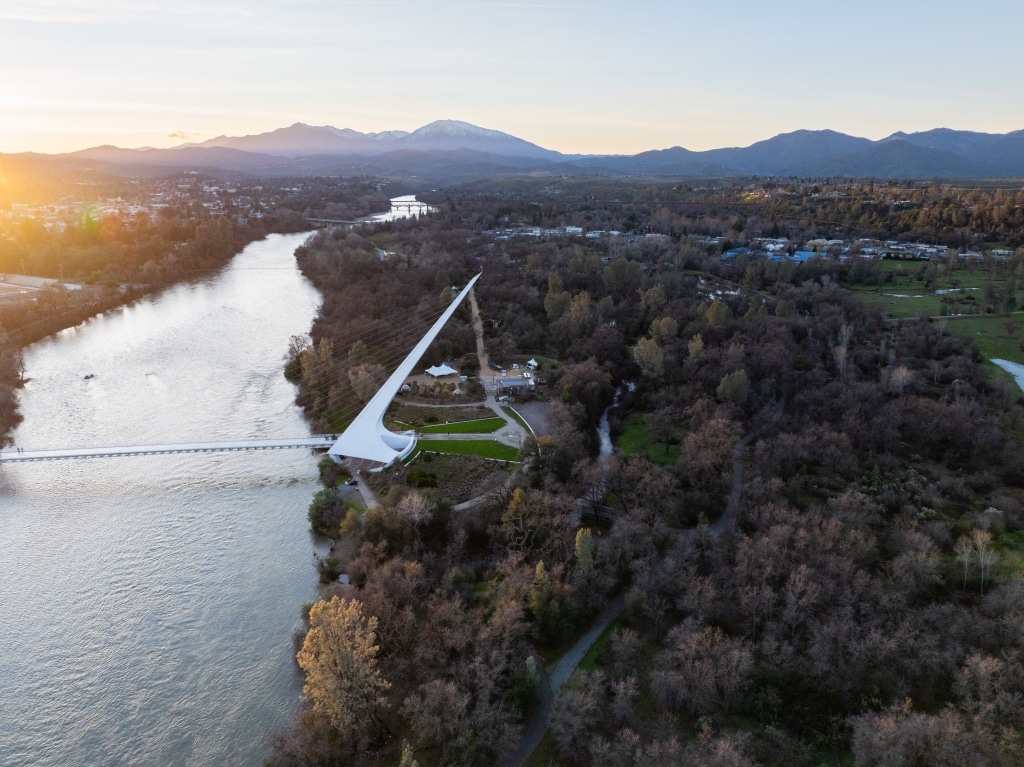
Redding staff are conducting an environmental study as part of a years-long downtown riverfront land planning process.
The city is updating the Redding Riverfront Specific Plan, a document that guides how prime land surrounding the Sundial Bridge at the downtown riverfront can be used. Tomorrow, city staff will present to the Redding Planning Commission as part of the “public scoping phase” of a developing Environmental Impact Report (EIR) for the plan, something that’s required by California law.
The city council approved an overall approach to Redding riverfront planning last November. The city is now building on that approval as the project moves forward into the EIR phase, where California environmental law will help define how the land could be used in the future.
“Members of the public, interested organizations, and public agencies are encouraged to participate and provide input at this early stage of the environmental review process,” city staff emphasized in a press release late last week.
The commission will hear from the public during a “scoping meeting” for the project, which will be held Tuesday. The meeting will provide an opportunity for the city to inform the public about the riverfront planning process and hear from the public on the range of issues and information that should be included as part of the EIR for the plan.
Members of the commission may also weigh in, if desired, with their thoughts on what the EIR should address. Staff from MIG, the design firm that has been facilitating the riverfront planning process over the last few years, will also be on hand Tuesday to provide an overview of the project.
In the city’s press release, Redding Director of Development Services Jeremy Pagan noted how much progress has occurred on riverfront planning over recent years. He said the scoping period “gives the public another opportunity to help shape that work by confirming whether we’re on the right track and identifying issues that should be addressed.”
Aaron Hatch, a former Redding planning commissioner who took a special interest in riverfront planning during his tenure on the commission, told Shasta Scout by text today that the risk with scoping for a broad project like the Riverfront Specific Plan is that the city allows too much flexibility for what might be allowed to be developed at the site in future.
“A plausible scenario would be that they broadly analyze impacts and conclude that there would be less than significant impacts with mitigation” for anything currently included in the vision and framework, Hatch wrote. “So it is important that the EIR have specificity, its scope constrained, and that there be clear boundaries so that future staff and councils aren’t given conceptual approval now for unintended uses,” he continued.
The Redding Planning Commission meeting will begin on Tuesday, Feb. 10 at 4 p.m. in the council chambers. It’s just one part of a 30-day comment period during which the public can provide into into the scope of the EIR. That comment period began on Jan. 30 and will close on March 2. Scoping comments may be submitted in person at the commission meeting, online at www.ReddingRiverfront.org or by email to info@ReddingRiverfront.org.
A draft EIR, as well as a draft for the Riverfront Specific Plan itself, is anticipated to be brought forward to the Planning Commission for formal review in the coming months, the city said.
Do you have a correction to share? Email us: editor@shastsascout.org.
Author

Comments (1)
Comments are closed.
Related Articles

Documents show the Shasta Sheriff’s Office attempted to enter an agreement with ICE last year. Doing so would have violated state law
The sheriff’s office took actions to enter what’s known as a 287(g) agreement with ICE last May, but the process appears to have been halted. ICE’s 287(g) program, which gives local and state officers immigration enforcement authority, has been making national headlines.

After the resignations of three board members, Cascade Union Elementary School District gains a new one: Jackie LaBarbera
Following a dispute with the superintendent, the majority of CUESD board members resigned over the last week. Shasta County Office of Education Board President Michael Orlicky has appointed SCOE Board Vice President Jackie LaBarbera to fill one of the empty seats, ensuring a quorum.

Redding Airport conducts full-scale emergency exercise to test disaster-readiness
The Mass-Casualty Incident training held last week was a “big success,” said airport Manager Andrew Solsvig. Organizers worked with local emergency personnel and airport staff to train for situations such as a plane crash or other major accident.
Leave the river front as is ALONE>