
Questions Remain after Release of Full Body-Worn Camera Footage of David Schaeffer’s Shooting
Shasta Scout has obtained and reviewed additional video material not included in the Redding Police Department’s video brief. We’ve shared it here.
5.29.25 5:49 pm: We have updated this story to include more information about what Schaeffer was wanted for when he was arrested.
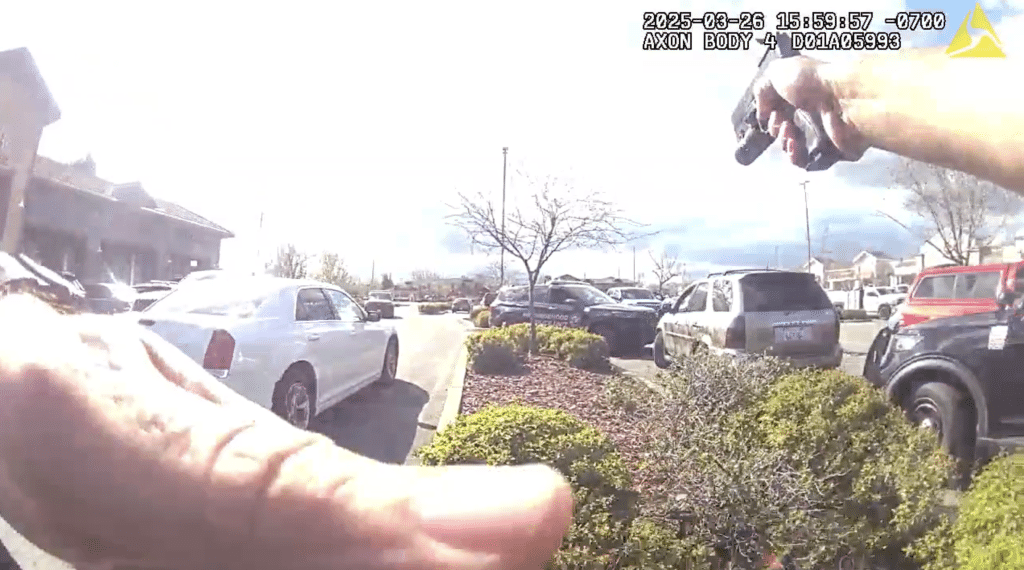
On March 26, in the span of just seconds, an unnamed Redding Police Officer drew his firearm and shot into the windshield of a moving car, striking 46 year old driver David Schaeffer as he drove away from the police during an attempted arrest. The Redding Police Department (RPD) claims Schaeffer’s decision to accelerate his vehicle in the direction of an officer left that officer with no choice but to unload their weapon, narrowly avoiding killing Schaeffer. At the time of his arrest, he had a warrant out for drug related charges.
What exactly happened in the five second window between the shooting officer drawing his gun and when Schaeffer was shot by police gunfire is still the subject of an interagency investigation. On May 8, RPD released an 11 minute video briefing that unequivocally justified the department’s use of force, illustrating the agency’s internal findings with body-worn camera footage captured from two angles.
Under California state law, police departments are required to release body camera footage of police shooting incidents within 45 days, with the possibility of extension if publication impedes an investigation under specific circumstances. While RPD’s public video announcement only included three angles of the shooting, Shasta Scout has now obtained all police videos of the event, including body-worn camera footage not yet disclosed to the public.
Video from the scene has answered some questions but spurred others. In particular, it’s unclear why none of the officers at the scene turned on their body-worn cameras before the incident began, as required by RPD policy. RPD Policy 421 includes a non-exhaustive list of situations in which activating body-worn cameras should occur, specifically, “prior to arrival to a call for service when practical,” during “all arrests and/or citations,” and during “all incidents involving the use of force.”
RPD Chief Brian Barner has not responded to Shasta Scout’s questions on that topic, which were submitted weeks ago. Barner also hasn’t responded regarding why RPD has so far withheld the name of the officers involved, in spite of a California Supreme Court ruling that compels police departments to publicly name officers involved in police shootings.
Shasta Scout has submitted a public records request for the name of the shooting officer, as well as all officers who were on the scene where Schaeffer was shot, and is awaiting a response.
A Closer Look at the Body-Worn Camera Footage
RPD’s carefully framed video briefing about the shooting incident included radio excerpts of a dispatch call that the officers responded to before confronting Schaeffer, and clips from body-worn cameras from three angles, as captured by three different officers. Narration during the video sought to help viewers visualize the space in which the shooting took place, a Safeway parking lot in the East Cypress area.
Schaeffer was sitting in his parked car around 4pm when two marked police vehicles boxed him in. According to Chief Barner, one parked directly behind him and the other at a somewhat perpendicular angle in front of him, with the intention to prevent Schaeffer from being able to drive away.
Despite that effort, Schaeffer managed to maneuver his way out of a gap left by RPD’s vehicle, even after having been shot. Moments later he crashed the car he was driving into another parked vehicle a few blocks away.
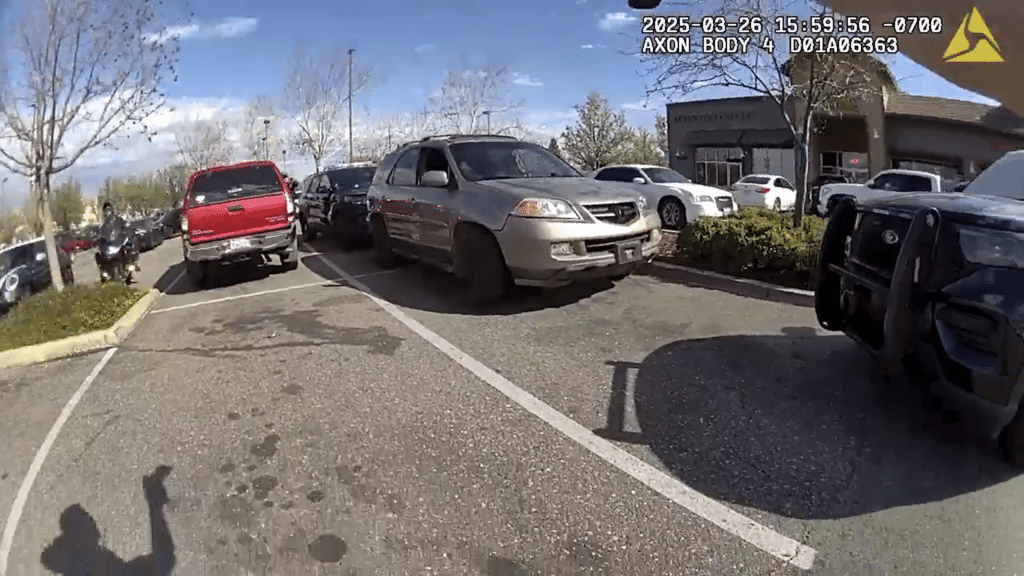
The video angles shown in RPD’s briefing are captured from the perspective of the shooting officer, from the perspective of the officer on a motorcycle behind Schaeffer’s vehicle a few feet to the left, and from that of another officer in a squad car parked directly behind Schaeffer. As expected, the footage from the perspective of the shooting officer is the most exposed vantage point of Schaeffer’s attempt to escape. What isn’t very clear is how close Schaeffer came to hitting the officer in the process.
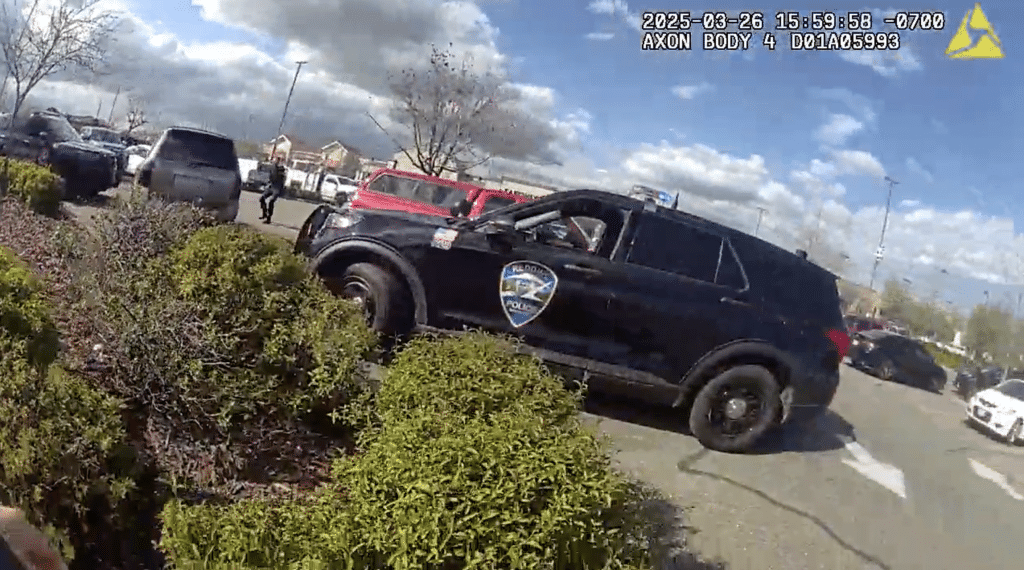
In the other two angles shown in RPD’s version of events, the shooting officer can be seen from a somewhat wider purview moving out of the way as Schaeffer drives away, ostensibly in the seconds after two shots were fired. However, as both of the nonshooting officers were in rapid movement, the body-worn camera footage does not capture the event from a fixed or sustained position, allowing key moments to occur out of the camera’s frame.
In all three videos, the officers did not start recording the encounter on their body-worn cameras until after Schaeffer was shot. As a result,the shooting itself, and any commands given beforehand, occured during a 30 second camera “buffer period,” during which no sound was recorded, preventing the viewer from determining whether Schaeffer was given any commands by law enforcement, something two witnesses have said did not occur.
RPD’s video briefing, as well as Shasta Scout’s past reporting, explains that RPD’s body worn cameras are set to a mode that allows the camera to continuously records video without sound in 30 second intervals, and then auto-delete. When an officer hits the record button, the camera does not delete, instead saving the silent 30 second period of video before the recording was activated. According to a user manual, RPD’s body cameras could be set up to capture buffer video with sound for up to 120 seconds before an officer hits record.
The previously unseen body-worn camera, which was not included in RPD’s video briefing, was also obtained by Shasta Scout via a public records request. That officer was in the driver’s seat of the squad car parked right behind Schaeffer. From this angle, this officer can also be seen drawing his weapon. His body camera captures a wide vantage point of the shooting officer as he maneuvers (on foot) out of the path of Schaeffer’s moving vehicle.
A Comparison to Past Briefings
RPD began using body-worn cameras in August of 2023. Since then, the department has issued three public briefings using body camera footage, two related to police shootings and one to defend the department against public allegations that an officer used excessive force on a man named Fredrick Phillips during a traffic stop. During that incident, the officer activated his camera prior to the encounter capturing the entirety of the interaction, as per RPD policy. Phillips case was later dismissed, the District Attorney has confirmed.
There has been only one other police shooting and RPD video briefing since body-worn cameras were implemented in Redding. During that shooting in 2024, the shooting officer never activated their body-worn camera. The incident began with two park rangers approaching a nearly-incoherent Levi Bailey, to move him off a privately owned lot where he was laying under an umbrella. As he left, Bailey threw a stone at officers, precipitating a pursuit. All of this is captured on camera with full audio.
A few moments later, Bailey (who held a small knife) was shot by a school resource officer who rushed to the scene from nearby after hearing what was happening on his radio. Because that officer never turned on his camera, RPD provided surveillance video from a gas station near the crime scene for the department’s video briefing on that shooting.
As in Schaeffer’s briefing, the department did not name the shooting officer in video recap of that incident. Concurrent reporting cites RPD officer Bryan Cowan as the shooter. Cowan was also involved in another RPD shooting in 2018, during which officers shot Masa Nathaniel Warden a total of 17 times. Warden, who survived, filed a civil lawsuit against the City of Redding, which is still working its way through federal Court.
The March 26 shooting consisted of two crime scenes. The first was the parking lot where Schaeffer was shot and the second was a residential neighborhood a few blocks away, where the suspect ultimately crashed his vehicle. At the second crime scene, Schaeffer was handcuffed by RPD officers before first responders tended to his gun shot wound. Five of the body-worn camera videos capture the officers present at both crime scenes while the last shows an officer who was only present at the second crime scene.
3) Body-worn camera D01A03163 shows the perspective of the officer on a motorcycle parked near Schaeffer when he was shot and his pursuit of the suspect to the second crime scene.
Do you have a correction to share? Email us: editor@shastascout.org.
Comments (5)
Comments are closed.
Related Articles
Bethel apologizes for failing to take appropriate action after alleged sexual misconduct by Christian ministry leader Shawn Bolz
In a statement this week, Bethel senior leaders Bill Johnson and Kris Vallotton acknowledged they didn’t do enough when one or more alleged victims confided in them.
Local flight school says espionage claims by Anderson City Council member undermine community safety
Anderson Councilmember Darin Hale has made claims on social media that IASCO Flight Training is a security risk to America due to its training of Chinese students. The school said such unfounded claims, made amid national tension over immigration enforcement, put its students at risk.
Wintu people say proposed reforms to a state list of tribes is erasure, threatens their homelands
A state commission’s proposal to remove Wintu and other federally non-recognized tribes from a consultation contact list would leave cultural sites vulnerable to destruction, tribal members say, and represents a form of unconstitutional discrimination.
Very comprehensive and in-depth. Good reporting but what questions actually remain?
Shaeffler was a fugitive, with multiple warrants out for his arrest.
Police found a POUND of meth in his trailer, surrounded him and the question is asked about how close he came to killing the policeman as he fled? Multiple drug convictions, a apouse-beater, ties with international narcotics peddlers, and a guy who has been on the lam for how long?
Being a father and a person who loves to ride motorcycles is not a character endorsement. Being a good father, obeying the law, those are things that aren’t on this bum’s resume.
I suppose
I don’t know how stupid he is, but when you flee half a dozen cops, and try to run one over, you can expect to see bullets flying in your direction.
And the he keeps going. Probably thought the cops were surrounding someone else.
Mike: A fundamental principle of a free society is the right to be assumed innocent until proven guilty. No one deserves spontaneous execution at the hands of law enforcement unless they truly place another human in direct and immediate harm – as stated by law. The fundamental responsibility of a free press is to hold those in power accountable. We at Shasta Scout are not capable of rendering judgment on Schaeffer’s guilt or innocence, the court will do so. What we are capable of is pointing out to the public that taxpayers are paying for body cameras that are not currently being used in compliance with policy and are therefore providing limited accountability and insufficient protection from liability.
05-29-2025
To: Reporter Nevin Kallepalli
Excellent in depth article that was well balanced.
Why was David Schaeffer confronted by the police? Was there warrants out for his arrest and if so, what for? What is his past history?
Nick: Schaeffer was wanted on a warrant for allegedly possessing drugs for sale. We covered this in detail here: https://shastascout.org/david-schaeffer-man-shot-and-injured-by-redding-officers-in-march-has-been-arrested-in-nevada/