
Recording contradicts lead Shasta attorney’s claim about election official’s remarks on county property
This week, county supervisors discussed whether Shasta election official Clint Curtis might have violated county policy by making campaign-related statements on county property. The county’s attorney said he had reviewed a single comment which would be viewed as only an “incidental.” A recording of the event illuminates many similar statements.
Complaints by members of the public about claims made by Shasta Registrar of Voters Clint Curtis during a recent tour of the county elections office resulted in only a brief discussion by county supervisors this week.
Curtis gave the tour to several gubernatorial candidates and members of the media, though some Shasta community members also attended. During the event, he repeatedly claimed that former election officials, which would include his campaign opponent in the June primary, engaged in “ballot stuffing,” a term that refers to the illegal submitting of more than one ballot per voter.
Supervisor Allen Long brought Curtis’ remarks to the attention of the board a few weeks ago, at which time they voted to bring back a discussion of the matter.
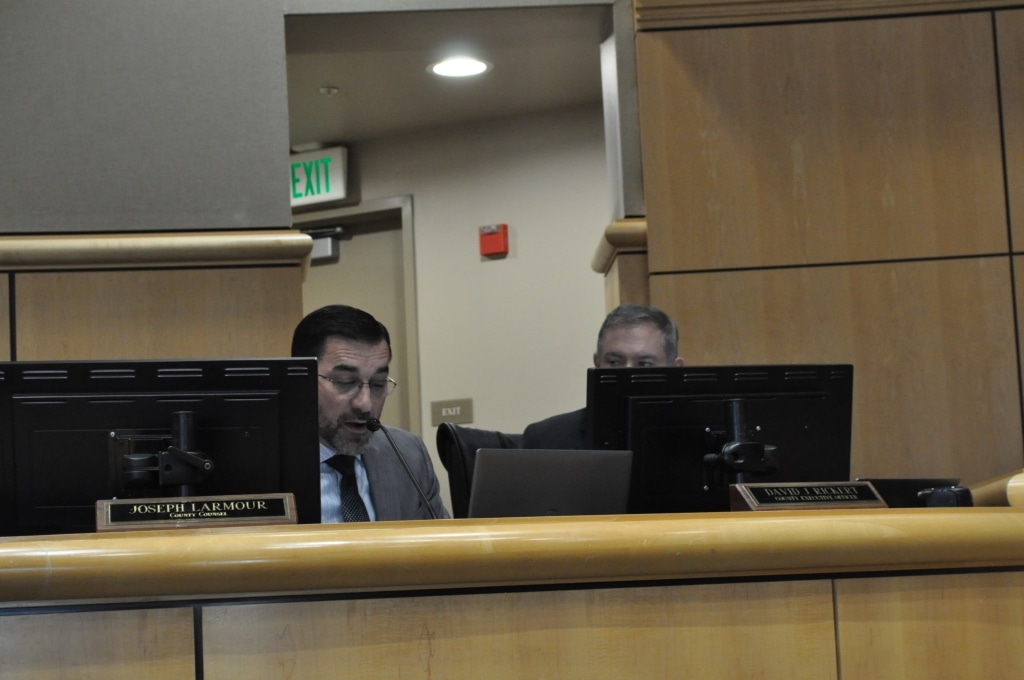
Shasta County attorney Joseph Larmour was asked by the board, with only Supervisor Corkey Harmon opposing, to look into the matter and investigate whether county policy had been broken by Curtis’ actions. Larmour provided his opinion on that matter yesterday, telling the board, “based on the information that I was able to observe, all the allegations came from one comment asked by the press.”
It’s not clear what comment Larmour was referring to, as Curtis’ remarks about ballot stuffing were repeated throughout the tour — evidenced by video of the event — although one particular remark, which came after a question by a member of the public, was highlighted by Shasta Scout in previous reporting.
“The predominant purpose of the event was a tour with dignitaries,” Larmour said, adding again that “the comment came from a response to the press, which was not related to the tour.” He then said his legal advice was that the single comment in question would be seen as “incidental,” or not significant under both county policy and state law.
Long replied by saying that Larmour’s remarks had satisfied him, and the board agreed — without a formal vote — to take no further action while not allowing public comment, a decision that resulted in shouts from the audience.
Board Chair Chris Kelstrom indicated that no comment would be taken because the issue was a “no vote” item. The decision appears to violate county policy outlined at the top of the agenda itself, as well California’s transparency law known as the Brown Act, which requires that public comment be taken for all items before the board. The act doesn’t make an exception for items in which no vote is taken.
Here’s why state law and county policy matter
As Larmour cited in his statements to the board, Shasta’s personnel policy says, “no County officer or employee may use any County property to conduct political campaign activities or for any other personal purposes or gain.”
The policy reflects a section of state law that Larmour also mentioned, which indicates that the term “personal purpose” includes activities that would offer someone private gain or advantage, while the term “campaign activity” indicates something that would influence or attempt to influence the action of voters for or against the election of a candidate. The law makes clear that the minimal use of public property for such purposes would not be subject to prosecution, as Larmour also noted.
Here’s what happened during the tour
In the first few minutes of the tour, while standing in an observer space within the election office, Curtis made his first comments related to former election officials, which include his political opponent, Joanna Francescut, who’s running against him for the registrar of voters position this year.
“Before I got here, they actually had a wall with blue bins they put the ballots in,” Curtis said during the tour. “They didn’t see them; they were stuck in a room. Not a good chain of custody, and that allows you to stuff the ballots.”
A few minutes later, Curtis makes his second remark about those who ran the office before him, in response to a question about the adjudication process.
“The way they used to do it, observers didn’t matter. They didn’t want to share anything. They were just used to doing it that way. So that’s my rule,” Curtis said, referencing his policy of including observers during the adjudication process. “We implemented it because it needs to be in place. They should not be able to do it without an adjudicator there. Legally, they can. Technically, they should not.”
At this point, Douglas Frank, a national election activist who supports Curtis, made a statement opining on the value of Curtis’ work for the benefit of those assembled, as well as the multiple cameras documenting the event.
“You’re spearheading election integrity in the state,” Frank proclaimed, “and you’re showing other counties how to do this. Now, when you first started implementing this, my understanding is the state was not happy, and they sent people up here to check on the legality. So it’s really important to point out that everything you’re doing is perfectly legal. It’s already been checked. So if you’re in a county in California and you love what you see … you can implement this totally legally in your own county.”
About 30 minutes into the tour, Curtis makes another comment about his predecessors, this time specifically mentioning his campaign opponent by her former title, assistant registrar of voters. He says while the Shasta board voted to hand count elections, former officials went against them by going to the state capitol to influence the law.
“The ROV and assistant ROV went down to Sacramento and had them put up a bill just for Shasta County … to force them to use machines,” Curtis claimed. He may have been referencing Francescut’s public comment to the California Secretary of State before a decision on hand count regulations, during which she read a letter written by her supervisor, former Registrar of Voters Cathy Darling Allen.
Moments later, Frank picked up the remark for the benefit of the media and those who might be watching virtually, saying, “Let’s reiterate that; it’s a really important quote. Shasta County Commissioners and people voted to go to all hand count and get rid of the machines. So as a county, you decided we don’t trust this stuff. We’re going to do it ourselves … But your former ROV and her assistant went down to Sacramento and lobbied the legislature to write a law forcing you to use these machines.”
The comment, made about 40 minutes into the tour, was the fourth seeking to tie former election officials, including Curtis’ campaign opponent, to some kind of impropriety during a tour on county property.
About one hour in, Curtis made another unverified claim, that under former election leadership the county had 2,700 more votes than voters, going into detail on why he believes this could indicate fraud.
A minute later, he repeated his claim about ballot stuffing happening under his predecessors and was asked by Frank to explain the term. Curtis not only elaborated on the term, but also explained why he thinks his predecessors engaged in election fraud in another series of unverified claims saying officials before him didn’t provide secure systems for ballot storage and implying that they might have altered computer logs to change vote outcomes.
It was at this point that community member Jeff Carr asked if Curtis was asserting that there was criminal activity by his predecessors in the county.
“Yeah, I believe there was,” Curtis confirmed.
The statement prompted a variety of responses from the crowd before Curtis doubled down on the topic, adding more information still focused on unverified claims of his predecessor’s alleged illegal actions.
“So now you have ballots in there that don’t add up to the rest, but there’s no way to take them back out. So if you have 2,700 extra stuffed ballots, it’s too bad, so sad.”
Another spirited conversation of tour members ensued, during which Curtis was asked whether he had reported this alleged misconduct while some weighed in on who he should have reported to. He said he had reported the misconduct to the federal Department of Justice and would now, at a community member’s request, also report it to the state. Someone suggested he should also report the alleged fraud to the local district attorney and sheriff.
The conversation went on for more than 10 minutes, after which Curtis opined again on all the issues he believed occurred under his predecessor, remarks that were followed by further conversation about ballot stuffing by others. In all, the conversation that began with Curtis’ second mention of unproven ballot stuffing lasted for 17 minutes.
The conversation then morphed into strategizing by various tour members about how to create changes in election processes statewide before the tour ended and tour members filtered outside for a press conference. The tour lasted about an hour and 20 minutes.
In all, Curtis’ unproven allegations about his predecessors, including his campaign opponent, took up a significant portion of the tour, a fact that stands in sharp contrast to the statements made by county attorney Larmour calling Curtis’ remarks “incidental” and therefore not significant enough to warrant a breach of county policy.
Asked what sources he had reviewed to learn what occurred on the tour, Larmour declined to comment.
Do you have a correction to share? Email us: editor@shastascout.org.
Author

Comments (33)
Comments are closed.
Related Articles

To save her daughter’s life, she advocated for her rights to be taken away
California’s conservatorship system can be used to force people with severe psychiatric illnesses into involuntary medical care for up to a year. Marci Fernandes said the process has been life-changing for her adult daughter, Ann, but significant obstacles to her well-being remain.

Redding seeks community members for two committees aimed at providing advice on the city’s financial processes
The city is accepting applications to join the newly-formed Financial Advisory Committee and the newly-formalized Audit Committee. Both applications are due April 17.
Shasta’s Measure B will remain on the ballot
A legal challenge to the ballot measure was dismissed because it did not specifically demonstrate how placing Measure B on the ballot would violate the law — even though implementing it appears illegal.
There are only three possible interpretations of Lamour’s statement, “…based on the information that I was able to observe, all the allegations came from one comment asked by the press.”
.
1. Lamour did not have access to the same recording reviewed by Shasta Scout.
.
2. Lamour is wretchedly incompetent.
.
3. Lamour is lying through his teeth.
.
The first of those three is untenable, so it’s either rank incompetence or deep dishonesty. My guess is both: It’s incompetent lying.
Lamour is Crye’s gym manager’s boyfriend which explains a lot!
Esteban- All three of your observations are correct. By trying to feign ignorance Larmour looks even worse by lying, being lazy, and devious. I hope people remember who hired this guy- Kevin Crye. Time to clean house this June snd November …
I’m no lawyer, but this sounds like grounds for a Slander lawsuit.
Time for several inquiries to the FPPC in SAC and the Atty, Gen, Bonta’s office in SAC. Just google their number. This is a clear Case of electionering , the predictable first one of many under this ROV, send your letters and ph calls today. You can make comments anonymously.
If it were not for Shasta Scout, we’d all be in the dark. Thank you for all that you do.
Take action if you believe this was electioneering:
File complaints against the conspirators (Curtis, Larmour) through the FPPC to get a legitimate, trustworthy investigation. It won’t be fast, but unlike internal decisions, it won’t be corrupt.
https://www.fppc.ca.gov/enforcement/file-a-complaint/
One could write a short, simple letter to the below, stating the concern, what, who, where, and when, identifying possible violations (like California Government Code § 8314, “incidental” use refers to minor, unintentional, or unavoidable interactions with political matters that happen during normal government activities), and including your request for a response.
• Shasta County Grand Jury P.O. Box 992086 Redding, CA 96099-2086 Phone: (530) 225-5098 Email: grandjury@shastacounty.gov
• The Senate Elections and Constitutional Amendments Committee 1020 N Street, Room 533, Sacramento, CA 95814. (916) 651-4037
• The California Assembly Elections Committee, 1020 N Street, Room 365, Sacramento, CA 95814. (916) 319-2094
• California Secretary of State Shirley N. Weber, Ph.D. Elections Division, 1500 11th Street, Sacramento, California 95814. (916) 657–5448
• Mr. Rob Bonta, California Attorney General. Office of the Attorney General, 1300 “I” Street, Sacramento, CA 95814-2919
• United States Senator Alex Padilla 501 I Street, Suite 7-800 Sacramento, CA 95814 (202) 224-3553
• Assembly Member Pellerin.1021 O Street, Suite 6310, Sacramento, CA 95814 (916) 319-2028
Google business letter format and go from there.
Yeah, it’s a hassle to mail, but letters sometimes get more attention, and just imagine what 200 letters from Shasta County Citizens would mean.
Shasta Scout continues to provide local news according to the highest journalistic standards as evidenced in the detailed explanation of this article!
I encourage readers to financially support the efforts of this tireless team.
That’s what you get when you choose the least qualified lawyer you can find because his girlfriend is your employee. If I recall correctly, at the time he was hired, he had less experience than every attorney he would be supervising. Not to mention he’s indebted to supervisor Crye for his exorbitant salary and ridiculous contract. Bad hiring decisions come home to roost. Again.
Incredible reporting, Shasta Scout.
How do you spell Cover-Up? Oh, just like that ….
The question is will any disposition be given that will ask if County Council Larmour, Supervisor Cye and ROV Curtis have committed premeditated conspiracy to avert Justice?
Smells like crime…
I was there for the whole tour. Curtis slammed Joanna numerous times during the tour. To suggest otherwise is denial of the facts
Joeanna ‘s apprenticeship of 17 years did her little good beings when she got her chance to run a transparent election she failed miserably then along comes Clint Curtis who has never run an election and runs the most transparent election in the state. Go figure.
Clint only used her name once and that was in answer to a question.
As far as being the last county to report election results, so what. Was there a race?
As usual, your version reflects a dystopian altered reality.
Well let’s see Nik, Mr Curtis was the one that made the claim about how quickly he could get everything done. So yeah it does matter that Shasta county was the last in the entire state to report to the Secretary of State.
And as far as being the most transparent election in the state, how many other elections from other counties have you actually witnessed? None?
Not to mention that nobody could view the live stream that Mr Curtis claimed was going to make everything transparent. But sure, Go ahead and tell yourself that it was the most transparent.
You are suggesting a staff member lacks transparency when in fact Tom Toller was responsible for elections before Curtis fired Joanna for no cause other than doing a great job. Prior to that, Cathy Darling Allen ran elections. She has always acted as an employee or assistant, not the one in charge. At least try to be honest once in a while Nick. She would not be currently working as an election consultant if she didn’t know anything about elections. How about you and I pitch in and buy Clown Curtis a unicycle and send him on his way back to Florida where he can work on his sunburn?
Oh Gee Brad. When Joeanna was competing for the job of ROV she said ” I ran the last two elections” meaning the ’22 and ’24 elections. Why would she claim that when she was only an employee or assistant, not the one in charge.
How about you and I pitch in and buy Clown Curtis a unicycle and send him on his way back to Florida. Why don’t you just loan him yours?
Happy to do so once you return it.
I can’t. You won’t give it back.
The post election reporting filing “ race “ is a non issue as clerical duties is not a sport. The media reporting was interesting as apparently based on inside office politics
The “ gotcha “ moment was apparently created by an internal “ slow – walk “ process by those looking to paint a picture of delay that did not exist Rather than reporting on the miraculous turnaround of the office from “ worst to first “ the SB took their lead from those rooting for the return of the previous administration. The SOS has hopefully since cleaned this up as partly responsible due to the errant actions of their media folks
The good news is the election was one of the best in Shasta and CA history for transparency and accountability
So what you’re really saying is that it was a conspiracy and is all staff’s fault. That about sum it up, Mr Turner?
You just keep going though, you’re digging yourself into a hole.
It’s A cOnsPIracY…..lmao
What’s your next excuse going to be Mr Turner?
HUH ?
Oh sweetheart, if you just smiled more and gnashed your teeth less you might find yourself a date on Valentines? We’re rooting for you!
Exactly!! This is just the ramblings of the same unimportant few that are from the alt left who thinks voting procedures should return to the very suspicious way they were under the Darling/ Francescut cabal! Mr. Curtis is righting the ship. I personally witnessed some of the suppressive attitudes from the prior enforcers. Mr Curtis is returning integrity and respect to the office. The next step should be to eliminate the electronic tabulation which we all know now are ripe for fraud!
But isn’t it funny Jon, that there STILL IS NO proof or shred of evidence of mass election fraud?
“But I was suspicious!”
Mr Curtis and Mr Turner are actually running the elections show. They also have hired some of the same election deniers who also had “suspicions”.
So tell me Jon, you actually got people on the inside, how come they haven’t been able to find any evidence of election fraud?
By the way bro, I’m a fiscal conservative and I think that the whole election denial movement is a bunch of bunk.
Jon sez: “The next step should be to eliminate the electronic tabulation which we all know now are ripe for fraud!”
.
Study after study has found that hand counts are the least accurate and the most susceptible to fraud. The basis for your suspicions about electronic tabulation is that you can’t wrap your head around how them newfangled machines work, whereas hand-counting is how you did it in 6th grade when you voted for classroom president. And at the end of the day, any count is bogus—machine or manual—unless it’s managed and conducted by your side.
Looks like a lawsuit. As aforementioned, should be everyone on the board as well as Curtis. This is as usual dirty politics and slander! No proof, just accusations and opinions. Great reporting!
Yep Michelle, lots of accusations and opinions, but little to no proof. Glad to see that other people in Shasta county are also aware of this.
Counsel Larmour has proven to be an incompetent attorney. I would bet his handlers told him to come back with this finding, which he was happy to do for his exorbitant payoff (aka his salary). He probably doesn’t know the meaning of incidental. No court of law would agree with his analysis. Since he has been county counsel has he ever won anything?
Lamour is the boyfriend of Crye’s gym manager. That’s why he got the job. And due to his incompetency, the board majority granted him a generous golden parachute should a future board decide to fire him. The board did the same golden parachute thing with two other unqualified appointees. They don’t look for the best, instead looking for those who will bow and affirm their political agenda. Lamour is protecting Curtis from censure by dismissing the overt electioneering as incidental, a nothingburger. A vote to censure Curtis would damage Crye and Kelstrom’s upcoming reelection campaigns, so they are not about to discipline their handpicked unqualified ROV pick.
Brad, you nailed it. It’s clear; Chair Crye (no, Kelstorm is just Crye’s Secretary,) and Lamour staged it, then Lamour got Long onboard with the Crye- Lamour plan and Crye ran interference to kill R-4, without a vote or any input from the people that pay their salaries, the citizens of Shasta County. This has a preponderance of a cover-up and concerned citizens should grand jury.
Not only are our First Amendment and Brown Rights rights under attack, but the rule of law as clearly prescribed by state code and Shasta County policy may have been violated. A Grand jury legal investigation needs to happen. The Shasta County board of supervisors have opened legal investigations for a lot less than this.
It is obvious that the legal the chaos of national and local MAGA it’s getting tiresome by the vast majority of the nation, and Crye it’s circling the wagons in fear of losing the November election to a Safe and Sane Republican, and in fear of the citizens rejecting his Clown Curtis.
All safe, and sain Republicans, Independence and Democrats need to send the Chaos Circus packing; they have created 4 years of absurd calamity damaging Shasta county’s reputation and economic foundation. Enough is enough.
Mr Larmour, I disagree with you entirely.
I am not a lawyer, but I have to cite law frequently. Consequently I know how to read law the right way. I have had about 10 different lawyers, who have commended me on how I was able to read the law and how it applied in certain situations.
In no way shape or form am I trying to say this as any type as a humble brag. I’m saying this because in my understanding, Mr Curtis CLEARLY was campaigning, and thus guilty of electioneering.
If I was a prosecutor, Mr Larmour, I would push you hard on this matter, because I think that you would lose.
The whole event was advertised ahead of time, and I think that most people would agree that it was for campaigning purposes.
Don’t believe me? Go and look it up yourself and tell me that it’s not meant to sway your vote, and is not campaigning.
While Clint Curtis shares certain protections from interference with all election officials, he does not have the same job-security protections as an elected Registrar of Voters (ROV).
• Because his appointment isn’t governed by a separate removal provision in county code, the Board’s general authority under Chapter 2.12 suggests the Board can remove him from that appointed position — although the Board may have internal policy or procedural rules on how that is done (e.g., requiring a board vote, notice, possible cause).
• Shasta County Code, Chapter 2.12 – the Board of Supervisors is explicitly given authority over non-elective department heads. The relevant language says the Board of Supervisors may“…appoint, transfer, discipline, suspend, or dismiss, as appropriate, any non-elective department head who is not appointed by the board of supervisors…”
In the context of California Government Code § 8314, “incidental” use refers to minor, unintentional, or unavoidable interactions with political matters that happen during normal government activities. The TAKE OUR CALIFORNIA BACK event, a political event, was premeditated, staged well in advance, and Curtis’s use of a significant amount of the event to attack his political opponent was clear and concise, and was only one example of a long, documented history of Curtis, a candidate, attacking another candidate, his political opponent.