
Redding implemented body cameras for police transparency. So why can’t Daniel Maher get video of his own arrest?
Body worn cameras are often seen as the gold standard for ensuring police transparency. But as this community member’s story shows, police departments sometimes stonewall public access by withholding body camera footage, even from those who may have been injured by law enforcement.
“Thinking RPD will be transparent is crazy,” 39-year-old Daniel Maher said in his distinctive Bostonian accent.
He told a Shasta Scout reporter last month that he’s willing to be open about what led to his arrest earlier this summer, but he had hoped for a similar level of transparency from the Redding Police Department (RPD).
As Maher described a June 28 incident that ended in his arrest, he wasn’t shy to admit to his own antagonistic behavior leading up to his being placed in the back of a squad car by police officers in the early morning hours of June 29.
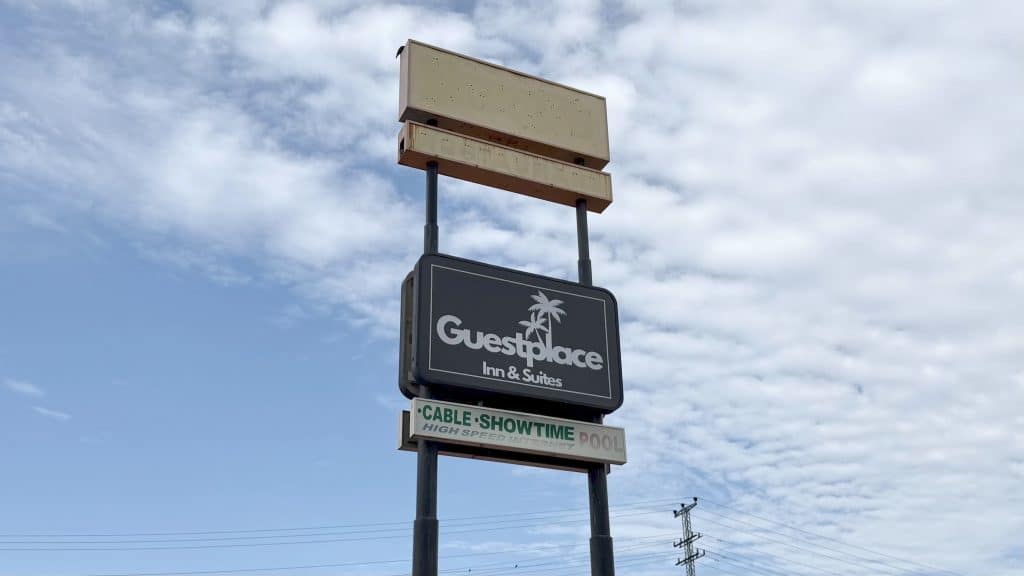
After a verbal dispute with an employee at a local convenience store that night, Maher was apprehended by police outside of GuestPlace Inn & Suites in downtown Redding. Maher’s short fuse can be clearly seen in the multiple videos he filmed of himself that night — and later shared with Shasta Scout. First heckling an attendant at a gas station with whom he had an ongoing feud over what he alleges were transphobic comments, and later, heckling responding officers too, some of whom heckled back.
As he scrolled through those videos on his phone during his interview with Shasta Scout in early August, Maher acknowledged to a reporter “I have a big fuckin’ mouth.” But the video clips also capture potentially concerning actions by law enforcement. In one, an officer threatens to pepper spray Maher as he walks his dog near them, instructing him to keep moving as the officers appear to be questioning someone on the street. That threat came even before responding officers realized he was the suspect of the call they were responding to.
The night of June 28
According to dispatch records, Ray Maready, Dylan Johnson, and Joseph Lensing were the RPD officers called to investigate trespassing allegations made by a convenience store employee, after that employee told Maher he wasn’t welcome in the store. Maher left, but not right away, first filming on his phone and jeering.
Records show Maher was booked into Shasta County Jail later that night on charges of trespassing and resisting arrest. In comments to Shasta Scout, he claimed he was forced to the ground by police twice during the process, once at the hotel and again at the jail. The forceful impacts, Maher said, broke bones.
RPD documents obtained by Shasta Scout only mention the first time that Maher was forced to the ground. But in response to questions, RPD Chief Brian Barner confirmed Maher’s testimony that he was taken to the ground twice, once during his arrest and again at the jail.
Maher has since lodged a formal complaint with RPD, alleging that the officers who took him into custody used enough force to break two of his ribs, causing a small part of his lungs to fill with fluid. Those injuries were cited in medical records, reviewed by Shasta Scout, for the care he received within hours of leaving the jail on his own recognizance with a future court date scheduled.
Chief Barner told Shasta Scout the department has launched an internal investigation in response to Maher’s complaint.
“I’m a pretty tough person, I’ve had some pretty gnarly injuries. There’s a difference between being hurt and being injured,” Maher said, describing the feeling of bones snapping beneath his skin against the pavement.
Making a claim without access to documentation
Maher’s jail intake form does not mention his ribs, despite what he says were his attempts to complain to “anyone in earshot” of his condition. On his intake form filled out by staff at the jail, the fields that notate an arresting officers’ use of force were left blank. The Sheriff’s department declined to comment on this specific incident, other than saying that “the staff at the Shasta County Jail takes the health and well-being of those in our custody seriously.”

In the weeks following his arrest and subsequent complaint, Maher sought to back his claims of injury with records, requesting and receiving documentation from law enforcement that included a dispatch log, a warrantless probable cause form, and jail paperwork. He was not given a copy of his police report, but Shasta Scout was able to obtain the report from the courts once the District Attorney filed charges on Sept. 9.
Maher also requested RPD’s body camera of his arrest and transport, something that would document to what extent he resisted arrest and the magnitude of the use of force against him by police in response. His requests for that footage have been denied, twice.
Over an investigation that’s spanned more than six weeks, Shasta Scout has reviewed the paper records Maher has provided including law enforcement paperwork and hospital discharge paperwork. But like Maher, Shasta Scout’s request for body camera footage was also denied by RPD.
In an email, Chief Barner noted for Shasta Scout that the officers’ body-worn cameras were turned on during the arrest, writing that the footage “shows Maher was resisting the officer and was taken down to the ground to gain control – both at the car and at the jail.” But he did not provide the footage.
What the police report versus what Maher reports
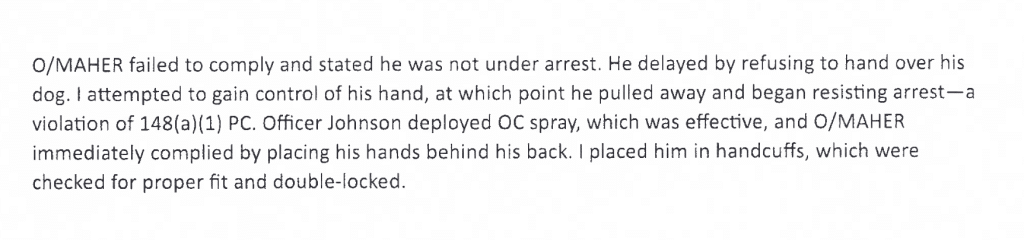
According to the police report, Maher was pepper sprayed when he attempted to pull away from an arresting officer. He was taken down, the police report attests, when he “pulled away” from the arresting officer’s grip as he was being escorted to the squad car. But at the moment he allegedly resisted, Maher says, his hands were restrained and his eyes were still searing.
The first time Maher read the police report was when Shasta Scout shared it with him earlier this week. He says the report’s descriptions of both the use of pepper spray and the take down are not consistent with his memory, but added that the body-worn camera is an “unbiased witness” that will reveal the truth, even if it contradicts what he remembers.
“I’ve only wanted the truth and I’ve only wanted transparency. Now that’s for both sides, right?” Maher said. “If I’m wrong, then I’m wrong… if I did something wrong, I gotta deal with the consequences of that, but I do believe in transparency. And if it’s to my detriment, then so be it.”
The police report of the pepper spraying does not appear consistent with CCTV video from the hotel, filmed by Maher after the event and provided to Shasta Scout. That video appears to show him putting his hands behind his back willingly just before he was sprayed in the face by police. The footage does not capture the subsequent take down.
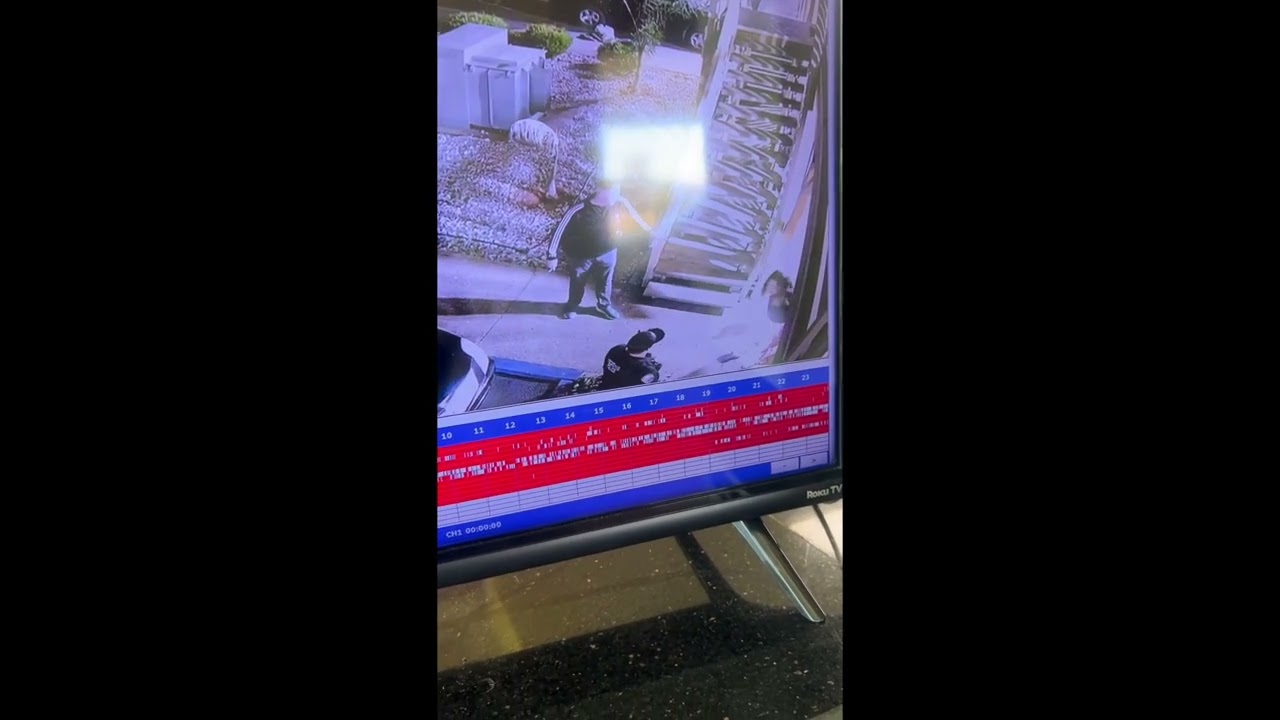
Video of the initial moments of the arrest as recorded by Maher from surveillance video at the hotel.
Publicly funded but not always publicly accessible
Body cameras were introduced to the Redding Police Department in August of 2023, after being approved by city council at an annual cost of $750,000 from the city’s general fund. Chief Barner has welcomed the implementation of these cameras saying on an episode of the city’s podcast that the devices “can protect both community members and police officers.”
The implementation of body-worn cameras is often thought to be the gold standard of police transparency policies, but in reality officers are only required to disclose this footage under specific circumstances. Perhaps surprisingly, California law allows — but does not require — police officers to withhold body camera footage during any open investigation – even to the person who is captured in the footage.
But Assembly Bill 748, referenced by both Shasta Scout and Maher in records requests, requires that police officers publicly disclose “critical incident” body camera footage to any member of the public within 45 days of a request. Critical incidents include those “in which the use of force by a peace officer or custodial officer against a person resulted in… great bodily injury.”
In other words, under the law, if Maher’s injuries are sufficient to meet the requirements of AB 748, RPD would be required to release the footage to anyone that asks for it.
RPD rejected Shasta Scout’s request for body camera footage of Maher’s arrest by saying they could only give it to the “victim or his authorized legal representative. They rejected requests from the victim, Maher, first by saying that they couldn’t disclose because his case is under investigation and then by citing that an RPD internal investigation would determine whether the force used against him was enough to cause the kind of critical injury that requires disclosure under AB 748.
The First Amendment Coalition’s Police Transparency Handbook cites case law that provides guidance on how the term “great bodily injury” — which is not specifically defined in the law — has been interpreted by the courts in the past. For example, in The People vs. Johnson (1980), the court determined a bone fracture constituted a great bodily injury because “it is common knowledge that a bone fracture is not merely a transitory bodily distress, but a severe and protracted injury which causes significant pain and requires considerable time to heal.”
Notably, Maher’s documented injuries after the event include two bone fractures.
In regards to RPD’s refusal to provide body camera footage, Allyssa Victory, the Senior Staff Attorney for the Northern California’s chapter of the ACLU noted in comments to Shasta Scout that body camera footage is a public record, and shouldn’t be thought of as private property of the police.
As such, she said, a police department’s refusal to release body camera footage is not necessarily the end of the conversation — if the department hasn’t made a valid case to withhold it. Public agencies can be challenged in court, and “agencies like ACLU, other nonprofits and law firms regularly sue to enforce [public record laws] because we want the letter of the law to be followed.”
“In specific requests where we feel like the department or the public information officer is shirking their responsibilities under the law,” she added, “or picking and choosing what things they want to respond to and comply with, sometimes that indicates that there may be more to discover and uncover.”
Transparency as a tool
While RPD is refusing to release Maher’s footage, in the past the department has at least once before voluntarily released body camera video of an arrest simply to protect the department’s reputation.
In 2024, in an attempt to dispel social media allegations of excessive force, RPD released clips of body camera footage that captured the arrest of disabled Redding local Fredrick Phillips during a Sept. traffic stop.
That RPD video briefing that included body worn footage of Phillips’ arrest and responded to community allegations of police misconduct in his case by calling them “inaccurate.” RPD’s video briefing of the event never addressed the entirety of Phillips’ actual allegations, which included that was mistreated in the hospital after his arrest and denied access to lifesaving medication while in jail.
Charges against Phillips were eventually dropped but not before his reputation was smeared by the public after RPD’s viral video. Phillips said the charges were dropped because the court violated his right to a speedy trial, thereby invalidating the case. The Shasta County District Attorney’s Office has confirmed that the case was dismissed because there was no available courtroom to move forward within the legally required time limit.
As for Maher, he told Shasta Scout he declined a deal from the DA offered last week on Friday, September 21. The deal would have mandated a year on probation and 10 days in jail in exchange for pleading guilty to trespassing and resisting arrest. The next steps in the judicial process are still pending, and he’s scheduled to return to court in late October.
9.29.25 We have updated the story to correct the timeline related to Maher’s interactions with RPD.
Do you have information or a correction to share? Email us: editor@shastascout.org.
Comments (10)
Comments are closed.
Related Articles
After branding a man guilty on social media, three RPD officers have been named in $12 million defamation suit
When Phetakhom Tu Manivong was arrested in 2022, Redding Police officers posted on the department’s Facebook page, claiming he had committed a heinous crime. After being found not guilty by a jury of his peers, Manivong has filed a lawsuit against the city alleging that RPD’s false statement followed him for years, ruining his career and his reputation.
Sheriff hopes to ‘change culture’ at Shasta jail with new medical service provider
A contract with medical services provider Mediko, Inc. was approved by supervisors yesterday. It will increase medical expenses at the jail by about $3 million annually. But county officials hope it will reduce county costs overall by lowering litigation expenses.
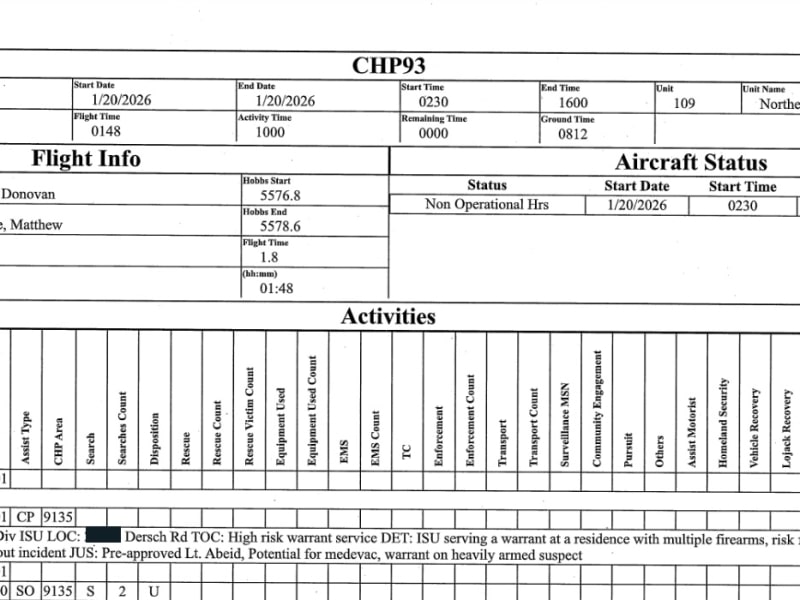
Flight logs shed only minor light on CHP arrest of Shasta man alleged to have illegal weapons, bunker
No charges have been filed in court against a man arrested by the California Highway Patrol in January. Flight logs obtained by Shasta Scout reveal little more than what the California Highway Patrol has already said by press release, that the search of a private property as part of an “illicit cannabis cultivation operation” revealed weapons and an underground bunker — leading to an arrest.
Just another anti-police article. Too bad Mr. Maher was such problem to deal with.
Liddy,
It’s folks like you that are really, unaware of life at all other than in your perfect little world, just because they have a badge does not give them a right to handcuff someone than beat them up and pepper spray them ECT.
Even in the cowboys you could not shot a fucker in the back, do you understand were Im coming from. Police are needed and do have a difficult job as they are only human to, but they must be held to the highestst standard,that’s the job not a back ally fight. Regardless if this do was being an asshole, they have a job, one that comes with a lot of responsibility, and power, and they must not be able to abuse it
Well said Chad.
Why do liberal Democrats always try to protect the criminals? Just goes to show how misguided some people can be.
There is a far better angle available of this video. It shows exactly what happened. Excessive, unnecessary force.
Danny was honest.
Christie: Would love to see it.
Nevin,
I know you are a big fan of the Palestinian government in the Gaza Strip. I wonder how they would have treated Mr. Maher and his big mouth. I would imagine he would have been stoned to death.
Hi Mary, regardless of whether the claim you’re making is true – about my personal convictions, or the ways that queer people are systematically targeted by both Israeli soldiers and Hamas (neither of which involve the trope of stoning) – that would not have changed the way I reported this story. Needless to say, this is about Redding not Gaza.
Serious question Mary: What in the hell are you talking about?
Look! Another zionist bootlicker from Redding gargling police jizz!