
Redding Police Department’s Citizen Academy Kicks Off with Facility Tour
During the first week of the Redding Police Department’s Citizen Academy, select members of the public were offered a tour of RPD facilities.
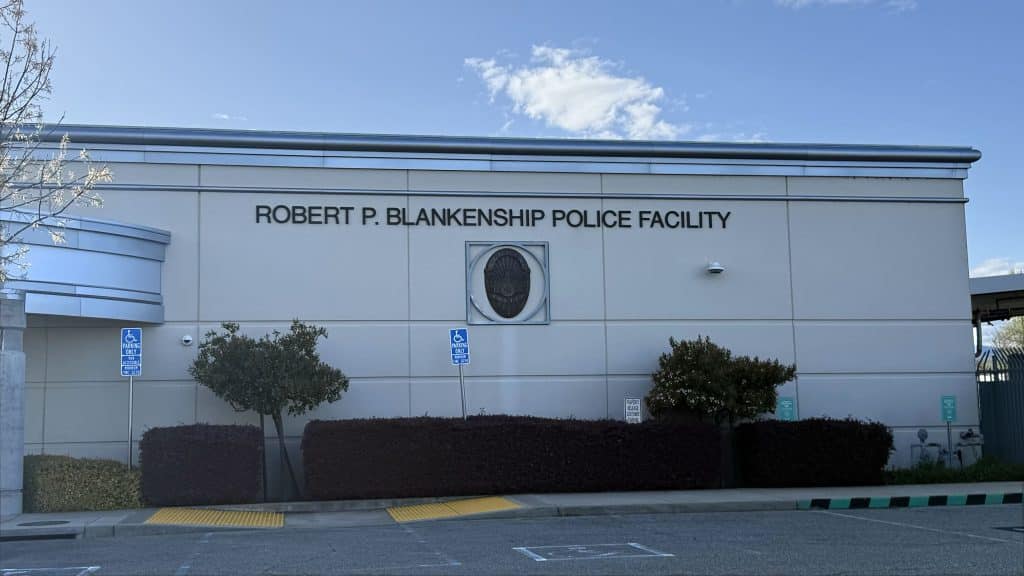
Photo by Nevin Kallepalli.
Our series on RPD’s Citizen Academy shares insights from a nine-week program which offers the public selective access to the inner workings of law enforcement. Here’s Week 1.
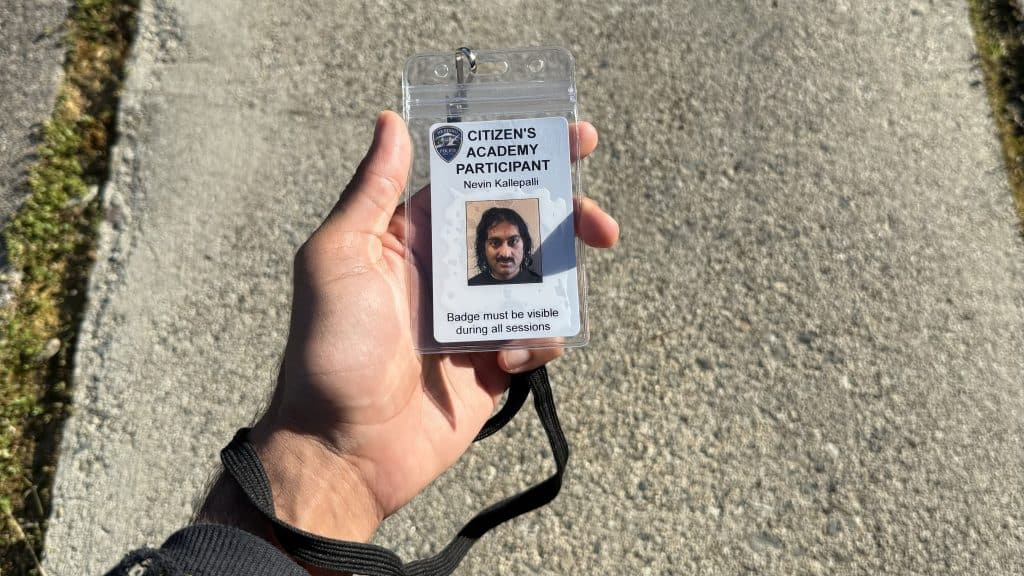
Taking a “mugshot,” was the first order of business during week one of the Redding Police Department’s (RPD) Citizen Academy. In lieu of an old-school placard inscribed with an arrest number, students held a piece of paper with their names on it as they smiled into the camera for a photo used for attendees identification cards.
This spring, every Thursday evening for nine weeks, approximately 24 students will meet at RPD’s patrol building on Cypress Avenue, adjacent to City Hall. During each three hour session of RPD’s “Citizen’s Academy,” select community members will learn about a broad swath of police work – from granular administrative tasks to more cinematic investigations.
Public Support for the Police
On March 20, participants settled into seats in an RPD conference room during day one of the course. Four RPD staff greeted the group including Chief Brian Barner, Captain Brian Cole, Captain Regan Ortega, and Lieutenant Jon Sheldon. The Chief and his officers shared a brief version of their life stories before a round of introductions among students.
Participants of RPD’s third Citizen’s Academy include some who are attending for job-related reasons such as individuals holding positions at the Children’s Legacy Center, within the juvenile justice system, and on City Council. Other attendees came simply out of curiosity, with one student describing her bygone dream of becoming a member of law enforcement.
Most participants voiced their unfettered support for law enforcement, with some implying that being pro-police was somehow controversial. One student complained about what he perceived to be unfair and negative press about the police as he sat across from two reporters–one from KRCR, and the other, Shasta Scout.
Only one woman expressed concern about systemic problems with policing. Chief Barner encouraged the class to ask tough questions saying debates over ethics might surface over the coming weeks as RPD addresses thorny issues such as “officer involved” shootings and RPD’s approach to interfacing with the unsheltered and those with mental health challenges.
For the most part, Barner emphasized, Citizen’s Academy is about bringing civilians into the rapport of RPD, which he described as more close-knit than many urban police departments.
Forensics and Fax Machines
After students got to know each other, Captain Cole led a tour of the patrol building. Recessed glass display cases lined the hallway walls, filled with antique weaponry, displayed like reliquaries. Cole pointed out a portrait of fallen Patrolmen Owen Ted Lyon, who was shot in the line of duty in 1967. He is one of three RPD officers who have been killed in the past century, and the Department honors his memory every year.
Students then entered a modest-looking room with a back door that opened to a vast warehouse space. The evidence room is filled with objects small and large that have been gathered during investigations. As Cole pointed out the various equipment and mechanics of the evidence-handling process he described the necessary chain of custody required by law when handling forensic material.
The first half of the tour ended in RPD’s fleet parking lot which houses squad cars, SUVs, at least one Tesla, and a boat. In contrast to the cost of a typical squad car–between $75,000 and $85,000 dollars each – the largest vehicle of RPD’s fleet is a $300,000 “ballistic engineered armored response counter attack truck” or “BEARCAT.” Built to withstand the shelling of a guerilla’s Kalashnikov or insurgent roadside bomb, BEARCATS have been used by suburban police departments across the US, as well as in actual war zones like the eastern Syrian front, where Kurdish freedom fighters were once embattled with ISIS. Some police forces call their BEARCATS “peace vehicles.” RPD has opted for the similarly positive euphemism, “rescue vehicle.”
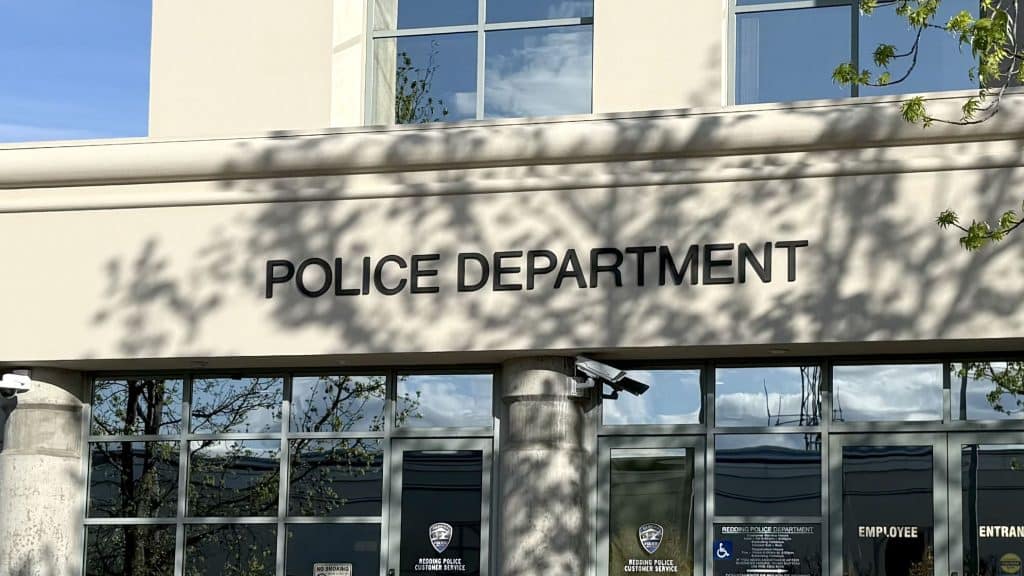
Photo by Nevin Kallepalli.
Leaving the patrol building, students crossed a small parking area to the Redding City Hall. Less technical than the forensic evidence rooms housed at RPD’s main facility, City Hall houses the Department’s records division, dispatch team, administrative staff, and most interesting to many of the students,the detective unit.
As students idled in the lobby, where Redding residents can request records, Chief Barner pointed out the case law that determines how records should be redacted. Frequent changes in legislative requirements necessitate that staff remain nimble, lest RPD be liable for revealing sensitive information.
Upstairs at City Hall, Citizen’s Academy students briefly peered into administrative offices where Captain Ortega discussed this seemingly banal but no less significant part of the Department’s operations. Ortega is the head of RPD’s Administrative Division, which oversees hiring and finances. Since 2021, RPD’s budget has hovered between $39 and $43 million dollars of taxpayer funds annually, making it by far the largest portion of Redding’s budgetary pie.
An inside scoop on detective work led by Captain Cole, who oversees the Detective Division, was next. Cole described the inordinate stress that comes with such a job, emphasizing his team’s dedication. Repeated exposure to some of the most depraved acts of violence, take a huge toll on detectives’ mental health, Cole explained, noting that financial crimes have become a growing aspect of detectives’ work, alongside the usual sex crime investigations.
A birds eye view of Redding’s crime data indicates that over the last ten years all kinds of crime has generally decreased in the City, despite upticks in 2012 and 2016. In 2023, violent crimes occurred at roughly half the rate as property crimes, with aggravated assaults significantly outweighing the number of robberies, rapes, and homicides. In 2024, there were three recorded hate crimes in Redding, all of which were directed toward African Americans.
Body-Worn Cameras
The final module of the first night of RPD Citizen’s Academy honed in on body-worn cameras, a relatively recent addition to the Department’s equipment. Barbara Grant, a staffer from RPD’s Records Department, along with her colleague Javona Tucker, began the demo by passing around an Axon body camera, roughly the size of a pack of cigarettes but surprisingly heavy.
Contrary to popular belief, Chief Barner said body worn cameras have been largely embraced by his team as a useful tool for both investigations and settling complaints from the public. But the cameras can also drain RPD time and resources, as staff work meticulously to redact videos to comply with current penal codes.
Those redactions processes, which can take between three hours and three days for each video, are intended to protect civilians, not the police, Captain Ortega emphasized. The process includes superimposing black boxes over images as needed to cover nudity, juveniles, and sensitive data such as that found on drivers licenses. Redaction can be especially difficult, Tucker added, when the officer wearing the camera is in rapid motion such as during a chaotic arrest.
In response to questions, RPD staff explained that body camera images are relatively low resolution. That’s because the cameras are designed to be used as an accurate recreation of what the human eye can see. In fairness to officers, body cameras must also capture a human’s physical limitations, or what someone could reasonably not see during a dark encounter. Body camera footage is legally accessible under California’s public records law.
4.3.25 4:27 pm: We have updated the story to correct the spelling of street name.
Do you have a correction to share? Email us: editor@shastascout.org.
Related Articles
Wintu people say proposed reforms to a state list of tribes is erasure, threatens their homelands
A state commission’s proposal to remove Wintu and other federally non-recognized tribes from a consultation contact list would leave cultural sites vulnerable to destruction, tribal members say, and represents a form of unconstitutional discrimination.
Decision on city financing for the Ironman competition tabled by Redding City Council
The council’s decision followed a tense discussion on financial spending. The item will be brought back into discussion on Feb. 17. An Ironman official says he’s not concerned about the delay.

Shasta man had illicit marijuana grow and underground bunker in addition to illegal weapons, CHP says
A press release from the California Highway Patrol alleges that Michael Kamfort was operating an illegal grow when he was arrested on weapons charges, including manufacturing a “ghost gun,” on Tuesday in Anderson.