
Redding Police Department Releases Video Briefing on the Shooting of David Schaeffer
A video announcement that includes body camera footage has just been released by RPD. The briefing includes only snippets of footage, some without sound.

“As an effort to be transparent,” Redding Police Department (RPD) Captain Regan Ortega begins, speaking on camera, “this video contains both audio and video footage from the incident, as well as information related to the case.”
More than six weeks after the initial non-fatal shooting of David Schaeffer on March 26, the Redding Police Department has shared a video briefing, which includes both audio and video captured by body-worn cameras. Under California state law, police departments are required to release this footage within 45 days. RPD met the deadline with only two days to spare.
Captain Ortega introduced the briefing by sharing the basic facts from the Department’s perspective: an unnamed officer identified Schaeffer, ” who they knew had felony warrants for his arrest” in a parking lot near 1070 Cypress Avenue. Schaeffer was wanted for felony possession of hard drugs.
The officer called for two marked vehicles to arrive on scene, referring to Schaeffer as a “target.” When those officers arrived, RPD says, Schaeffer was sitting in the driver’s seat of a parked car outside of a Safeway near the corner of Cypress Avenue and Churn Creek.
Ortega says RPD officers boxed Schaeffer’s car in with two marked police vehicles: one from behind, and one at a perpendicular angle in front of Schaeffer, to prevent him from fleeing. Another officer on a motorcycle arrived, staging a few feet away.
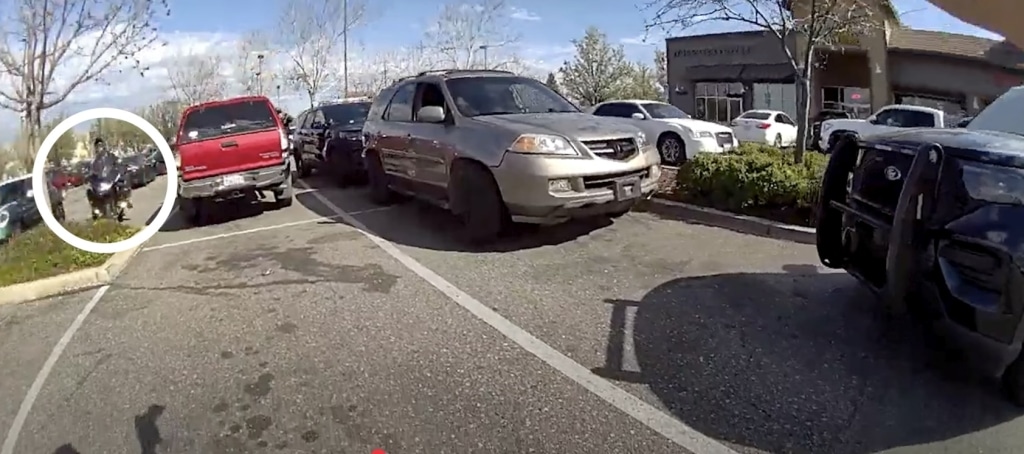
The officer who was parked in front of Schaeffer’s car then exited his RPD vehicle, Ortega said, “ drew his department-issued firearm, and pointed it at Mr. Schaeffer.” She says that that officer then issued a “lawful verbal command” with his gun already drawn and while moving around directly in front of the car to reach the passenger side of Schaeffer’s vehicle.
Before the body-worn camera portion of the briefing is shown, Captain Ortega prefaces the scenes by describing the limitations of such devices. She cautioned viewers that “the camera does not provide a view of everything a police officer sees, feels, or experiences,” and to “keep in mind that video does not always accurately capture time and distance.”
Importantly, the first 30 seconds of the body-worn camera footage does not contain sound. This is a standard feature of these devices. When a camera is simply turned on, it automatically captures footage in half minute loops without saving it, until the officer hits record. Once the camera recording mode has been activated, the finished saved video will include the 30 seconds prior to activation, known as “buffer video” that does not contain audio. It was during this portion of the silent buffer that shooting actually occurred.
The body-worn camera footage begins with the officer still in his vehicle, driving toward the scene where Schaeffer was sitting in his parked car. The officer then parked, and within one second of exiting from his driver’s seat, drew his gun. With his gun drawn, the officer moved around Schaeffer’s car and allegedly issued a verbal command. The command cannot be seen or heard on camera but according to Ortega “several witnesses in the parking lot report (hearing) the verbal commands to Schaeffer.” This detail contradicts what two eyewitnesses told Shasta Scout at the scene. Both claimed to have been a few feet away and said they told police they did not hear any commands.
According to the body-worn camera’s timecode ticking in the top right hand corner of the footage, the shooting officer drew his gun at 3:59 pm. Three seconds later, as the officer was still moving, Schaeffer can be seen turning the wheel of his vehicle in an apparent attempt to maneuver around the squad car obstructing his path. One second later, Schaeffer’s vehicle is seen starting to move forward, and another second later the windshield of the vehicle shatters as it was hit by RPD’s fire. After shooting, the officer backed away from Schaeffer’s moving car.
Despite being shot, Schaeffer successfully maneuvered around the squad car in front of him. The body camera was activated three seconds after the shooting, at which point the sound begins. The officer can he can be heard saying “shots fired,” as Schaeffer drove away toward a residential street, where, minutes later, he crashed into an empty parked car.
According to RPD’s policy manual, officers should activate their body-worn cameras during all enforcement and investigative contacts. It’s unclear why the shooting officer, who is never named in RPD’s briefing, did not activate their camera before approaching the suspect in his vehicle. RPD does not address this in the video briefing.

As RPD’s video briefing continues, additional body-worn camera footage is used to show some of what occurred at the site of the vehicle accident, which constituted a second crime scene. Schaeffer’s car is shown stationary after having allegedly collided with a parked vehicle. Multiple officers are shown already on scene — it’s not clear why their body camera video wasn’t shared. One officer is shown yelling “hands up” at Schaeffer as he lies face down on the pavement having already exited the vehicle.
In the seconds before handcuffing Schaeffer the officer asked him, “are you shot,” to which Schaeffer responded with a near inaudible sound. The officer then put on black latex gloves, rolled Schaeffer over onto his side and searched his pockets. This is the first time Schaeffer’s face becomes visible on camera, with blood steadily streaming out of his mouth. While a gunshot wound is not clearly visible in the body camera footage, RPD says he was shot once.
While going through Schaeffer’s pockets, the officer asked him if he has any weapons on him. Schaeffer again responds with an indiscernible gurgle. The officer says, “you don’t know?” To which Schaeffer musters the response, “I can’t talk.” The officer searching his pockets replied, “you can’t talk? Why? You got shot in the mouth?”
According to RPD, Schaeffer was taken to a local hospital for treatment shortly afterwards and was then was transferred to a hospital in the Sacramento area, where, according to statements to Shasta Scout by a family member, he underwent major surgery.
While RPD initially placed handcuffs on Schaeffer we now know that he was never actually arrested, in part because the county would then be responsible for paying his medical bills, according to RPD Chief Brian Barner. Weeks after the shooting, Schaeffer was discharged from the hospital without RPD’s knowledge and traveled to Nevada. He was later apprehended by Reno law enforcement and held in the Washoe County Jail before being extradited to Shasta County in late April.
Following every police shooting, a multi-agency team conducts an investigation. The team, which is known as the Officer Involved Critical Incident Response Team (OCIRT), comprises law enforcement from local and state levels. The team is currently headed by the Shasta County Sheriff’s Office. Ortega said law enforcement-led investigations into the actions of other law enforcement agencies involve multiple interviews, a detailed review of video and audio footage, and forensic evidence.
In any critical incident such as this one, the Shasta County District Attorney also conducts its own review, which can take years to release. Under state law, if a civilian is killed by police, the California Department of Justice also conducts an independent investigation. In the case of Schaeffer, the Attorney General’s Office will not be involved because he survived the police’s use of deadly force.
California Penal Code states that officers can only use deadly force if “necessary to defend against an imminent threat of death or serious bodily injury to the officer or to another person.” This can include someone unarmed behind the wheel of a car, if an officer has reason to believe that the vehicle may imminently be used as a deadly weapon.
Of the 19 DA investigations of police shootings in Shasta County–all of which the County concluded to be justified – two have involved officers who reported that they shot the suspect because they believed lives were threatened by the use of a moving vehicle.
This is a developing story. Shasta Scout is pending receipt of all RPD body camera footage from the incident.
Do you have a correction to share? Email us: editor@shastascout.org.
Related Articles
Local flight school denies espionage claims by Anderson City Council member, saying his statements undermine community safety
Anderson Councilmember Darin Hale has made claims on social media that IASCO Flight Training — a Redding-based flight school that also trains international students — is a security risk to America due to its training of Chinese students. The school said such unfounded claims, made amid national tension over immigration enforcement, put its students at risk.
Wintu people say proposed reforms to a state list of tribes is erasure, threatens their homelands
A state commission’s proposal to remove Wintu and other federally non-recognized tribes from a consultation contact list would leave cultural sites vulnerable to destruction, tribal members say, and represents a form of unconstitutional discrimination.
Decision on city financing for the Ironman competition tabled by Redding City Council
The council’s decision followed a tense discussion on financial spending. The item will be brought back into discussion on Feb. 17. An Ironman official says he’s not concerned about the delay.