
Redding Took Nearly $1 Million In State Funds To “Resolve” Encampment Off Masonic Avenue
The funds, which are intended to promote innovative models for resolving homelessness, were supposed to “vastly increase” emergency and transitional shelter options. They’re required to be spent in a way that does not cause trauma. But the process the City has used to clear the encampment appears little different than other recent illegal camping enforcement.
Last fall, while many in the Redding unhoused community were still finding new places to live after the August 2022 displacement of long-term campers living on public land at Nur Pon Open Space, Redding staff were already moving forward with plans to enforce against campers at additional sites, including an area that includes several parcels of private land off Masonic Avenue in Redding.
In May of 2023 the City followed through with long-term plans to clear the Masonic camp, displacing those living at the site through a process that included red tagging the site, following up with warnings, and ultimately making three arrests.
The City’s process for clearing the Masonic camp has appeared similar to other recent City anti-camping enforcement actions, including last August’s clean-up of public land at Nur Pon Open Space, off Cypress Street.
This is remarkable because the Masonic “clean-up” was facilitated through use of a new source of funding, known as the Encampment Resolution Funding (ERF) Program. The program awarded State funding that is supposed to support innovative models for resolving homeless camps that can later be used as models to be replicated across California.
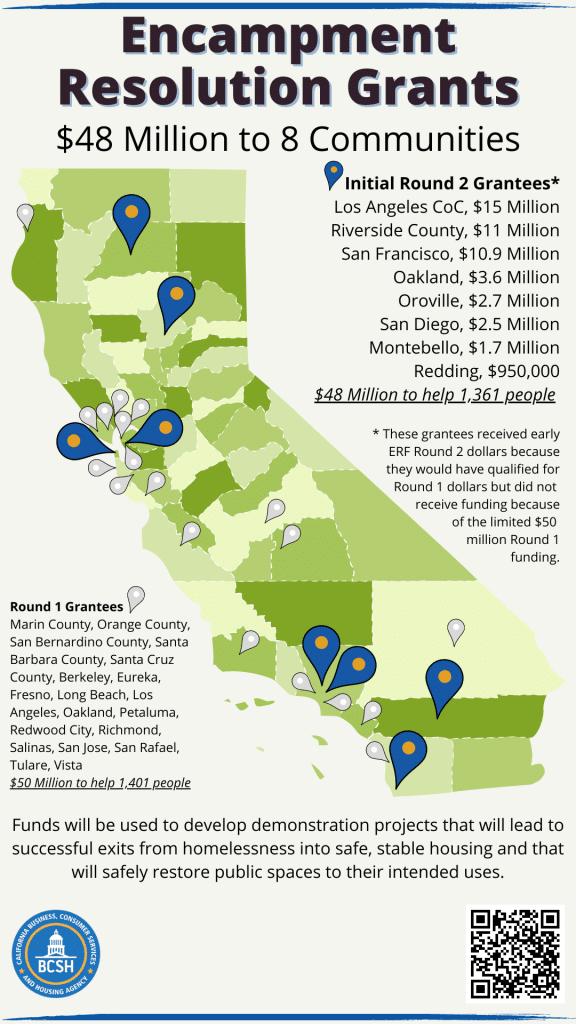
Last year, Redding was awarded just under $1 million in ERF funds to “clean up” 232 acres of public and private land off Masonic Ave. and South Market Street, after providing pathways to housing for those living there.
The funding was provided by California’s Business, Consumer Services and Housing Agency and projects that received the funds are being closely tracked by California Interagency Council on Homelessness or Cal ICH. Redding was one of eight sites across California awarded ERF funds according to an October 2022 announcement by the State.
In grant application materials the City refers to the Redding site as the “Lost Lane Encampment” describing it as a “closely linked community of encampments that reside in the greenway south of Lake Blvd. near downtown Redding.”
The $950,000 Redding was awarded was intended to provide a Housing First approach to sheltering the approximately 70 community members the City knew would be displaced by enforcement at the site.
“The requested amount,” City staff wrote to the State in the funds application, is equivalent to “$13,380.28 for each additional individual able to be served under this program.”
The City said they’d combine those State funds with more than $700,000 in other available funds, to “vastly increase emergency housing stock and provide additional direct services to people experiencing unsheltered homelessness.”
California awarded the grant funds to Redding and other California jurisdictions in hopes of facilitating model demonstration projects that “lead to successful exits from homelessness into safe, stable housing” and could be replicated across California.
That’s exactly what Redding officials said they were planning to do when they applied for the State funding with application wording that said that their process for clearing the Masonic camp would “exemplify Housing First values” by addressing the “known barriers to housing for people experiencing unsheltered homelessness, creating the ability to provide housing for all.”
Staff said the State funds would ensure that the “potential trauma and impact of resolving an encampment” would be minimized by “prioritizing the health and wellbeing of people experiencing unsheltered homelessness,” a requirement of the grant funding.
To do so City staff said they planned to work with community partners to address the Lost Lane Encampment in a “coordinated and deliberate manner” by “seamlessly connecting individuals in need [of] services.”
Clearing the Masonic camp site, City staff wrote to the state, would occur only once “infrastructure to house the people experiencing homelessness is in place.”
That infrastructure, they wrote, would include launching micro-shelters to add 71 “emergency housing beds” to provide adequate housing for everyone living at the Masonic encampment.
To date, the City of Redding only contains eight micro shelter units, built and managed by United Way of Northern California, none of which provide drop-in low-barrier emergency shelter.
On May 31, in response to Shasta Scout’s questions about the planned micro shelter sites, Redding’s Deputy City Manager, Steve Bade, said ERF funds had been approved for either micro-shelters or hotel rooms and “the city will be using both types of interim housing options.”
He provided a budget which he said had been approved for use with the ERF funds that showed the City planned to spend $170,000 on pallet shelter development and $343,000 on “direct placement to motels.” That funding will pay for hotel rooms for only a limited period of time.

A revised budget for use of State ERF funds at the Masonic site.
According to Redding Police Officer Jon Sheldon, who spoke to Shasta Scout on May 24, the final day of police enforcement at the Masonic camp, twenty individuals had accepted offers of housing either through the Good News Rescue Mission or the City-funded hotel program, No Boundaries.
It is not yet clear how many former Masonic residents were accepted into those sites. Admission to the sites are dependent on both the client and the facility agreeing to placement. Good News Rescue Mission has a number of restrictive rules and requirements which prevent many in the unhoused community from accessing ongoing shelter there.
No Boundaries had similarly restrictive policies, but updated them after a November 2022 article by Shasta Scout that revealed the existing policies were deeply out of compliance with Housing First values and State funding requirements.
As of today, July 18, six weeks after the Masonic camp was cleared, Community Development Manager for the Redding Housing Division Nicole Smith said she does not yet have access to data about how many of the residents of the Masonic encampment remain housed in the No Boundaries program partially funded through the Cal ICH grant, but hopes she may have data available by next week.
The City’s agreement for use of State funds to “resolve” the Masonic camp states that funds can’t be used for any kind of encampment resolution that has a traumatic effect on members of the unhoused community. Nevertheless, Redding cleared Masonic through the method also used at Nur Pon Open Space, by tagging the site and following up with days of warnings, and finally, several arrests.
That pattern of camp resolution, which is often described by the Redding Police Department and others as a “sweep,” is known to cause significant trauma to unhoused community members, according to the National Health Care for the Homeless Council, and others.
Sweeps of homeless camps are detrimental to unsheltered people in part, NHCHC says, because they separate people from survival items like tents, tarps, and medications and sever ongoing connections to medical and mental health service providers. They also increase the risk of overdose, move people into more dangerous areas, and damage hope and resilience.

A section of the National Health Care for the Homeless Council‘s documentation on the risks of camp clean ups.
On May 24, Shasta Scout watched as the last three inhabitants of the Masonic camp were driven off the property in a police vehicle, after being arrested on trespassing charges.
The cleanup of their camp occurred just days before the June 2023 deadline for the City to spend the first half of its nearly $1 million in ERF funds. The City has until June of 2024 to spend the rest.
The Redding City Council has already approved City staff’s application for for an additional $10 million in ERF funds to continue to facilitate what they refer to as “stable pathways to housing” for Redding’s unhoused community members.
If you have a correction to this story you can submit it here. Have information to share? Email us: editor@shastascout.org
Author

Related Articles
Fact Check: ‘A lot of [Joanna Francescut’s] funding is coming from San Francisco’
Shasta election official Clint Curtis has made claims that donors from San Francisco are “pouring tons of money” into his opponent’s campaign. Records show that donations from San Francisco donors make up less than half of a percentage point of Francescut’s donation total.
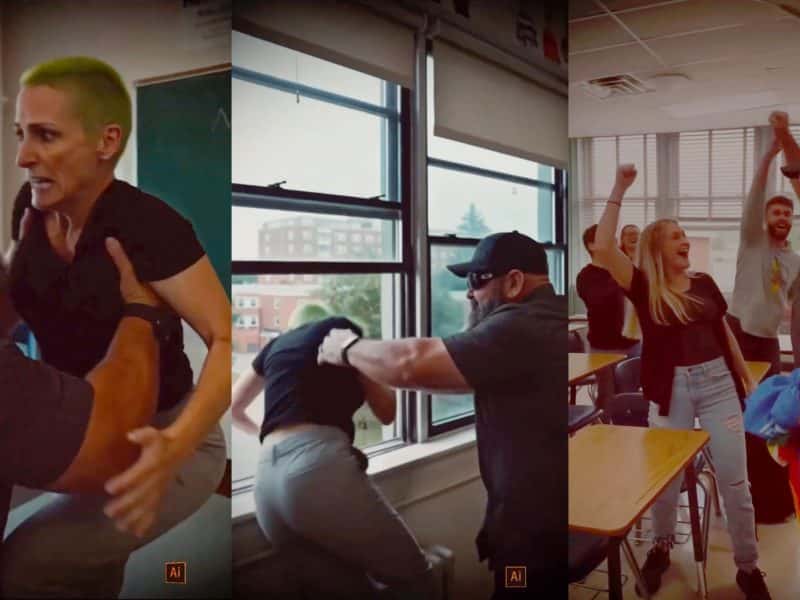
Anderson council member Darin Hale posts AI-generated video depicting assault of teacher, sparking outrage
Anderson Council member Darin Hale is running for California Assembly in next week’s primary. In the lead up to the election, he posted an AI video depicting himself assaulting a “woke” teacher. He’s using the endorsement of violence as promotional material for his campaign.
The Redding Chamber has endorsed Resner, Kelstrom, and Gallagher for the upcoming primary
The chamber released its first ever candidate guide this spring. It was focused on supervisor races, endorsing Erin Resner for Supervisor in District 1, and both Chris Kelstrom and Mike Gallagher for District 5.
