
School Board Member’s Dual Roles in Office Prompt Impending Legal Demand from California’s Largest Teacher’s Union
Local politician Jackie LaBarbera says her dual school board roles are legal. But after a recent set of votes in which her loyalties to the two bodies may have clashed, a representative of the California Teachers Association said the union will issue a cease and desist letter next week.
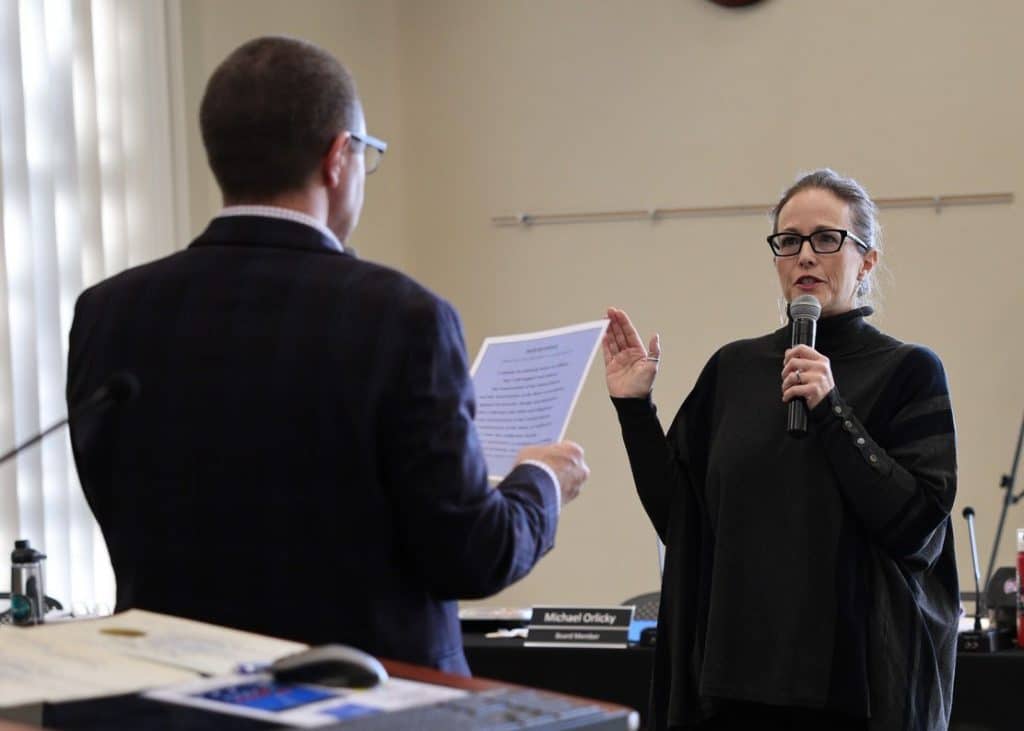
Photo courtesy of SCOE.
On Tuesday night, two Shasta County Office of Education (SCOE) Board members attended the Anderson Union High School District (AUHSD) Board meeting. One, Teresa Roberts, was there as a member of the public. The other, Jackie LaBarbera, was there because she still sits on the AUHSD Board, despite her recent election to SCOE.
The questionable legality of simultaneously holding seats on two, often interconnected, school boards came to a head during AUHSD’s February 25 meeting, as LaBarbera voted on contracts between the agencies.
“I find it interesting,” another AUHSD Board member Joe Gibson said, “that you have (two SCOE) Board members—one on our Board, another one out there in the audience–coming here and downplaying this grant (that SCOE) wrote for us (at AUHSD) and that we’re getting the benefit of.”
Gibson made his remarks while providing input on a vote to decide whether or not AUHSD should withdraw from the California Community School Consortium, a funding source that provides direct social services to impoverished and otherwise underprivileged students on one of AUHSD’s campuses.
The Community Schools Grant was the thorniest item on this month’s AUHSD Board agenda, and generated the most significant discussion. The grant funds, provided to individual school districts via SCOE, were distributed to Anderson Union High and 29 other schools in Shasta County beginning in 2023.
Ultimately, the Board terminated AUHSD’s contract with SCOE for the Community Schools program, a vote that LaBarbera participated in despite her role on both AUHSD’s Board and SCOE’s.
Legal Questions Abound
LaBarbera’s decision to maintain her seat on the AUHSD Board despite also being elected to SCOE, has been the subject of community concern since she emerged as the frontrunner in the SCOE Board race last November.
Holding both roles may be forbidden under California law, which does not allow elected officials to hold dual roles in office if one of the seats holds supervisory power over the other, or if sitting on both causes a “significant clash of duties or loyalties.”
After LaBarbera’s decision to vote on two contracts between SCOE and AUHSD earlier this week, the California Teachers Association (CTA) is taking action. Tamara Pellow, an AUHSD educator who’s also President of AUHSD Chapter of the CTA, told Shasta Scout in response to a request for comment that a legal demand is on the way.
“The California Teachers Association is planning to send a cease and desist letter next week,” Pellow wrote by text, “identifying that these (two Board) positions have an inherent conflict of interest.”
Should LaBarbera fail to respond to that legal demand by stepping down from AUHSD’s Board, California law indicates the next legal step would be to file a quo warranto with the California Attorney General’s Office, asking the state to weigh in on whether the dual roles present a conflict.
During this week’s Board meeting, Pellow spoke directly to LaBarbera, urging her to recuse herself from any vote involving SCOE–related items. In contrast, community member Leslie Sawyer, Chair of the Shasta County chapter of Moms for Liberty, demanded that LaBarbera not recuse herself, saying she doesn’t have to because SCOE doesn’t have oversight over the AUHSD Board.
Sawyer is correct that SCOE does not exercise direct jurisdiction over individual school districts’ decision making. But whether one office governs another is not the only criterion that makes two elected positions incompatible. According to Government Code 1099, incompatible offices are also defined by whether one elected office holds the power to audit another, by any (aforementioned) “significant clash of duties or loyalties between offices,” or if there are “public policy considerations that make it improper.”
Shasta Scout asked LaBarbera via email whether her votes on SCOE-related items pose such a “significant clash of duties or loyalties” and if she has sought legal counsel or consulted the Attorney General’s office on whether it’s permissible to hold the dual roles and participate in these kinds of votes. She responded by sharing her understanding of the separate nature of the two jurisdictions, but did not address questions about a potential clash of duties or loyalties or whether she’s sought out relevant legal opinions.
The Community Schools vote was not the only SCOE–related contract that LaBarbera weighed in on. Earlier in the meeting, she also voted in favor of an agreement that facilitates bussing for special education students. Before casting that vote, she ran the question of whether the vote could be an issue given her concurrent elected offices, past her fellow AUHSD Board members.
“I just want to know if you’re not okay with me voting on it… I can abstain,” she asked, adding that bussing contracts are not something she has direct oversight on in her role on SCOE’s Board. She did not make the same offer to the AUHSD Board when it came to voting for or against the Community Schools Consortium contract.
Why the Opposition to the Community Schools Program?
LaBarbera has previously attempted to sever AUHSD’s ties with the Community Schools program twice, both before she joined the SCOE Board in 2025. The latest effort by LaBarbera to terminate the grant agreement failed in November, after three of the other AUHSD Board members expressed hesitation about whether such a decision would benefit students.
At the time, LaBarbera said she opposed the Community Schools Program because she believes integrating mental health programs into schools distracts students from learning. Her comments contradicted remarks shared by some AUHSD teachers at that meeting who said the added interventions allow them to focus more intently on academic instruction for students.
SCOE Board member Roberts, who like LaBarbera shares ideological viewpoints that are consistent with the political mission of Moms for Liberty, echoed LaBarbera’s earlier sentiments during this week’s public comment. Speaking at the podium, Roberts insinuated that mental health problems are caused by psychologists and psychiatrists.
“The only thing that I can see is, you got a bunch of kids out there right now in these schools that [have] mental health problems because all of these psychologists and psychiatrists that are coming into the schools,” Roberts said. “ It’s taking away from their education.”
Julia Rinauro, a newly-elected addition to AUHSD’s Board, shared a similar perspective on mental health, while reflecting on her own childhood experiences.
“I understand that (some students) don’t have a family who is even there to feed them dinner at night,” Rinauro said, “because I was one of those kids… but to have someone continue to want to talk about your trauma, versus trying to pull you up and to push you higher, versus helping you to stay in victimhood, is not the way that we create productive citizens.”
Educators who work directly with underprivileged students used their public comments to share an opposite perspective, indicating that receiving counseling services helps students to succeed academically.
That’s a perspective shared by Wendy Hall, SCOE’s Executive Director for Community School and Support Services. In comments for a previous story, she told Shasta Scout that the Community Schools program is intended to provide an “added layer of support” that improves attendance and morale in direct service of a healthier and more productive learning environment.
As AUHSD educators spoke to the Board in favor of Community Schools, disruptively loud whispers could be heard from a table where SCOE Board member Roberts, former AUHSD Board member Darin Hale, and Katie Gorman (wife of SCOE Board member Authur Gorman) were sitting.
At one point, as Katie Gorman interrupted an AUHSD staffer’s public comment by calling out from her seat, Superintendent Brian Parker interjected.
“Please don’t comment,” Parker told Gorman. “You had your chance to speak.”
In the end, Gibson was the single dissenting vote on the Community Schools program as the rest of the Board, LaBarbera among them, voted to terminate the District’s involvement with the grant.
Since its inception in 2023, the grant has provided students with a dedicated SCOE staff member on AUHSD’s campus who provided coordinated access to resources such as food, clothing, and counseling when needed. Over 100 families have benefited from the grant-funded on-campus services, according to SCOE Director of Programs April Matthews.
Do you have a correction to share? Email us: editor@shastascout.org.
Related Articles

Wintu people say proposed reforms to a state list of tribes is erasure, threatens their homelands
A state commission’s proposal to remove Wintu and other federally non-recognized tribes from a consultation contact list would leave cultural sites vulnerable to destruction, tribal members say, and represents a form of unconstitutional discrimination.

Decision on city financing for the Ironman competition tabled by Redding City Council
The council’s decision followed a tense discussion on financial spending. The item will be brought back into discussion on Feb. 17. An Ironman official says he’s not concerned about the delay.

Shasta man had illicit marijuana grow and underground bunker in addition to illegal weapons, CHP says
A press release from the California Highway Patrol alleges that Michael Kamfort was operating an illegal grow when he was arrested on weapons charges, including manufacturing a “ghost gun,” on Tuesday in Anderson.