
Shasta introduced ‘poll closers’ for the June 2 election. How did it go?
The new role, implemented by Shasta Registrar of Voters Clint Curtis, was intended to increase efficiency. For some working at the polls, it added chaos and confusion to an already-complex process.
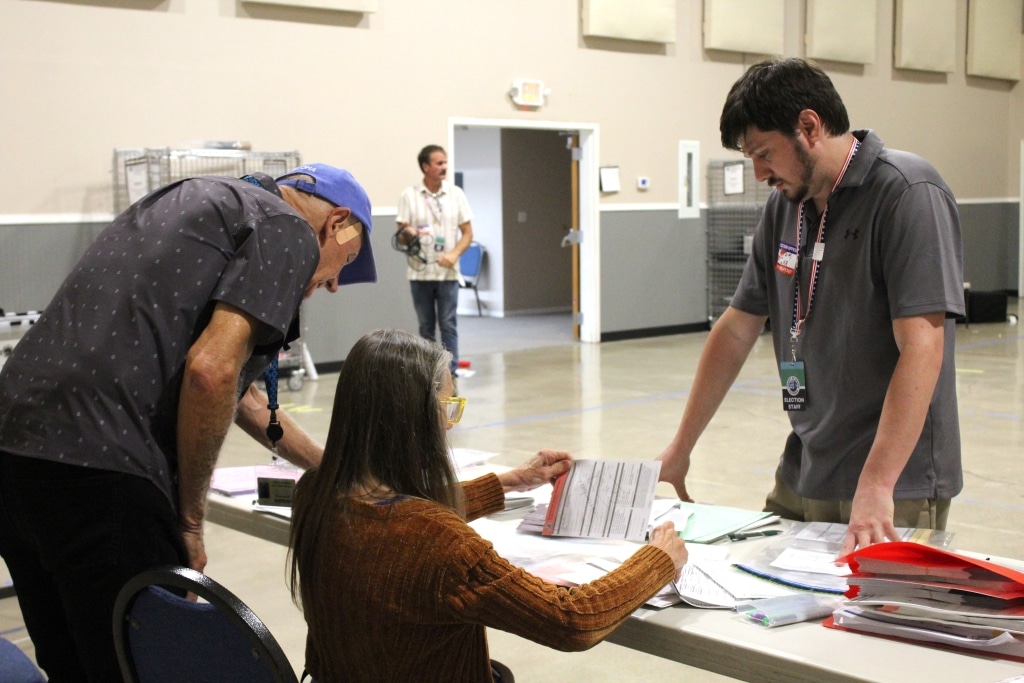
At the Redding Christian Fellowship church shortly after 8 p.m. on June 2, about a dozen people were hurriedly scrambling to close up the polling place and prepare ballots to be brought to the elections office.
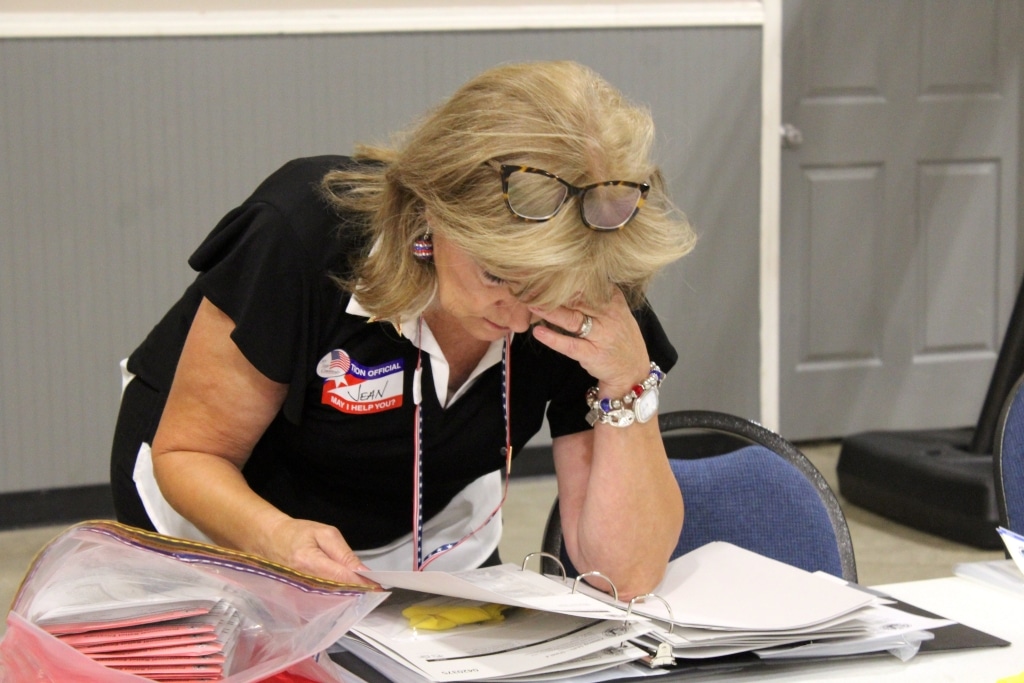
It was Election Day, and the church had just closed its doors after a long day of welcoming voters. Jean Young Werbil, one of the precinct inspectors at the church — which hosted two different voting precincts in one central space — flipped through her inspector’s manual to make sure she and her team of poll workers were closing the polling place properly.
She asked a nearby poll worker where her “poll closers” were, to which he responded that they were helping clean up the room next door. She asked him to retrieve them.
“They need to do their job,” she said in a stern manner.
When the two poll closers approached Werbil, they at first expressed some confusion and hesitancy about what they were supposed to do, with one of them saying they were only given a broad overview during a two-hour class about their role. Werbil looked through her handbook, and together, they all got started on next steps.
Shasta County Registrar of Voters Clint Curtis — who’s likely to lose his bid for re-election, according to current vote totals — implemented the new process of poll closers just a couple weeks before the primary election. Prior to this election, once the polls closed at 8 p.m., poll workers would conduct a simple count of the various types of ballots submitted at the polling place, then precinct inspectors would take ballots to the elections office.
The poll closers’ jobs were to sort through ballots that were voted in person at each precinct to ensure that any that were damaged or had extraneous markings were separated out for different processing, something that used to be done only after ballots had reached the elections office.
The process was intended to be more efficient. But a number of those working the polls said the new process was chaotic and confusing. At some precinct locations, ballots didn’t leave the polling places until two hours after polls initially closed, potentially delaying voting results.
Amy Andrews was assigned as a poll rover — someone who provides support to and oversees multiple precincts. She said she was part of a group chat with other rovers used to communicate during Election Day. After the polls closed, she said, several rovers messaged the group chat and said the closers at their locations didn’t seem to know what they were doing.
“I think the overall consensus was that it was a little scattered, and it was not as helpful as it could have been,” she added.
What were the poll closers supposed to do?
The poll closer process isn’t the first change Curtis has made to elections in Shasta. During the November 2025 special election, he started livestreaming ballots before and after machine processing in an effort to increase transparency. Before ballots can be shown on the livestream, they must be reviewed to look for extraneous and possibly identifying markings to ensure they’re removed before being shown on screen.
The need for this review process is largely what prompted Curtis’ implementation of poll closers. At each precinct, poll closers were instructed to sort precinct ballots — only those cast in person — into “good” and “bad” ballots, as Curtis described them during training, with “bad” ballots being ones that have extraneous markings on them or can’t go through the machine because they are damaged or unreadable. Those ballots, Curtis said, required further assessment by staff and may have needed to be duplicated in order to be properly read by machines.
The “bad” ballots were supposed to be placed in a bag marked with an “X” by poll closers. The ballots without extraneous markings or damage were to be sorted into groups of 50, then placed into sealed bags and marked with their precinct number.
The new role, classified as extra help, was also a paid position. Curtis said starting pay for the closers was about $17 an hour, contrasting from the flat rate of around $100 given to poll workers and $125 to precinct inspectors, who often work more than 15 hours on Election Day. Curtis added that the poll closers’ hours depended on how busy polling places were and whether they needed to fill in for poll workers who didn’t show up on Election Day.
Each precinct location — there’s more than 50 in Shasta County — was intended to have two poll closers.
How did the poll closer process play out?
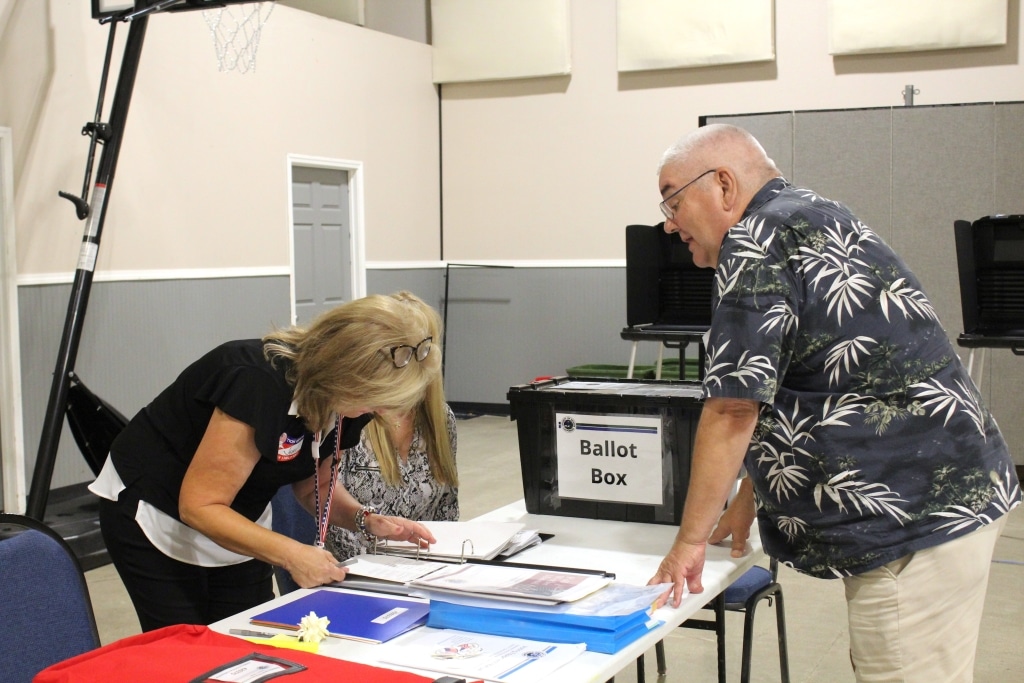
While poll closers’ primary jobs only started once the polls closed, some of them reportedly arrived hours before the 8 p.m. closing time. Andrews, the poll rover, said some closers showed up as early as 4 p.m., but since the role they were responsible for didn’t start until hours later, they sat idly until then.
Andrew Jacobsen, an experienced poll worker who was at Saint James Lutheran Church for the election last week, said this was one of the aspects about poll closers that frustrated him most. He said the closers at his precinct showed up more than two hours before the polls closed and often got in the way of voters by standing in front of ballot boxes and chatting with poll workers.
“There was nothing for them to do until the very end,” he said. “Basically we had to just give them stuff to pacify them until it was time for them to actually work. That was very disruptive.”
Jacobsen said the poll closers didn’t come in with any sort of manual or instructions, and they sometimes argued with the precinct inspector about their responsibilities.
“They didn’t seem to really understand their exact role and what they were supposed to be doing,” he said.
Andrews agreed. She said she had to explain the poll closer process to some of the closers she oversaw, which she said got confusing because there were contradictions in how everyone involved was instructed.
“If it had been made clear to all the poll workers and rovers and everyone exactly what the closers were going to do, that would have been better, because there was no consistency in what we were told they were doing,” she said.
During the poll closer process, she described the scene as chaotic, with the involvement of extra people making the closing process more complex. “There’s more questions coming from every direction,” she said.
She explained that it might’ve been better for the elections office to limit the poll closers to just cleaning up the polling place and leave ballot sorting to staffers at the elections office.
“It’s always helpful to have people to help pick things up,” she said, “but I don’t know that that’s worth money that’s paid out and the chaos of it.”
Donna Hunter, a precinct inspector at a different location, said her polling place finished closing the latest she had ever experienced.
“I was relieved when I was dropping off our ballots at the clerk’s office to see the line, which meant we were not the only ones” running late, she said, referring to the line of cars waiting to drop off ballots outside the Market Street elections office.
Not everyone struggled with the poll closer process. Werbil, the precinct inspector at the Redding Christian Fellowship church, said the process made sense to her — as long as she went step-by-step with her manual.
“It’s just a matter of opening up your book and following the directions,” she said.
Werbil noted that this was her first time as a precinct inspector, and she had only been a poll worker once before, so she didn’t have a point of comparison when considering the potentially added time of the poll closer process. She said she overall felt that the closers were very helpful.
Shasta Assistant ROV Brent Turner acknowledged after the election that “the whole poll worker thing is a tremendous work in progress,” adding that poll closers were part of an effort by Curtis to reinvent poll worker training, operations and manuals simultaneously as a way to “tackle everything at once.” He said the goal of poll closers was to expedite the election night process in a way that would increase efficiency.
“I think that was the attempt,” he said. “Now, when you get out in the field, how it plays out when you have different personalities at every poll [and] different skillsets, some of them might retain better than others.”
Regardless, Turner said, he thinks the timing of voting results coming in on election night was around the same as the November 2025 election.
“Even if it did take a little bit longer, in my mind, if it creates efficiency and or security, then it’s worth another 15 minutes in the chain,” he said. “But that’s to be analyzed.”
Do you have a correction to share? Email us: editor@shastascout.org.
Comments (16)
Comments are closed.
Related Articles
Meet Bruce Ross for Shasta County Office of Education Trustee
Bruce Ross is running for one of four open seats on SCOE. He’s served on another local school district board for more than a decade and is a parent who hopes to bring a “focus on kids’ needs, not adults’ dramas” to the SCOE Board.
Meet Dan Sloan for Shasta County Office of Education Trustee
Dr. Dan Sloan is running for one of four open seats on SCOE. Sloan is a Redding-born candidate who hopes to bring his multicultural and law-focused perspective to the school board.
Redding Chamber of Commerce endorses Wenham and Prosperi for City Council.
With three seats open, the Chamber has endorsed two candidates after an evaluation “measuring competence over confidence.”
Waste of tax payer money.
It is a reasonable idea. As the article mentions, poll workers do put in very long days and can be punchy by the end.
Frankly, the training that Curtis provided to poll workers (and, presumably, closers too) was less rigorous and thorough than what I had previously. That does not help when you are trying to make a big change in detailed procedures.
To all my fellow hard working poll workers and the inspectors: Please share your observations about the poll closers and other sundry items with the Secretary of State Elections Division office.
“Big Top” and “Clown Show” sounds sadly accurate but not funny. As our rights to vote in a fair and safe environment are being challenged at the highest levels in Government, we should be seriously concerned about this process. I too hope the Sec of State will force Mr. Curtis to resign and let Joanna take over early. We don’t need to go through this mess again in November. Thank you to the women and men who worked so hard to maintain the dignity of Voting.
I was quoted in this article and now that I’ve had time to go over the closing in my head I have a couple of observations. First and I think most important was the lack of experience from the top down. That lack of experience, as well intentioned as they all were, was glaring in both of my training sessions so I imagine if you were a new poll worker, inspector or poll closer that you only had a general idea of what your responsibilities would be on Election Day but very few specifics. In my inspector training we were told that once the ballots were counted and the poll closers had done their sorting the inspector could seal up the ballots and take them to the clerk’s office. We could go home and the closers would take over closing the polling site. This sounds great in theory but because Mr. Curtis had no experience in closing a polling site, he had no idea what is truly required. So I’m thinking that my second point, the unintentional added voices and for some chaos stems from that lack of experience. Time to move passed all this. Support our new ROV and support all those poll workers who simply want to serve the voters of Shasta County. Happy 250th America!!
My wife and I were poll workers for the first time this election. We didn’t have any closers and after reading this I’m glad we didn’t. It was an extremely long day as it was. We were there at 6am and I didn’t get home until midnight. If it wasn’t for our excellent Inspector, who was there at 5am, it could have been longer. Those who advocate for only in person voting should have to be a poll workers at least once to see what a long and difficult day it already is.
Curtis was appointed, never elected, and thus has lost his first campaign attempt. I’m grateful for that as are many others.
One thing is clear: chaos and disruptions have permeated every level of the election process, before, during and after. It never should have been this way.
Now, we’re left with a big mess to rectify.
One more example of how both Clint Curtis and Brent Taylor did have a clue as to how to manage an election. This absolutely reprehensible and idiotic. Let’s East’s more tax payer money on stupid, ill thought out foolishness!
Clearly it did not work. For the first time I voted in person. Signed the register and deposited a clean ballot. My ballot is missing. Mr. Curtis still owes me a call back once they find my ballot. I keep checking the SoS ballot tracking system and mine has not yet been accepted, let alone counted. You would think if there was a reason for this, Mr. Curtis would have explained it.
Let us know if and when it posts on the SoS website—I wouldn’t trust anything Curtis tells you on the phone. I’m not 100% convinced yet that the Curtis election-fabulist hires weren’t playing shell games with ballots. There was a lot of weird new sorting and shuffling going on with this election—a lot of it being done by weirdo bad actors.
Yup, that’s the reason I decided at the last minute to vote my ballot at home and drop it in the box at my polling place. I didn’t want anyone touching my ballot before it got to the ROV office.
One more performance, then the Big Top closes and the clown show is over. Maybe we’ll get lucky and the complaint with the Sec. of State will be serious enough to force the head clown to resign in disgrace and Joanna can take over early.
Selah
Curtis won’t resign early unless it’s under a deal to avoid prosecution by the SoS. If that happens, the BOS will have to appoint an interim ROV who would serve through January 2027. For that appointment to be Francecutt, one of Los Tres Pendejos would have to break ranks. It obviously won’t be Crye. It’s hard to imagine it would be Harmon, who apparently doesn’t have two brain neurons to trade action potentials with one another, and does as he’s told.
.
That leaves Kelstrom, who is staring down a runoff in November with Gallagher. Kelstrom would weigh how much good will vs. bad will a vote to appoint Francecutt would buy him. If I were a political advisor, I’d tell him his only chance to keep his seat is to peel some votes away from Gallagher, and that means supporting Francecutt’s appointment. Voting to appoint another MAGA election fabulist isn’t going to skim any votes off of Gallagher, but Kelstrom might do is anyway if his mindset is going to be like Crye’s…. let’s just burn it all down on our way out.
Just another solution looking for a problem.
A non-existent problem, at that.