
Speculation swirls about who will pick up LaMalfa’s mantle in Congress
GOP sources in the North State say Assembly member James Gallagher could be well positioned to fill LaMalfa’s vacancy. Gallagher’s office did not answer questions about whether he’s considering running for the seat.
Rep. Doug LaMalfa’s sudden passing last week occurred amid the political turmoil brought on by Prop. 50 redistricting. His death has also thrust the North State’s political representation into the national spotlight at a key political moment in U.S. history.
The vacancy will prompt a special election, but whoever’s chosen to fill the remainder of LaMalfa’s term will hold that seat for less than eight months. While that may seem inconsequential to some local voters, on a national scale the vacancy is likely to impact the passage of legislation that supports President Donald Trump’s often controversial domestic and international goals.
For this story, Shasta Scout spoke with multiple sources familiar with California’s GOP machinery who are connected to municipal, county or statewide governing bodies. They all requested to go unnamed given the sensitivity of political strategizing on who the GOP may encourage as its frontrunner.
From these conversations, one person was consistently named as the speculated, and at this point, unconfirmed possibility: California Assembly member James Gallagher of Yuba City. His office did not provide a response to Shasta Scout on whether he plans to run.
When, where, how: special election specifics
As per California law, Gov. Gavin Newsom is expected to announce the date of a special election by Jan. 20 — within 14 days of the vacancy created by LaMalfa’s absence —meaning his deadline to do so is Jan. 21. The date of that special election, the law says, must take place on a Tuesday no less than 126 but no more than 140 days after Newsom’s proclamation.
If the governor were to wait until the last possible day to call the election, it would need to occur within the window of May 21 through June 10. Shasta Scout’s analysis indicates that June 2 is likely to be chosen as the date, since a statewide primary is already scheduled for that day.
According to the Secretary of State’s office the first step in the process must come even before that special general election can be held, a special primary election that must be held on a Tuesday nine weeks earlier, or ten weeks earlier in the case it conflicts with a public holiday. Shasta Scout estimates a special primary election likely to fall on March 24.
If the results of that special primary provide a simple majority — meaning a result of at least 50% plus one vote for any single candidate of any party — that candidate will be declared the winner, with no need for a special general election.
But wait, there’s more …
Even before his death, LaMalfa’s seat in Congress was soon to be up for a vote.
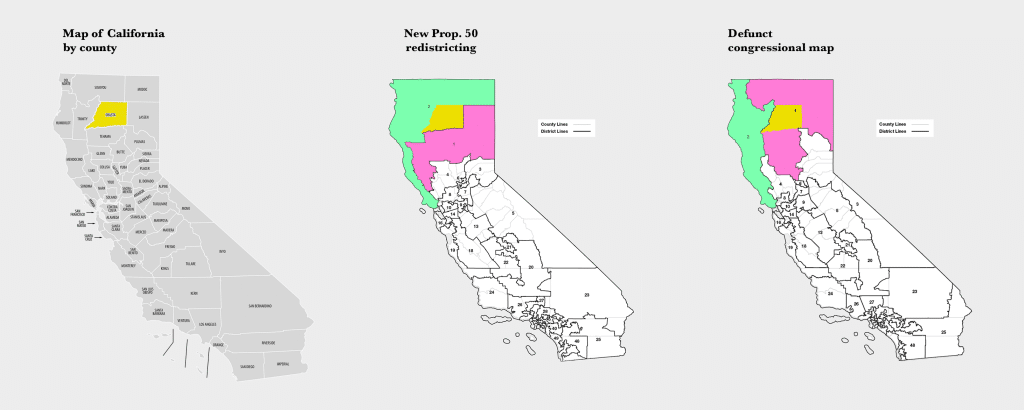
During this year’s statewide June primary, voters are due to choose new congressional representation, this time under newly-drawn district lines created by Prop. 50. As Shasta Scout reported in November, LaMalfa had already launched a re-election campaign in the newly-defined post-Prop. 50 District 1, a geographical area drastically redistributed by the voter-approved initiative that redrew district lines across California’s far north. Under those lines, LaMalfa’s home county of Butte remains within the new D1 alongside newly-added sections of liberal-leaning counties, Mendocino and Sonoma.
But some North State voters, including those in the conservative stronghold of Shasta County, would not have had the opportunity to vote for LaMalfa, even if he had survived his recent emergency surgery. That’s because under Prop. 50, Shasta will no longer be a part of D1, instead joining the heavily Democrat-leaning District 2 which stretches all the way down to Marin County.
Shasta voters are expected to have two congressional district races on their ballots: one to fill a seat for their representation under California’s current D1, to finish LaMalfa’s term and another to select their representative within Shasta’s new home in D2, a term that will begin in 2027.
The Secretary of State’s office confirmed for Shasta Scout that it would be legal for someone to run for both positions concurrently during the June election. That person could run for the old D1 seat, to carry on the torch of LaMalfa for the remainder of his term, while also seeking the role of congressional representative in the new post-Prop. 50 D1, which doesn’t include Shasta.
Who will take up LaMalfa’s mantle?
As evidenced by LaMalfa’s consecutive victories at the polls from 2012 onward, the former congressman had a strong support base of rural conservative voters in the area of California he represented. While multiple Democratic candidates had already announced their plans to challenge LaMalfa under new district lines —including the Chico-based educator and rival in past elections Audrey Denney and California State Senator Mike McGuire — no Republican candidates have stepped forward so far.
In LaMalfa’s absence, speculation is swirling over what conservative candidates might throw their hat in the ring both to fill the remainder of his time in office and the D2 seat he hoped to win. LaMalfa’s office did not respond to Shasta Scout’s request for comment on whether his team is discussing a possible candidate to fill his vacancy.
Given that whoever assumes LaMalfa’s vacancy will be in office for the less than eight months until his term ends, it may make strategic sense for them to simultaneously run for the congressional seat in the new D1, therefore dovetailing a successful run for LaMalfa’s vacancy into a new tenure in Congress, assuming they win both positions.
Could Gallagher be the heir apparent?
In a eulogizing message after LaMalfa’s death, Gallagher described the former congressman as a kind of “big brother” figure and “mentor” to him. Geographically, Gallagher fits the bill as he currently represents an assembly district that overlaps with both LaMalfa’s homebase and the part of D1 that will remain in place after Prop. 50.
Sources also noted that his tenure in the California legislature is set to “term out,” as state politicians can only serve a lifetime total of 12 years. The 44-year-old politician began his career in the assembly in 2014, and has been consecutively reelected every time he ran, making this his final term in that particular office.
As political analysts have pointed out, the new D1, which will still include Butte County and much of Gallagher’s current assembly district, will be slightly less skewed towards a Democratic win than the new D2, which Shasta will be joining. This means that a Republican could stand a better chance at winning in D1 than in Shasta’s new congressional district, making the effort more worth the investment of time and resources for a committed politician like Gallagher.
He’s also been at the forefront of the conservative and rural contingency within California’s state assembly, making headlines last year when he proposed a bill to vertically partition the state into coastal and inland parts — the latter of which, Gallgagher told Shasta Scout in October, would empower inland Californians with a sense of “self-determination” given that rural inlanders often have different material concerns than their counterparts in more densely populated counties along the Pacific.
Gallagher made significant inroads with the Shasta County board when he presented his “two-state solution” partitioning plan at a public meeting just after Election Day last year, when voters across the state affirmed Prop. 50. A board majority comprising supervisors Kevin Crye, Chris Kelstrom, and Corkey Harmon all voted to symbolically support the partition as a county.
Who else might run?
Sources also named another possible contender to fill LaMalfa’s seat. Brian Dahle, the husband of Meghan Dahle — who represents much of the North State in the state senate — is a former state senator himself. Like Gallagher, Dahle also “termed out” of his state role, after strong support by voters in consecutive races. He lives in Lassen, a part of the current congressional D1 which will remain in the new D1 after redistricting. According to his website, Dahle plans to run for Lieutenant Governor in 2026. His office did not respond to two requests for comment asking whether his political aspirations have changed, given LaMalfa’s unexpected death.
What’s at stake nationally?
Given that LaMalfa’s seat is federal, the stakes of both his congressional vacancy and the North State’s eventual congressional representation — whether that be in the new District 1 or 2 — have serious national implications, as well as local ones. As it stands right now, there is a razor thin margin between Democrats and Republicans in the House of Representatives. With the loss of both LaMalfa and the recently resigned Marjorie Taylor Green of Georgia, that margin is even thinner: 218 Republicans versus 213 Democrats, with four vacant seats.
Given that narrow divide, Republican Speaker of the House Mike Johnson would need a near unanimous vote on behalf of his fellow Republicans to push through controversial partisan legislation. The loss of LaMalfa specifically has particular resonance here, as President Donald Trump himself noted that the congressman “voted with me 100% of the time.”
In recent months, this delicate balance has come into play on certain bipartisan votes in which a number of Republicans defected from the party line on certain issues. For instance, Speaker Mike Johnson delayed the swearing in of Democratic Rep. Adelita Grijalva of Arizona after she committed to releasing the Epstein files. Her affirmative vote on the controversial files would have tipped the scales, mandating their full release — though Johnson has denied that there was any sort of connection between her pledged vote and the delay of her swearing in.
On other issues, Republicans have broken with the party majority by a much larger margin than just two votes — the maximum number of votes the slight Republican majority in the House can afford to lose to Democrats and independents across the aisle — as demonstrated by Congress’ recent vote on whether to extend Obamacare.
In the arena of foreign policy, the Republican front has also begun to fray ever so slightly, adding to Johnson’s current risk matrix given LaMalfa’s empty seat. On Jan. 8, five GOP Senators joined Democrats to limit Trump’s incursion into Venezuela, an action which the United Nations Security Council said has jeopardized both Venezuela’s sovereignty and the very foundation of international law.
How the Venezuela issue may play out in the lower House of Representatives will remain to be seen. But as of Jan. 8, Democrats Jim McGovern of Massachusetts and Joaquin Castro of Texas had joined Kentucky Republican Thomas Massie in presenting a bipartisan war powers resolution to block further escalations in Venezuela without the approval of Congress. The resolution is nearly identical to one already presented in the House of Representatives, including LaMalfa, which failed by only two votes.
1.14.2026 1:40 pm: We have updated Shasta Scout’s estimated date for when a special primary election could occur.
Do you have information or a correction to share? Email us: editor@shastascout.org.
Comments (4)
Comments are closed.
Related Articles
To save her daughter’s life, she advocated for her rights to be taken away
California’s conservatorship system can be used to force people with severe psychiatric illnesses into involuntary medical care for up to a year. Marci Fernandes said the process has been life-changing for her adult daughter, Ann, but significant obstacles to her well-being remain.

Redding seeks community members for two committees aimed at providing advice on the city’s financial processes
The city is accepting applications to join the newly-formed Financial Advisory Committee and the newly-formalized Audit Committee. Both applications are due April 17.
Shasta’s Measure B will remain on the ballot
A legal challenge to the ballot measure was dismissed because it did not specifically demonstrate how placing Measure B on the ballot would violate the law — even though implementing it appears illegal.
Unless the law has changed, a person does not have to live in the CD they want to represent. Please consider doing a piece on Jared Huffman and Rose Yee, contenders for D2 and D1 respectfully.
I was wondering if Shasta Scout could do a profile/interview on Audrey Denney? What she is all about? https://audreyforcongress.com/
The Special Primary Election cannot be held on March 31, 2026, since that is a State holiday and elections cannot be held the day before, the day of or the day after a State Holiday. See Elections Code section 1100. State holidays are listed in Government Code section 6700, which includes Cesar Chavez Day on March 31. If the Governor calls for the Special General Election to be consolidated with the June 2, 2026 Statewide Direct Primary Election, the Special Primary Election would be held 10 weeks prior on March 24, 2026. See Elections Code section 10704(a).
Thank you! We reviewed the law, and it is consistent with your comment. Correction notice at the bottom.