Supreme Court Case About Impact Fees Could Have Huge Consequences For Housing In California
The plaintiff in the case wants to put new guardrails on impact fees. But that would come at a sharp cost: Local governments, restricted by California law from raising property taxes and borrowing funds, disproportionately rely on impact fees to pay for infrastructure like roads and sewer lines.
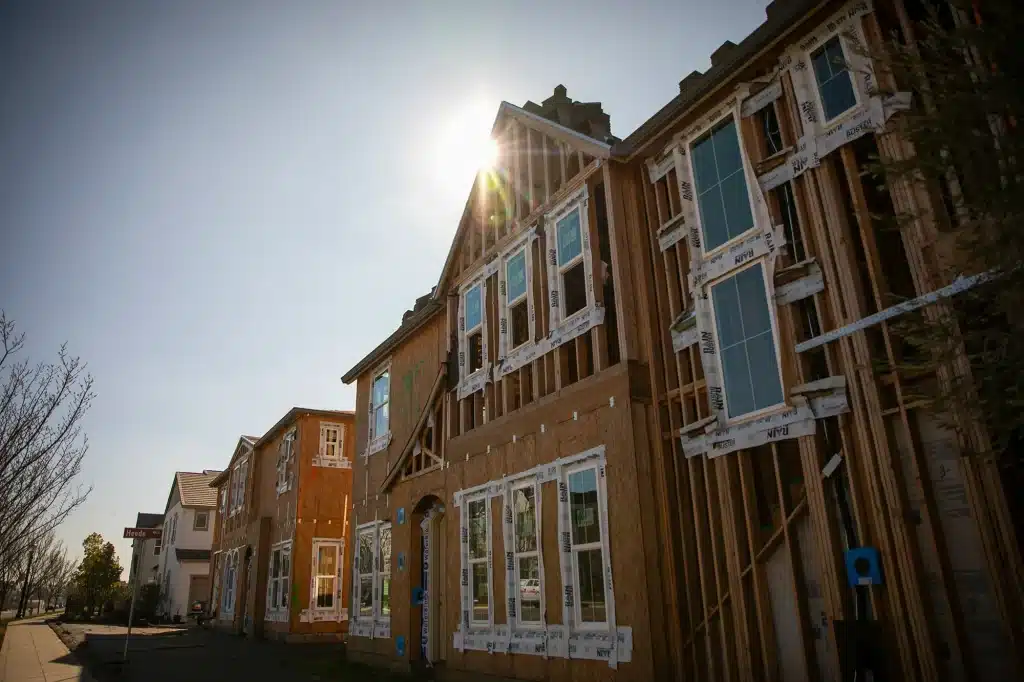
New housing construction in the Crocker Village neighborhood in Sacramento on Feb. 10, 2022. Increasing the supply is one solution to rising California home prices. Photo by Miguel Gutierrez Jr., CalMatters
This story was originally published by CalMatters on January 9, 2024, and is reprinted here with permission.
A dispute between a 72-year-old retiree in Placerville and El Dorado County over a $23,420 building fee got its day before the country’s highest court this morning in a case with potentially seismic consequences for local government budgets and housing markets across California and the country.
At issue is just how far cities and counties have to go to justify “impact fees”: fees slapped on new construction projects in order to offset the toll new developments take on local infrastructure.
The stakes are especially high in California, where impact fees can tack on hundreds of thousands of dollars to new housing projects that are already among the most expensive to build in the nation.
The plaintiff in this case wants to put new guardrails on those fees. But that would come at a sharp cost: Local governments, restricted by California law from raising property taxes and borrowing funds, disproportionately rely on impact fees to pay for infrastructure like roads and sewer lines.
The justices waded deep into the legal weeds of the case during oral arguments today and seemed alternately frustrated and bemused as they grappled with whether El Dorado County’s fee should be treated like the government were seizing a homeowner’s property, a simple tax or something in between.
The legal saga began in 2016 when George Sheetz, a retired engineering consultant, built a small manufactured home on a vacant tract in the Sierra foothill city of Placerville. The county stuck Sheetz with the five-figure “impact fee” to fund local roads, highways and bridges. Sheetz paid up, but then sued.
With the backing of a conservative legal nonprofit, the Pacific Legal Foundation, he argued that, contrary to a four-decade old Supreme Court precedent, the county had failed to prove that the fee accurately reflected the wear and tear his small project would likely leave on local roads.
“Everyone loves good roads and schools and public infrastructure, so the government certainly has many tools at its disposal, including taxes to pay for those,” said Paul Beard, Sheetz’s attorney, in presenting his case before the court today. “What we’re saying is that the government can’t select a few…property owners who happen to need a permit at any given time — to select them to bear the burdens of paying for that public infrastructure.”
The lawyer representing the county countered that officials had done the legally required due diligence to justify the fee. But even if they hadn’t, they added, fees passed by local elected bodies that apply equally to all applicants — as opposed to one-off exactions levied on a specific development — don’t warrant such close judicial scrutiny.
Requiring cities and counties to enact fees only after they’ve done a thorough, property-specific analysis of the impact a proposed development would have on local roads, for example, “would disrupt if not destroy their ability to fund capital intensive infrastructure necessary to serve new development, bringing such development to a grinding halt,” said Aileen Marie McGrath, the attorney for El Dorado.
With so much potentially at stake, the case has drawn the attention of a wide array of competing interests. Building industry groups, conservative property right defenders and Yes In My Backyard advocates have all filed briefs pleading with the court to force local governments to clear a higher bar before charging for the right to build.
A decision against Sheetz would only encourage “unconstrained exactions on new development, further adding to the crushing costs of housing in California and other jurisdictions that refuse to require governments to show any proportionality between the amount of fees demanded and the alleged impacts of new development,” the California Building Industry Association wrote in its brief from June.
“Unless you want a dirt road and like, you know, bandits out there because we don’t have a sheriff, we need to have some level of an assessment done.”
Mark Neuburger, legislative advocate, California State Association of Counties
City and county government groups, along with the governments of both the state of California and the United States, have come to El Dorado County’s defense.
Many court watchers expect the court’s conservative majority to side with the burdened property owner and require the cities and counties to work a bit harder to justify the fees they impose on new home construction. It remains unclear for now just how far such a ruling could go and whether it might place fresh limits on other widely used housing and revenue-raising policies.
“It seems kind of like a nightmare to figure out where the line should be drawn,” Justice Amy Coney Barrett said.
A uniquely California case
Though today’s debate took place in the ethereal clouds of abstract constitutional consideration, for California developers, the issue at hand is plenty concrete. As a group, they’ve spent a generation griping about impact fees.
As of 2015, the average impact fee on a single family home in California was more than quadruple what it was in other states, according to a survey. While such fees were found in a “minority” of jurisdictions outside of California, they were “virtually universal” here.
In a 2018 study from UC Berkeley’s Terner Center, impact fees in a survey of California cities ranged from between 6% to 18% of the local median home price.
It’s not especially surprising that California cities and counties have come to rely so heavily upon this particular form of financing.
During the high-growth decades of the 1950s and ’60s, local governments could easily assume that new development would pay for its own added toll on publicly funded roads and pipes through increased property tax revenue. That changed in 1978, when voters passed Proposition 13, capping local property taxes and muzzling the ability of local governments to borrow or raise new taxes.
That’s led to some frustration from El Dorado County and its defenders. If impact fees are intolerable, some have asked, what are the alternatives?
“Unless you want a dirt road and like, you know, bandits out there because we don’t have a sheriff, we need to have some level of an assessment done,” said Mark Neuburger, a legislative advocate for the California State Association of Counties. “It’s unfortunate when it’s a noticeable size of your project, but we live in a modern society and this is just part of the expense of paying for it.”
Sheetz and his supporters contend that these fees aren’t justified solely on meeting specific, related infrastructure costs and point to the wide variability in fees from one city to the next — even between neighboring jurisdictions.
As the city of Oakland noted in a recent report, its typical fee on large apartment projects comes out to $39,264 per unit. The neighboring city of Berkeley, sets the tab at $66,594. Across the Bay in San Francisco, the fee is $74,597.
At the more extreme end, the 2018 Terner Center study found that the city of Fremont imposed a single-family home impact fee of $157,000.
“You look at places like Fremont and they have these immaculate parks that are funded very significantly by impact fees,” said David Garcia, the center’s policy director. “There’s a question whether it’s reasonable to want to have top notch services and infrastructure, but for that to come on the backs of new residents.”
A fee or “out-and-out” extortion
The origins of this particular debate date back to another legal dispute brought by Californians trying to build a new house.
In the early 1980s, James and Marilyn Nollan, a Ventura County couple, decided to convert their coastal bungalow into a two-story home. The California Coastal Commission, which regulates land use along the state’s coastline, issued a construction permit, but only on the condition that the couple give up a slice of their property to allow for a public walkway to the beach.
In 1987, the U.S. Supreme Court ruled that the Coastal Commission had overstepped. If the government wants to take someone’s private property in exchange for granting them a land-use permit, there has to be some obvious connection between the property being seized (in this case, a slice of land for a walking path) and the government’s purpose in restricting development in the first place (capping a building for the preservation of ocean views), the court held. Because there was no “essential nexus” between the two in this case, Justice Antonin Scalia wrote in his majority opinion, taking the Nollans’ property was “not a valid regulation of land use,” but amounted to “an out-and-out plan of extortion.”
“Why is a fee attached to a development any different from any other kind of tax? No one has a good explanation for that.”
Chris Elmendorf, Law professor, UC Davis
In subsequent rulings, the Supreme Court laid out further limits on this kind of public-sector “extortion.” In the 1990s, the court found that the cost of getting a permit also has to be roughly proportionate to the impact a development is likely to have on the public. In 2013, the court ruled that these “nexus” and “proportionality” standards don’t just apply to the taking of physical property, but monetary fees made in lieu of giving up land, too.
Sheetz and his legal supporters argue that it’s time for the court to apply the “nexus” and “proportionality” rules to El Dorado — and to local impact fees across the country.
The California exemption
In response, El Dorado County and its cavalcade of legal allies put up a double-barreled defense.
First, California courts, along with those in many other blue states, have carved out a major exception to the Supreme Court’s rules. Fees slapped on individuals on an ad hoc basis — by say, by the Coastal Commission in adjudicating a single permit — might lack transparency, political accountability and be ripe for abuse. But fee schedules — voted upon by city councils or county boards of supervisors and that apply to all applicants across the board — don’t deserve such special treatment, the state’s courts have found.
The logic for that distinction, in part, comes down to political accountability.
“A city council that charged extortionate fees for all property development, unjustifiable by mitigation needs, would likely face widespread and well-financed opposition at the next election,” the California Court of Appeal noted when it ruled against Sheetz in 2022.
The fee that El Dorado County levied on Sheetz was passed as part of a general road and highway funding program. Sheetz’s specific fee was based on the size and location of his single family project, as listed on a menu of such fees on the county’s website.
In bringing the case, Sheetz’ legal team asked the U.S. Supreme Court to do away with this “California’s judicially-created exemption.” Some members of the court’s conservative majority appeared ready to do exactly that.
“There’s just no categorical exemption from legislative enactments — what would be wrong with that holding today?” said Justice Neil Gorsuch.
Treating such a set of fees as comparable to the seizing of an individual’s private property could open a whole can of constitutional worms, said UC Davis law professor Chris Elmendorf.
“Why is a fee attached to a development any different from any other kind of tax? No one has a good explanation for that,” he said. He also pointed to local inclusionary zoning rules, in which cities permit new housing projects in exchange for a developer making a certain share of the units affordable, as another policy that could find itself on the chopping block if Sheetz succeeds at the Supreme Court.
Another local policy that could find itself ensnared in a ruling for Sheetz: Requirements that large developments set aside space for public art or pay a fee if they don’t.
Many of the justices, especially the court’s three-member liberal minority, seemed to have a hard time identifying a distinction between across-the-board impact fees and other types of taxation that don’t require a court’s fine-toothed once-over.
Justice Sonia Sotomayor likened El Dorado County’s impact fee system to a set of user fees, building permits or even a road toll.
“If you’re going to start saying, as you did, that you’re reserving the right to say that a toll could be an unconstitutional taking, I bet New York City is going to be sued very soon on that on that toll to come down into Lower Manhattan,” Sotomayor, who was born in the Bronx, told Sheetz’s counsel. “At what point do we stop interfering?”
Already complying
If the court doesn’t buy that particular argument, the county put up a second one: It is already abiding by the court’s prior rulings.
A state law, known as the Mitigation Fee Act from 1987, requires local governments to justify the fees that they impose with detailed studies that show a connection between the fee levied on a new development and the financial impact that development is likely to impose on local infrastructure.
In conducting those analyses, they argue, California counties are already complying with the Supreme Court’s standards.
For Sheetz’s proponents, those “nexus studies” are a paltry substitute for heightened judicial scrutiny.
These studies often amount to “high-level black boxes” that can justify a wide range of potential charges, said the Terner Center’s Garcia. In California, state courts have historically been reluctant to second-guess those analyses.
If the high court does ultimately decide that a more rigorous, project-by-project analysis is required, the implications could be dramatic — and not in the way that plaintiffs either imagine or hope, warned Jennifer Henning, a lawyer with the California State Association of Counties.
“I don’t think it’s going to result in zero fees,” she said of a possible Sheetz victory.
What it would almost certainly do is “really slow down and make more expensive the process of pulling permits and doing other kinds of development projects,” she said. “We’re just concerned, particularly in the middle of a housing crisis.”
Even Trump-appointed Justice Brett Kavanaugh worried about the practical workability of that requirement in his back-and-forth with Beard, Sheetz’s lawyer.
“Your way is going to be more time consuming (and) administratively burdensome,” he said.
“It very well may be,” said Beard. “But this is a constitutional standard.”
This article, which was originally published in CalMatters on January 9, 2024, is republished, with permission. CalMatters is a nonpartisan and nonprofit news organization bringing Californians stories that probe, explain and explore solutions to quality of life issues while holding our leaders accountable. They are the only journalism outlet dedicated to covering America’s biggest state which includes 39 million Californians and represents the world’s fifth largest economy.
Ben covers California politics and elections. Prior to that, he was a contributing writer for CalMatters reporting on the state’s economy and budget. Based out of the San Francisco Bay Area, he has written for San Francisco magazine, California magazine, the San Francisco Chronicle, and Priceonomics. Ben also has a past life as an aspiring beancounter: He has worked as a summer associate at the Congressional Budget Office and has a Master’s in Public Policy from the University of California, Berkeley.
Comments (6)
KATHLEEN RAVEN SURBAUGH
●
January 15, 2024 at 2:56 am
Need to fix the Prop 13 loophole that lets corporate owners get around ‘sale’ of RE by simply substituting shares (no legal change of deeded owner, but just stock being transferred to new buyers,) Prop 13 is a lifesaver for private citizens who stay in their homes as they age, but corporations have completely put themselves out of reach of reassessment by this ruse. Stupid voters didn’t allow the ballot proposal to fix this to go through last election. If sold RE that corporately owned were properly reassessed, there would be no outrageous use fees required. It’s that big a deal.
I speak as a former Deputy Assessor for a small county and a former RE Broker who had family members directly affected by this tax relief, and I benefit from it myself now at 80+ years of age.
I
Ralph Ross
●
January 11, 2024 at 11:27 am
thats a good thing to void the impack fees just another rip off .
they can’t justify those fees because on Hilltop dr the roads are good .
and one business fees were 100,000 .
I glad the cut them out .
Now they need to cancelled the fees the health dept charges outrageous .
Linda Russell
●
January 11, 2024 at 8:19 am
Eliminating impact fees might just be the most reckless and financially irresponsible thing the 3 Stooges have done so far. Foregoing impact fees puts the county in the position of either having to backfill those funds from other sources, or foregoing traffic, fire and other essential services. And why? It’s not like builders have been unable to sell new homes. The cost savings will not get passed along to homebuyers, they’ll go into builders’ pockets. I’m all for them making a profit, but prioritizing their profits over the roads we all share, the infrastructure we all expect to be maintained, and the fire services we all need is the wrong choice for this county.
Christian Gardinier
●
January 10, 2024 at 8:41 pm
Thanks for passing this article on.
What is also interesting is supervisor Jones did not recuse himself from voting although he is now a developer of a multi-million dollar project here in Shasta County. But I’m sure Jones believes he is above the law.
Frankly, I believe the three supervisors Jones, Crye and Kelstrom most likely subscribe to the Grover Norquist theory of government, “shrink it until you can drown it in the bathtub.” I asked supervisor Crye if he knew who Norquest was and he said, “Who?” That is the type of neophytes currently running our County at this time.
Mike Evans
●
January 10, 2024 at 3:32 pm
The question of “impact fees” has long been disputed, both in their necessity and more often with regard to the amounts. Prior to Proposition 13, such fees were rare if they existed at all. Most “required” infrastructure was negotiated at the zoning approval level and then school sites, infrastructure like roads, sidewalks and utility mains were included in the developers’ costs and/or bonded for later repayment by all property owners – NOT just those electing to build new improvements. It is also part of the basic unfairness imposed by Proposition 13 in freezing assessments for existing older properties while fully assessing new properties at current market values. The “welcome stranger” approach now results in horrific discrimination in the taxation of new or newly acquired properties versus existing old and those under long standing ownership. The later quirks include the ability to carry Prop. 13 assessments from property to property and no distinction made when corporations simply exchange stock and not ownership deeds. As a result of a rapid inflation from say 1990 to 2024, costs for infrastructure improvements and maintenance have skyrocketed everywhere, yet the wide variation in development fees has no rational basis from jurisdiction to jurisdiction.
And now, the Shasta County Board of Supervisors has rolled back impact fees to zero! Where will the funds for new infrastructure and maintenance come from? The general property tax, of course. Is that what people want, knowing they will all now have to dig deeper or neglect fixes and improvements altogether?
Linda Russell
●
January 11, 2024 at 8:35 am
This is just one in a laundry list of bad decisions this board has made. Crye is the king of 💩 financial decisions, as evidenced by personal bankruptcy and investigation by the FPPC. He’s not the guy that should be making financial decisions for over 100,000 people.
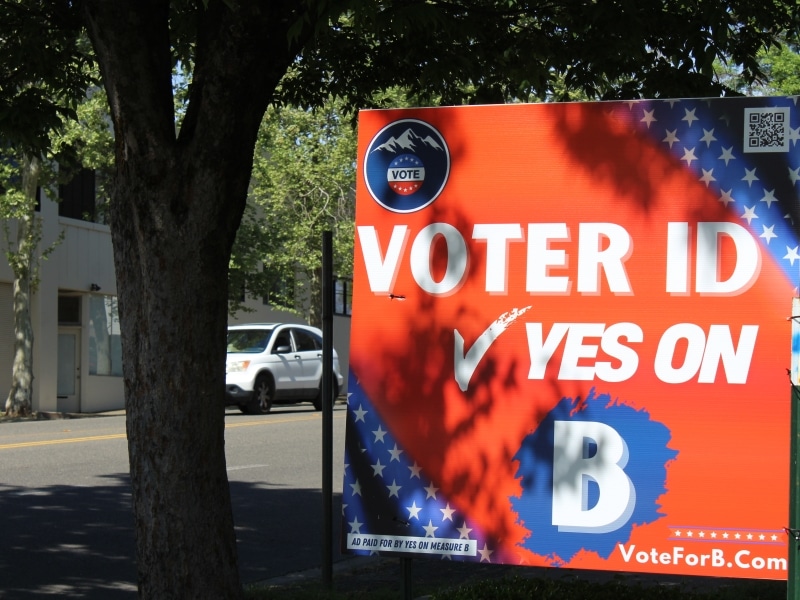
A ballot initiative slated to appear before voters in June continues to face legal pushback. The initiative, if passed by voters, would change Shasta’s election laws in ways that violate current state election law. A recent legal filing alleges that Measure B never received enough signatures to appear on ballots at all.
When Phetakhom Tu Manivong was arrested in 2022, Redding Police officers posted on the department’s Facebook page, claiming he had committed a heinous crime. After being found not guilty by a jury of his peers, Manivong has filed a lawsuit against the city alleging that RPD’s false statement followed him for years, ruining his career and his reputation.


Need to fix the Prop 13 loophole that lets corporate owners get around ‘sale’ of RE by simply substituting shares (no legal change of deeded owner, but just stock being transferred to new buyers,) Prop 13 is a lifesaver for private citizens who stay in their homes as they age, but corporations have completely put themselves out of reach of reassessment by this ruse. Stupid voters didn’t allow the ballot proposal to fix this to go through last election. If sold RE that corporately owned were properly reassessed, there would be no outrageous use fees required. It’s that big a deal.
I speak as a former Deputy Assessor for a small county and a former RE Broker who had family members directly affected by this tax relief, and I benefit from it myself now at 80+ years of age.
I
thats a good thing to void the impack fees just another rip off .
they can’t justify those fees because on Hilltop dr the roads are good .
and one business fees were 100,000 .
I glad the cut them out .
Now they need to cancelled the fees the health dept charges outrageous .
Eliminating impact fees might just be the most reckless and financially irresponsible thing the 3 Stooges have done so far. Foregoing impact fees puts the county in the position of either having to backfill those funds from other sources, or foregoing traffic, fire and other essential services. And why? It’s not like builders have been unable to sell new homes. The cost savings will not get passed along to homebuyers, they’ll go into builders’ pockets. I’m all for them making a profit, but prioritizing their profits over the roads we all share, the infrastructure we all expect to be maintained, and the fire services we all need is the wrong choice for this county.
Thanks for passing this article on.
What is also interesting is supervisor Jones did not recuse himself from voting although he is now a developer of a multi-million dollar project here in Shasta County. But I’m sure Jones believes he is above the law.
Frankly, I believe the three supervisors Jones, Crye and Kelstrom most likely subscribe to the Grover Norquist theory of government, “shrink it until you can drown it in the bathtub.” I asked supervisor Crye if he knew who Norquest was and he said, “Who?” That is the type of neophytes currently running our County at this time.
The question of “impact fees” has long been disputed, both in their necessity and more often with regard to the amounts. Prior to Proposition 13, such fees were rare if they existed at all. Most “required” infrastructure was negotiated at the zoning approval level and then school sites, infrastructure like roads, sidewalks and utility mains were included in the developers’ costs and/or bonded for later repayment by all property owners – NOT just those electing to build new improvements. It is also part of the basic unfairness imposed by Proposition 13 in freezing assessments for existing older properties while fully assessing new properties at current market values. The “welcome stranger” approach now results in horrific discrimination in the taxation of new or newly acquired properties versus existing old and those under long standing ownership. The later quirks include the ability to carry Prop. 13 assessments from property to property and no distinction made when corporations simply exchange stock and not ownership deeds. As a result of a rapid inflation from say 1990 to 2024, costs for infrastructure improvements and maintenance have skyrocketed everywhere, yet the wide variation in development fees has no rational basis from jurisdiction to jurisdiction.
And now, the Shasta County Board of Supervisors has rolled back impact fees to zero! Where will the funds for new infrastructure and maintenance come from? The general property tax, of course. Is that what people want, knowing they will all now have to dig deeper or neglect fixes and improvements altogether?
This is just one in a laundry list of bad decisions this board has made. Crye is the king of 💩 financial decisions, as evidenced by personal bankruptcy and investigation by the FPPC. He’s not the guy that should be making financial decisions for over 100,000 people.