
Tippin Responds To Community Concerns About Populous’ Proposed Role In Updating Redding’s Riverfront Plan
Redding’s City Manager answers Shasta Scout’s questions about how the City is navigating trust, transparency, stakeholder involvement, and a potential conflict of interest as it looks to update the City’s plan for riverfront land use.
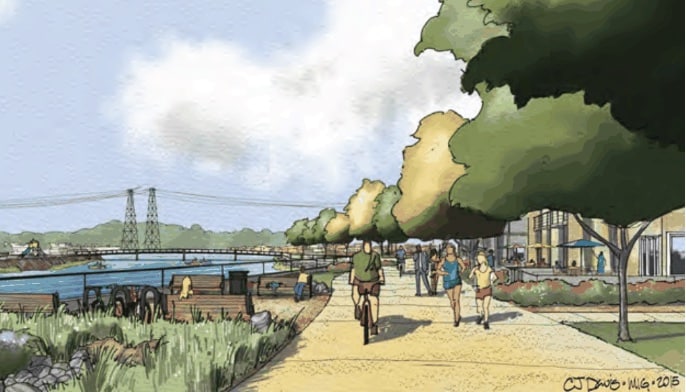
On Tuesday, February 7, the Redding City Council will consider approving a proposal by the national planning and design firm MIG to lead the process of updating Redding’s Riverfront Specific Plan. Tippin has confirmed that MIG hopes to work with Kansas City-based architectural design firm Populous, Inc. as a subcontractor in the project.
Populous is well known by many in the Redding Community as part of a collaboration of developers and nonprofits that submitted a proposal to buy and develop approximately 200 acres of prime public land at the Redding riverfront in the fall of 2021.
Now Populous hopes to help facilitate an update to the Riverfront Specific Plan, a city document that provides specifics on how land can be used within a riverfront area of Redding that includes approximately 500 acres around the Sundial Bridge and Park Marina Drive.
MIG’s proposal indicates that Populous will be involved in all aspects of stakeholder and community engagement for the Riverfront Plan update and will specifically lead planning and design for Redding’s Northern Riverfront Area, which includes the Redding Rodeo and Civic Auditorium grounds.
Environmental advocates and others in the community are mobilizing to provide public comment about at Tuesday’s Council meeting. Some worry that MIG’s contract with the City may lead to the same concerns about development that ultimately shut down the riverfront land deal Populous was involved with in 2021 and 2022.
In response to community concerns, we reached out to Redding City Manager Barry Tippin. We’ve provided our questions and his lightly edited answers, below, along with a link to all three proposals for the Riverfront Plan update, including MIG’s.
Scout: “What would you say to community members who feel the involvement of Populous in a planning project the Council voted last year to put back into the hands of the people, is a ‘bait and switch’?”
Tippin: “I understand the sentiment, but it’s a misunderstanding of what the role of Populous would have been then and what it is now.
“The important thing to know is that Populous, as far as I’m told by Populous Partner Michael Lockwood, was never a capital investor in the plan to buy and develop Redding Riverfront land.
“Back then, Populous was simply a consultant for K-2 Development and the McConnell Foundation that would have been hired to do the master planning for the project.
“Populous did not have any anticipated investment in a deal to buy Redding riverfront land. They are not developers and have never been developers, they’re simply a planning consultant.
“It’s also important to remember is that in this proposal, Populous is a subcontractor to MIG. Our contract will be with MIG, not with Populous.”
Scout: “Why did the Council’s staff report include so little information about the current and former role of Populous in the riverfront land development process?”
Tippin: “I understand the criticism. But if you look back, every single contract award that we’ve ever done has also not included the RFPs in the agenda packets. It’s not standard operating procedure for us to include them. And it didn’t seem like something we needed to do this time either. As you know they’re large files, they’re very technical. Most people would not follow through with all of the details being provided in that proposal.”
Scout: “Do you think the community has enough trust for the City to be able to successfully work on riverfront land design with Populous after public concerns about the Redding riverfront land deal last year?”
Tippin: “I can’t speak to what people will or won’t trust. I think you said it well when you mentioned earlier that the will of the people and the will of the Council was to have this project be done under the City’s leadership.
“The city was authorized to go out and advertise this project and hire the best consultant and ask the City Council to approve that proposal for the future master planning of this area. We’re recommending that the Council choose MIG. They have put forth the best proposal and they also offered the cheapest price, by the way.
“Our expert staff have reviewed the proposal and determined that MIG is the best firm to do this work for us. And if their chosen they will do the work under contract with the City and under the purview of the City Council. If we can’t trust that then I don’t know where we go next.”
Scout: “A staff report for the contract says staff from a number of City departments selected MIG’s proposal. Which staff were involved?”
Tippin: “The people on staff who reviewed the proposals and selected MIG as the best of the three were Amber Kelley from Public Works, Janelle Galbraith from the City Manager’s office, Vishnu Krishnan from the Planning Department, Jeremy Pagan our Director of Development Services, and Kim Niemer our Community Services Director. Lily Toy who manages the Planning Department was invited but was not available.”
Scout: “The staff report includes information about the City’s goals for the riverfront area, including a focus on tourism and development. How were those goals chosen?”
Tippin: “We actually had City Council approve them, which was a step outside of our normal process. Most of the time, we would make an RFP and submit it out. But in this case, because of community concern, we actually took the RFP to the council for approval before we took it to the street.
“I would hate to think that because of some misunderstandings that the city of Redding would be eliminated from the ability to utilize the expertise of a firm like Populous. I think that would be a shame, frankly.”
Scout: “The City’s staff report says MIG’s bid was lowest. How much were the other bids?”
Tippin: “All three proposals were very close to $1.25 million which was the amount allocated by City Council for the project. It’s important to remember that this us not a low-bid award; we chose MIG because they’re the most qualified.”
Scout: “Why are MIG’s contract specifics, particularly about how the community will be involved, being delegated to you instead of being approved by the Council?”
Tippin: “It’s pretty common to do business this way. There’s times when we have the contract buttoned up and ready to go with all the details in place. But when we don’t, we ask permission for a staff member to negotiate the details. Council may ask for specifics and they can certainly do so and have us bring this back to another meeting. Delegating the specifics just expedites the process.”
Scout: “If MIG and subcontractor Populous win this bid, could Populous still be involved in a land deal with local partners later or would that be a conflict of interest?”
Tippin: “The last time I talked to Populous — and I plan to talk to them again before the meeting — they had no interest in being a partner in any land development. They are a consulting firm, not a developer.
“If in the future we have a master plan and there’s a developer involved and the developer wants to hire Populous or MIG or anyone else, they’d be hiring those organizations with private money. So there’s no restrictions on that and no conflict of interest.”
Scout: “The Riverfront Plan went out to bid because staff didn’t have the expertise to manage it, according to city documents. Why does the city have the capability of managing the General Plan update but not the Riverfront Plan update?”
“Well we’re doing a lot, so staff resources are a problem. But also, it’s important to remember that we hired Vishnu (Krishnan) specifically to run our General Plan update. He has the background to do it and he’s helping us take the existing General Plan elements and adjust and modify those for the current times.
“That’s in contrast with the process for the Riverfront Specific Plan, which has to be updated in specific ways, for example, to look at transportation corridors, which we don’t have the expertise on-staff for.
“It’s also important to remember that we do have a consultant contracted to do the Environmental Impact Report for the General Plan, as well as both the traffic and transportation elements of the Plan.”
Scout: “Right now the Redding Riverfront Specific Plan includes about 500 acres at the Redding Riverfront, including the area around Turtle Bay Exploration Park and Park Marina Drive. Could an update change the amount of land that the Plan covers?”
Tippin: “It could. The Council could expand or contract the area covered by the Plan. The Council always has the ability to do that. You’ll remember, with the recent update to the Downtown Specific Plan, the Council moved the boundaries from what staff recommended. The Planning Commission could recommend changes to the land area, or input from the public could lead to changes. I don’t expect changes, but you may note we did already change the boundaries so that they no longer include Turtle Bay East.”
Scout: “How will the Redding Planning Commission be involved in the update to the Riverfront Plan?”
Tippin: “Any time the City does a specific plan, the Planning Commission will be involved, but we have yet to determine the way they’ll be involved this time. I suspect we’ll have check-ins with the Planning Commission for architectural standards, zoning changes, transportation elements, etc. One of the first things we’ll do with MIG is develop a schedule for Planning Commission involvement.
“But yes, ultimately the Planning Commission will take a look at the Riverfront Plan update before the Council will and would decide whether to recommend it to the Council. Ultimately, we need to have an updated Riverfront Plan that’s not only what the community has asked for but one that the Planning Commission endorses.
“And we’ll want ample community input along the way, with all stakeholders involved.”
Resources:
Author

Related Articles
ROV Curtis oversees shredding of 2024 ballots amid activist protest
Several dozen people protested the mandatory shredding of 2024 ballots at the election office today. Amid the chaos, election official Clint Curtis supervised the proceedings with his signature cheerfulness.
Shasta County risks litigation after attempting to shield federal subpoena
The First Amendment Coalition has issued a legal demand on Shasta Scout’s behalf in an attempt to compel disclosure of a federal grand jury subpoena under public records law. A board meeting to discuss anticipated litigation is scheduled for Monday.

Meet Christina Prosperi for Redding City Council
There are nine candidates running for three seats on the council. Prosperi is a local business owner who wants to focus on the city’s budget, filling top leadership positions, collaboration within the council and staff morale.