
Using Suspects’ Faces, RPD Weaves Compellingly Pro-Police Narratives. It’s a Practice that’s Known to Cause Harm.
The Redding Police Department regularly issues social media “news releases” about suspects that have been arrested. Shasta Scout’s analysis showed the social media posts do more to boost RPD’s image than increase public safety.
For this story, Shasta Scout reviewed more than 600 RPD social media postings shared over the last three years. While we’ve chosen to highlight only a single post it represents many hundreds more.
In the wee hours of the morning on October 2022, Sergeant Aaron Hollemon prepared a post for the Redding Police Department’s (RPD) official Facebook page, drafting a story that detailed the events of his night patrol. His 634-word caption included references to two arrests which occurred within a three mile radius. The hero? A German Shepherd named Otto, who serves alongside police officers as part of the Department’s K9 unit.
OTTO’S BUSY NIGHT, as Holleman titled his post, followed the actions of a much-beloved crime-fighting dog as he apprehended two suspects in separate incidents just hours apart. His story also includes two alleged villains, 51-year-old Rafael Zendejas and 34-year-old Travis McLaughlin. Both were subdued by Otto through the use of “less than lethal force,” as Hollemon put it, in the process of their separate arrests that night.
As told in OTTO’S BUSY NIGHT, Zendejas was arrested for allegedly pelting rocks at the windows of both a 99 Cents Only Store and Ross Dress for Less, shattering them. McLaughlin, according to the same post, had allegedly set off an alarm at the Trilogy Architecture and Design offices–coincidentally the same workspace out of which Shasta Scout now operates. Neither were compliant with responding officers, Hollemon wrote.
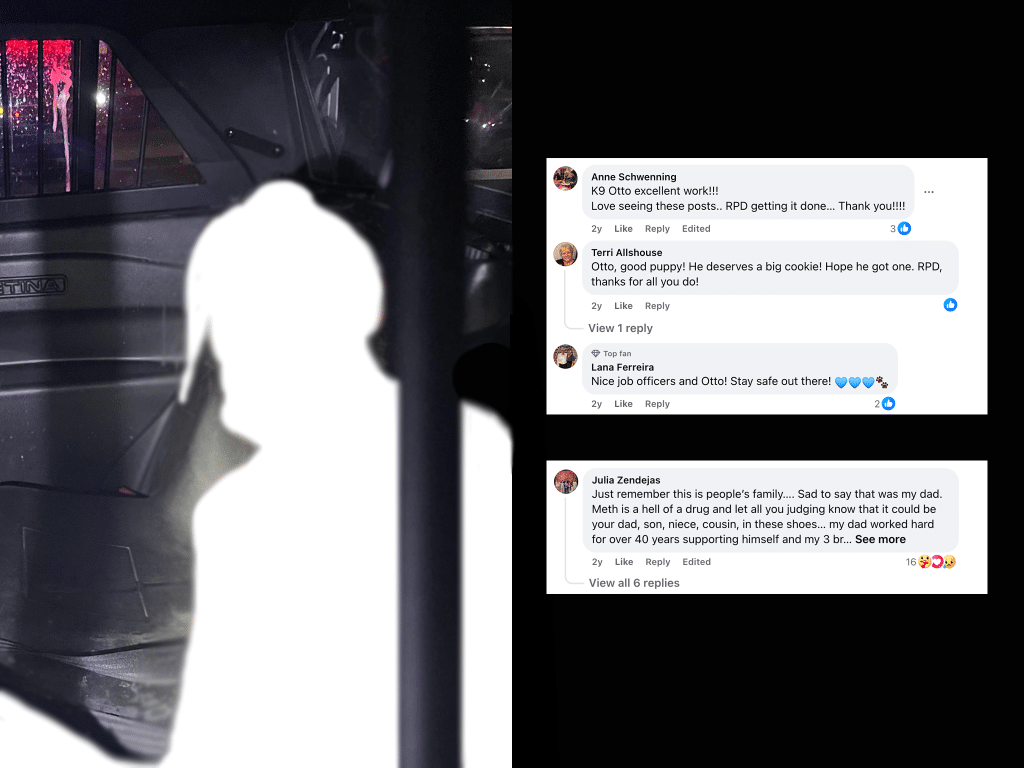
After their arrests, police took the men to a nearby hospital for medical care. Photographs taken by RPD throughout the process document a journey in pictures from crime scene to Emergency Room: a spray of broken glass, Zendejas teetering in the back of a squad car illuminated only by a camera’s hard flash in the dark, the back entrance of the building where a security siren tore through the night after McLaughlin allegedly tried to force the door open, and Otto, the hero of the narrative, staring blankly at the camera.
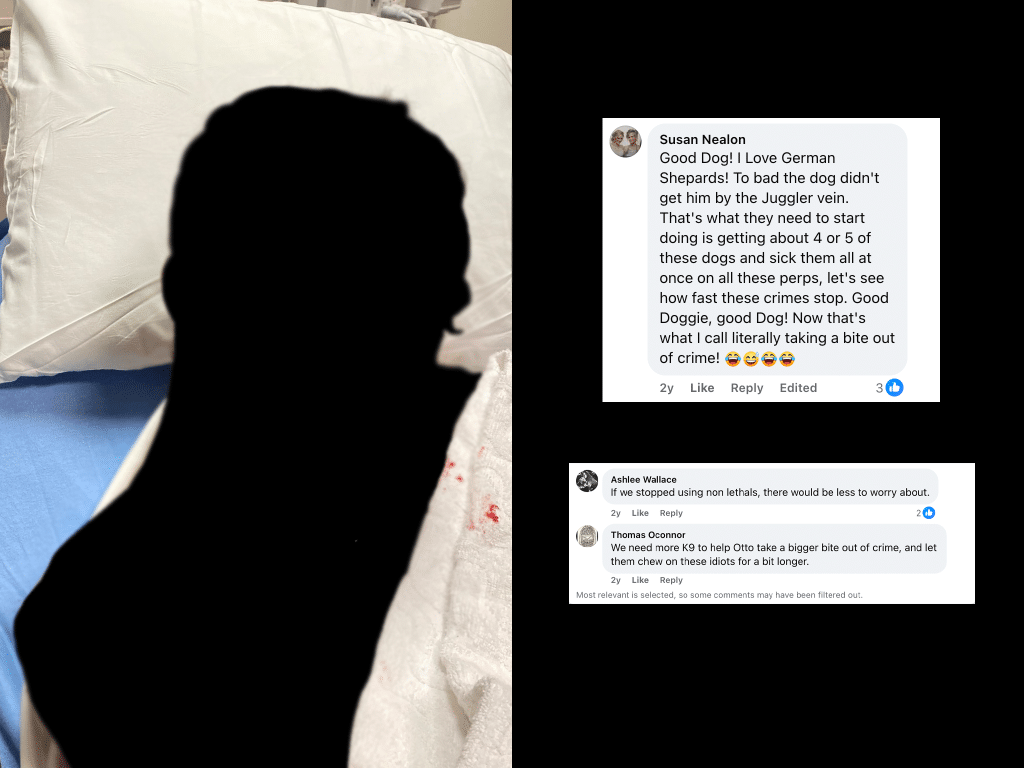
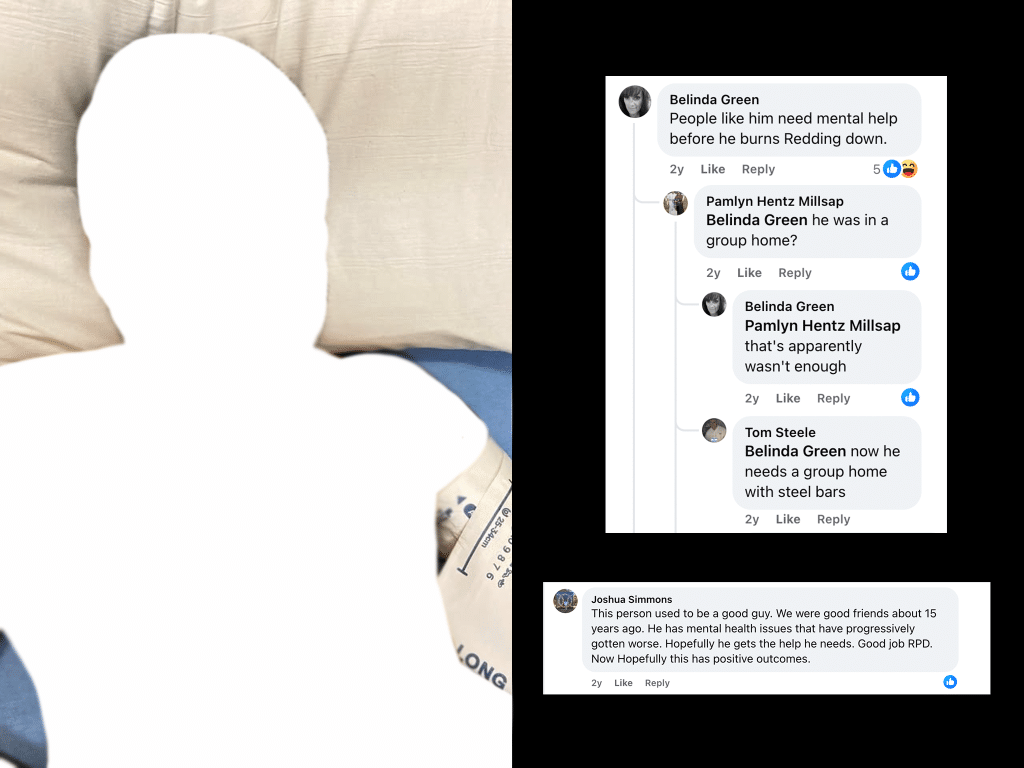
From what can be seen in the photos of the suspects, Zendejas–gaunt, bearded, physically restrained on a hospital bed, and dampened with some kind of clear liquid–bore no visible signs of injury. McLaughlin, on the other hand, arrived at the hospital peppered with inflamed puncture wounds, each the shape of a dog’s incisor. Scabs crusted around the rim of his nostrils, while splotches of bright red blood, fresh and not yet oxidized, speckled his blanket and pillow. In the photo, McLaughlin looks away from the policeman’s lens. Peering out of the frame now, more than two years later, he still wears the unmistakable look of anguish on his face.
In the caption, RPD named McLaughlin as a registered sex offender and parolee, stating plainly that a police “investigation revealed that McLaughlin had entered the office through the unsecured front door with the apparent intent to commit a burglary.” Similarly, Hollemon wrote, “the investigation revealed that Zendejas had shattered or damaged a total of six windows.”
The wording of the social media post makes the leap for the public between evidence gathered in the course of RPD’s investigation (broken windows and a suspect nearby) and a suspect’s actual guilt, which can only be determined by a jury of the accused’s peers, under the assumption that they are innocent until proven guilty.
OTTO’S BUSY NIGHT remains one of RPD’s most viral posts. “Hopefully you got big treats from Daddy,” commented one follower, “Hope the canine got a good bite in before he was done,” wrote another. Hundreds of people liked, shared, and commented on the “arrest story,” unperturbed by the bloodstained pillowcase, wet shadow on the hospital bedsheets, or any of the other sordid details that still lurk in the corners of RPD’s photos from that night.
But there are members of the public for whom these images of suspects mean something completely different, people who know intimately that any arrest story is more complicated than a simple struggle between good and evil. Amidst a mob of gleeful comments praising Otto the German Shepherd for his “busy night,” someone who identified themselves as Zendejas’ daughter, Julia, commented the following:
“Just remember this is people’s family…. Sad to say that was my dad. Meth is a hell of a drug and let all you judging know that it could be your dad, son, niece, cousin, in these shoes… my dad worked hard for over 40 years supporting himself and my 3 brothers but after struggling his whole life with this, drugs have finally won. Mental health and who (he is) will never be the same. We’ve tried to get him help. Anyone of you who may claim to be religious while judging, please say a prayer for the families instead. This is all I will say. Thank you.”
OTTO’S BUSY NIGHT is just one of the numerous stories from the field that RPD shares with social media followers every week, sometimes multiple times in a single day. Categorized as “news releases,” the Department’s social media postings take the public on virtual ride-alongs to witness action–packed scenes of “crime fighting” that seemingly pervade the City of Redding.
In an email conversation with Shasta Scout, RPD Chief Brian Barner described the social media posts as “arrest stories,” saying they are an important part of the Department’s larger social media strategy which is used to communicate “all the positive work being done by our Department to make our community better.”
In a City with a population of only about 90,000, the Department boasts more than 51,000 Facebook followers. That’s a following second in the North State only to KRCR, Chief Barner said. The Department’s social media following aptly demonstrates the ability of law enforcement agencies to amplify their own narratives of justice with the use of public funds.
It’s a power that California’s legal system has responded to, putting up guardrails out of concern for the affect such postings can have on those who are so far only suspected of a crime. In 2021, California passed Assembly Bill 1475, which prohibits local police from indiscriminately posting photos of suspects, specifically “booking photos” or mugshots as they’re more commonly known.
AB 1475 permits an important exception: agencies may publish booking photos when doing so is needed due to an “urgent and legitimate law enforcement interest” such as a missing person or a violent suspect on the loose.
The Letter of the Law
While reporting this story, Shasta Scout reviewed 626 of RPD’s social media posts over the last three years, comparing the Department’s feed over a timeline spanning back to the implementation of the bill, against the stated intent of AB 1475.
Those posts were sorted between violent charges and nonviolent charges, as defined by California’s Penal Code and then reviewed using a simple methodology: if these were booking photos rather than arrest photos, would this be legal? In at least 269 cases, the photos would not comply with AB 1475 if they were booking images rather than arrest images, because the suspects posed no threat to the public at the time that their photos were disseminated, and because they were arrested on nonviolent charges such as vandalism, retail theft, or drug possession.
Shasta Scout’s analysis shows the Department has been complying with AB 1475, in its most technical interpretation, since the law was passed. But it also shows the Department using a clear and careful workaround: a policy that complies with the law by prohibiting the posting of booking photos on social media while endorsing the use of arrest photos in the very same way, instead.
While RPD’s policy seems to maintain adherence to the law only on a technicality, RPD Chief Barner stands strongly behind his Department’s practice. Emphasizing that AB 1475 “is clearly defined as booking photos,” Barner said he does not believe the use of arrest photos violates the law’s intent.
But it’s clear from RPD’s social media posts that arrest photos tell stories far more vivid than the legally prohibited mugshot ever could. Evoking the narration of a county prosecutor, RPD’s photo captions provide compelling narration to a wide-ranging and unselected jury of netizens. Usually accompanied by images of either alleged evidence or the alleged crime scene (sometimes the interiors of suspects’ private homes), RPD’s “news releases” often prime followers to arrive at a foregone conclusion of the suspect’s guilt.
As to how such images might impact actual juries, the Shasta County District Attorney, Stephanie Bridgett, told Shasta Scout she doesn’t know whether previous exposure to RPD’s social media postings has been an issue in the past.
“Every case is unique and the topic of pre-trial publicity does come up at times but we don’t have an accurate ability to know if that specific question has ever been posed in jury selection,” wrote DA Stephanie Bridgett, by email.
A Permanent Stain
During the long hot summer of 2020, a year before AB 1475 was passed, San Francisco’s Police Department (SFPD) made an announcement. Following both local and national demands for police reform in the wake of George Floyd’s death, the agency became one of the first in the nation to ban releasing mugshots–except when necessary to warn the public of danger or help locate someone.
Prior to the new policy, precincts around California had made a habit of circulating booking photos, leaving a trail of images which can remain online well beyond a prison sentence. The change was informed by research and input from academics, journalists, attorneys, community groups, and public safety sources which showed that disseminating photos of suspects has two primary effects on the public.
First, that mugshots of Black and Brown suspects perpetuate the illusion that communities of color are predisposed to criminality. That’s particularly relevant because data shows that Black Americans are seven times more likely to be wrongfully convicted of a crime than White Americans. And second, that releasing a booking photo of a suspect (regardless of their race) undermines what SFPD’s chief called “a core principle of procedural justice,” the presumption of innocence.
A year later, state law would catch up to SFPD’s landmark policy reform when AB 1475 was passed.
“The presumption of innocence is such a fragile thing,” said Sam Jacobs, a legal scholar and adjunct professor at UC Berkeley’s School of Law, who spoke to Shasta Scout by phone for this story. “It is for this reason that (AB 1475) is very clear that there has to be some sort of compelling interest” to release suspect photos publicly.
Jacobs’ work has focused on the power of narrative storytelling in the prosecutorial trial process. For this story, Shasta Scout sent Jacobs three typical examples of RPD posts detailing suspects, arrested in separate incidents on charges of retail theft, evading police, and burglary.
In response, Jacobs said that any “compelling state interest” of public safety was “absolutely absent” in the arrest stories she reviewed because the images showed people already in custody.
In her assessment, Jacobs said, RPD’s practice is “just completely running afoul of the spirit of the law.”
From Timeline to Headline
Only a sliver of suspects taken into custody ever make it to fame on RPD’s social media pages, according to Chief Barner, who cited the Department’s more than 11,000 arrests last year for comparison. He explained that it’s up to the discretion of the social media team and/or supervisors what gets posted.
In addition to arrest stories, RPD also posts photos of road closures, officer trainings, public engagement, and so-called “sweeps” of encampments during which unsheltered people’s belongings are confiscated and disposed of.
The comment sections on RPD social media posts are used as a lively public forum by the community. Most comments provide general praise for the Department’s work, but some community members take the opportunity to hurl insults at arrestees on the basis of their appearance or body image, or wish physical harm upon the accused. On posts of people of color, commenters have also scrutinized the subjects’ racial backgrounds, names, or perceived immigration statuses. In some, RPD staff chime in with their own jokes replying to public commenters.
The Department does not have a separate budget for social media work or track the exact amount of time officers spend creating posts, RPD staff told Shasta Scout in response to a records request. But Chief Barner estimates that his team allocates about five hours per week to social media posting, utilizing extra time while already on duty. He said there are a total of 23 staff members, both sworn and unsworn, who contribute to RPD’s accounts.
Stories are selected for social media, Barner said, to reflect “what the community is interested in seeing,” including so-called “quality-of-life type issues” such as DUIs and retail theft as well as weapon and drug violations. The Department’s social media strategy, Barner said, is consistent with RPD’s “community policing” model and overall mission of “working in partnership with the community to protect people and property, solve neighborhood issues, and improve the quality of life in Redding.”
When asked how “arrest stories” keep the public safer, Chief Barner called his Department’s postings an “excellent use of public safety funds,” that the community “uses to stay informed.”

Some reporters also utilize the Department’s social media postings, parroting RPD’s “arrest stories” almost word-for-word as they work to quickly publish brief crime stories. In the case of McLaughlin, the same image of his tattered face appeared on KRCR a mere eight hours after McLaughlin’s arrest on October 9, 2022, accompanied by words nearly-identical to Hollemon’s Facebook caption.
This pipeline between police communications and local media outlets is nothing new. Prior to the passage of AB 1475, it was common practice for news organizations to use mugshots and information released by various police departments as fodder for stories.
That’s changed as many media organizations have strengthened ethical standards. In response to SFPD’s policy change in 2020, newsrooms from The Houston Chronicle to the Sacramento Bee began officially limiting their own use of mugshots–citing many of the same reasons that would soon be outlined in the law. One exception is body cam footage which the Bee continues to publish, the newspaper said in a 2020 announcement, as a means to “hold those in positions of power accountable.”
The titillating details of high-drama arrests are common fodder for local media but it’s rare for either the news or RPD to follow up by providing the public with the rest of the story. However it’s important to note that the legal process for Holleman’s two alleged villains did not end on OTTO’S BUSY NIGHT.
McLaughlin received 32 months in state prison for one felony count of resisting the police, paired with a former strike. Zendejas pled guilty to two counts of felony vandalism and served two days in jail and two years on supervised probation.
Do you have a correction to share? Email us: editor@shastascout.org.
Related Articles
Redding has eliminated more than a dozen vacant police and fire positions and will close Fire Station 3
The changes were made to increase city savings amidst a struggling budget. Council members were united on fire department changes, but two were opposed to some of the police department cuts.

Meet Madison Zimmerman for Shasta County Office of Education Trustee
Madison Zimmerman is running for one of seven seats on SCOE. She refers to herself as a proud product of Shasta County Schools and plans to bring her skills developed both inside and outside of the county to expand opportunities for students to thrive here in Shasta.
Accountability vs. micromanagement: Shasta board debates its role during wide-ranging discussion
Supervisor Matt Plummer was accused of micromanagement for asking for data in response to an assessment of fire services. Meanwhile, Supervisor Kevin Crye spent nearly thirty minutes questioning a decision by the HHSA director with no such accusation sent his way.