
“We Don’t Count As Community To Them”: Unhoused Shasta County People Share Their Challenges And Some Solutions
Shasta County’s affordable housing and emergency shelter crisis has spurred serious community discussions about how to respond to the needs of the region’s growing unhoused community. Community Voices writer Alissa Johnson and others in the unhoused community respond to reader questions about the causes of homelessness and the solutions they’d like to see the community pursue.
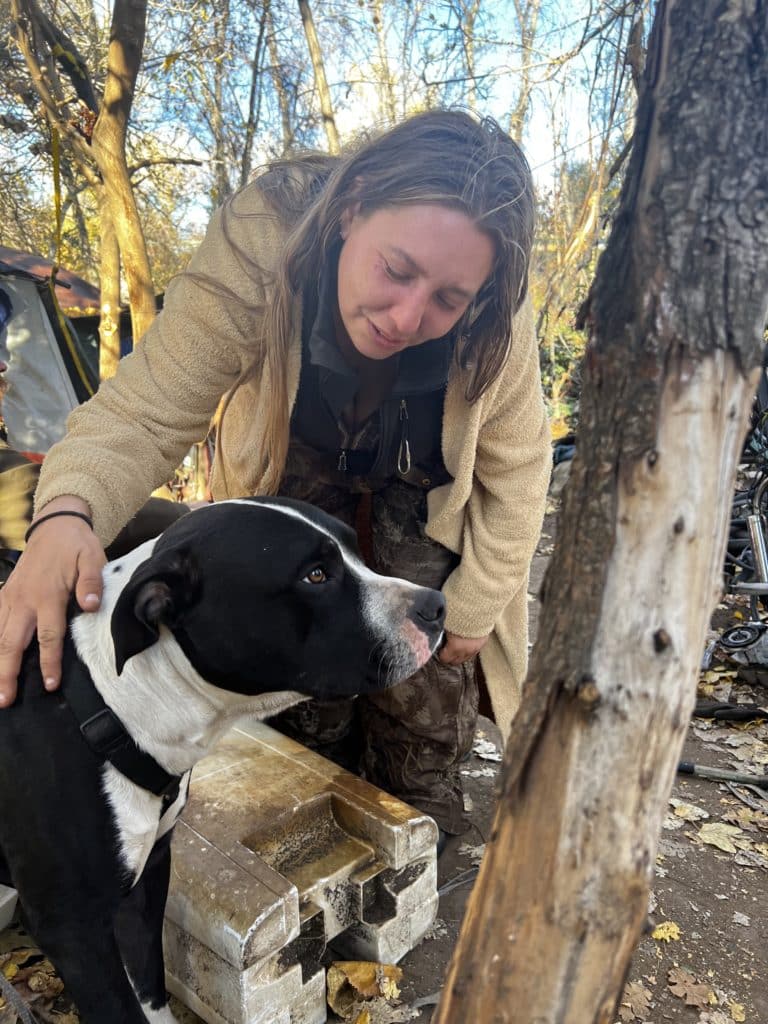
After Alissa Johnson wrote about her lived experiences as a member of Shasta County’s unhoused community, readers reached out with questions.
Noting that the experiences of unhoused people vary significantly, Alissa advocated for Shasta Scout to publish not only her responses but those of others in her community.
We worked with Alissa to interview half a dozen unhoused community members outside the Redding Library and in a Redding camp. The first names, photos and stories of those we met are shared with their consent.
Here are some of the questions you asked, and what we learned.
What Causes Homelessness in Shasta County?
Most unhoused community members we spoke with said they’re homeless because they cannot afford the cost of housing on a limited income.
Ron, who became homeless as an older adult after his parents passed away, said his Social Security income of around $1000 per month isn’t enough to afford even a local studio apartment. He would also face a challenge getting approved, he said, because landlords usually require income equal to three times the monthly rent.
While Ron recently received a HUD voucher that he hopes he may find a way to use, he’s concerned about the $35 per application he’ll have to pay each time he applies. And he’s heard even with the voucher it’s hard to finding housing.
Chris, another community member, says he became homeless after he split up with his girlfriend. On his own, he said, his credit score wasn’t high enough to allow him to rent.
“We moved out of our place, and I didn’t have a high enough credit score to rent a place even though I could have paid six months’ rent up front. I couldn’t find a place and hotels were getting too expensive. So I just said ‘Screw it, I’ll go to the Mission’, and I just ended up here (on the streets).”

Timothy, who said his disability income is too low to allow him to afford housing, explained that he became homeless when he experienced conflict with the local family members he used to stay with.
He said that while people lose access to housing for unique reasons, there are consistent categories. Many lose housing due to family issues, he said, including the aftermath of divorce. But while the reasons for homelessness vary, what happens next is often the same, Timothy continued, turning to substance use to help quiet the ever-present hopelessness.
“Then they turn to alcohol, they turn to drugs,” Timothy explained. “You try to make the best of it. I mean everybody gets depressed. Some people ask if you’ve ever thought about suicide. I wouldn’t admit it, but everyone has. I mean, you feel like, man, what kind of future do I have?”
What Challenges do Redding’s Unhoused Community Members Face?
Those we spoke with felt their most significant challenges right now are conflicts with local police, whose actions, they said, often feel like harassment.
Chris said he’s been told by the police to stay out of sight so he will stay off their mind and that’s what he tries to do.
Timothy said in the past police used to be able to respect people in the camps but recently things have changed.
“They’re moving people around, saying ‘you can’t do this.’ and they’ll take people’s tents and their belongings, which I feel is not right at all. . . If I were to go into your home and start throwing stuff in the dumpster, I’d be breaking the law.”
Under the decision in the court case Martin v. Boise, local police cannot prosecute unhoused people for sleeping outdoors unless there are viable low-barrier shelter options. But the police can and do regularly remove unhoused community members from where they’re sheltering.
Before displacing unhoused people, the Redding police use a process known as “red tagging” where they mark the site with a document showing the date when they may return to clear the space of people or possessions.
In August, the City of Redding cleared Nur Pon Open Space off Cypress Avenue in Redding, displacing a significant number of unhoused community members who used to shelter there. Since then, the numbers of unhoused people visible in other parts of the community, including the area under the Cypress Bridge and close to the old Movies 8, both on Park Marina Drive, have increased.
A local community service agency outreach worker who asked not to be named because they fear community retaliation, confirmed for Shasta Scout that each time the police conduct a “sweep,” it disrupts the tenuous social networks that unhoused community members form for safety and community. That makes outreach workers job of finding specific members of the unhoused community to provide resources, much more difficult, they said.
Police disruptions of camps also disconnect unhoused community members from their medication and other belongings, the community worker said, increasing health and safety risks and medical costs.
How do Unhoused People View the Redding Police Department’s Crisis Intervention Team (CIRT)?
Alissa said while she’s heard some good things about the Redding Police Department’s Crisis Intervention Response Team, or CIRT, she and many others in the unhoused community can’t help but be very cautious of the police.
“Cops cause more damage to people in poverty than they help,” Alissa said. “After so many years of getting targeted by the police, asking us to trust the police feels wrong.”
She doesn’t believe the police should be involved in housing issues at all, she said, especially since neither the city nor county actually offer any low-barrier shelter options.
Alissa is currently working her way through the process of responding to a misdemeanor citation for sleeping outside. She says she doesn’t appreciate that Redding police officers are still treating those in her community like criminals just for sleeping, just for trying, she says, to exist.
“I like to avoid people who seem eager to treat me like I’m a criminal, and could possibly shoot me. And I think that is an agreeable thought process for many intersections of the marginalized,” Alissa said.
“I will almost always think there are many better options than the police, but if a safer relationship with the police is possible, I want to see that.”
But, she added, “I also want to see the police and people in general stop hiding behind the word “criminal” to come after the poorest people’s makeshift shelters.”
What Solutions Do Unhoused Community Members Want?
Of those we spoke with, most suggested that the community should start by listening to everyone affected by homelessness, including the unhoused themselves.
Timothy put it this way: “If you don’t have communication between both sides, you get nowhere. And that’s what has been happening. . . They’re getting feedback from the community but we don’t count as community to them. . . The people who are in charge, most of them are people that have never had to live in a situation where you’re treading water and don’t know what to do.”
Alissa agreed: “So far (decision-makers) hardly interact directly with any of us . . . It seems like the people of this community have a mentality that we should just be thankful to suffer.”
Instead of ignoring the voices of those most affected by homelessness, Timothy continued, the city could put out flyers encouraging unhoused residents to meet up at specific time and place. City leaders could then commit to attending and listening to the unhoused community, recording their responses and even hearing their votes on the ideas that are generated.
That kind of stakeholder input, Timothy said, could be used to help generate real, workable solutions.
He and others agreed that any housing solutions must require rules. But they also said that the rules should be developed, implemented and enforced with the participation of the community members themselves.
An inclusive process is one of the reasons Alissa strongly supports the new micro shelters that United Way and the City of Redding are partnering to put in place downtown on Mark Street. She says she sees that project as respectful to the voices of unhoused people.
“We the homeless have a hand in making the decisions,” Alissa said, “on the supports and the community we want to build together there.”
The community outreach worker we spoke with said they know from their own lived experience outside that the local unsheltered community needs access to several areas of public land that include space to camp, bathroom facilities, running water, and regular trash pickup.
Alissa said she’d welcome that solution, especially if the properties included fencing to help reduce nighttime theft.
“Water and trash pickup is awesome,” she added, “ because it makes it simpler for us. Electricity is helpful. I have various items like an electric hotpot, air fryer, and a tiny griddle big enough to cook up one egg at a time. Bathrooms are necessary.”
All that’s good, local unhoused community member Zenobia said, but in addition to safe shelter and community space the community really needs to focus on access to truly affordable housing.
“The rent is crazy . . .” she emphasized. “If you get a job, you have to make like $2500 (with a deposit) to even move to a place.” And, Zenobia added, “Section 8 is giving out vouchers knowing there’s not really much housing.”
Here’s What Else Members of the Unhoused Community Want You To Know:
For Zenobia, who grew up struggling to pay rent by helping her mother clean hotels, the language people use to describe those who lack housing is of central importance.
“We’re not homeless,” she explained, “We’re houseless. People lost their jobs. COVID hit. . . People cannot pay their rent . . Houseless is anybody who was not able to pay their rent. It’s like cancer (it does not discriminate.)”

Timothy says he’s tired of people forgetting that he’s a community member too.
“I’ve paid taxes for many years,” he said. “I pay taxes even though I’m on disability . . .There’s money that comes out of my check before I even see it. . . . Every time I buy groceries, I pay city tax and state tax.”
He also said he and others in the homeless community feel extremely judged and alienated by community hostility.
“Just some of the looks that people give you sometimes,” he said. “They don’t know where I’ve been and how I was raised or the situation I’m in. . . ”
Alissa explained that people like her who have lived for years outside need not just access to affordable housing but supportive services to help make their transition back to indoor living possible.
“ . . . many of us have been outside so long that we’re dysfunctional indoors,” she explained. “We forget how to take care of things . . . we’ve lived in destruction for a long time, and we need people dedicated to our health, people that will give us that extra push.”
Most of all, she said, the larger Shasta County community should get to know those who are unhoused.
“I encourage people to meet us, talk to all of us,” she said. “The stories you’ll learn… I’m not the only brilliant one out here. Many sparkle, but are kept in the dark, so who would know.”
*Note: Alissa Johnson contributed to this news story both by serving as a source of information and by collaborating to facilitate community interviews. She was paid an honorarium for her work. See more about how we report, here.
Related Content:
We, the Autistic People, and We, the Homeless People, Have Dreams Just Like Everyone Else
Authors



Related Articles

Appeal court pauses Shasta judge’s ruling in election ballot measure case
Election staffer Laura Hobbs has successfully appealed a temporary restraining order, allowing a controversial ballot measure she helped champion to move forward. If approved by Shasta voters, the measure would amend the county’s charter to implement local election practices that would violate state and national law.
Flight school official says multiple international students have withdrawn enrollments after Chinese espionage claims by Anderson council member
After advocacy by IASCO Flight Training Operations Manager Miranda Vorhis, the Anderson city council adopted a social media policy Tuesday night. But she said there’s already been measurable harm inflicted upon the school.
Council defers decision on REU rate increases; approves open alcohol containers during Kool April Nights Cruise
The council agreed to honor a request from REU to take more time for more public outreach, given low attendance at recent workshops used to explain the rate increase.