
Wintu people say proposed reforms to a state list of tribes is erasure, threatens their homelands
A state commission’s proposal to remove Wintu and other federally non-recognized tribes from a consultation contact list would leave cultural sites vulnerable to destruction, tribal members say, and represents a form of unconstitutional discrimination.
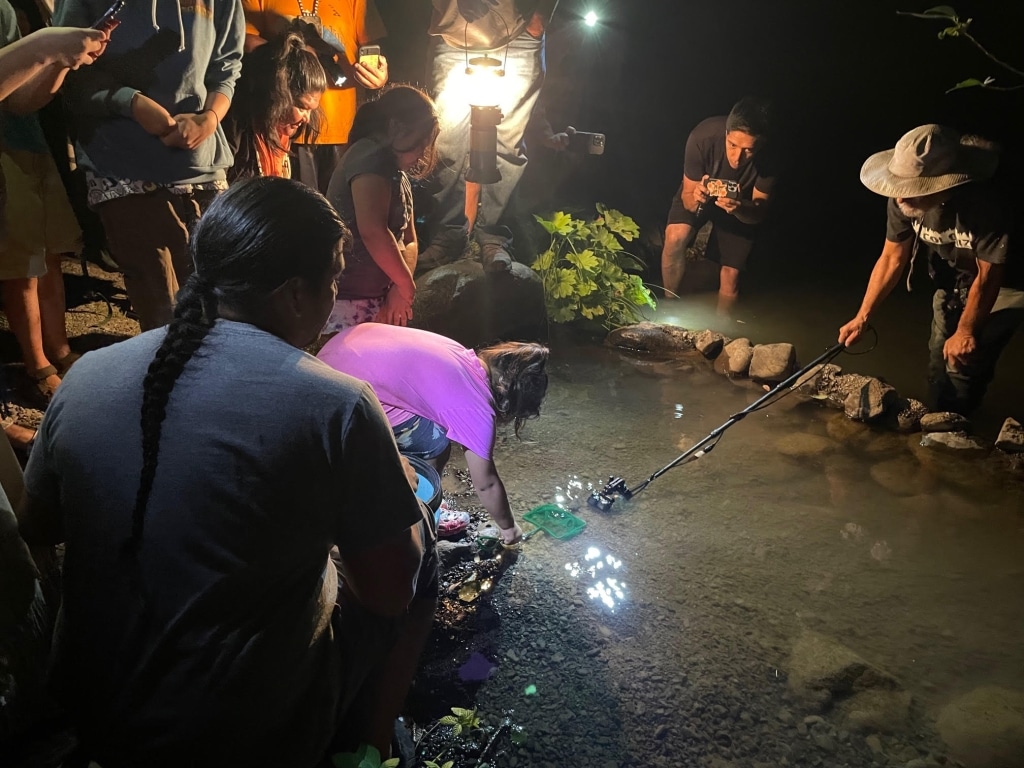
As a Wintu cultural monitor, Shawna Wilson says she always carries her hard hat, clipboard, and tribal ID card in her vehicle because she never knows when she might have to step into her role and stop a construction project.
California law requires that state and local agencies contact the appropriate tribes when they’re planning development projects within their ancestral territories. After a consultation process, agencies often broker agreements with tribes to place cultural monitors like Wilson on construction sites to prevent damage to ancestral village sites, sacred places, cemeteries and other cultural resources.
However, the system doesn’t always work as intended. Even though agencies should consult with tribes long before breaking ground, Wilson says she often learns about construction projects in her Wintu homelands, which includes the Redding area, when she happens to drive past them.
“It can be difficult to navigate when you’re dealing with foremen who don’t want to listen or slow down their work,” said Wilson, a member of the Wintu Tribe of Northern California. “But it’s important we speak up for our lands and ancestors.”
Sometimes her Tribe is left in the dark simply due to poor communication, but Wilson said sometimes public officials falsely believe they don’t have to consult with her Tribe because the Wintu are federally unrecognized.
Wilson and several California tribal leaders say excluding non-recognized tribes, something which currently violates state law, could soon become encoded into California regulations, much to their alarm. A state commission is currently evaluating a proposal that would remove unrecognized tribes, including the Wintu, from an important list agencies use to determine which tribes to consult.
Known as the tribal contact list, it’s been curated by the tribal-led Native American Heritage Commission for 50 years. The list is a valuable resource for public officials because it can be challenging to know which tribe is culturally affiliated to a given place, given the sheer diversity of tribes in California and the sometimes overlapping nature of tribal territorial boundaries. For non-recognized tribes — many of whom suffer from their exclusion from federal Indian funding and legal protections as well as the lack of a land base — the list is a lifeline, one of the few legal avenues they have to advocate for their place-based ways of life, they say.
“It’s going to make the exclusion and silencing we experience now more permanent.” Wilson said.
For this story, Shasta Scout interviewed seven representatives of non-recognized tribes from throughout the state. They all say their removal from the list could leave their territories extremely vulnerable to cultural and environmental destruction. In many cases, tribal representatives said, the nearest recognized tribe that would be consulted for any given project may be some distance away and may also lack the experience and capacity to advocate for homelands that are not their own.
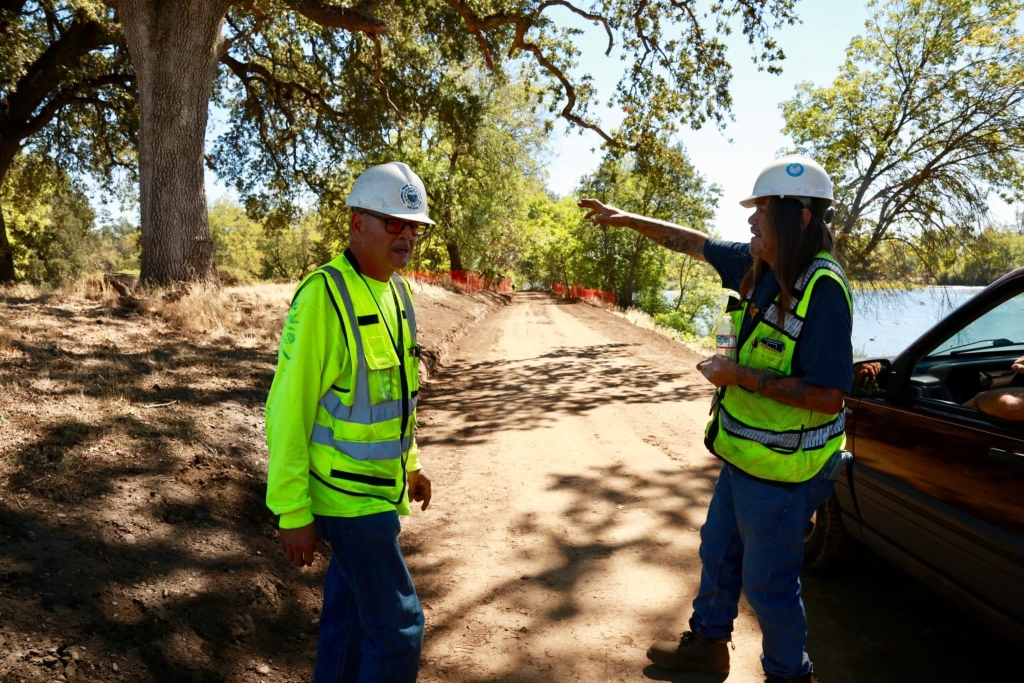
Hereditary Chief Caleen Sisk said her Tribe, the Winnemem Wintu, is the only one qualified to advocate for their ancestral homelands of the McCloud River watershed, where they have been working with government agencies to protect sacred sites, revitalize ceremonies and restore the river’s ecology for decades. For example, the Tribe has spent more than 20 years resisting the Bureau of Reclamation’s raise of Shasta Dam and since 2022 have been working with state and federal agencies to restore salmon to the McCloud.
In part because of the Winnemem Wintu’s advocacy for their river, the State Assembly passed a joint resolution in 2009 urging the federal government to recognize the Tribe. Sisk said she doubted the Redding Rancheria, the closest recognized Tribe that has Wintu members, would have the resources or knowledge to work on the river.
“If we don’t have the right to speak up for our sacred sites, who is going to do that? Other Tribes don’t know where the sacred sites are or know how to protect the river,” Sisk said. “[The proposed regulations] would be opening up thousands of acres of land that will have no one to protect it.”
Cultural monitor Wilson echoed Sisk’s concern that the Rancheria could become the one stop shop for Redding area tribal consultations when they “don’t represent the full Wintu history or all of the Wintu voices.”
Redding Rancheria Chairman Jack Potter noted that his Tribe has regularly written letters for the other Wintu Tribes, supporting their cases for recognition and their inherent Indigenous rights. He added that Redding Rancheria tribal members can empathize with unrecognized Tribes’ struggles today because Congress terminated them as a Tribe in 1959, and it wasn’t until 1983 that the courts restored their sovereign status with the U.S. government.
“We were also without a voice at one time. We honor and respect the entire Wintu country because if we don’t respect all Wintu people ourselves, how can we expect other people to?” he said.
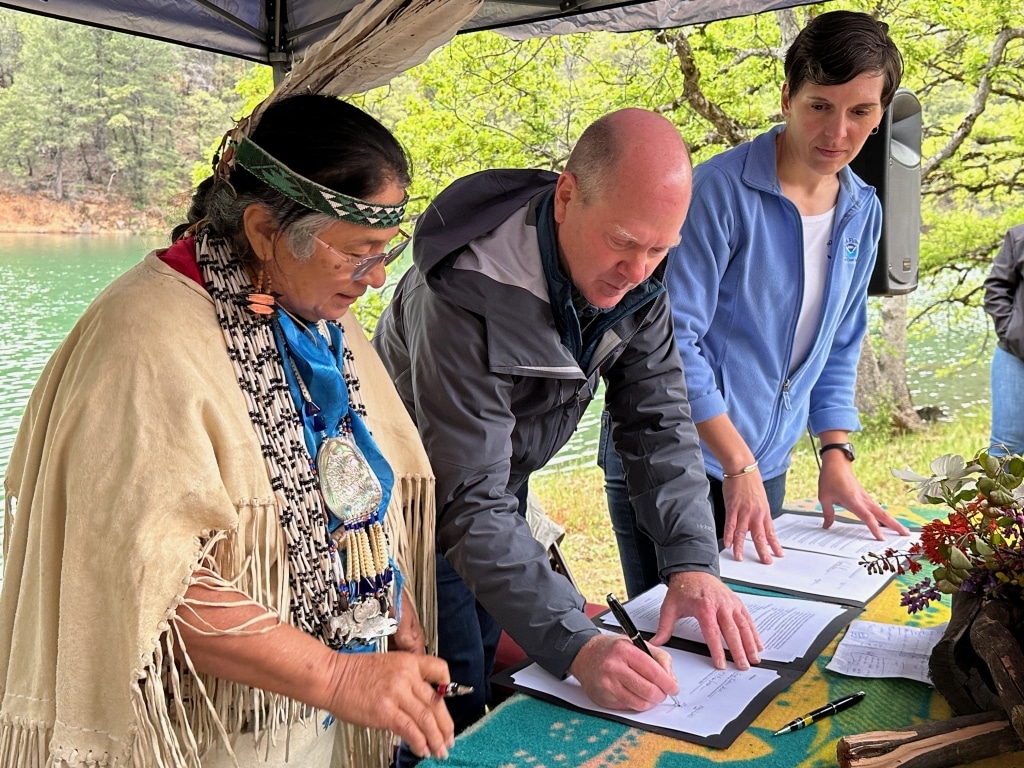
Non-recognized tribes call proposal “administrative erasure”
Under the proposed regulations, the current list would be discarded, and only federally recognized tribes, such as the Redding Rancheria, would stay on the revised list. About 60 non-federally recognized tribes, including three Wintu Tribes whose territories cover parts of Shasta County, would be forced to apply to the commission for consideration to be re-added to the list. The current draft of the regulations indicates that would require extensive documentation and records, and tribal leaders say it would likely be a long and uphill battle to get added back to the list.
When a tribe is federally recognized, it means that the United States has established a government-to-government relationship with a tribe as a sovereign nation, although U.S. law does place some constraints on tribes’ ability to self-govern. Historically this relationship with the U.S. was established primarily by treaties and the establishment of reservations held in trust for tribes by the federal government.
In California, it’s well known that many historical and legitimate tribes lack federal recognition because of systemically oppressive actions by the state and federal governments’. Numerous government studies and academic analyses have concluded that the lack of recognition is rooted in the state’s complex history of unratified treaties, the impacts of the Spanish Missions — which fragmented many tribal societies through enslavement and high death tolls — and the devastating state-led campaigns of genocide and removals that accompanied 19th century Euro-American settlement.
In recent decades, being on the Bureau of Indian Affairs’ official list of federally recognized tribes has become a precondition for tribes to access federal funding and legal protections, such as receiving an eagle feather permit, protection for ceremonies on public lands and many other rights specific to Tribes, including the ability to operate gaming businesses.
Tribal legal advisors and scholars told Shasta Scout the proposed changes to the contact list would undermine decades of established practice at the Native-led Heritage Commission. The commission was created in 1976 to help Tribes protect their cultural sites, and the group has historically been careful to be inclusive of both unrecognized and recognized tribes, they say.
“It’s very transparent that these regulations are not about enabling California Indians to engage with our sacred places, to practice our religions or our traditional ecological knowledge. It’s really about creating this discriminatory hierarchy among our Tribes and prioritizing recognized Tribes,” said Olivia Chilcote, a tribal member of San Luis Rey Band of Mission Indians and associate professor of American Indian Studies at San Diego State University.
Native American Heritage Commissioners declined to answer questions about the proposed regulations for Shasta Scout noting that those regulations are still in draft form and haven’t been finalized, according to an email from Gita Chandra, Communications and Special Projects Director for the California Natural Resources Agency.
Regulations with unclear motivations and legality
Claire Cummings, a legal advisor for the Winnemem Wintu, said the proposed regulations would violate the equal protection principle outlined in the state’s constitution. She said the regulations arbitrarily creates two separate classes of California Indians and would give the NAHC a new role of judging the legitimacy of different tribes. This is a role it is not legally entitled to wield, Cummings explained.
“The issue here is sovereignty. The law clearly states that California must protect the sovereignty of unrecognized Tribes, but now the NAHC is trying to put itself in the position of deciding who is and isn’t worthy of sovereignty,” said Cummings.
Cummings as well as tribal leaders also said it’s unclear why the NAHC is pursuing the regulation changes and that commissioners have not explained what problem they’re trying to solve.
The proposed regulations do refer to problems with disputes over tribal boundaries as well as “splinter” Tribes, and sets up a process by which the NAHC would evaluate these conflicts and the legitimacy of unrecognized Tribes. However, unrecognized tribal leaders interviewed by Shasta Scout do not think NAHC is the appropriate body to be acting as a final judge on these disputes.
Potter, chairman of the Redding Rancheria, said he believes the proposed changes to the contact list are designed to address what he calls “boy scout clubs,” or illegitimate groups who are staking claims to tribal lands.
“I don’t think it’s their intention to eliminate anyone. I think they’re just trying to figure out how to deal with these imaginary groups who have ties to nothing and have legitimate Tribes going around and around in the courts,” Potter said.
Cummings said the law is clear that Tribes have the power to put themselves on the list, and it’s the NAHC’s role simply to facilitate that rather than evaluate the legitimacy of other Tribes. NAHC commissioners are politically appointed by the governor, and historically there has been a mixture of unrecognized and recognized commissioners. Today, there is only one unrecognized commissioner and five who are enrolled with recognized Tribes.
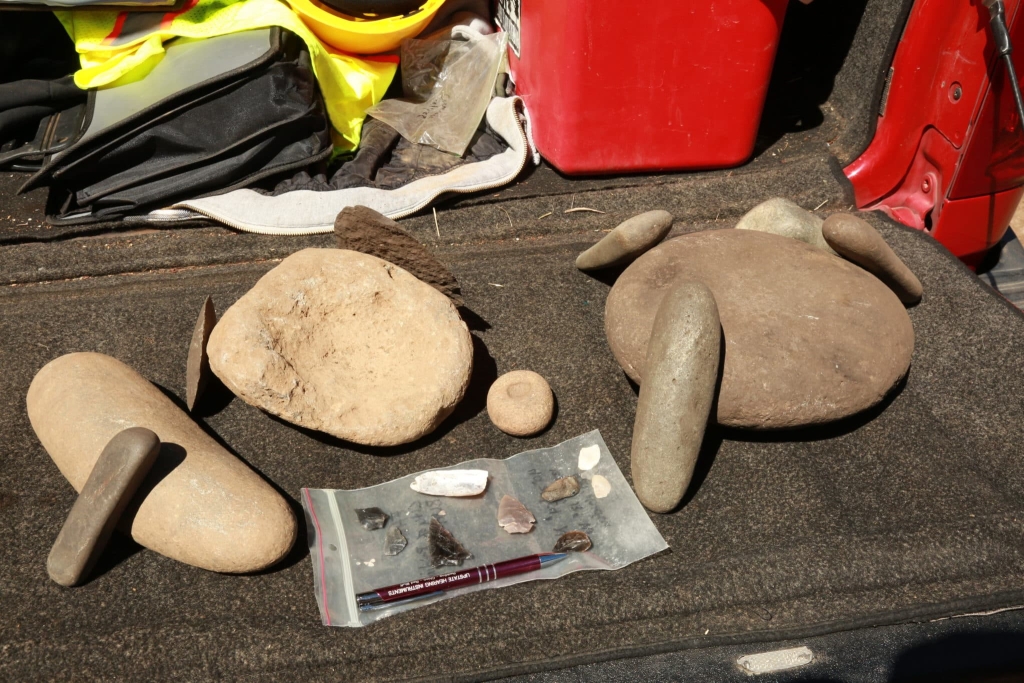
Tribal representatives are also concerned about commissioner ties to wealthy gaming Tribes, some of whom were co-sponsors on a 2025 bill that similarly would have excluded unrecognized Tribes from the state’s environmental review process.
“It’s really concerning for me that the NAHC would have this kind of discretionary authority to judge our tribal communities and it really raises serious questions about who has the ability, time and resources to review the documentation they’re requesting,” said Chilcote, the San Diego State professor.
Chilcote also noted that the commission’s proposed regulations create an evaluation process that is similar to a petition process the Bureau of Indian Affairs created in 1978. For decades that process had been criticized as highly political, unnecessarily laborious and discriminatory toward California Tribes, none of whom have been recognized through the process since 1983.
“To say (the commission) is going to decide who is the right tribe is antithetical to our cultures and the history of how our communities functioned,” said Chilcote. “There were always shared territories, places that were sacred to many of us.”
A barrier to healing
The proposed regulations come at a time when non-recognized tribes in California have made tremendous progress in cultural revitalization and healing some of the scars of the historical genocide and land dispossession. In recent years, many non-recognized tribes have restored land bases and reengaged in traditional environmental stewardship, often with state partnerships. For instance, since 2023, the Winnemem Wintu have been co-managers with state and federal wildlife agencies on a historic project to restore salmon to the McCloud River where the fish have been absent for nearly 80 years.
However, if they are removed from the contact list, non-recognized tribes fear these informal and formal partnerships may be undermined, and they may be excluded from funding streams such as the state’s $101 million Tribal Nature-Based Solutions grant program.
In 2019, Gov. Gavin Newsom issued an official acknowledgment of California’s role in the 19th century genocide, and initiated a Truth and Healing Council to investigate reconciliation. Many tribal leaders are now wondering how their removal from the contact list fits into this vision.
“There’s no truth and healing for us if we can’t protect our sacred sites, if we can’t get back to the river and get back our salmon,” said Sisk, Chief of the Winnemem Wintu. “Taking us off the list is just another type of the same genocide.”
The public comment period on the draft regulations will end on January 26.
1.23.2026 8:24 pm: We have updated the story to include comment from Redding Rancheria Chairman Jack Potter.
Do you have a correction to share? Email us: editor@shastascout.org.
Author

Comments (17)
Leave a comment
Related Articles
The fate of the Civic Auditorium may be decided this week. Here’s what you should know
The Civic needs between $1.4 million to $1.6 million in additional annual funding to keep its operations going, according to the organization that runs the event space.

Active measles case in Shasta County, officials urge vigilance and immunization
A patient with newly-diagnosed measles is being kept in isolation to prevent the spread of the highly contagious illness. Community members who might have been exposed during the patient’s eight-day contagious period are being contacted by Shasta’s public health staff.

Killing of armed Minneapolis protester Alex Pretti ignites 2A debate in conservative Shasta County
Second Amendment supporters in Shasta County including some with connections to a local militia, weigh in on topics including the right to carry at protests and the federal government’s current approach to immigration enforcement.
The Wintu Tribe really has been the most greedy and cruel to their own tribal members. When they disenrolled the Foreman’s, they showed that they don’t govern the tribe by DNA and rights but by greed. I for one, would love to see them lose all of their rights since they seemed to feel it was right to take away about 69 other tribal members’ tribal recognition. The sooner the better IMO. When you treat those that had every tribal right and proved it with DNA the way they have, then KARMA baby!
Hi Deborah,
It’s important to remember there are three distinct Wintu Tribes (check out the infographic in the story), who had nothing to do with the disenrollment of the Foremans. The Foreman’s disenrollment was condcuted by the Redding Rancheria, whose members are of Wintu, Pit River and Yana descent.
Disenrollment is a complex issue, and some Wintu leaders have been very outspoken against it. You may be interested in the new film that’s out on the topic – You’re No Indian. https://www.yourenoindian.com/
Exactly right. I did not mean to include the Wintu Tribe negatively when I am specifically talking about the Rancheria. Thank you for informing me on this topic.
Exactly.
Excellent analysis. I wish it had been published (and featured on ICTnews.org) earlier, because of the public comment period that closes today.
I am trying to submit comments on NAHC’s proposed change. Every time I go to their website or the public comment page, I get a “connection closed” error message. This happens whether I use the links provided in this story, or whether I navigate to their site by typing the URL directly or using a web browser. The problem seems to be on NAHC’s end. How else can we submit comments by the deadline, if the web page is not working?
This is a well-written and researched article. It tells a story that we should all read and digest.
Marc, thank you for the comprehensive article on this important item.
I looked on the public comment link. Marc, can you please let us know the best way to send a letter in support of the Wintu recommending they stay on the list and that the California government works with all the First Nations in good faith in helping to maintain the history and heritage the whites have tried to erase from the beginning of the white invasion of America?
Thanks
Like the Beatles?
The Shasta Scout article on Wintu opposition to proposed reforms of California’s tribal contact list is emotionally compelling and morally framed, but it ultimately adopts an advocacy-first narrative that underexamines the structural failures, corruption risks, and administrative breakdowns that have historically plagued tribal consultation systems. By centering the debate almost exclusively on erasure and discrimination, the author implicitly assumes that the existing system is functioning in good faith and merely needs preservation. A broader research suggests the opposite: California’s tribal consultation framework has long suffered from inconsistent enforcement, mismanagement, and vulnerability to abuse, problems the article barely acknowledges.
The article presents the Native American Heritage Commission (NAHC) proposal as a near-existential threat without meaningfully grappling with why the state is attempting to reform the contact list in the first place. Across California and federally, there is a documented history of fraudulent claims, misused funds, broken consultation processes, and institutional incompetence—from local governments repeatedly violating AB 52 requirements, to state universities ignoring repatriation laws, to federal agencies mismanaging tribal trust funds for decades. Ignoring this context produces a lopsided analysis that treats reform itself as suspect, rather than interrogating whether reform may be a response—however flawed—to real governance failures.
More troubling is the article’s tendency to conflate consultation access with legitimacy, without acknowledging how poorly defined legitimacy standards have enabled both corruption and confusion. High-profile scandals like the Abramoff lobbying case, repeated Inspector General findings of tribal fund misuse, and internal disputes within and between tribal entities show that unchecked inclusion can be as damaging as exclusion. By failing to distinguish between protecting cultural sites and preserving an opaque administrative process, the author sidesteps the uncomfortable reality that poor oversight harms tribes too, especially smaller or less politically connected ones.
The piece also downplays the role of institutional incompetence, preferring a narrative of intentional erasure. Yet many of the most damaging outcomes for tribes—destroyed sites, delayed consultations, lost repatriations—stem not from overt hostility but from bureaucratic failure, undertrained staff, and inconsistent policy execution. Courts have repeatedly rebuked cities and agencies for botched consultation not because they were discriminatory, but because they didn’t understand or properly apply the law. By framing the issue primarily as moral wrongdoing, the article obscures the administrative realities that any sustainable solution must confront.
In the end, the article functions more as a rallying cry than as rigorous journalism. It gives voice to legitimate fears but resists engaging with the deeper, messier question: how to design a consultation system that is inclusive, accountable, resistant to corruption, and administratively competent. Without that analysis, readers are left with a false binary—reform equals erasure, preservation equals justice—when history shows that unreformed systems have repeatedly failed the very communities they claim to protect. A more responsible approach would have held both truths at once: that non-recognized tribes face real risks, and that governance without oversight is not protection, but negligence.
Hi Labbada,
I really appreciate the insightful comments. You may want to read other articles I’ve written addressing the issues around consultation, including this one for Scout – https://shastascout.org/federal-project-managers-halt-redding-area-construction-threatening-ancestral-village-site/
I also wrote this one for Reveal when I was a little less bald and was about 20 pounds lighter – https://revealnews.org/article/is-nothing-sacred-how-archaeological-reviews-imperil-tribal-lands/
I don’t think the piece or our previous reporting intends to give the impression the consulting process always works great, but I will consider a follow up on these issues. Great analysis!
Sorry for the typo it’s 61 acres held in trust and it’s been way to long read the court documents
Wintu Tribe of Northern California once Toyon Wintu Center is held in trust until federal recognition comes from Washington DC for it is 6 in Shasta Lake City which once was Central Valley, Project City, Project Citysll these towns existed. Tuition Wintu Center residents. 1984-85 was evicted from Toyon for substandard housing which Bureau of Indian Affairs (BIA) came in evicted and then bulldozed Toyon in 1989.
Thanks for that history Lauri! The story around Toyon is very dense, so I was trying to simplify it as much as I could for the sake of space. But that story deserves to be told in all its depth
Thank you for the article Marc and for telling us all the issues. It is unbelievable to me that this could be happening in this day and age.
If Newson’s Administration allows this to happen they are participating in the cultural genocide of California unrecognized Tribes. All recognized tribes need to be part of the solution and stand for what is right. To do otherwise is to further cultural genocide.
Truth and Healing Council? This is the same government that begs for more affordable housing. We need less red tape not more. If someone in a buckskin hard hat came to my job site and tried to halt work they would be encouraged to “ride out.”
NC – I think there is a misconception that Tribes are always “obstacles” to development. The spirit of the law is that Tribes should be involved early in the planning process. If that happened regularly, the unexpected work stoppages as described in the story wouldn’t be as common.
Also, if government entities and communities co-designed projects with Tribes from the very beginning, there are many examples of how weaving of collective knowledge can lead to innovation that is less impactful. The Winnemem Wintu’s co-management project on the salmon introduction is a good example as the Tribe has created new technologies – an incubator, a hands-free fish measurer and a juvenile fish trap – that support the salmon’s healthy development and improve the project’s performance.
I think the larger question is how do we create development and planning systems that are democratic and don’t roughshod over the people who are deeply rooted to this place, but still build the future we need to be healthy and happy as a community.
Fair points and a great article. I have a fundamental skepticism of tribal motivation so I am hard to persuade. For what it’s worth, if I were running the tribe I would be doing the same.