
With deadlines looming, ballot filming process is doubling the time needed to count Shasta’s votes
The Shasta County Elections Office has until June 11 to certify the special election for deceased congressman Doug LaMalfa’s vacancy. A new ballot filming process implemented by Registrar of Voters Clint Curtis has complicated the timeline. Curtis remains confident.
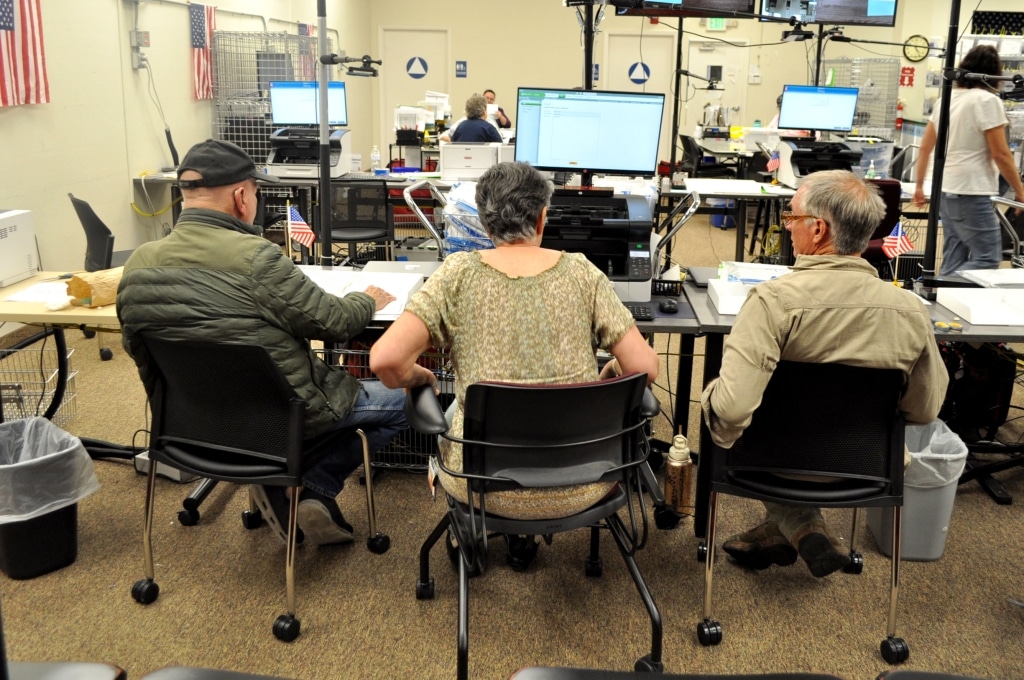
This week is only the second time Registrar of Voters Clint Curtis has deployed a newly designed ballot filming system that integrates a number of manual steps into an otherwise mostly-automated process of vote-counting.
The added steps are intended to allow for more human oversight. They certainly add more time.
How much time? Analysis by Shasta Scout indicates the ballot filming process is adding at least an additional five minutes per 50 ballot batches, essentially doubling the time required to process ballots, even in best case scenarios.
The extra time demand of Curtis’ ballot filming process is particularly significant this election given the state’s accelerated timeline to certify votes for a special election for California’s District 1 congressional seat. The election was called to fill the remainder of the late Congressman Doug LaMalfa’s term.
Shasta Scout’s time estimate for the ballot filming process roughly aligns with what Anna Rodriguez, an election manager, said yesterday. Rodriguez acknowledged that the new process is significantly slower, wagering an estimate of 11 minutes in total per batch, versus 5 minutes without the added process — affirming that the new process is roughly doubling the amount of time it takes to get through stacks of ballots.
In an interview yesterday, Curtis shared what he said staff were actually able to accomplish on June 4. He told Shasta Scout that counting started at noon and ended around 5 p.m., and estimated the team processed about 5,000 ballots, meaning roughly 1,000 per work hour. The rate he described, given three teams working, is similar to both Shasta Scout’s, and Rodriguez’ estimation.
As of the evening of Friday, June 5, an estimated 21,500 ballots remained to be processed. If election staff are able to maintain their pace moving forward it will take them about 21 hours, or roughly 3 work days to finish.
Curtis told Shasta Scout that elections staff will work both days over the weekend to meet the office’s internal Monday deadline to have all ballots initially processed so they can notify any voters who must correct, or cure, issues on their ballots that impact the congressional district 1 race.
Curtis is confident the team will get past the finish line, on time.
“We don’t want to just meet the deadline,” Curtis emphasized jovially, “we want to beat the deadline!”
What does the ballot filming process entail?
Before Curtis’ tenure, all ballots were scanned, and votes counted, by Hart InterCivic machines. Those machines are still what scan Shasta’s ballots and count Shasta’s votes.
What Curtis has added is a process that involves showing all ballots to a camera, twice. Two staffers, one on each side of the ballot scanner, manually turn each page of the ballot under the watchful digital eye of phone cameras fixed on stands above the ballot work area. The process occurs once before the ballot is scanned and again after.
Staff are not counting either the ballots themselves, or the votes, they’re merely showing the pages to the cameras above.The machine itself still tallies the election results, processing tens of thousands of ballots by the end of an election.
Theoretically, this process allows members of the public to manually count both the number of ballots and the votes themselves by reviewing the video archives, a process that would be so time-consuming it boggles the mind. There are hours of footage, and in order to attempt to quantify the number of votes on each ballot, one would have to pause the video, and correctly record the multiple votes seen on screen, tens of thousands of times.
Additionally, actually verifying all vote totals against the machine count would be impossible, not only because of the logistics of the process but also because not all ballots are shown on screen, due to legal restrictions related to personally identifiable information. The video archives have also been only inconsistently available. For example, midway through Shasta Scout’s analysis this week, all June 2 video files temporarily disappeared from the elections site. There is also a lack of contextual information provided by the elections office about what was recorded and shown on screen, making a thorough review of votes nearly impossible.
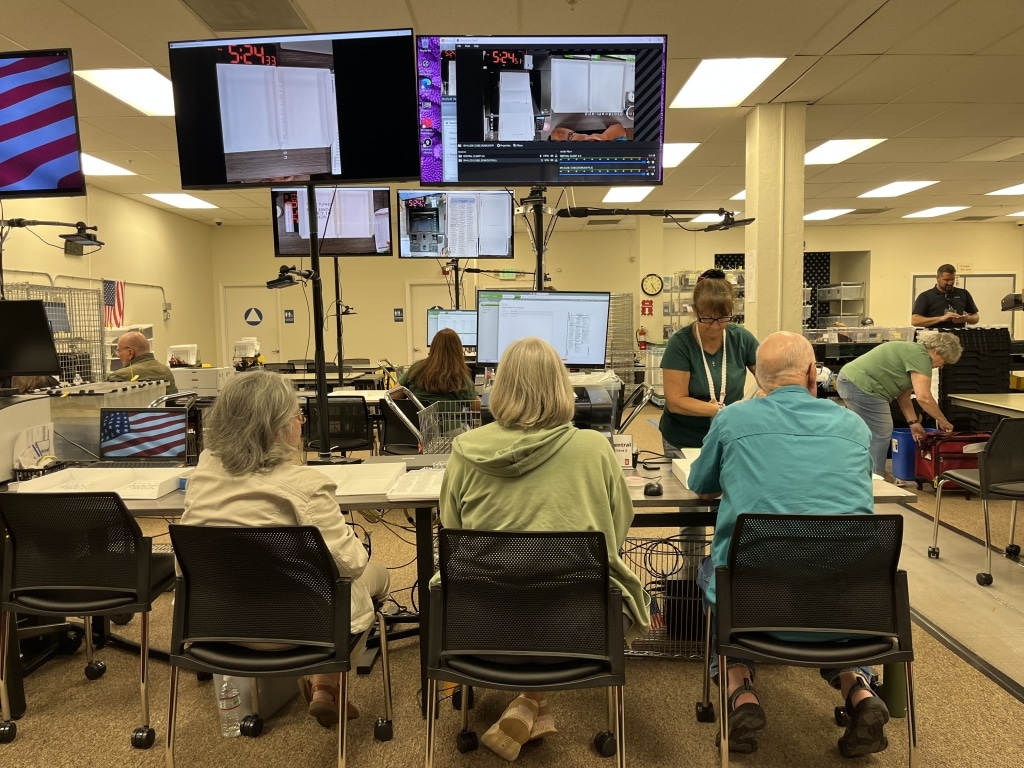
For this story, Shasta Scout timed multiple staffers working on a variety of batches. The teams generally consist of four temporary part-time employees each: one that turns ballots for display to the camera before they go into the scanner, one person loading and working the machine, a second page-turner performing a post-machine display for the camera, and the last worker who reseals batches of ballots in plastic bags.
While the speed of the scanner itself is mechanized and consistent, the introduction of human page-turners into the process has introduced a variety of factors impacting speed of processing.
Some page-turners are significantly slower than others — one worker observed on June 5 consistently took about 2 minutes and 20 seconds to flip 50 ballots while another took 8 minutes and 20 seconds to get through the same number. That same slower worker was able to reduce their time to 6 minutes during a different round, indicating that flip times also range significantly within a single worker’s shift.
And these workers are humans, with human needs they are entitled to. They are dedicating hours of their time to performing an extremely repetitive task, and may be slowed down by chatting with a neighbor — or taking breaks as required by labor law.
The time variables that come with additions of human labor into the election process provide a real-time demonstration of the likely impact if Measure B is passed by voters, something that appears likely to occur based on current election results.
The measure seeks to impose a full hand-count of ballots in future elections, which proponents claim will be easy and fast, producing same-day results. It’s a claim that sounds similar to how Curtis first portrayed the ballot filming process.
Find a link to Shasta’s ballot processing video here.
Do you have a correction to share? Email us: editor@shastascout.org.
Comments (12)
Comments are closed.
Related Articles
Redding declares emergency in anticipation of El Niño, makes plans to clear congested drainage ditch
The cyclical weather event is expected to bring heavy rainfall to Northern California this winter, something especially worrisome for those who experienced severe impacts from last year’s flooding.
Flock talk fizzles at Anderson council meeting
The council took no action even after Anderson Police Chief Oliver Collins’ acknowledged that the Anderson Police Department had previously granted Flock login access to employees of other agencies, something he described as “wrong.”
Mobile home residents voice concerns at town hall meeting
Residents from mobile home parks met with park owner Harmony Communities on Monday night to discuss rent increases. Supervisors are considering rent stabilization to address the issue.
“Theoretically, this process allows members of the public to manually count both the number of ballots and the votes themselves by reviewing the video archives, a process that would be so time-consuming it boggles the mind.”
AI could count every ballot to verify the results, if a full audit was the goal. I wouldn’t currently trust AI’s output today, but its rapidly getting better so its easy to see that being the case in the future.
However, even a partial audit would be extremely helpful if you’re wondering why the post election audit found a high error rate with, say, batch number 2254 yet the ROV refuses to tell the public what caused the machines to miscount votes beyond a vague “human error” description. Because that’s exactly what happed in 2024 with Francescut and Toller in charge
aaand with Measure B, all ballots will be counted on election night! By magic?
Any UPDATE on Shasta County’s special weekend board meeting (specifically on the ANTICIPATED LITIGATION item)?
What a ridiculous farce. Phone cameras? Seriously? And the end product is such a mishmash heads or tails can’t be made of it? “But look how transparent we are!” Yes, transparently imbecilic. This clown show can’t end fast enough.
Selah
All the bagging, zip tying, monitoring recordings onscreen (that works intermittently) and on paper then rebagging and zip tying back to a container becomes redundant BUT I guess it goes with the Curtis philosophy of nothing being unsecured greater than 3 feet. And the videos are truly meaningless observation with the resolution and lack of info like batch or precinct number to inquire with. Thank goodness the established election workers remained dedicated and professional while Curtis and Turner have shown their incompetence and deplorable behavior towards them. Time, energy and goodwill have been squandered as well as obvious political bias under ROV Curtis. His appointment by Crye, Kelstrom and Harmon speak volumes to their very partisan politics while in office. And the voters are speaking !
“And the videos are truly meaningless observation with the resolution and lack of info like batch or precinct number to inquire with.”
There were coversheets with that info when I observed the livestream. You could also match the time in the video against the batch/ballot scan report
Ironically, it seems that most of the people counting the ballots are boomers by checking the article’s images! Those individuals should be retired enjoying life rather than being involved in these matters.
How much longer until the demise of the snake charmer is done and the vote of the people speaks volumes?
Knock me over with a feather.
In other news, keep up the great work Shasta Scout! Your team is doing great work!
What a waste of time and especially of money.
Curious…while Donald Trump alleges voting fraud in California, citing the lengthy time it takes the California vote count, Mr. Curtis implements useless procedures that creates additional time to the process, claiming he “doesn’t want fast, he wants it accurate.” It would seem one of them “missed the memo.” Still here we are.
Yep this new system is way faster. Mr. Curtis was right, his system will take far less time to tally all of the ballots than in the past. 🤣