
Workshop Highlights Unanswered Questions About Shasta County Jail Expansion
County supervisors want to expand jail capacity. The community has questions.

A public workshop, designed to solicit meaningful feedback on potential options for expanding Shasta County Jail capacity, was held Tuesday night, December 13 at the Redding Library.
Shasta County Supervisors have been trying to significantly expand jail capacity for more than a decade. Sheriff Michael Johnson, the former police chief of Anderson, has pushed hard for a new facility outside of downtown Redding since being appointed to office in 2021.
The jail is at particularly low capacity right now, after Johnson closed 120 beds in July due to staffing issues, leaving the county’s current jail capacity at 374 beds.

On August 16, the Supervisors voted to explore both rehabilitating a building downtown and building a new facility outside of downtown. They have not yet voted to fund either of the projects.
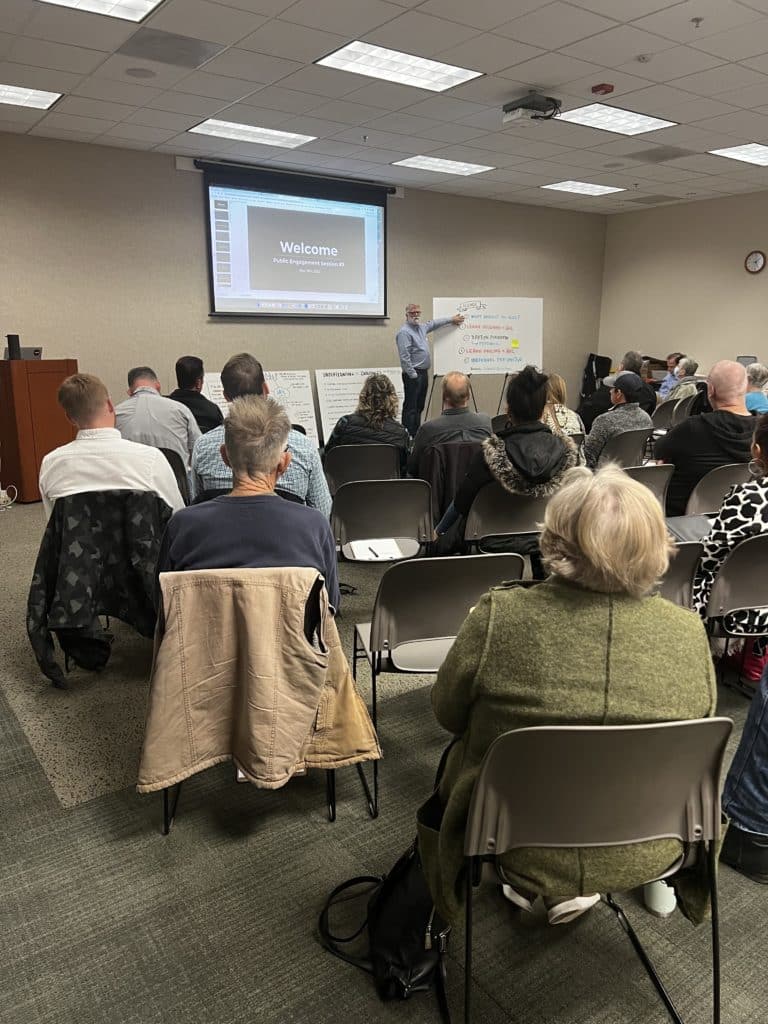
Tuesday’s workshop was facilitated by local business consultant Jack Burgess, under contract with the Sheriff’s Office, and drew about forty participants. Burgess presented the group with three options for how the county could move forward on jail expansion. Those options include rehabilitating a facility close to the jail to add beds to current capacity, building a new facility outside of the downtown area to eventually replace the current jail, or moving forward simultaneously on the rehabilitation option and the new facility option to provide both short- and long-term fixes for jail capacity needs.
Noticeably absent from the event was Johnson himself, who appeared only by recorded video. That prompted anger from some in the crowd, including Shasta County resident Chelly Mack, who said when it comes to the jail, “the Sheriff is the end-all, say-all. And he wasn’t even there to give information.”
Many participants voiced similar frustration with what they perceived as an overall lack of information offered as part of the workshop.
Community members repeatedly interrupted Burgess to ask pointed questions, including how the county will staff and fund a larger facility, how many jail beds are needed, how cost estimates for the expansion plans were developed, and how long various options for jail expansion might take.
Burgess fielded all questions openly, but offered few answers, repeatedly emphasizing his role as a facilitator, not a decision maker.
“I’m with you,” Burgess, who has lived in the area for more than a decade, told participants.
“I want answers too. I’m just here trying to do the job I was contracted to do. You’re asking all the right questions. I suggest you write them down on the papers we’ve provided and on the post-it notes we’re about to give you, so that your County Supervisors can really hear those questions and understand your perspectives.”
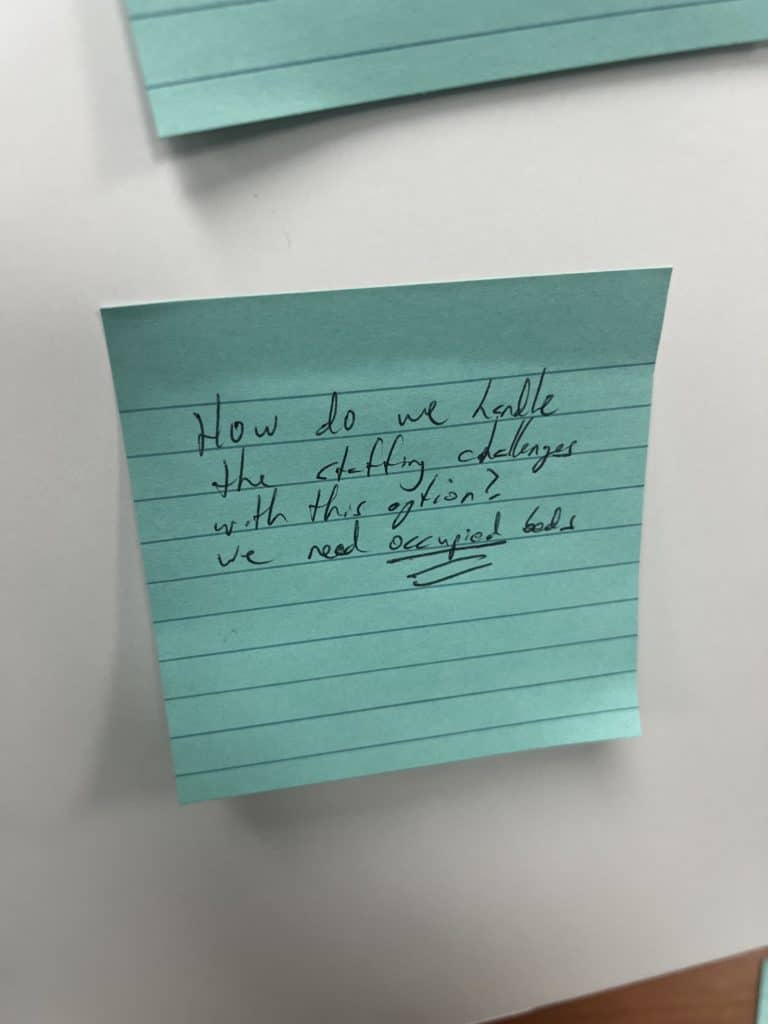
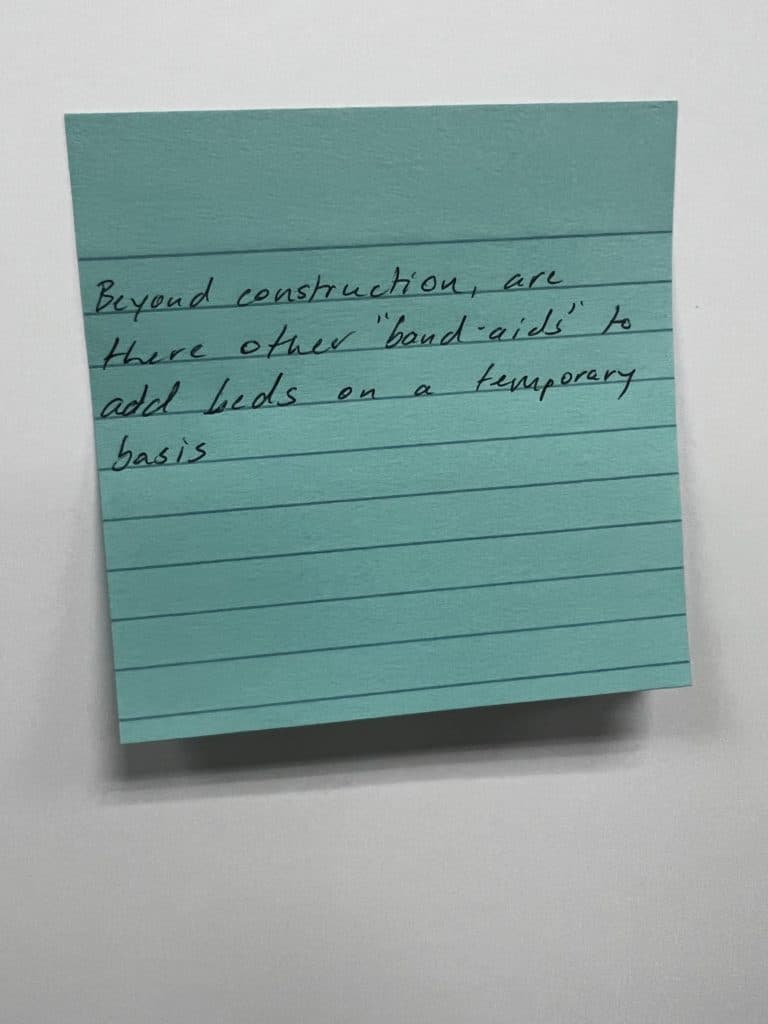
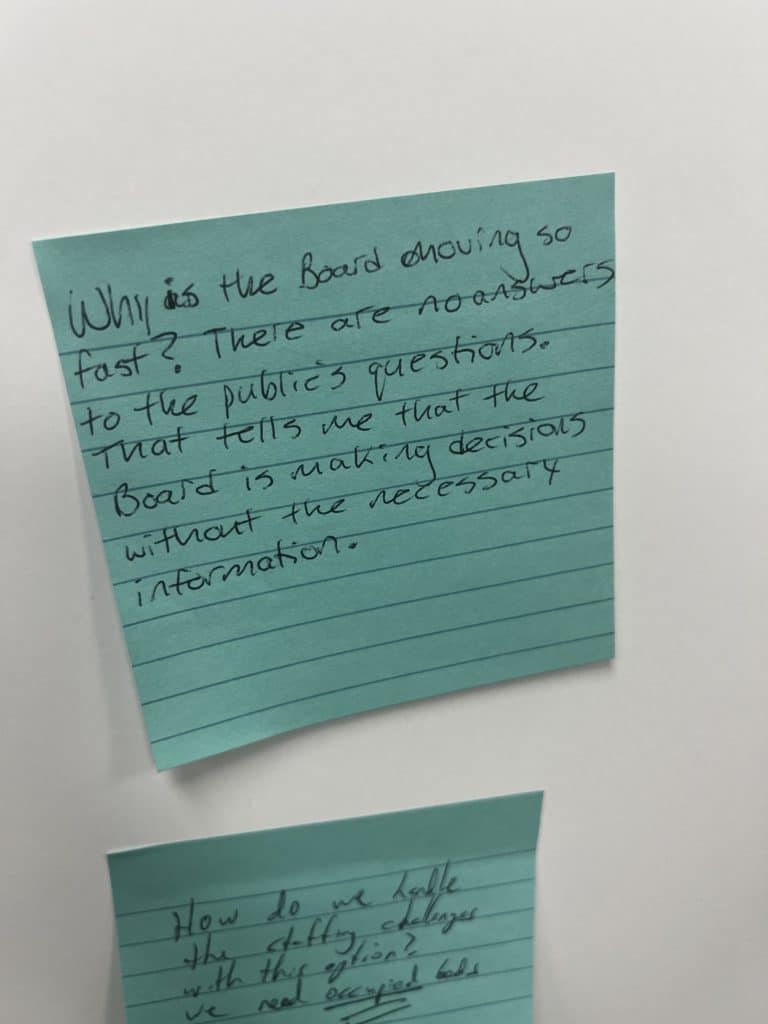
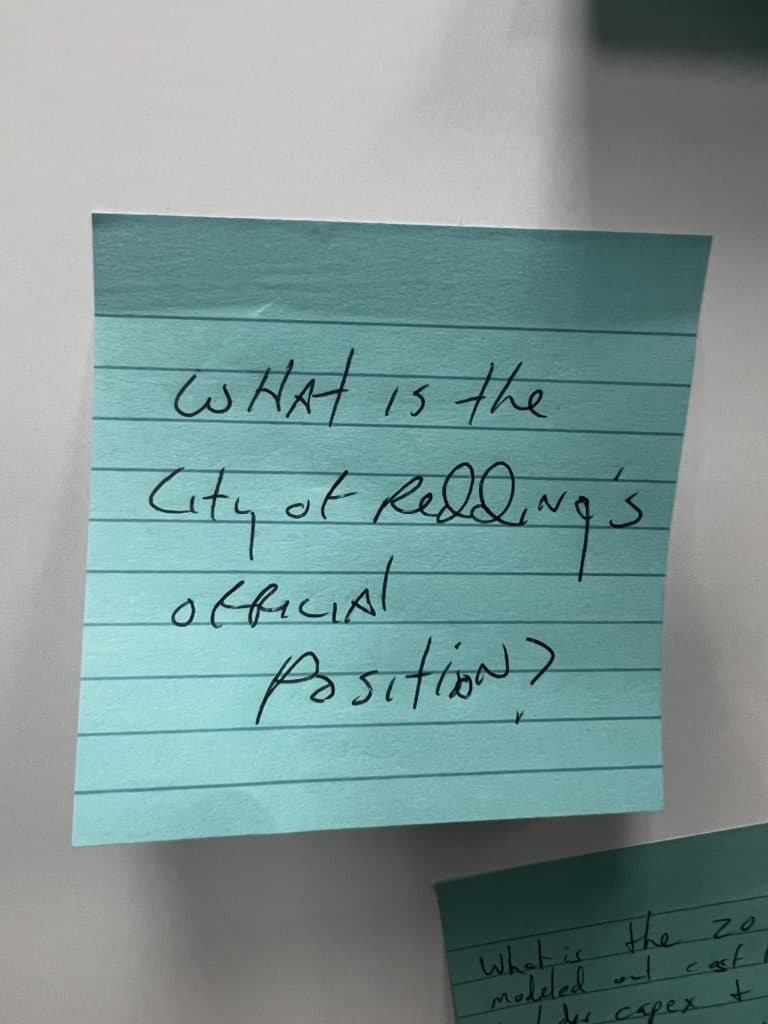
Community members were first asked to fill out individual forms with their questions, concerns and comments about jail expansion before being shown a video by a jail construction consultant outlining design and pricing complexities for correctional facilities.
After Burgess showed a second video from Sheriff Johnson outlining the three jail expansion options, participants were invited to gather around three poster boards and use colored post-it notes to share their pros (pink), cons (yellow) and questions (blue) for each option.
As the workshop concluded and the room cleared, the rainbow of post-it notes on the three sets of boards in the back of the room began to bring some of the big picture results of the workshop into focus, even from a distance. The majority of post-it notes had been placed on the board for Option 3, building a new jail facility outside of downtown. The notes represented perspectives both for and against the idea and included many questions.
Speaking to Shasta Scout after the event, Burgess said those preliminary high-level results are very similar to what he saw during two previous stakeholder workshops that were invite-only and included county and city staff, law enforcement, and representatives from the business community.
Midway through the evening, long-time Redding resident Steve Woodrum said he was finding the workshop useful because he didn’t expect to have his questions answered.
“We’re in the preliminary stages,” Woodrum said. “No one has any definite answers, we’re just looking for what the questions are. This is a way to draw out the questions. If you came here expecting definite answers, you were mistaken.”
A comprehensive report of the full public engagement process, which will include both a high-level summary and participants’ actual responses, will be made accessible to the general public in January after Burgess holds the last public workshop and releases an online community survey.
Do you have a correction to this story? Submit it here.
Author

Related Articles

Shasta County Public Health identifies sixth site of possible measles exposure
The Ninja Coalition is the latest site listed by the county where community members might have been exposed. The public is encouraged to remain vigilant for measles symptoms and update their MMR vaccinations if needed.
Local chapters of Turning Point USA will host a “faith night” amid looming protests
The conservative youth organization’s event, scheduled for Feb. 7, is the latest flashpoint among ongoing political debate in the county.
Disaster declaration by federal administration makes loans possible for December flood victims
The city and the federal Small Business Administration will host a Disaster Loan Outreach Center for several weeks to help individuals and businesses affected by the flooding apply for loans. It opens Feb. 6.